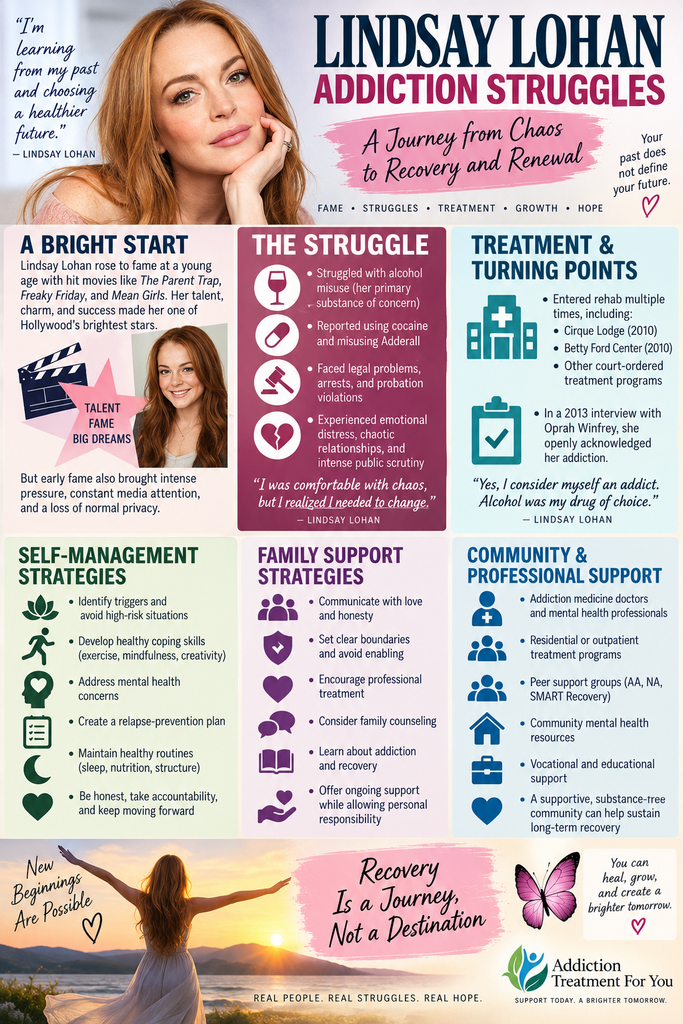
Lindsay Lohan became internationally famous at a remarkably young age. Movies such as The Parent Trap, Freaky Friday, and Mean Girls transformed her from a child actor into one of Hollywood’s most recognizable young stars. But behind her professional success, Lohan experienced years marked by substance misuse, legal problems, rehabilitation programs, intense media scrutiny, and personal instability.
Her story provides an opportunity to understand addiction without reducing a person to their most difficult years. Lohan eventually publicly identified herself as having an addiction and named alcohol as her primary substance of concern. In a widely reported 2013 interview with Oprah Winfrey after completing court-ordered treatment, she said alcohol had acted as a gateway to other substances and acknowledged cocaine use as well.
When Fame and Substance Use Collided
Lohan achieved major success while she was still very young. As her celebrity increased, so did public attention surrounding her nightlife, relationships, legal difficulties, and substance use.
Her struggles became particularly visible during the late 2000s and early 2010s. She experienced arrests, probation violations, and repeated treatment episodes. The cycle became a public spectacle, but behind the headlines was a young woman dealing with substance-related and emotional difficulties.
After completing treatment in 2013, Lohan spoke unusually openly about what she had experienced. When Winfrey directly asked whether she considered herself an addict, Lohan answered yes and identified alcohol as her drug of choice.
Alcohol, Cocaine and Adderall
Lohan described alcohol as particularly significant because drinking could lead her toward other substances. She acknowledged using cocaine and said she had previously minimized how many times she had used it because she feared being judged. She also identified stopping Adderall as an important change following treatment.
These admissions highlight an important addiction concept: substances do not always exist independently from one another. For some people, using one substance lowers inhibitions and makes another substance more likely.
That is why identifying personal patterns and triggers can be just as important as identifying a particular drug.
Addiction and the Search for Escape
One of the most revealing aspects of Lohan’s public discussion was her description of becoming comfortable with chaos. Speaking after treatment, she suggested that the instability surrounding her had become so familiar that even incarceration represented, on some level, an escape from it.
This does not mean that chaos itself caused her addiction. Addiction develops through a complicated interaction of biological, psychological, social, and environmental factors.
However, people struggling with substance use may begin using alcohol or drugs as ways of escaping stress, anxiety, loneliness, trauma, interpersonal conflict, or overwhelming emotions. Eventually, the coping strategy can create additional problems of its own.
Self-Management Strategies for Recovery
Lohan’s experiences can help illustrate why recovery requires more than simply deciding not to use a substance. Sustainable recovery often requires changing behaviors, environments, and coping strategies.
Helpful self-management strategies may include:
- Identify triggers. Recognize people, places, emotions and situations associated with previous substance use.
- Create structure. Regular sleep, meals, work, exercise and appointments can reduce unnecessary instability.
- Avoid high-risk environments. Early recovery may require temporarily stepping away from parties, nightlife, or relationships strongly connected with substance use.
- Develop healthier coping skills. Exercise, meditation, creative activities, journaling and relaxation techniques can provide alternatives to substance use.
- Address mental health. Depression, anxiety, trauma, and other psychiatric concerns deserve appropriate professional evaluation.
- Create a relapse-prevention plan. Know whom to contact and what actions to take when cravings or warning signs emerge.
- Accept accountability. Recovery often includes recognizing consequences without allowing shame to define one’s identity.
- Continue treatment. Recovery should be viewed as an ongoing process rather than something completed after leaving rehabilitation.
Lohan herself spoke after treatment about wanting to maintain the healthier way she was feeling and being willing to learn from people with more recovery experience.
Family Support Strategies
Addiction rarely affects only the individual. Parents, siblings, partners and children may experience fear, anger, disappointment and confusion.
Family support can be extremely valuable, but support should not become enabling.
Families can:
- Learn about substance use disorders and recovery.
- Communicate concerns calmly and specifically.
- Encourage professional treatment rather than trying to provide it themselves.
- Establish consistent boundaries regarding money, housing, and unacceptable behavior.
- Avoid repeatedly protecting someone from the natural consequences of substance use.
- Participate in family therapy when appropriate.
- Recognize that rebuilding trust takes time.
- Develop their own emotional support network.
- Have an emergency plan for overdose, severe intoxication, or suicidal behavior.
- Encourage progress without expecting immediate perfection.
Family members should also recognize the limits of their control. They can encourage treatment and create healthier boundaries, but they cannot personally force another person’s long-term recovery.
Community and Professional Support
Recovery becomes more sustainable when people have access to supportive environments outside their immediate families.
Community resources may include:
- Addiction medicine physicians and other qualified healthcare professionals.
- Licensed mental health counselors.
- Psychiatrists and treatment for co-occurring mental health conditions.
- Residential treatment when clinically appropriate.
- Intensive outpatient and outpatient treatment programs.
- Recovery coaches and peer-support specialists.
- Alcoholics Anonymous, Narcotics Anonymous, and other mutual-help groups.
- SMART Recovery and other alternatives to traditional 12-step programs.
- Community mental health centers.
- Vocational, educational, and housing assistance.
- Recovery-oriented social and recreational activities.
The appropriate combination varies from person to person. Treatment should be individualized rather than based on what worked for a celebrity or someone else in recovery.
Relapse Does Not Erase the Possibility of Recovery
Lohan’s history involved multiple treatment episodes. This is sometimes portrayed in celebrity coverage as evidence that rehabilitation “failed.”
That interpretation misunderstands the chronic and recurring nature that substance use disorders can have.
A return to substance use does not mean previous treatment was worthless or that future recovery is impossible. It may indicate that treatment intensity, coping strategies, medications (when appropriate), environmental influences, or ongoing support need reassessment.
Recovery should be measured over time, not by expecting a person to become permanently problem-free immediately after treatment.
Rebuilding Identity After Addiction
Another important part of recovery is separating someone’s identity from their past behavior.
For years, much of Lohan’s public identity became connected with arrests, court appearances, and rehabilitation rather than acting. In her post-treatment interview, she acknowledged that rebuilding her career would require regaining people’s trust.
This reflects a challenge many people in recovery experience.
Relationships may need repairing. Employers may need reassurance. Financial problems may remain. Family members may still be cautious. Recovery therefore involves rebuilding a life as well as reducing or stopping substance use.
Progress may occur gradually through consistency, accountability, and healthier decisions.
Understanding Lindsay Lohan’s Journey Without Judgment
Lindsay Lohan’s story also demonstrates why addiction should not become entertainment at another person’s expense.
During her most difficult years, nearly every arrest, court appearance, and treatment episode became international news. Such attention can encourage the public to see addiction as scandal rather than as a serious behavioral health problem.
People experiencing addiction need accountability, but accountability and compassion are not opposites.
We can recognize harmful behavior and its consequences while also recognizing someone’s capacity for change.
Lessons From Lindsay Lohan’s Addiction Struggles
Her highly publicized experiences provide several broader lessons:
- Fame and financial success do not provide immunity from addiction.
- Alcohol can become a trigger for other substance use.
- Fear of judgment can make honest conversations about substance use more difficult.
- Treatment may need to occur more than once.
- Changing one’s environment can be important during recovery.
- Family support works best when combined with healthy boundaries.
- Professional and community resources can provide long-term support.
- A person’s worst period does not have to determine the rest of their life.
Conclusion: A Life Can Be Bigger Than Addiction
Lindsay Lohan’s journey illustrates both the destructive potential of addiction and the possibility of moving beyond a period of instability. She publicly acknowledged addiction, identified alcohol as her primary substance problem, discussed cocaine and Adderall, participated in treatment, and confronted the difficult task of rebuilding her personal and professional life.
The most useful lesson is not that everyone should follow Lohan’s particular path. Recovery is highly individual. Instead, her experience reminds us that addiction should be addressed with self-awareness, appropriate treatment, family boundaries, community support, and opportunities to rebuild one’s identity.
A history of addiction can remain part of someone’s story without becoming the definition of who that person is.
Recovery is not about rewriting the past. It is about creating a healthier future from what has been learned.
Frequently Asked Questions
Here are some common questions:
1. Did Lindsay Lohan publicly acknowledge having an addiction?
Yes. In a widely publicized 2013 interview with Oprah Winfrey following treatment, Lindsay Lohan described herself as an addict and identified alcohol as her primary substance of concern. Her openness provided a clearer picture of her experiences than many of the sensationalized stories that had previously surrounded her.
2. What substances did Lindsay Lohan struggle with?
Lohan has publicly discussed problematic alcohol use as well as cocaine use. She also discussed stopping Adderall after treatment. It is important to distinguish her own statements from rumors or speculation about her substance use.
3. Was alcohol Lindsay Lohan’s main addiction?
Lohan identified alcohol as her “drug of choice.” She also explained that drinking could contribute to decisions to use other substances. This illustrates how one substance can sometimes become a trigger for another person’s high-risk behavior.
4. Did Lindsay Lohan use cocaine?
Yes. Lohan publicly acknowledged cocaine use and admitted that she had previously minimized the extent of that use because she was afraid of being judged. Her admission demonstrates how stigma and shame can make honest conversations about substance use more difficult.
5. Did Lindsay Lohan go to rehab?
Yes. Lohan participated in rehabilitation and treatment programs multiple times during the highly publicized period of her substance-related and legal difficulties. Some treatment episodes were connected with court requirements.
6. Why did Lindsay Lohan struggle with addiction?
There is no responsible way to identify one single cause. Addiction generally develops through interacting biological, psychological, environmental, and social influences. Lohan has discussed stress, emotional difficulties, chaotic circumstances, and the enormous pressures associated with becoming famous at a young age.
7. Did becoming famous at a young age cause Lindsay Lohan’s addiction?
It would be inaccurate to say that fame caused her addiction. However, early fame can introduce unusual pressures, including constant scrutiny, demanding work schedules, easy access to nightlife, reduced privacy, and difficulty maintaining ordinary relationships. Such factors may contribute to vulnerability in some individuals.
8. Did Lindsay Lohan experience legal consequences related to her substance-use period?
Yes. Her highly publicized difficulties included arrests, probation requirements, court appearances, and treatment orders. These consequences became a major part of the media coverage surrounding her during that period.
9. Did Lindsay Lohan relapse after receiving treatment?
Her history included repeated treatment episodes and continued difficulties over several years. Rather than viewing repeated treatment as proof that recovery “failed,” it is more useful to recognize that substance use disorders can involve recurrence and may require adjustments in treatment and continuing support.
10. What self-management strategies can help someone experiencing similar struggles?
Helpful strategies include:
- Identifying emotional and environmental triggers.
- Avoiding people and situations strongly connected with substance use.
- Developing healthy coping mechanisms for stress.
- Establishing consistent sleep, nutrition, exercise, and daily routines.
- Addressing co-occurring mental health concerns.
- Creating a relapse-prevention plan.
- Building relationships with supportive, substance-free people.
- Continuing professional treatment when recommended.
- Asking for help when cravings or warning signs increase.
11. How can families support someone struggling with addiction?
Families can express concerns without humiliation, learn about substance use disorders, encourage professional treatment, maintain healthy boundaries, avoid enabling substance use, and consider family counseling. Supporting recovery does not require protecting someone from every consequence of their behavior.
12. Can families force someone to recover?
Families can influence and encourage treatment, establish boundaries, and respond appropriately during emergencies, but they cannot guarantee another person’s long-term recovery. Sustainable change generally requires active participation by the individual.
13. What community resources can help someone with addiction?
Depending on individual needs, resources can include addiction medicine professionals, therapists, psychiatrists, residential or outpatient programs, peer recovery specialists, community mental health centers, Alcoholics Anonymous, Narcotics Anonymous, SMART Recovery, and family-support organizations.
14. Why is mental health support important during addiction recovery?
Substance use may become intertwined with anxiety, depression, trauma, stress, or other emotional difficulties. Treating co-occurring mental health concerns can therefore be an important component of a comprehensive recovery plan.
15. Does going to rehab more than once mean treatment has failed?
Not necessarily. Some people require multiple treatment episodes or different levels of care. A recurrence of substance use can indicate that triggers, treatment intensity, mental health needs, environmental factors, or continuing support should be reassessed.
16. How important is changing your environment during recovery?
It can be extremely important. Returning immediately to people, locations, or routines strongly associated with substance use can increase risk. Developing healthier relationships and activities can help establish a lifestyle that supports recovery.
17. How can shame interfere with recovery?
Shame can make people hide their substance use, minimize problems, or avoid asking for help. Accountability remains important, but treating addiction solely as a moral failure can create additional barriers to treatment.
18. Has Lindsay Lohan rebuilt her career and personal life?
Lohan has experienced a substantial public and professional change from the period when arrests and rehabilitation dominated coverage of her life. She returned to acting, pursued business and media projects, married financier Bader Shammas, and became a mother. Her later life should not automatically be interpreted as proof of any particular clinical recovery status, but it demonstrates why people should not be permanently defined by their most difficult period.
19. What can Lindsay Lohan’s experience teach families about addiction?
Her story demonstrates that money, talent, career opportunities, and fame cannot guarantee protection from substance problems. Families should pay attention to behavioral changes, encourage early intervention, maintain boundaries, and seek professional guidance rather than waiting until someone’s situation reaches a crisis.
20. What is the most important message from Lindsay Lohan’s addiction journey?
A person’s past does not have to determine the rest of their life. Recovery can involve treatment, accountability, environmental changes, healthier coping strategies, supportive relationships, and opportunities to rebuild identity and purpose.
Video: What Lindsay Lohan’s Addiction Can Teach Us About Celebrity Culture #lindsaylohan #celebrityhealth