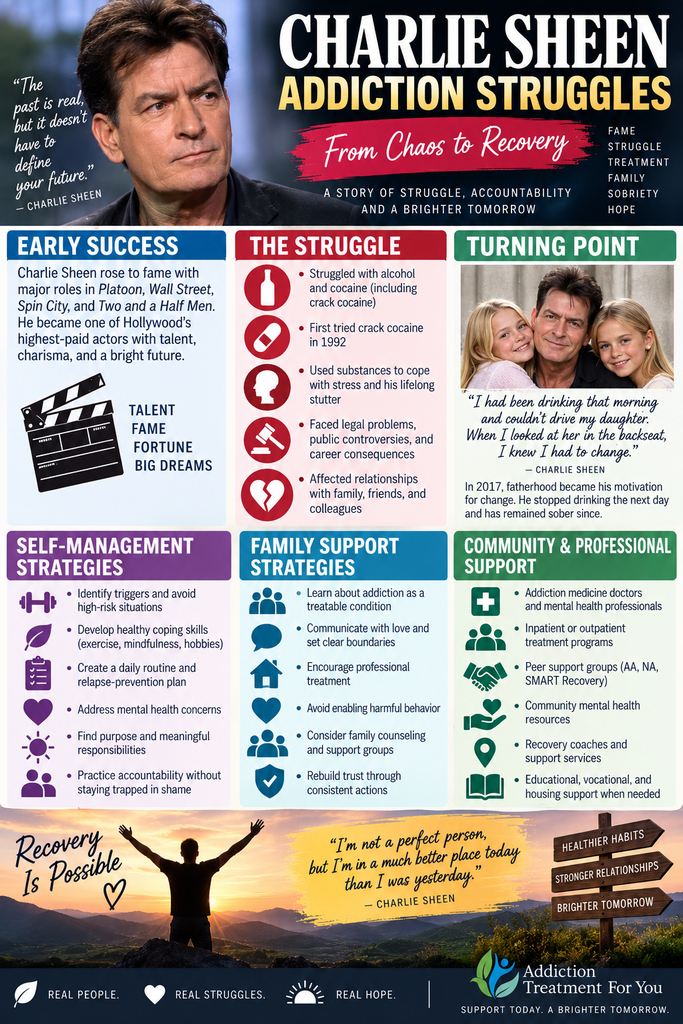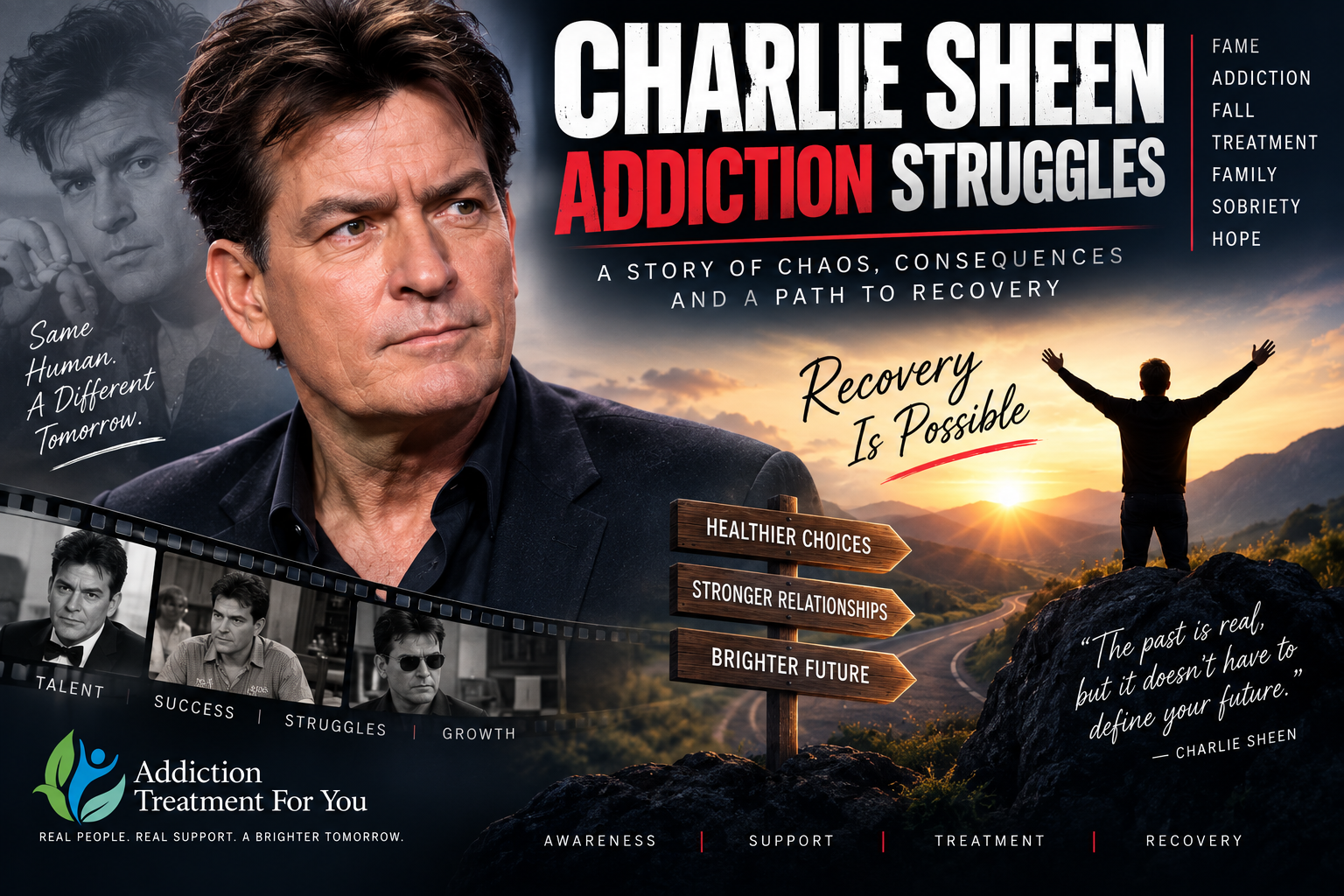
Charlie Sheen was once one of Hollywood’s highest-profile actors, known for movies such as Platoon and Wall Street and television successes including Spin City and Two and a Half Men. Behind the fame, however, Sheen experienced a long and highly publicized struggle involving alcohol, cocaine, and other drug use, repeated treatment, damaged relationships, professional consequences, and periods of chaotic behavior.
Today, his story looks considerably different. Sheen has said he has remained sober since 2017. In recent interviews surrounding his memoir The Book of Sheen, he has spoken candidly about addiction, accountability, fatherhood, and learning to forgive himself for his past.
His experiences offer an important lesson: addiction can cause enormous damage, but a person’s most chaotic years do not necessarily determine the rest of their life.
Charlie Sheen’s Struggles With Drugs and Alcohol
Sheen has publicly described significant problems involving alcohol and cocaine, including crack cocaine. In a 2025 interview, he said he first tried crack cocaine in 1992 and described being deeply involved with alcohol and cocaine during portions of his career. He also revealed an important reason alcohol initially appealed to him: Sheen has a lifelong stutter and said drinking made him feel freer when speaking.
This illustrates an important concept in addiction. Substance use sometimes begins because a person discovers that alcohol or drugs temporarily change an uncomfortable emotional or physical experience.
Temporary relief, however, can eventually develop into dependence and destructive patterns.
Fame, Success and Addiction
Sheen’s career demonstrates that professional success does not protect someone from addiction.
At the height of Two and a Half Men, he was enormously successful professionally. Yet his substance use and increasingly erratic public behavior became major concerns. In 2011, his highly publicized conflict with producer Chuck Lorre contributed to his firing from the television series.
His addiction affected much more than his career. Relationships, parenting, reputation, and personal stability were also affected.
Addiction does not always immediately take away someone’s ability to work. Some individuals continue functioning professionally for years while experiencing serious problems elsewhere in their lives.
Family Intervention and Treatment
Sheen’s family recognized his problems long before many of his most notorious public episodes.
He has said that his family staged an intervention in 1990 when he was 24, resulting in the first of multiple rehabilitation experiences. Looking back, Sheen acknowledged how difficult it was to accept help when others were essentially making the decision for him.
This illustrates a challenge families frequently experience.
Loved ones may recognize addiction before the individual is ready to acknowledge it. Families can encourage treatment, establish boundaries, and intervene in dangerous situations, but lasting recovery generally requires the individual to be actively involved in the change.
The Turning Point: Fatherhood
Sheen has identified a surprisingly ordinary parenting experience as a major turning point.
In 2017, he had promised to drive one of his daughters to an appointment. He had already been drinking that morning and realized he could not safely drive her. A friend had to take them instead.
Sheen later described looking at his daughter in the backseat and realizing she was wondering why her father was not driving.
The experience deeply affected him.
He went home, thought about what had happened, and stopped drinking the following morning. What initially began as trying sobriety for a month continued as he noticed improvements in his relationships and daily life.
His experience demonstrates how motivation for recovery can become deeply personal. For Sheen, being a dependable father became more important than continuing to drink.
Building a Different Daily Life
Long-term recovery often involves changing everyday life rather than merely eliminating a substance.
Sheen has described a remarkably structured lifestyle compared with his earlier years. He has talked about waking up around 4:30 or 5:00 in the morning, watching the news, exercising, answering emails, and helping his children start their day.
Structure can be especially helpful in recovery because predictable routines reduce idle time and provide meaningful responsibilities.
Self-Management Strategies for Recovery
Sheen’s experience can help illustrate several self-management principles, although someone else’s treatment should never be based solely on what worked for a celebrity.
Helpful strategies may include:
- Identify the purpose behind substance use. Ask whether alcohol or drugs are being used to manage anxiety, insecurity, emotional pain, social discomfort, or another underlying problem.
- Recognize personal consequences. Sometimes the impact on children, relationships, employment, or health makes the need for change clearer.
- Develop daily structure. Consistent sleep, exercise, meals, responsibilities, and appointments can support stability.
- Avoid high-risk environments. People, places, and activities strongly associated with substance use may need to change.
- Develop healthier coping mechanisms. Exercise, meditation, hobbies, therapy, music, and social connection can provide alternatives.
- Address mental health concerns. Anxiety, depression, trauma, and other conditions should receive appropriate professional evaluation.
- Create a relapse-prevention plan. Identify warning signs and decide beforehand whom to contact when cravings increase.
- Practice accountability without remaining trapped in shame. Recognizing past behavior can promote change, while constant self-condemnation may interfere with recovery.
- Find meaningful responsibilities. Parenting, employment, volunteering, education, and relationships can help provide a sense of purpose.
Family Support Strategies
Charlie Sheen’s story also demonstrates how addiction can affect an entire family.
Parents, partners, and children may experience repeated disappointment, fear, anger, and uncertainty. Families need support too.
Helpful approaches include:
- Learn about addiction as a treatable behavioral health condition.
- Discuss specific behaviors rather than attacking someone’s character.
- Encourage professional assessment and treatment.
- Establish clear boundaries around money, housing, and unacceptable behavior.
- Avoid providing resources that unintentionally support continued substance use.
- Do not repeatedly hide consequences from employers, relatives, or authorities.
- Consider family counseling.
- Recognize that rebuilding trust requires consistent behavior over time.
- Develop an emergency plan for overdose, severe intoxication, or psychiatric crisis.
- Maintain support for the individual while protecting the family’s own emotional health.
Family support does not mean accepting dangerous behavior. Compassion and boundaries can exist simultaneously.
Community and Professional Support Strategies
Recovery is often strengthened by having multiple layers of support.
Depending on individual circumstances, community resources may include:
- Addiction medicine physicians and other qualified healthcare professionals.
- Psychiatrists and mental health counselors.
- Medically supervised withdrawal management when necessary.
- Residential addiction treatment.
- Intensive outpatient and outpatient programs.
- Recovery coaches and certified peer-support specialists.
- Alcoholics Anonymous or Narcotics Anonymous.
- SMART Recovery and other mutual-support alternatives.
- Community mental health centers.
- Family therapy and family support organizations.
- Recovery-friendly recreational and social activities.
- Vocational, educational, and housing assistance when needed.
No single recovery pathway works for everyone. Treatment should consider the substances involved, severity of addiction, physical health, mental health, family environment, and individual preferences.
Addiction, Shame and Self-Forgiveness
One of the most interesting aspects of Sheen’s recent reflections is that sobriety did not automatically erase regret.
In 2025, after approximately eight years of sobriety, he described still experiencing what he called “shame shivers” when remembering some of his past behavior. He has discussed trying to make peace with other people while recognizing that forgiving himself has sometimes been more difficult.
This distinction is important in recovery.
Accountability says: “I did things that hurt myself and other people, and I am responsible for changing.”
Toxic shame says: “Because I made those mistakes, I am permanently a bad person.”
Recovery benefits from the first without requiring the second.
Relapse and Repeated Treatment Do Not Mean Someone Is Hopeless
Sheen’s history included multiple attempts at treatment before sustained sobriety.
This is important because families sometimes assume that if rehabilitation does not permanently stop substance use the first time, treatment has failed.
Addiction can behave like a chronic, relapsing condition. A return to substance use may indicate that treatment intensity, environmental triggers, mental health care, or continuing recovery support needs to be reassessed.
Repeated treatment should not automatically be interpreted as hopelessness.
Recovery Is More Than Simply Stopping Drugs
By 2025, Sheen described himself as eight years sober. His later reflections have emphasized fatherhood, personal responsibility, rebuilding relationships, and living differently rather than simply counting years without alcohol or drugs.
That distinction matters.
Recovery can involve:
- Restoring relationships.
- Becoming dependable again.
- Developing healthier routines.
- Accepting responsibility for previous behavior.
- Learning healthier coping mechanisms.
- Repairing professional relationships when possible.
- Rediscovering purpose.
- Learning to live without substances as an emotional escape.
- Developing self-forgiveness while maintaining accountability.
What Charlie Sheen’s Journey Can Teach Us
Sheen’s experience provides several broader lessons about addiction and recovery:
- Addiction can affect people regardless of fame, intelligence, wealth, or professional success.
- Substance use may begin as an attempt to cope with an underlying difficulty.
- Families can recognize serious problems before the individual is ready for change.
- Treatment may require more than one attempt.
- Personal motivation can become a powerful part of recovery.
- A daily structure can support long-term behavioral change.
- Parenting and meaningful relationships can provide strong reasons for maintaining recovery.
- Accountability is important, but lifelong shame does not have to be part of sobriety.
- Recovery can include rebuilding a meaningful life rather than merely stopping substance use.
Conclusion: From Public Chaos to a Personal Reset
For many years, Charlie Sheen’s name became associated with addiction, controversy, and highly publicized behavior. That history is real, and some of his actions had significant consequences.
But it is not the entire story.
Sheen has reported remaining sober since 2017 and has described fatherhood as a central motivation for changing his life. More recently, he has characterized this period not simply as a celebrity “comeback,” but as something closer to a personal reset.
His journey demonstrates why people experiencing addiction should not automatically be defined by their worst period. Self-management can provide structure and healthier coping skills. Families can combine compassion with boundaries. Professional treatment and community resources can provide additional support.
Most importantly, recovery can involve more than putting down alcohol or drugs. It can mean learning to show up again—for your children, your family, your responsibilities, and yourself.
The past cannot be changed, but recovery can change what happens next.
Frequently Asked Questions
Here are some common questions:
1. Did Charlie Sheen publicly struggle with addiction?
Yes. Charlie Sheen has openly discussed a long history of problematic alcohol and drug use. His substance-related difficulties became highly publicized and affected his health, relationships, career, and family life. In later interviews, Sheen has spoken more reflectively about addiction, sobriety, and taking responsibility for his past.
2. What substances did Charlie Sheen struggle with?
Sheen has publicly discussed heavy alcohol use as well as cocaine, including crack cocaine. When discussing his history, it is important to rely on his own statements and credible reporting rather than rumors surrounding his highly publicized years.
3. When did Charlie Sheen first enter rehabilitation?
Sheen has said his family staged an intervention when he was approximately 24 years old, resulting in treatment. This was followed by additional treatment experiences during subsequent years.
4. Why did Charlie Sheen use alcohol and drugs?
There is no single explanation for addiction. Sheen has discussed how alcohol affected his confidence and helped him feel less inhibited while dealing with his lifelong stutter. More broadly, substance use disorders can involve interacting biological, psychological, environmental, and social factors.
5. How did addiction affect Charlie Sheen’s career?
His substance use and increasingly chaotic behavior became intertwined with serious professional problems. His highly publicized conflict with Two and a Half Men producer Chuck Lorre preceded his dismissal from the successful television series in 2011. Addiction should not be considered the sole explanation for every professional decision or behavior during this period.
6. How did Charlie Sheen’s addiction affect his family?
Sheen has acknowledged that his behavior affected relationships and his ability to be consistently present as a father. He has also described fatherhood as becoming one of his strongest motivations for changing his life.
7. What became Charlie Sheen’s major turning point?
Sheen has described an incident in 2017 when he had been drinking and realized he could not safely drive his daughter to an appointment as promised. Someone else had to drive them. Seeing his daughter’s reaction reportedly made him reconsider the direction of his life.
8. When did Charlie Sheen become sober?
Sheen has said that he stopped drinking in December 2017 and has continued describing himself as sober in subsequent interviews.
9. Did Charlie Sheen immediately plan to remain sober permanently?
Interestingly, he has explained that he initially approached sobriety for a shorter period. As he experienced improvements in his life and relationships, continuing sobriety became increasingly important.
10. What does Charlie Sheen’s experience teach us about motivation for recovery?
Motivation can develop from deeply personal experiences. For one person it might involve health; for another, relationships, employment, finances, spirituality, or parenting. Sheen has identified being a dependable father as an important reason for changing his behavior.
11. What self-management strategies may help someone in addiction recovery?
Helpful strategies can include:
- Identifying emotional and environmental triggers.
- Avoiding situations strongly associated with alcohol or drug use.
- Creating consistent sleep, exercise, nutrition, and daily routines.
- Developing healthy ways to manage stress.
- Addressing underlying mental health concerns.
- Building supportive, substance-free relationships.
- Creating a relapse-prevention plan.
- Recognizing early warning signs of recurrence.
- Maintaining meaningful responsibilities and activities.
- Seeking professional help when cravings or difficulties increase.
12. Why can daily structure be important during recovery?
Predictable routines can reduce chaos and provide purpose. Sheen has described a much more structured lifestyle during sobriety, including getting up early, exercising, managing everyday responsibilities, and being involved with his children.
13. How can families help someone struggling with addiction?
Families can communicate concerns clearly, encourage professional treatment, establish healthy boundaries, avoid enabling harmful behavior, learn about substance use disorders, and seek counseling or family support themselves.
14. Can a family force someone into long-term recovery?
Families may intervene in dangerous situations and strongly encourage treatment, but they cannot guarantee another person’s long-term recovery. Sustainable recovery generally requires increasing personal participation and motivation.
15. Does going to rehabilitation multiple times mean treatment has failed?
No. Some people require repeated treatment episodes or different levels of care. A recurrence of substance use may signal that the recovery plan needs modification rather than proving that recovery is impossible.
16. What community resources can help people experiencing addiction?
Resources may include addiction medicine providers, therapists, psychiatrists, residential or outpatient programs, recovery coaches, community mental health centers, Alcoholics Anonymous, Narcotics Anonymous, SMART Recovery, and other peer-support organizations.
17. What role does mental health care play in addiction recovery?
Mental health and substance use can strongly interact. Anxiety, depression, trauma, stress, or other concerns may contribute to substance use or become worse because of it. Integrated treatment can address both substance use and mental health needs.
18. What has Charlie Sheen said about shame and his past?
In more recent interviews, Sheen has discussed feeling embarrassed and ashamed when recalling some of his past behavior. He has also talked about accountability and the challenge of forgiving himself.
This highlights an important distinction in recovery: accountability encourages someone to recognize harmful behavior and make changes, while persistent shame can convince a person that change is impossible.
19. Can relationships damaged during addiction be repaired?
Sometimes, but rebuilding trust usually takes time. Apologies can be meaningful, but consistent behavior is often more important. Reliability, honesty, boundaries, sobriety, and accountability can gradually help restore relationships.
20. What is the biggest lesson from Charlie Sheen’s addiction journey?
His experiences demonstrate that addiction can exist alongside extraordinary professional success and that repeated difficulties do not necessarily eliminate the possibility of meaningful change. Recovery may involve treatment, personal motivation, healthier routines, family support, community resources, and accepting responsibility for past behavior.
Video: How His Kids Saved Charlie Sheen’s Life #charliesheen #sobriety #family