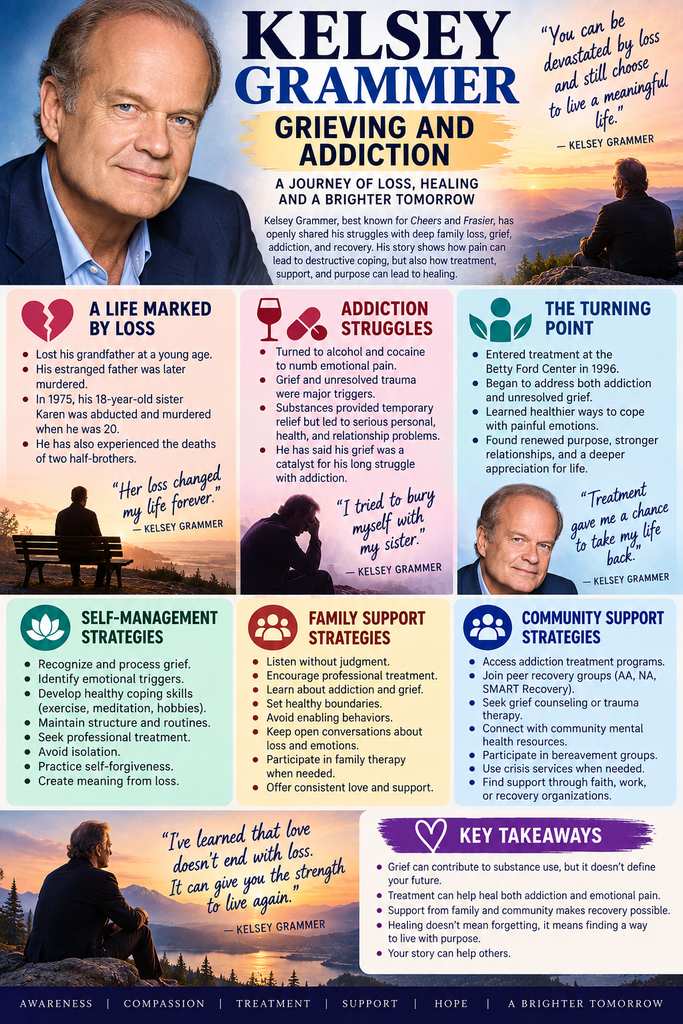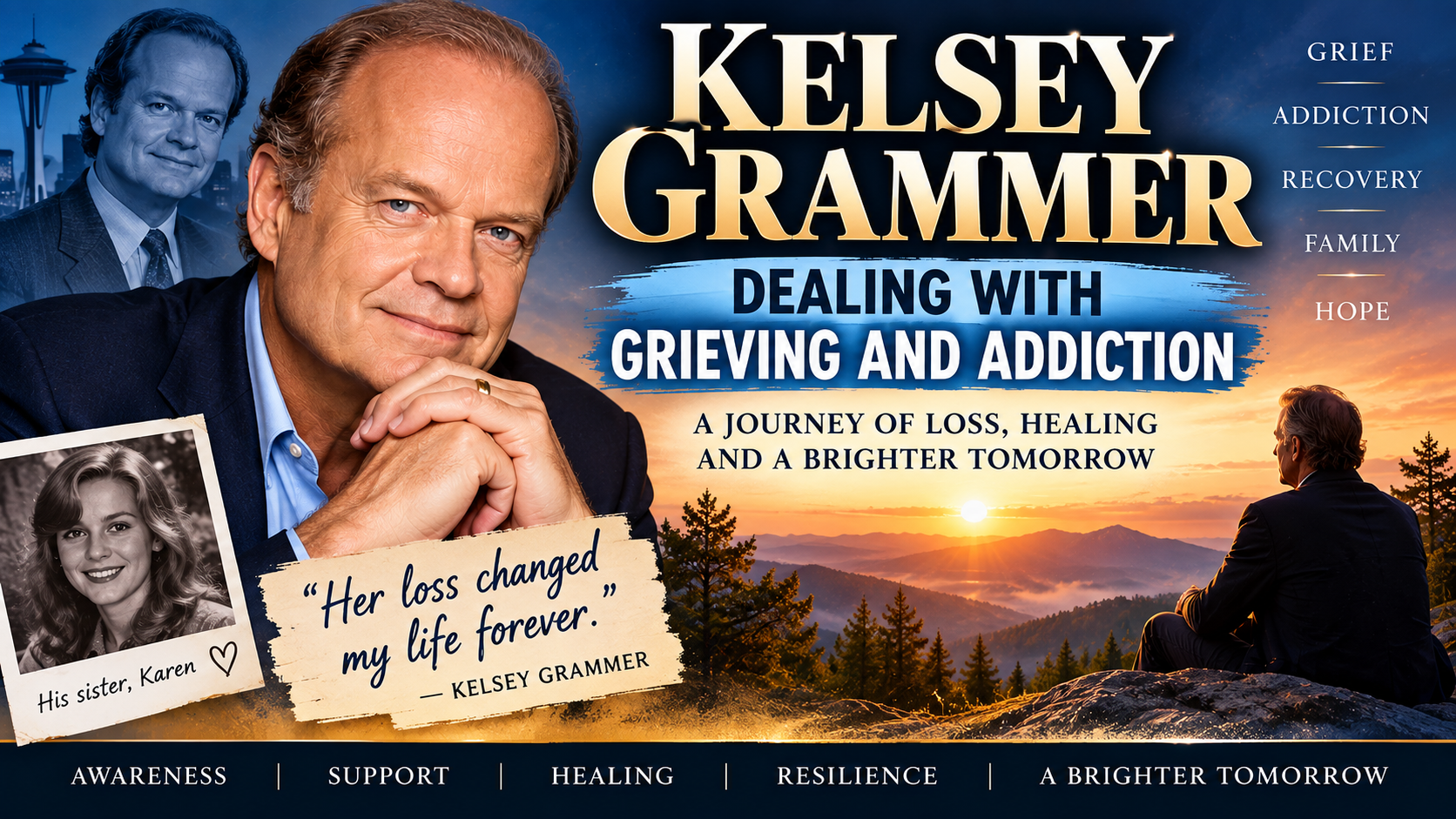
Kelsey Grammer is best known for portraying psychiatrist Dr. Frasier Crane on Cheers and Frasier, but behind his successful career is a history marked by profound family loss, grief, and substance misuse. Grammer has spoken openly about struggling with alcohol and cocaine and about the role unresolved grief played in his destructive behavior. In recent years, he has reflected more deeply on these experiences, particularly while discussing the 1975 murder of his younger sister, Karen.
Grammer’s story provides an opportunity to examine an important relationship: grief can sometimes contribute to unhealthy coping behaviors, including substance use. His experience also demonstrates how professional treatment, emotional processing, supportive relationships, and finding meaning after loss can become parts of a longer healing journey.
A Life Marked by Multiple Losses
Grammer experienced significant losses beginning early in life. His grandfather, who helped raise him, died when Grammer was young. His estranged father was later murdered. In 1975, when Grammer was 20, his 18-year-old sister Karen was abducted and murdered in Colorado Springs. He has also experienced the deaths of two half-brothers.
Karen’s death had an especially profound effect on him. Grammer has described feeling responsible as her older brother and carrying guilt because he believed he should have somehow protected her. Decades later, he continues to discuss how that loss affected his emotions, relationships, and behavior.
This illustrates something important about grief: time alone does not necessarily resolve traumatic loss. People may continue functioning professionally and socially while carrying intense emotional pain internally.
When Grief and Addiction Become Connected
Grammer has directly connected his substance problems with unresolved grief. In a 2007 interview, he said his grief following Karen’s murder was probably a catalyst for a serious problem that lasted many years. During his period of substance misuse, alcohol and cocaine became particularly problematic.
In discussing his more recent memoir about Karen, Grammer described some of his destructive behavior as an attempt to bury himself along with his sister. He also explained how grief affected his ability to become emotionally invested in relationships because he anticipated experiencing another devastating loss.
Grammer has expressed the personal belief that addiction can arise from unresolved grief. Clinically, however, addiction does not have one universal cause. Substance use disorders can develop through combinations of genetics, mental health, trauma, environment, stress, drug exposure, and social circumstances. Grief may be one important contributing factor for some individuals.
Using Substances to Escape Emotional Pain
Alcohol and drugs can temporarily numb painful emotions. Someone grieving may discover that substances briefly decrease sadness, anxiety, guilt, intrusive memories, or emotional distress.
The relief is temporary.
Repeated substance use can create additional problems involving health, relationships, employment, finances, judgment, and emotional stability. Over time, a person can become caught in a cycle:
Pain → substance use → temporary relief → consequences → more emotional pain → additional substance use.
Grammer’s experience demonstrates how outward success does not necessarily protect someone from this cycle. He continued achieving extraordinary professional success while experiencing serious problems privately.
The Turning Point
Eventually, Grammer received treatment at the Betty Ford Center in 1996. He later described rehabilitation as a turning point that helped him begin taking charge of his life differently.
Treatment did not erase his sister’s death or eliminate grief. Instead, it helped him change how he responded to his pain.
This distinction is important in recovery. Healing does not necessarily mean forgetting a traumatic event or reaching a point where it never hurts again. Recovery can mean developing healthier ways to carry painful memories without relying on substances or destructive behaviors to escape them.
Self-Management Strategies for Grief and Addiction
People experiencing both grief and substance-use problems may benefit from addressing the two issues together rather than treating them as completely separate problems.
Helpful self-management strategies include:
- Identify emotional triggers. Recognize situations, anniversaries, memories, people, or feelings that increase cravings or emotional distress.
- Allow yourself to grieve. Constantly suppressing sadness, anger, guilt, or fear may make emotional distress more difficult to manage.
- Develop healthier coping strategies. Exercise, journaling, meditation, hobbies, spiritual practices, and creative activities can provide healthier emotional outlets.
- Maintain structure. Consistent sleep, meals, exercise, appointments, and daily routines can provide stability during difficult periods.
- Seek professional treatment. Addiction treatment, psychotherapy, grief counseling, and psychiatric care can address different aspects of recovery.
- Avoid isolation. Grief often creates a desire to withdraw, but healthy social connections can provide emotional protection.
- Recognize cravings early. A craving does not require action. Developing a plan for cravings can reduce impulsive substance use.
- Practice self-forgiveness. Survivor guilt and regret can keep people emotionally trapped in past events.
- Create meaning from loss. Remembering how someone lived—not simply how they died—can become an important part of healing.
In 2025, Grammer explained that writing about Karen allowed him to reconnect with memories of the love and beauty they shared rather than allowing her murder to dominate his memories of her.
Family Support Strategies
Addiction and traumatic grief rarely affect only one person. Family members may experience fear, anger, helplessness, resentment, exhaustion, or their own grief.
Supportive families can help by:
- Listening without immediately judging or trying to fix every emotion.
- Encouraging addiction treatment and grief counseling.
- Learning about substance use disorders and complicated grief.
- Recognizing warning signs of recurrence or worsening emotional distress.
- Encouraging healthy routines and social connections.
- Avoiding behaviors that enable continued substance misuse.
- Establishing clear and compassionate boundaries.
- Encouraging open conversations about deceased loved ones.
- Participating in family therapy when appropriate.
- Developing a plan for mental health or substance-related crises.
Grammer has also described how later relationships and family life helped him reconnect with living more fully. In discussing his journey, he emphasized the importance of continuing to love despite knowing that love carries the possibility of future loss.
Community Support Strategies
Recovery becomes more difficult when people attempt to manage grief and addiction completely alone.
Community resources can provide treatment, understanding, accountability, and connection. Helpful resources may include:
- Addiction treatment programs.
- Grief counselors and trauma-informed therapists.
- Peer recovery specialists.
- Alcoholics Anonymous, Narcotics Anonymous, SMART Recovery, or other recovery groups.
- Bereavement and traumatic-loss support groups.
- Community mental health centers.
- Faith communities when consistent with the individual’s beliefs.
- Family-support organizations.
- Crisis intervention services.
- Recovery community organizations.
Community support is especially valuable because grief can create isolation. Meeting people who understand loss or addiction can reduce the feeling that one’s experience is impossible for anyone else to understand.
Grief Does Not Follow a Schedule
One of the most important lessons from Grammer’s experience is that grief can remain significant decades after a death.
In 2025, approximately 50 years after Karen’s murder, Grammer published Karen: A Brother Remembers. He explained that writing about his sister helped him move beyond remembering the circumstances of her death primarily and reconnect with who she was during her life.
That distinction can be meaningful for people experiencing traumatic bereavement.
A loved one’s death is an event.
Their life is an entire story.
Healing can involve gradually reclaiming memories of the person from the traumatic circumstances surrounding their death.
Turning Grief Into Meaning
Grammer has said that the loss of his sister ultimately contributed to his determination to live fully. In a 2025 interview, he explained that abandoning his own life would feel disrespectful to the life that had been taken from Karen.
This represents a concept sometimes associated with meaning-making after bereavement. People cannot change the loss, but they may eventually decide what they want to carry forward from the person they loved.
Meaning can come through:
- Sharing the person’s story.
- Helping other grieving families.
- Supporting addiction or mental health organizations.
- Creating art or writing.
- Volunteering.
- Strengthening family relationships.
- Advocating for others.
- Living according to values shared with the person who died.
Finding meaning does not make a tragedy acceptable. It allows something constructive to coexist with grief.
Lessons From Kelsey Grammer’s Journey
Grammer’s experience demonstrates that success does not protect someone from trauma, grief, or addiction. A person may continue working and accomplishing extraordinary things while privately experiencing significant emotional pain.
His story also shows why treating only substance use without exploring the emotional experiences surrounding it may sometimes leave important issues unresolved.
Recovery may require asking a deeper question than:
“How do I stop using?”
It may also require asking:
“What pain am I trying not to feel?”
Answering that question can open opportunities for grief counseling, trauma treatment, addiction care, family support, and healthier coping strategies.
Conclusion
Kelsey Grammer’s journey illustrates the complicated relationship that can exist between grief, trauma, guilt, addiction, and recovery. The murder of his sister Karen became a profound loss that influenced him for decades, and he has acknowledged turning to alcohol and cocaine during periods of unresolved emotional pain. Professional treatment eventually became an important turning point.
His experience also demonstrates three important dimensions of recovery. Self-management involves recognizing triggers, processing grief, developing healthier coping mechanisms, and seeking treatment. Family support provides connection, boundaries, encouragement, and a safe place to discuss difficult emotions. Community support connects people with addiction treatment, grief counseling, peer recovery, and others who understand loss.
Perhaps the greatest lesson is that healing does not require forgetting.
A person can continue loving someone who died while gradually learning how to live again. Grief may remain part of the story, but it does not have to control every chapter that follows.
Frequently Asked Questions
Here are some common questions:
1. What major losses did Kelsey Grammer experience?
Kelsey Grammer experienced several devastating family losses. His father was murdered, his younger sister Karen was abducted and murdered in 1975, and two of his half-brothers later died in a scuba-diving accident. Grammer has spoken particularly openly about how Karen’s murder affected him for decades.
2. How old was Kelsey Grammer when his sister was murdered?
Grammer was approximately 20 years old when his 18-year-old sister, Karen, was murdered. As her older brother, he later described carrying considerable grief and guilt surrounding her death.
3. Did grief contribute to Kelsey Grammer’s addiction struggles?
Grammer has personally connected unresolved grief with his problems involving alcohol and drugs. However, addiction does not have one universal cause. Genetics, trauma, mental health, environment, stress, substance exposure, and other factors can all contribute to substance use disorders.
4. What substances did Kelsey Grammer struggle with?
Grammer has publicly discussed problems involving alcohol and cocaine. He has described substance use as part of a destructive period in his life while he was carrying significant unresolved emotional pain.
5. Can grief actually increase someone’s risk of substance misuse?
Yes. Some grieving individuals may use alcohol or drugs to temporarily escape sadness, guilt, anxiety, loneliness, traumatic memories, or sleep difficulties. This type of self-medication may provide short-term relief while creating additional psychological, physical, and social problems.
6. What is the connection between trauma and addiction?
Trauma can contribute to emotional distress, sleep problems, anxiety, depression, intrusive memories, and difficulty regulating emotions. Some people attempt to manage these symptoms with substances. Trauma-informed addiction treatment therefore considers both substance use and the experiences that may contribute to it.
7. Did Kelsey Grammer receive treatment for addiction?
Yes. Grammer entered the Betty Ford Center in 1996. He has subsequently described treatment as an important turning point in his life.
8. Does addiction treatment eliminate grief?
No. Addiction treatment cannot erase the death of someone a person loves. Instead, treatment can help someone develop healthier ways of coping with painful emotions without relying on alcohol or drugs.
9. Why can unresolved grief last for many years?
Grief does not follow a fixed schedule. Traumatic or violent deaths can be particularly difficult because the survivor may experience guilt, anger, intrusive memories, unanswered questions, or difficulty accepting what happened. Some people may benefit from professional grief or trauma-focused therapy even many years after a loss.
10. How did Grammer eventually address his grief over his sister?
Grammer increasingly spoke and wrote about Karen rather than keeping his grief private. In 2025, he published Karen: A Brother Remembers, reflecting on his sister’s life, her murder, his grief, and his efforts to heal.
11. What self-management strategies can help someone dealing with grief and addiction?
Helpful approaches include:
- Recognizing emotional and substance-use triggers.
- Maintaining regular sleep, meals, exercise, and daily routines.
- Developing alternatives to substance use for managing difficult emotions.
- Avoiding isolation.
- Attending addiction treatment and recovery programs.
- Seeking grief counseling or trauma-focused therapy when appropriate.
- Journaling, exercising, meditating, creating art, or engaging in meaningful activities.
- Developing a plan for managing cravings.
- Staying connected with supportive people.
- Asking for help when grief becomes overwhelming.
12. How can families support someone experiencing grief and addiction?
Families can listen without judgment, encourage professional treatment, learn about addiction and grief, recognize warning signs, establish healthy boundaries, and avoid enabling harmful substance use. Family counseling may also help everyone communicate and process their own emotions.
13. What is the difference between supporting and enabling?
Support encourages recovery, treatment, responsibility, and safety. Enabling unintentionally makes continued substance misuse easier or repeatedly protects someone from its consequences. Compassion and boundaries can exist together.
14. How can community support help?
Community resources may include addiction-treatment programs, grief counselors, trauma-informed therapists, peer recovery specialists, bereavement groups, community mental health centers, Alcoholics Anonymous, Narcotics Anonymous, SMART Recovery, and other recovery organizations.
15. Can someone appear successful while struggling with addiction and grief?
Absolutely. Career achievement does not reveal someone’s complete emotional condition. Grammer achieved enormous professional success while also experiencing significant personal struggles. This is an important reminder not to assume that someone is emotionally healthy simply because they appear successful.
16. What is survivor guilt?
Survivor guilt can involve believing that you should have prevented another person’s death, done something differently, or somehow do not deserve to continue living normally after someone else has died. These thoughts can become particularly powerful following sudden or traumatic loss.
17. How can someone honor a loved one without remaining trapped in the circumstances of their death?
Healing can involve gradually shifting attention from how the person died to how the person lived. Sharing memories, writing about the person, creating traditions, supporting causes important to them, helping others, or simply continuing to talk about them can preserve their memory without allowing the tragedy to define their entire life.
18. Does healing mean forgetting the person who died?
No. Healthy grieving does not require forgetting. A person can maintain an emotional connection with someone who died while continuing to build relationships, experience happiness, and create meaning in their own life.
19. What can someone do when an anniversary or memory triggers cravings?
Planning ahead can help. The person might schedule a therapy or recovery meeting, spend time with supportive people, avoid high-risk environments, exercise, journal, participate in a remembrance activity, and contact a sponsor or trusted recovery support if cravings develop.
20. What is the biggest lesson from Kelsey Grammer’s journey?
His experience demonstrates that unprocessed emotional pain can influence destructive coping behaviors, but the past does not have to determine the future. Treatment, supportive relationships, healthy coping strategies, and finding meaning after loss can all contribute to recovery.
Video: