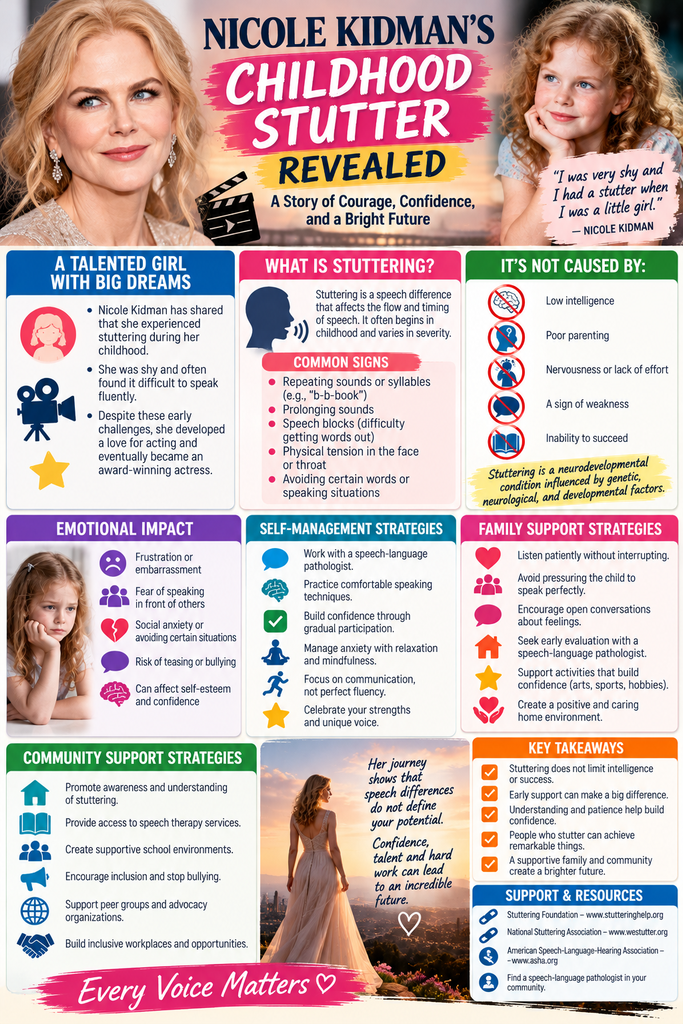
Nicole Kidman is one of Hollywood’s most accomplished actresses, celebrated for her performances in Moulin Rouge!, The Hours, Big Little Lies, and The Undoing. Her remarkable acting career demonstrates extraordinary versatility, emotional expression, and confidence in front of the camera.
However, behind her professional achievements lies a lesser-known childhood experience: Kidman has spoken publicly about struggling with a stutter when she was young.
For a child, difficulty speaking fluently can affect confidence, classroom participation, friendships, and emotional well-being. Stuttering may create frustration or anxiety, especially when children feel pressured to speak quickly or fear being interrupted.
Kidman’s experience offers an opportunity to discuss the challenges of childhood stuttering and the importance of understanding, early intervention, supportive relationships, and self-acceptance.
Her story highlights an important message: Speech differences do not determine a person’s intelligence, creativity, professional abilities, or potential for success.
Nicole Kidman’s Childhood Experience With Stuttering
Nicole Kidman has acknowledged that she stuttered as a child. In interviews, she has described being shy and struggling to speak fluently when she was younger.
Despite these early challenges, Kidman developed a passion for acting and eventually built an internationally recognized career.
Her experience shows how communication difficulties can coexist with strong artistic ability, determination, and professional achievement.
However, the precise severity of her childhood stutter, whether she received formal speech-language therapy, and the specific techniques she may have used are not fully documented publicly.
What is childhood stuttering?
Childhood-onset fluency disorder, commonly called developmental stuttering, is a speech condition that disrupts the normal flow and timing of speech.
These disruptions may include:
- Sound repetitions: Repeating sounds or syllables, such as “b-b-b-book.”
- Sound prolongations: Stretching sounds longer than intended.
- Speech blocks: Experiencing difficulty initiating or continuing a word despite attempting to speak.
- Physical tension: Tightness in the face, lips, or throat during speech.
- Secondary behaviors: Blinking, facial movements, or other behaviors associated with efforts to speak.
- Avoidance: Avoiding certain words or speaking situations because of anticipated difficulty.
Stuttering varies considerably between individuals and may change depending on circumstances, fatigue, emotional state, and communication demands.
Why Do Some Children Develop a Stutter?
Developmental stuttering typically begins between ages two and six, when language skills develop rapidly.
Researchers believe it arises from interactions among genetic, neurological, and developmental factors.
Common contributing factors
- Genetic predisposition: Stuttering frequently occurs in families, suggesting a hereditary component.
- Speech-motor coordination differences: Variations in the brain networks involved in speech planning and production may contribute to disruptions.
- Language development: Stuttering often emerges during periods of rapid language acquisition.
- Individual developmental differences: Children develop speech and language abilities at different rates.
Importantly, stuttering is not caused by poor parenting, low intelligence, or a lack of effort.
Although stress and anxiety may increase stuttering in certain situations, they are not considered the primary cause of developmental stuttering.
The Emotional and Psychological Impact of Childhood Stuttering
Children who stutter may face emotional challenges beyond speech disruptions.
The impact varies widely. Some children communicate comfortably and confidently, while others feel frustrated, embarrassed, or anxious in social situations.
Common emotional challenges
- Fear of speaking in front of classmates.
- Embarrassment when repeating words or experiencing speech blocks.
- Anxiety about being interrupted or misunderstood.
- Reduced willingness to participate in classroom discussions.
- Difficulty introducing themselves to unfamiliar people.
- Fear of teasing or bullying.
- Avoidance of social activities involving public speaking.
These difficulties can affect self-esteem and social participation, particularly when children receive negative reactions from others.
Stuttering and self-confidence
A child’s confidence depends not only on how often they stutter but also on how parents, teachers, peers, and other adults respond.
Children who receive patient, respectful communication support may develop a more positive relationship with speaking.
Nicole Kidman’s later success as an actress illustrates that childhood speech difficulties do not necessarily limit future communication-intensive careers.
However, her experience should not be interpreted as proof that acting alone treats or eliminates stuttering.
Self-Management Strategies for Children and Adults Who Stutter
Self-management strategies can help individuals develop communication confidence, manage speaking-related anxiety, and participate more comfortably in everyday activities.
For children, adapt these strategies to developmental needs and, ideally, have a speech-language pathologist experienced in stuttering guide them.
A. Work with a speech-language pathologist
Speech-language therapy is a primary evidence-based intervention for childhood stuttering.
Treatment may include:
- Individualized assessment of speech fluency and communication experiences.
- Age-appropriate fluency strategies.
- Reducing struggle and physical tension during speech.
- Building confidence in challenging communication situations.
- Addressing avoidance behaviors.
- Supporting emotional well-being and communication participation.
The goal is not always to eliminate every instance of stuttering. Effective therapy also helps individuals communicate comfortably, confidently, and authentically.
B. Practice comfortable communication
Some individuals benefit from speech techniques introduced by a qualified clinician.
These may include:
- Gentle initiation of speech.
- Adjusting speaking rate when helpful.
- Using pauses naturally.
- Reducing unnecessary physical tension.
- Practicing communication in supportive environments.
Do not impose techniques on every person who stutters. Some people prefer approaches that emphasize acceptance and reducing avoidance rather than increasing fluency.
C. Develop confidence through gradual participation
People who avoid speaking situations may benefit from gradually participating in manageable activities.
Examples include:
- Reading aloud when comfortable.
- Participating in small-group discussions.
- Practicing introductions with supportive friends.
- Joining drama, music, or storytelling activities.
- Volunteering for classroom participation when ready.
- Practicing presentations in a low-pressure environment.
Encourage participation without forcing children into situations that create distress.
D. Manage communication-related anxiety
Mindfulness, relaxation techniques, and cognitive behavioral therapy may help individuals who experience significant anxiety associated with stuttering.
Helpful strategies include:
- Recognizing negative thoughts about speaking.
- Practicing self-compassion.
- Developing realistic communication goals.
- Using relaxation exercises to manage tension.
- Seeking mental health support when anxiety interferes with daily functioning.
Anxiety management can improve emotional well-being, although it does not necessarily eliminate the underlying stutter.
E. Focus on communication rather than perfect fluency
One of the most valuable self-management principles is recognizing that effective communication does not require perfectly fluent speech.
Individuals can build confidence by focusing on expressing ideas, participating in conversations, and maintaining meaningful relationships.
The goal is to make communication more comfortable and fulfilling, not to measure personal worth by the absence of stuttering.
Family Support Strategies: Helping a Child Who Stutters
Families play an important role in shaping a child’s communication experiences and emotional well-being.
Although Nicole Kidman has discussed her childhood stutter, detailed information about how her family responded to it is not publicly available.
The following strategies are recommended for families supporting children with speech fluency difficulties.
A. Listen patiently without interrupting
Parents and caregivers should give children enough time to finish their thoughts.
Helpful approaches include:
- Maintaining natural eye contact.
- Listening to what the child says rather than how fluently they speak.
- Avoiding finishing words or sentences.
- Responding calmly when speech disruptions occur.
- Allowing comfortable pauses in conversations.
- Demonstrating that the child’s ideas are valued.
B. Avoid pressuring children to speak perfectly
Statements such as “slow down,” “take a deep breath,” or “try again” may unintentionally increase pressure or frustration.
Instead, parents can model a relaxed speaking pace and allow children to communicate naturally.
C. Encourage emotional expression
Children should feel comfortable discussing their feelings about stuttering.
Parents can ask supportive questions about school experiences, friendships, and speaking situations.
If a child experiences teasing or bullying, caregivers should work with teachers and school administrators to address the problem promptly.
D. Support early evaluation
Parents should consider consultation with a speech-language pathologist when stuttering persists, worsens, causes visible tension or distress, or interferes with communication.
Earlier evaluation is especially important if there is a family history of persistent stuttering or the child begins stuttering after about age three and a half.
E. Celebrate strengths beyond speech fluency
Children benefit from encouragement that recognizes their creativity, kindness, curiosity, academic interests, and personal achievements.
Families can support activities such as:
- Art and music.
- Sports and outdoor recreation.
- Theater and storytelling.
- Reading and creative writing.
- Community volunteering.
- Social clubs and hobbies.
These experiences can strengthen confidence and reinforce that stuttering is only one aspect of a child’s identity.
Community Support Strategies: Creating Inclusive Environments
Schools, healthcare organizations, community groups, and workplaces can help reduce the stigma associated with stuttering.
A. Promote speech-language education
Community education programs can explain that stuttering is a neurodevelopmental speech difference, not a sign of nervousness, intellectual limitations, or poor communication skills.
Educational efforts should emphasize respectful listening and understanding.
B. Improve access to speech-language services
Communities can support early identification and treatment through:
- School-based speech-language programs.
- Pediatric developmental screening.
- Affordable outpatient speech therapy.
- Telepractice services.
- Parent education workshops.
- Referrals to specialized fluency clinics.
C. Establish supportive school environments
Teachers can create more inclusive classrooms by:
- Allowing students sufficient time to answer questions.
- Avoiding unnecessary interruptions.
- Addressing bullying immediately.
- Offering flexible presentation formats when appropriate.
- Collaborating with speech-language pathologists.
- Encouraging classroom discussions about respectful communication.
D. Encourage peer support and advocacy
Support groups give individuals who stutter opportunities to share experiences and build confidence.
Helpful organizations include:
- National Stuttering Association — Education, advocacy, and peer support.
- Stuttering Foundation — Resources for parents, educators, and healthcare professionals.
- American Speech-Language-Hearing Association (ASHA) — Professional information about speech and language disorders.
E. Promote inclusive workplaces
Adults who stutter should have equal opportunities for employment, leadership, and professional advancement.
Employers can promote inclusion by encouraging respectful communication, avoiding assumptions about competence, and providing reasonable accommodations when appropriate.
Lessons From Nicole Kidman’s Childhood Stuttering Experience
Nicole Kidman’s experience offers several meaningful lessons.
Lesson 1: Stuttering does not determine intelligence or ability. People who stutter can succeed in academic, artistic, scientific, and professional careers.
Lesson 2: Confidence can develop over time. Early communication challenges do not necessarily predict future limitations.
Lesson 3: Supportive environments matter. Families, educators, and peers can help reduce communication-related stress and stigma.
Lesson 4: Professional intervention can be valuable. Speech-language therapy can help individuals develop personalized communication strategies and improve participation.
Lesson 5: Self-acceptance is important. Individuals should not feel that they must eliminate every speech difference to be respected or successful.
Lesson 6: Creative expression can provide opportunities for growth. Activities such as acting, music, and storytelling may help some individuals build confidence, although they are not substitutes for individualized treatment.
When Should Parents Seek Professional Help?
Parents should consider a speech-language evaluation when a child:
- Has been stuttering for several months.
- Experiences increasing frequency or severity.
- Shows visible tension or struggle while speaking.
- Avoids talking or becomes distressed about communication.
- Has a family history of persistent stuttering.
- Experiences teasing, bullying, or classroom difficulties.
Parents don’t need to wait for severe symptoms to seek guidance.
Early evaluation can provide reassurance, identify individual needs, and help families choose appropriate support.
Helpful Resources for Children and Adults Who Stutter
- Stuttering Foundation: Educational materials, treatment information, and family resources.
- National Stuttering Association: Peer support, advocacy, and community programs.
- American Speech-Language-Hearing Association: Evidence-based information about stuttering.
- National Institute on Deafness and Other Communication Disorders: Research and medical information about stuttering.
Conclusion: Nicole Kidman’s Story Highlights the Power of Confidence and Support
Nicole Kidman’s childhood experience with stuttering reminds us that communication difficulties do not define a person’s intelligence, creativity, or potential.
Although she experienced speech challenges early in life, she went on to build a highly successful acting career that depends heavily on communication, emotional expression, and storytelling.
Her experience offers an opportunity to raise awareness of childhood stuttering and the importance of compassionate support.
Self-management strategies can help individuals build communication confidence and address speaking-related anxiety. Families can create patient, supportive environments that encourage expression without pressure. Communities can promote inclusive education, accessible speech-language services, and greater understanding of speech differences.
The most important message is that a person’s voice deserves to be heard, whether their speech is fluent or includes stuttering. Confidence, communication, and personal achievement are not defined by perfect speech.
Frequently Asked Questions and Answers
Understanding Nicole Kidman’s Childhood Stuttering
1. Did Nicole Kidman have a stutter as a child?
Yes. Academy Award-winning actress Nicole Kidman has publicly discussed stuttering as a child. She has described being shy and having difficulty speaking fluently when she was younger. Despite these early communication challenges, she built a successful acting career, showing that stuttering does not limit a person’s abilities or future achievements.
2. At what age did Nicole Kidman develop her stutter?
Kidman has described stuttering as something she experienced as a young girl. However, publicly available accounts have not clearly established the exact age when her speech difficulties began. Developmental stuttering typically begins between ages two and six, when children are rapidly developing speech and language skills.
3. What caused Nicole Kidman’s childhood stutter?
The specific cause of Kidman’s childhood stutter is not publicly known. Developmental stuttering generally results from a combination of genetic, neurological, and developmental factors. It is not caused by low intelligence, poor parenting, or a lack of effort. Stress may increase stuttering in certain situations, but it is not considered the primary cause.
4. How did stuttering affect Nicole Kidman’s childhood confidence?
Kidman has described herself as shy as a child. However, the precise emotional effects of her stutter have not been fully documented. Children who stutter may feel frustrated, embarrassed, or afraid to speak, especially when others interrupt them or react negatively to their speech.
5. Did Nicole Kidman receive speech therapy for her stutter?
No clearly established public record confirms whether Kidman received formal speech-language therapy during childhood. Her experience should not be used to assume that she underwent a particular treatment. Speech-language therapy is an evidence-based approach that can help children and adults who stutter.
6. Did acting help Nicole Kidman overcome her stutter?
Kidman developed an interest in acting at a young age and eventually became an internationally recognized performer. Acting may provide opportunities for self-expression and confidence in communication, but there is insufficient evidence to conclude that acting specifically treated or eliminated her childhood stutter.
7. Does Nicole Kidman still stutter today?
Kidman’s childhood stutter has been discussed publicly, but her current speech fluency status should not be assumed from her performances or interviews. Stuttering can change over time, and some individuals become more fluent while others continue to experience occasional or persistent disruptions.
8. How did Nicole Kidman become a successful actress despite childhood speech difficulties?
Kidman’s professional success reflects her acting abilities, training, dedication, and creative expression. Her childhood stuttering did not prevent her from pursuing a communication-intensive career. Her experience illustrates that speech differences do not determine intelligence, talent, or professional potential.
Understanding Childhood Stuttering
9. What is childhood stuttering?
Childhood stuttering, also called developmental stuttering, is a speech fluency disorder characterized by interruptions in the normal flow and timing of speech. These interruptions may include repeated sounds, prolonged sounds, or blocks in which an individual temporarily cannot produce a word.
10. What are the common signs of stuttering in children?
Common signs include:
- Repeating sounds or syllables, such as “b-b-b-ball.”
- Stretching sounds longer than intended.
- Experiencing speech blocks.
- Showing facial or throat tension while speaking.
- Avoiding certain words or speaking situations.
- Displaying frustration during communication.
- Using additional movements, such as blinking, during difficult speech moments.
Not every child who stutters experiences all these symptoms.
11. Is childhood stuttering a neurological condition?
Developmental stuttering is considered a neurodevelopmental speech disorder. Research has identified differences in brain networks involved in speech planning, timing, and motor coordination. Genetics also contributes to susceptibility. Stuttering is not a sign of intellectual disability.
12. Can anxiety cause a child to stutter?
Anxiety is not considered the primary cause of developmental stuttering. However, stressful situations or speaking-related anxiety can increase stuttering frequency or make communication feel more difficult. Some children develop anxiety because of negative experiences associated with their stutter.
13. Is childhood stuttering hereditary?
Yes, genetics can play an important role. Stuttering often occurs in families, and researchers have identified genetic factors linked to developmental stuttering. However, having a family history does not guarantee that a child will develop persistent stuttering.
14. Can children naturally outgrow stuttering?
Yes. Many children who begin stuttering in early childhood recover spontaneously, particularly within the first few years after onset. However, some continue to stutter into adolescence or adulthood. A speech-language pathologist can evaluate factors associated with persistence and recommend appropriate intervention.
15. Does stuttering affect a child’s intelligence or learning ability?
No. Stuttering does not indicate reduced intelligence or an inability to learn. Children who stutter can demonstrate typical or advanced academic abilities. However, communication-related anxiety, bullying, or avoidance may interfere with classroom participation and educational experiences.
Self-Management and Speech Therapy Strategies
16. What treatments are available for childhood stuttering?
Speech-language therapy is the primary professional intervention. Treatment depends on the child’s age, speech characteristics, emotional experiences, and individual needs.
Approaches may include:
- Parent-supported treatment programs.
- Direct or indirect fluency interventions.
- Strategies to reduce speech-related tension.
- Communication confidence development.
- Reducing avoidance behaviors.
- Counseling for speaking-related anxiety when appropriate.
Treatment goals should emphasize comfortable, effective communication rather than demanding perfect fluency.
17. Can breathing exercises help someone who stutters?
Breathing and relaxation exercises may help some individuals manage physical tension or anxiety associated with speaking. However, breathing exercises alone are not a proven cure for developmental stuttering. A qualified speech-language pathologist should individualize techniques.
18. How can children build confidence when they stutter?
Children can build confidence through supportive communication experiences, encouragement, and opportunities to participate in activities they enjoy.
Helpful strategies include:
- Practicing communication in comfortable environments.
- Participating in hobbies and group activities.
- Recognizing personal strengths.
- Developing positive self-talk.
- Learning how to respond to teasing.
- Working with a speech-language pathologist when needed.
19. Can mindfulness help people who stutter?
Mindfulness may help individuals manage anxiety, frustration, and negative thoughts associated with communication. It can promote emotional awareness and self-acceptance. However, mindfulness is a supportive strategy, not a primary treatment for the underlying speech disorder.
20. Is there a permanent cure for stuttering?
No universally effective cure guarantees permanent fluency for every individual. Many children recover naturally, and speech-language therapy can improve fluency, communication comfort, and participation. For people with persistent stuttering, treatment can also reduce struggle and improve quality of life.
Family Support Strategies
21. How can parents help a child who stutters?
Parents can create a supportive communication environment by listening patiently, maintaining natural eye contact, and allowing children to finish their thoughts without interruption.
They should focus on the child’s message rather than speech fluency.
22. What should parents avoid saying to a child who stutters?
Parents should avoid repeatedly instructing children to “slow down,” “relax,” “take a deep breath,” or “start over.” Although these statements may be well-intended, they can increase pressure or frustration.
Instead, parents can model relaxed communication and give children sufficient time to speak.
23. Should parents finish sentences for children who stutter?
Generally, no. Finishing a child’s sentences may unintentionally communicate impatience or suggest that the child cannot express themselves independently. Parents should let the child finish their thoughts unless the child specifically requests help.
24. How can families protect children who stutter from bullying?
Families can help by:
- Encouraging children to discuss school experiences.
- Recognizing signs of teasing or social withdrawal.
- Communicating with teachers and school counselors.
- Supporting anti-bullying interventions.
- Teaching respectful communication.
- Helping children develop confidence and self-advocacy skills.
Bullying should be addressed directly rather than expecting children to manage it alone.
25. When should parents seek professional help for a child’s stutter?
Parents should consider an evaluation when stuttering persists for several months, becomes more frequent, involves visible tension, causes distress, or interferes with communication.
Early evaluation is also appropriate if there is a family history of persistent stuttering or if parents are concerned about their child’s speech development.
Community and Educational Support Strategies
26. How can teachers support students who stutter?
Teachers can support students by providing a supportive classroom environment, allowing adequate response time, avoiding unnecessary interruptions, and addressing teasing.
Additional strategies include:
- Collaborating with school speech-language pathologists.
- Encouraging participation without pressure.
- Offering appropriate classroom accommodations.
- Teaching classmates about respectful communication.
- Recognizing students’ abilities beyond speech fluency.
27. What community resources are available for people who stutter?
Several organizations provide education, advocacy, and peer support:
- National Stuttering Association — Peer support, education, and advocacy.
- Stuttering Foundation — Resources for families, educators, and healthcare professionals.
- American Speech-Language-Hearing Association (ASHA) — Professional information and speech-language pathology resources.
- Local speech-language clinics and university communication disorder programs.
28. Can support groups improve confidence in people who stutter?
Yes. Support groups can reduce isolation, encourage self-acceptance, and provide opportunities to share communication experiences. They can also help individuals develop self-advocacy skills and connect with others who understand the challenges of stuttering.
29. How can communities reduce stigma surrounding stuttering?
Communities can reduce stigma through education, inclusive communication practices, anti-bullying programs, and increased representation of people who stutter.
Public awareness should emphasize that stuttering does not reflect intelligence, character, competence, or professional potential.
30. What is the most important lesson from Nicole Kidman’s childhood stuttering experience?
Nicole Kidman’s experience shows that childhood communication difficulties don’t have to limit future opportunities. Her successful acting career shows how talent and personal development can coexist with early speech challenges.
The broader lesson is that individuals who stutter deserve patience, understanding, accessible support, and opportunities to communicate without judgment.
Video: