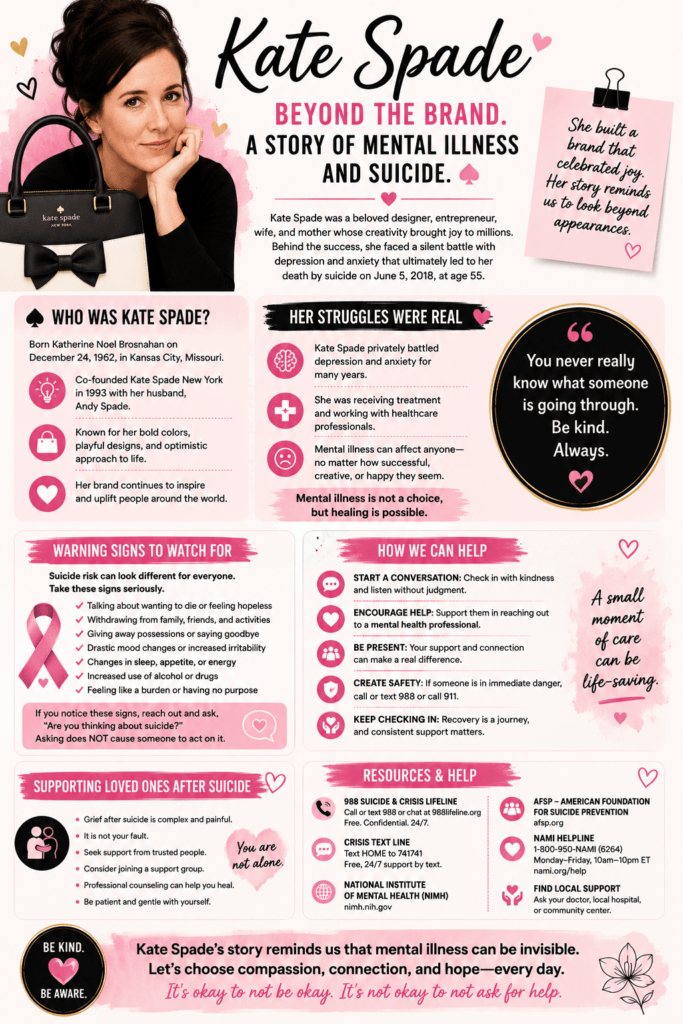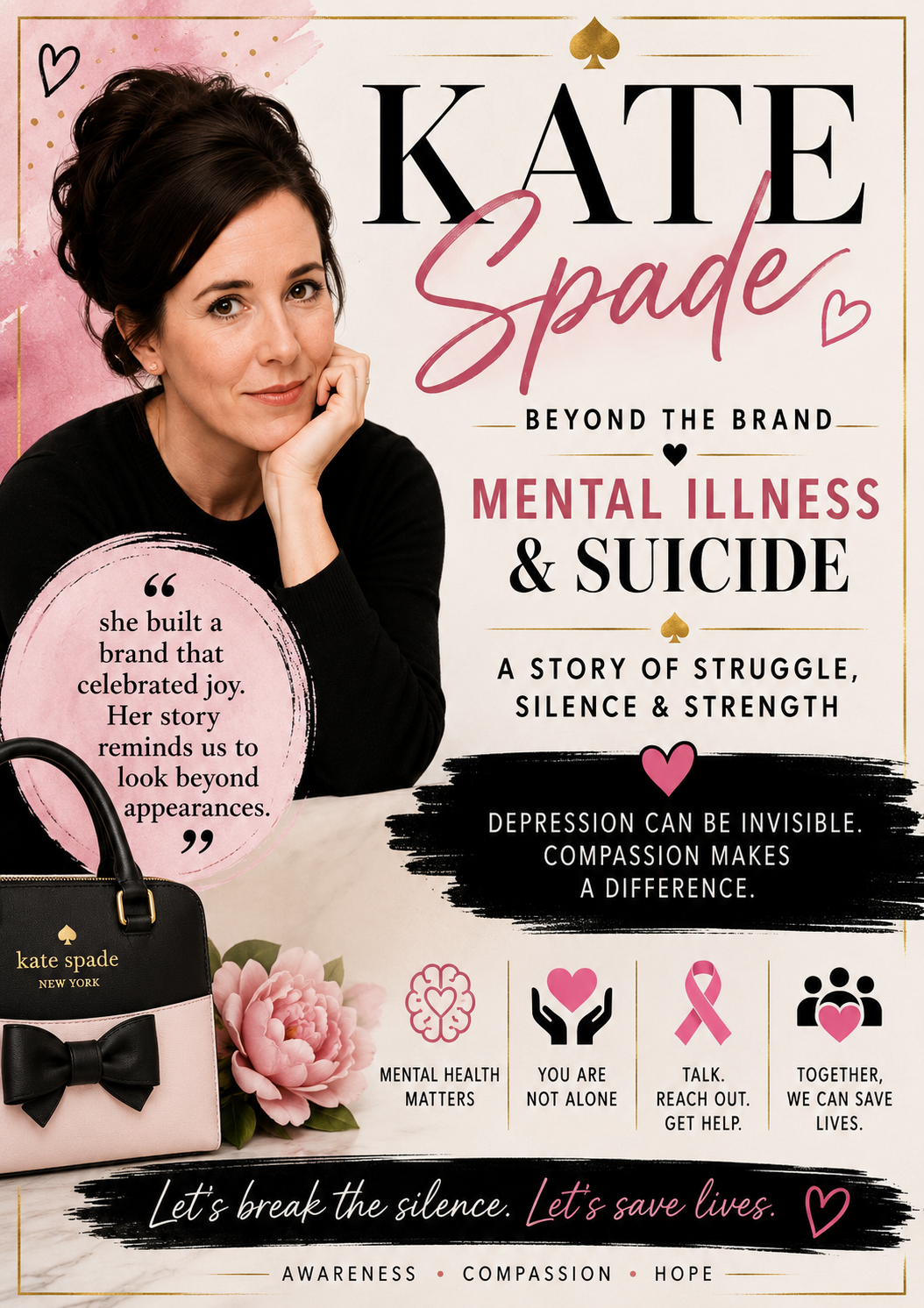
Kate Spade was an influential American fashion designer and entrepreneur whose colorful, optimistic designs helped create an internationally recognized brand. Behind her successful public image, however, Spade experienced significant mental health challenges. Following her death by suicide in 2018, her husband publicly shared that she had struggled with depression and anxiety for years and had been receiving professional treatment. Her story demonstrates an important mental-health lesson: serious psychological distress is not always visible, and professional achievement, financial security, creativity, and an outwardly positive personality do not guarantee emotional well-being. Understanding her experience can encourage greater awareness of depression, anxiety, suicide risk, early intervention, and the importance of compassionate mental-health support.
Kate Spade’s Mental Illness and Suicide
Kate Spade was an influential American fashion designer and entrepreneur who co-founded Kate Spade New York in 1993. Her colorful designs and optimistic aesthetic helped create an internationally recognized fashion brand. Behind that public image, however, Spade experienced significant mental health difficulties. She died by suicide on June 5, 2018, at age 55.
Her death became an important reminder that professional achievement, financial security, creativity, and an outwardly positive personality do not necessarily reveal a person’s internal mental-health struggles.
Depression and Anxiety
Following Spade’s death, her husband, Andy Spade, publicly stated that she had experienced depression and anxiety for many years and had been actively seeking professional help.
This distinction is important when discussing her life. Mental-health conditions are sometimes invisible to friends, colleagues, customers, and the general public. Someone may continue working, maintaining relationships, caring for family members, and appearing successful while experiencing significant psychological distress privately.
The Difference Between Appearance and Mental Health
The Kate Spade brand became associated with bright colors, playful designs, optimism, and joy. This contrast between her public creative identity and her private psychological struggles generated considerable discussion following her death.
However, appearing cheerful does not mean someone cannot experience depression. Depression may involve persistent sadness, hopelessness, loss of pleasure, sleep or appetite changes, fatigue, difficulty concentrating, feelings of worthlessness, or thoughts of death. Not every person experiences the same symptoms, and some people continue functioning at a high level despite severe distress.
This is one reason families and communities should avoid assuming that someone is emotionally well simply because they are successful or appear happy.
Mental Illness and Suicide Risk
Depression and other mental-health conditions can increase suicide risk, but suicide is rarely adequately explained by one factor. Psychological illness, acute stress, relationship difficulties, physical illness, substance use, previous suicidal behavior, access to lethal means, and other circumstances can interact differently for each person.
Therefore, it would be inappropriate to reduce Kate Spade’s death to a single explanation.
It is also important to distinguish between suicidal thoughts and suicide death. Many people experience suicidal thoughts and recover with appropriate treatment and support. Having depression does not mean someone will inevitably attempt suicide.
She Had Been Receiving Treatment
One of the most important lessons from Spade’s experience is that seeking treatment does not guarantee that symptoms will immediately disappear.
Mental health treatment may involve psychotherapy, medication, lifestyle interventions, social support, or a combination of these approaches. Treatment plans sometimes need to be adjusted as symptoms or circumstances change.
For families, this means that someone who is already receiving professional care should still be taken seriously if their symptoms worsen or they begin expressing hopelessness or thoughts of death.
Why Suicide Can Be Difficult to Predict
After a suicide, families and communities often search for an explanation or wonder whether someone should have recognized what was happening.
Unfortunately, suicide risk can be difficult to predict precisely. Some people openly communicate suicidal thoughts, while others conceal their distress.
Potential warning signs can include talking about wanting to die, expressing profound hopelessness, withdrawing from others, giving away possessions, dramatic mood changes, escalating substance use, or behaving recklessly. However, not everyone displays obvious warning signs.
The safest approach is to take concerning statements or major behavioral changes seriously rather than attempting to determine whether someone “really means it.”
The Impact on Families
Suicide creates complicated grief for surviving family members. Loved ones may experience sadness, anger, guilt, confusion, unanswered questions, or repeated thoughts about what they might have done differently.
Families affected by suicide may benefit from grief counseling, mental-health treatment, survivor-support groups, and supportive communities. Discussions about suicide should avoid assigning blame to family members or assuming that one action could necessarily have prevented a particular death.
Turning Tragedy Toward Mental-Health Advocacy
Kate Spade’s death also influenced the direction of the company she founded. Kate Spade New York states that it reaffirmed its commitment to mental-health efforts following its founder’s death in 2018. The company now describes women’s and girls’ mental health as central to its social-impact work and has invested in expanding access to mental-health resources.
Kate Spade New York’s mental-health and social-impact work
This represents an important community lesson: suicide prevention requires more than encouraging individuals to “stay positive.” It involves reducing stigma, improving access to mental-health professionals, recognizing warning signs, strengthening social connections, and ensuring that people experiencing crises can obtain timely assistance.
What Kate Spade’s Story Can Teach Us
Kate Spade’s life demonstrates why we should not judge mental health by outward appearance. Someone can be creative, accomplished, loved, financially successful, and outwardly joyful while simultaneously experiencing serious psychological distress.
Her experience also reinforces the importance of asking about mental health directly when someone appears to be struggling. Conversations about depression and suicide do not need to be avoided because they are uncomfortable. Compassionate, direct communication can create opportunities for people to disclose distress and receive professional assistance.
At the same time, Kate Spade should not be remembered solely for how she died. She was a designer, entrepreneur, wife, mother, and creative figure whose work influenced fashion internationally. Her death can inform suicide-prevention education, but it should not overshadow the entirety of her life.
Key Message
The central lesson from Kate Spade’s story is that mental illness is not always visible, and outward success is not proof of emotional well-being. Depression and anxiety deserve serious attention, treatment may require continued adjustment, and suicidal thoughts should always be taken seriously.
Her legacy also demonstrates how tragedy can motivate broader change. The company bearing her name continues to make women’s and girls’ mental health part of its social-impact mission, emphasizing greater access to mental-health resources and reducing stigma.
Self-Management Strategies to Understand Kate Spade’s Mental Illness and Suicide
The life and death of Kate Spade can help people understand that depression, anxiety, and suicidal distress may not always be visible from the outside. Her husband publicly stated after her death that she had experienced depression and anxiety and had been receiving treatment. Her experience should be approached as an opportunity for suicide-prevention education rather than as a simple explanation of why a particular person died.
- Recognize that outward success does not equal emotional wellness. A person may have a successful career, financial stability, supportive relationships, and a positive public image while privately experiencing serious psychological distress. Avoid comparing your internal struggles with how other people’s lives appear from the outside.
- Learn your personal signs of depression. Pay attention to persistent sadness, loss of interest, hopelessness, fatigue, changes in sleep or appetite, difficulty concentrating, irritability, social withdrawal, or feelings of worthlessness. Recognizing changes early can help you seek assistance before symptoms become overwhelming.
- Monitor anxiety symptoms. Persistent worry, racing thoughts, muscle tension, restlessness, panic symptoms, insomnia, and difficulty controlling fear may indicate that anxiety deserves professional attention rather than simply being accepted as everyday stress.
- Track changes in mood and functioning. Keeping a simple record of mood, sleep, stress, social activity, and daily functioning can make it easier to recognize patterns. Significant deterioration should be discussed with a healthcare professional.
- Do not hide distress to maintain appearances. People sometimes feel pressure to appear strong, successful, cheerful, or capable. Allowing trusted people to know when you are struggling can create opportunities for meaningful support.
- Challenge perfectionism. High-achieving individuals may connect their self-worth with productivity or professional success. Practice viewing mistakes and setbacks as experiences rather than evidence of personal failure.
- Maintain social connection. Depression often encourages withdrawal, which can increase isolation. Regular contact with trusted friends, relatives, colleagues, support groups, or community organizations can provide emotional connection during difficult periods.
- Develop healthy stress-management strategies. Exercise, adequate sleep, regular meals, relaxation exercises, mindfulness, creative activities, spending time outdoors, and structured routines can support mental health. These strategies complement professional treatment rather than replace it.
- Seek professional treatment early. Depression and anxiety are treatable conditions. Psychotherapy, medication when clinically appropriate, or combinations of treatments can help. Symptoms do not need to become severe before someone deserves professional assistance.
- Reassess treatment when symptoms change. Already receiving treatment does not mean a person cannot experience worsening symptoms. Increasing depression, severe anxiety, hopelessness, medication problems, or suicidal thoughts should prompt communication with the treating professional so the treatment plan can be reevaluated.
- Learn suicide warning signs. Statements about wanting to die, profound hopelessness, feeling like a burden, withdrawing from others, giving away meaningful possessions, dramatic behavioral changes, or preparing for death should be taken seriously.
- Create a personal safety plan. Someone with recurring suicidal thoughts can work with a mental-health professional to identify warning signs, coping strategies, supportive people, professional contacts, safer environments, and specific actions to take during a crisis.
- Reduce access to lethal means during periods of crisis. Creating distance from potentially lethal methods can provide additional time for suicidal impulses to decrease and for treatment or support to intervene. This is an established component of suicide-prevention planning.
- Avoid treating suicide as inevitable. Depression and anxiety can increase suicide risk, but most people experiencing mental illness do not die by suicide. Suicidal crises can change, and effective intervention and treatment can save lives.
- Separate a person’s life from the way they died. Kate Spade was an influential designer, entrepreneur, wife, mother, and creative professional. Suicide prevention education should acknowledge her death without allowing it to become the defining feature of her entire identity.
Key Takeaway
Kate Spade’s experience reminds us that serious psychological distress can exist behind an outward appearance of happiness and success. Effective self-management involves recognizing changes in mood, being willing to disclose distress, maintaining supportive relationships, using healthy coping strategies, and seeking professional treatment when symptoms interfere with everyday life.
Most importantly, suicidal thinking should be treated as a health and safety concern rather than something someone must manage alone. When suicidal thoughts emerge or become more intense, self-management strategies are no longer enough by themselves; involving trusted people and qualified mental-health professionals becomes especially important.
Family Support Strategies to Understand Kate Spade’s Mental Illness and Suicide
The death of Kate Spade provides families with an important opportunity to understand that depression, anxiety, and suicidal distress may exist even when someone appears successful, productive, and outwardly happy. Her husband stated publicly after her death that she had experienced depression and anxiety and had been receiving professional treatment. Families can use the broader lessons from her experience to improve mental-health awareness and suicide prevention without assuming that any single factor explains her death.
- Learn about depression and anxiety. Family members should understand that mental illness may affect mood, sleep, concentration, energy, relationships, decision-making, and everyday functioning. Symptoms are not always obvious to other people.
- Do not judge mental health by outward appearance. A successful career, financial security, family relationships, humor, creativity, or an apparently happy personality do not guarantee psychological wellness. Families should take emotional concerns seriously even when someone’s life appears successful.
- Create opportunities for honest conversations. Ask about emotional well-being rather than waiting for the person to volunteer information. Calm, private conversations can make it easier for someone to disclose depression, anxiety, hopelessness, or suicidal thoughts.
- Listen without immediately trying to solve everything. Sometimes the most helpful response is to listen carefully and acknowledge the person’s distress. Avoid minimizing statements such as “You have everything to live for” or “Other people have it worse.”
- Ask directly about suicide when concerned. If someone expresses hopelessness, says they do not want to live, or shows significant behavioral changes, asking directly whether they are thinking about suicide can help identify risk. Asking about suicidal thoughts does not cause someone to become suicidal.
- Recognize warning signs. Families should take seriously statements about wanting to die, profound hopelessness, feeling like a burden, increasing isolation, giving away meaningful belongings, dramatic behavioral changes, escalating substance use, or preparations related to death.
- Do not promise secrecy about immediate danger. If someone reveals an imminent intention to harm themselves, safety takes priority over confidentiality between family members. Involve appropriate professional or emergency support.
- Encourage professional treatment. Depression and anxiety are treatable. Families can assist with locating clinicians, transportation, appointments, medication organization when welcomed, and practical barriers that might interfere with treatment.
- Remember that being in treatment does not eliminate risk. Someone receiving therapy or medication may still experience worsening symptoms. Families should encourage reassessment when depression, anxiety, hopelessness, or suicidal thinking increases.
- Develop a family safety plan. When suicide risk is known, families can work with mental-health professionals to identify warning signs, coping strategies, supportive contacts, professional resources, and specific actions to take if symptoms escalate.
- Reduce access to lethal means during periods of elevated risk. Creating distance from potentially lethal methods can provide valuable time during a suicidal crisis. Families should discuss individualized safety measures with healthcare professionals.
- Maintain connection without becoming controlling. Regular phone calls, shared meals, visits, transportation assistance, or simply spending time with someone can help reduce isolation. Support should communicate genuine connection rather than surveillance.
- Avoid blame after a suicide. Suicide usually involves complex interacting factors. Family members may repeatedly ask what they missed or what they could have done differently. Assigning blame to relatives, friends, or the individual oversimplifies a complicated event and can intensify grief.
- Support suicide-loss survivors. Families affected by suicide may experience grief, anger, guilt, confusion, trauma, and unanswered questions. Grief counseling, family therapy, and suicide-loss support groups can help relatives process these experiences.
- Remember the whole person. Kate Spade’s death should not overshadow her entire identity. Similarly, families should remember a loved one’s relationships, personality, achievements, creativity, humor, and contributions rather than allowing mental illness or suicide to become the only story told about their life.
Family Takeaway
Kate Spade’s story reinforces a crucial lesson for families: do not assume someone is emotionally well simply because they appear successful or happy. Families can help by maintaining open communication, recognizing behavioral changes, asking directly about suicidal thoughts when concerned, encouraging professional treatment, and developing appropriate safety plans.
Families cannot predict or prevent every suicide, but they can create an environment in which mental-health struggles can be discussed without shame and concerning symptoms receive serious attention. When someone appears to be in immediate danger, the priority should shift from ordinary family support to obtaining urgent professional help.
Community Resource Strategies to Understand Kate Spade’s Mental Illness and Suicide
The life and death of Kate Spade can help communities understand that depression, anxiety, and suicidal distress may exist even when someone appears successful, creative, productive, and happy. Community strategies should focus on prevention, early recognition, accessible treatment, crisis response, and support for people affected by suicide rather than attempting to identify a single explanation for an individual’s death.
- Expand mental-health education. Schools, colleges, workplaces, libraries, healthcare organizations, and community centers can provide education about depression, anxiety, suicidal thoughts, protective factors, and available treatments. Education can help people recognize symptoms before they become crises.
- Increase access to screening. Primary-care practices, community health centers, universities, and behavioral-health organizations can offer confidential screening for depression, anxiety, substance misuse, and suicide risk, followed by appropriate assessment and referrals.
- Teach communities to recognize warning signs. Programs can educate people about concerning behaviors such as expressing a desire to die, severe hopelessness, feeling like a burden, withdrawing from relationships, dramatic mood changes, or making preparations for death.
- Provide suicide-prevention training. Community organizations can train teachers, healthcare workers, employers, faith-community leaders, first responders, and other community members to recognize possible warning signs, ask directly about suicide, and connect people with professional assistance.
- Improve access to professional treatment. Communities need affordable psychiatrists, therapists, primary care services, crisis programs, and other behavioral health resources. Telehealth can also help individuals who face geographic, transportation, scheduling, or mobility barriers.
- Develop workplace mental-health programs. Kate Spade’s professional success demonstrates why workplaces should not assume productive employees are necessarily emotionally well. Employee assistance programs, confidential counseling, mental-health education, reasonable accommodations, and supportive workplace cultures can encourage earlier help-seeking.
- Create safe spaces for honest conversations. Community campaigns can normalize statements such as “I’m struggling,” “I’m depressed,” or “I need help.” Reducing shame may make people more willing to disclose distress before reaching a crisis.
- Promote evidence-based safety planning. Behavioral-health organizations can help people experiencing suicidal thoughts develop individualized plans identifying warning signs, coping strategies, supportive contacts, professional resources, and actions to take during escalating distress.
- Educate about reducing access to lethal means. Suicide-prevention programs can teach families how temporarily creating distance from highly lethal methods during periods of elevated risk may provide critical time for a crisis to pass and treatment to intervene.
- Provide resources for families. Family workshops can teach communication skills, depression and anxiety warning signs, how to ask about suicidal thoughts, how to respond to disclosures, and when urgent professional evaluation is necessary.
- Support people bereaved by suicide. Suicide-loss survivors may experience complicated grief, guilt, anger, trauma, and unanswered questions. Communities can provide grief counseling, survivor groups, faith-based support (when desired), and specialized mental health services.
- Encourage responsible media and social-media communication. Suicide should not be sensationalized, romanticized, or reduced to a single cause. Community educators and content creators should emphasize prevention, treatment, recovery, and available support while respecting the dignity of the deceased and their family.
- Connect people with reputable organizations. National Institute of Mental Health provides evidence-based information about mental health and suicide prevention, while the American Foundation for Suicide Prevention offers prevention education and resources for people affected by suicide.
- Promote mental-health advocacy. Following its founder’s death, Kate Spade New York has incorporated women’s and girls’ mental health into its social-impact work. Community partnerships involving healthcare organizations, nonprofits, schools, and businesses can expand mental-health awareness and access to support.
- Emphasize that treatment and recovery are possible. Depression and anxiety are treatable, and suicidal crises are not necessarily permanent. Community messaging should balance awareness of suicide risk with realistic messages about treatment, connection, recovery, and hope.
Community Takeaway
Kate Spade’s story demonstrates why communities must look beyond outward appearances when discussing mental health. Success, wealth, creativity, and an optimistic public image do not provide immunity from depression, anxiety, or suicidal distress.
Effective suicide prevention requires more than telling people to ask for help. Communities must make that help accessible, affordable, timely, confidential, and free from stigma. Mental-health education, early screening, trained community members, professional treatment, safety planning, family support, and services for suicide-loss survivors can work together to create a stronger safety net.
Frequently Asked Questions
Here are some common questions:
1. Who was Kate Spade?
Kate Spade was an American fashion designer and entrepreneur who co-founded Kate Spade, New York. She became internationally known for her colorful, playful handbags and accessories, building an influential fashion legacy.
2. Did Kate Spade experience mental illness?
Following her death, her husband, Andy Spade, publicly stated that she had experienced depression and anxiety for many years and had been receiving professional treatment.
3. When did Kate Spade die?
Kate Spade died by suicide on June 5, 2018, at age 55.
4. Did her successful career protect her from depression?
No. Professional achievement, wealth, creativity, family relationships, and social status do not make someone immune to mental illness. Her experience demonstrates why emotional well-being cannot be determined solely by outward appearances.
5. Was Kate Spade receiving mental-health treatment?
According to her husband’s public statement, she had been seeking professional help and taking medication for depression and anxiety. Her experience demonstrates that being in treatment does not necessarily mean symptoms cannot worsen and that treatment sometimes needs ongoing reassessment.
6. Why might depression be difficult for other people to recognize?
Some individuals continue working, socializing, caring for their families, and appearing cheerful despite significant internal distress. Depression can therefore be less visible than people expect.
7. What are common symptoms of depression?
Symptoms can include persistent sadness, hopelessness, loss of interest or pleasure, fatigue, sleep or appetite changes, difficulty concentrating, irritability, feelings of worthlessness, social withdrawal, and thoughts of death or suicide. Symptoms vary among individuals.
8. What are common symptoms of anxiety?
Anxiety may involve excessive worry, restlessness, racing thoughts, muscle tension, difficulty concentrating, sleep problems, panic symptoms, or avoidance of situations that produce fear.
9. Does having depression mean someone will become suicidal?
No. Most people experiencing depression do not die by suicide. However, depression and certain other mental-health conditions can increase suicide risk, particularly when combined with other risk factors. Appropriate treatment and support can substantially improve outcomes.
10. Is suicide usually caused by one event?
Usually, no. Suicide is complex and may involve interacting psychological, biological, social, environmental, and situational factors. It is generally inappropriate to identify one relationship problem, diagnosis, stressful event, or personal circumstance as the sole explanation for someone’s death.
11. What are possible suicide warning signs?
Warning signs can include talking about wanting to die, expressing severe hopelessness, feeling like a burden, withdrawing from loved ones, giving away important possessions, dramatic behavioral changes, increasing substance use, or making preparations associated with death.
12. Should you ask someone directly if they are thinking about suicide?
Yes. When there is genuine concern, asking clearly and compassionately about suicidal thoughts can help identify someone who needs assistance. Asking about suicide does not implant the idea or cause a person to become suicidal.
13. What should families do if someone reveals suicidal thoughts?
Take the disclosure seriously, listen without judgment, help the person connect with qualified mental-health professionals, and follow an appropriate safety plan. If there is immediate danger, urgent professional or emergency intervention is appropriate.
14. Can someone recover from suicidal thoughts?
Yes. Suicidal crises can change, and many people who experience suicidal thoughts recover and go on to live meaningful lives. Psychotherapy, psychiatric treatment, social support, safety planning, and treatment of underlying conditions can all contribute to recovery.
15. How should people talk about Kate Spade’s death responsibly?
Discussions should avoid sensationalizing her death, describing the method, assigning blame, or suggesting that suicide was inevitable. The emphasis should remain on mental-health awareness, prevention, treatment, support, and her life beyond the circumstances of her death.
16. How can families support someone with depression or anxiety?
Families can listen without judgment, maintain regular contact, encourage professional treatment, learn warning signs, help reduce isolation, support healthy routines, and take significant behavioral changes seriously.
17. How did Kate Spade’s death influence mental-health awareness?
Her death generated broader conversations about depression, suicide prevention, and the fact that serious psychological distress can exist behind an outwardly successful life. Kate Spade New York has also made women’s and girls’ mental health an important part of its social-impact efforts.
18. What reliable resources provide suicide-prevention education?
Organizations such as the American Foundation for Suicide Prevention and the National Institute of Mental Health provide evidence-based information about suicide risk, prevention, mental-health conditions, and supporting people experiencing psychological distress.
19. Should Kate Spade be remembered primarily for her suicide?
No. Her death is part of her story, but it should not define her entire life. She was also a designer, entrepreneur, wife, mother, and influential creative professional whose work had a lasting impact on American fashion.
20. What is the most important lesson from Kate Spade’s story?
Perhaps the most important lesson is that mental illness is not always visible. Someone who appears happy, accomplished, creative, and successful may still be experiencing significant psychological distress. Compassionate conversations, early recognition, accessible treatment, and taking suicidal thoughts seriously can help create opportunities for intervention and recovery.
Conclusion
Kate Spade’s life and death remind us that mental illness can exist behind even the brightest public image. Her experience reinforces the importance of recognizing changes in mood and behavior, listening without judgment, taking suicidal thoughts seriously, and connecting people with appropriate professional care. Suicide is complex and should never be reduced to one event, diagnosis, or explanation, nor should it define the entirety of a person’s life. Kate Spade should also be remembered for her creativity, entrepreneurship, influence on fashion, and lasting cultural legacy. By transforming greater awareness into education, accessible treatment, supportive communities, and open conversations about mental health, society can honor stories like hers while emphasizing an essential message: psychological distress deserves attention, treatment is available, and seeking help should never be a source of shame.
Video: If Only They Knew: Kate Spade’s Fight for Mental Peace