Talking about addiction recovery with someone who shows narcissistic traits can be challenging. They may become defensive when confronted, minimize the consequences of substance use, blame other people, or interpret concern as criticism. However, narcissistic traits exist on a spectrum and are not the same as narcissistic personality disorder (NPD), which requires professional assessment and diagnosis.
When narcissistic traits and substance use problems occur together, conversations about recovery often work better when they focus on specific behaviors, consequences, treatment options, and boundaries rather than labels or arguments about the person’s character. The objective is not to “defeat” the person in a confrontation. It is to communicate clearly, protect yourself, and encourage professional treatment while recognizing that the decision to participate in recovery ultimately belongs to them.
Understanding Narcissistic Traits and Addiction
Some people with strong narcissistic traits have difficulty tolerating criticism, admitting mistakes, or accepting vulnerability. Substance use can further complicate these patterns by contributing to impaired judgment, secrecy, impulsivity, conflict, or denial.
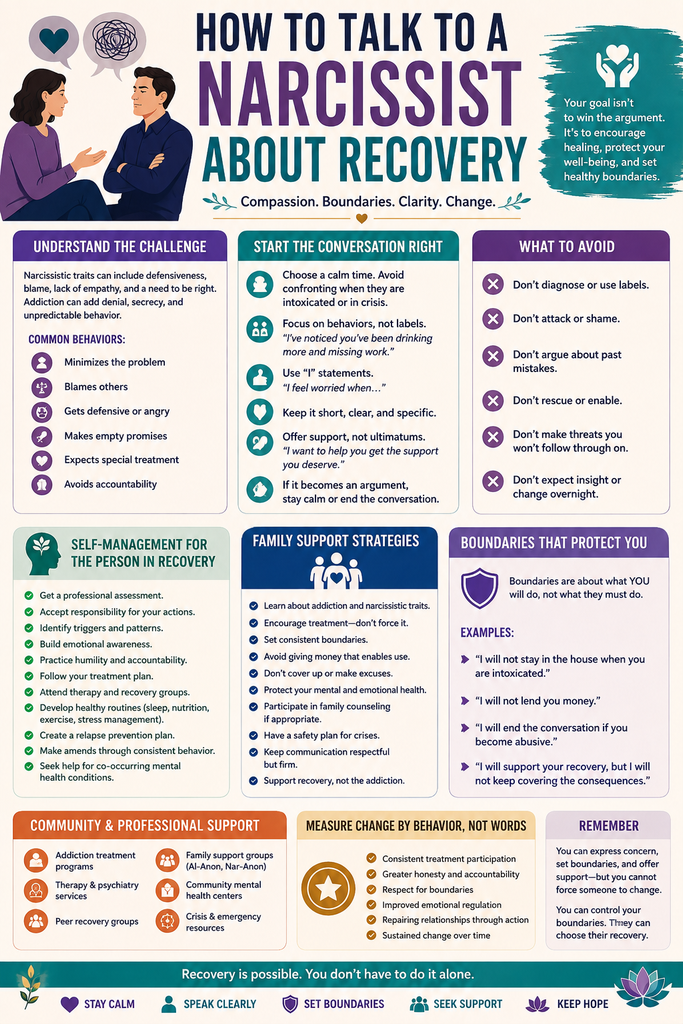
Possible behaviors may include:
- Minimizing the severity of substance use
- Blaming family members or circumstances
- Becoming angry or defensive when concerns are raised
- Making promises without sustained behavioral change
- Expecting others to protect them from consequences
- Manipulating conversations away from substance use
- Rejecting treatment because they believe they can handle the problem alone
- Using charm or persuasion to avoid accountability
- Viewing requests for change as personal attacks
None of these behaviors alone proves that someone has NPD. Addiction itself can also produce denial, defensiveness, secrecy, and interpersonal conflict.
How to Start the Recovery Conversation
Choose a time when the person is not intoxicated and when the environment is reasonably calm and private. Avoid beginning an important recovery conversation during an argument or crisis unless immediate safety requires intervention.
Keep the discussion focused on observable behavior.
Instead of saying:
“You’re a narcissist, and you don’t care about anyone.”
A more constructive approach might be:
“I’m concerned because your drinking has increased, you’ve missed work several times, and our family is being affected. I want you to speak with a professional about what’s happening.”
Specific examples are usually more useful than character judgments.
Helpful communication strategies include:
- Speak calmly and directly.
- Describe specific behaviors rather than attacking personality.
- Use short, clear statements.
- Explain how substance use is affecting you or the family.
- Avoid arguing about every detail of the past.
- Do not attempt to diagnose the person during the conversation.
- Present realistic treatment options.
- State your boundaries clearly.
- End the discussion if it becomes threatening or abusive.
Avoid the Battle Over Who Is Right
A conversation about recovery can quickly turn into an argument over blame. The person may insist that others caused the problem or attempt to redirect attention to your mistakes.
You do not have to resolve every accusation before discussing recovery.
Bring the conversation back to the central issue:
“We may disagree about why this happened. I’m talking about what is happening now and what needs to change.”
This approach helps prevent the conversation from becoming an endless debate.
Self-Management Strategies for the Person in Recovery
Recovery requires more than acknowledging substance use. Someone who also struggles with narcissistic traits may benefit from developing greater emotional awareness, accountability, empathy, and tolerance for uncomfortable feelings.
Helpful strategies can include:
- Obtain a professional substance use and mental health assessment.
- Identify triggers for substance use and interpersonal conflict.
- Develop healthier responses to criticism and rejection.
- Practice recognizing emotions before reacting impulsively.
- Learn to accept responsibility without immediately blaming others.
- Follow an individualized treatment plan.
- Attend counseling consistently rather than only during crises.
- Participate in peer-recovery or mutual-help groups when appropriate.
- Build healthy routines for sleep, nutrition, exercise, and stress management.
- Create a written relapse-prevention plan.
- Identify trustworthy people who can provide honest feedback.
- Practice making amends through sustained behavior rather than promises alone.
- Seek treatment for co-occurring mental health conditions when indicated.
Recovery often requires learning that accountability is not humiliation. Acknowledging harmful behavior can become part of rebuilding relationships and self-respect.
Family Support Strategies
Families sometimes become trapped in cycles of confrontation, rescue, forgiveness, crisis, and repeated disappointment. Supporting recovery does not mean protecting someone from every consequence of their substance use.
Family members can:
- Learn about addiction and personality traits.
- Encourage professional treatment.
- Communicate expectations clearly.
- Establish consistent boundaries.
- Avoid giving money that may support substance use.
- Refuse to lie or make excuses for the person’s behavior.
- Avoid repeatedly rescuing them from preventable consequences.
- Recognize manipulation without becoming drawn into prolonged arguments.
- Participate in family counseling when appropriate.
- Develop an emergency plan for overdose, violence, or severe intoxication.
- Protect children from destructive adult conflicts.
- Maintain supportive relationships outside the household.
- Seek counseling or peer support for themselves.
A useful principle is: support recovery without supporting the addiction.
Setting Boundaries Without Trying to Control the Person
A boundary describes what you will do, not simply what another person must do.
For example:
Control: “You are never allowed to drink again.”
Boundary: “I will not stay in the house when you are intoxicated and behaving aggressively.”
Another example:
Control: “You have to go to therapy.”
Boundary: “I am willing to support your recovery, but I will not continue covering the consequences of refusing help.”
Boundaries work best when they are realistic, clearly communicated, and consistently followed.
Community Support Strategies
Recovery should not depend entirely on one family member. Community resources can provide treatment, accountability, education, and social support.
Helpful resources may include:
- Addiction treatment programs
- Primary care and behavioral health services
- Individual psychotherapy
- Psychiatric evaluation when appropriate
- Medications for substance use disorders when clinically indicated
- Peer-recovery specialists
- Mutual-help groups
- Family support groups
- Community mental health centers
- Recovery community organizations
- Crisis and emergency services
- Domestic violence resources when relationships become unsafe
Integrated treatment can be especially valuable when substance use disorder occurs alongside significant personality-related or other mental health difficulties.
When Manipulation Enters the Conversation
Some difficult conversations involve guilt, threats, blame, denial, or attempts to make another person question what happened. Avoid trying to “win” through increasingly intense confrontation.
Instead:
- Return to observable facts.
- Keep explanations brief.
- Repeat important boundaries when necessary.
- Avoid making threats you will not carry out.
- Document important financial, legal, or safety matters when appropriate.
- Seek outside professional guidance.
- Disengage when the conversation becomes abusive or unsafe.
You cannot force another adult to develop insight. You can control how much unhealthy behavior you participate in.
When Safety Comes First
Addiction combined with severe anger, impulsivity, coercive behavior, or violence can create dangerous situations. If conversations about treatment lead to threats, stalking, physical aggression, intimidation, or other abuse, the priority should shift from persuading the person to enter recovery toward protecting those at risk.
Do not assume that better communication alone can resolve an unsafe situation. Professional safety planning and emergency assistance may be necessary.
Measuring Recovery by Behavior
Apologies and promises can be meaningful, but sustainable recovery is demonstrated through repeated actions.
Look for changes such as:
- Consistent treatment participation
- Reduced or discontinued substance use according to the treatment goal
- Greater honesty
- Acceptance of consequences
- Respect for boundaries
- Improved emotional regulation
- Willingness to receive feedback
- Reduced manipulation and secrecy
- Repairing relationships through actions
- Maintaining recovery behaviors over time
The question becomes less “What is the person promising?” and more “What pattern is developing?”
Conclusion
Talking to someone with narcissistic traits about addiction recovery requires clarity, realistic expectations, boundaries, and compassion without enabling. Labeling, shaming, or attempting to overpower the person may increase defensiveness without producing meaningful change.
A stronger approach focuses on observable behaviors and their consequences, encourages professional treatment, establishes boundaries, and allows trained clinicians to evaluate both substance use and possible personality-related concerns.
Families also deserve support. They cannot complete recovery on another person’s behalf, and they should not have to sacrifice their own safety or well-being to keep someone else comfortable.
Recovery becomes more meaningful when words are accompanied by action. With appropriate self-management, family boundaries, community resources, evidence-based treatment, and personal accountability, change is possible—but sustainable recovery requires the individual to participate in that change.
Frequently Asked Questions
Here are some common questions:
1. Why can talking about recovery with someone who has narcissistic traits be difficult?
A person with strong narcissistic traits may have difficulty accepting criticism, acknowledging vulnerability, or taking responsibility for harmful behavior. Addiction can add denial, secrecy, impaired judgment, and defensiveness, making conversations about treatment especially challenging.
2. Are narcissistic traits the same as narcissistic personality disorder (NPD)?
No. People can display narcissistic traits without having NPD. Narcissistic personality disorder is a specific mental health diagnosis that requires evaluation by a qualified professional. Avoid diagnosing someone based solely on difficult or selfish behavior.
3. When is the best time to discuss recovery?
Choose a calm, private time when the person is not intoxicated or experiencing an acute crisis. Starting the conversation during an argument often increases defensiveness and reduces the chance of productive communication.
4. How should I begin the conversation?
Focus on specific behaviors and consequences rather than attacking the person’s character. For example: “I’m concerned because your drinking has increased and you’ve missed work several times. I’d like you to consider talking with a professional.”
5. Should I tell the person that they are a narcissist?
Generally, labeling the person is unlikely to help an addiction conversation. Focus instead on observable behaviors, their consequences, and what needs to change. Questions about a personality disorder are better addressed through professional assessment.
6. What should I avoid saying?
Avoid insults, humiliation, sweeping accusations, amateur diagnoses, and threats you do not intend to carry out. Statements such as “You’re a narcissist,” “You ruin everything,” or “You’ll never change” can shift attention away from the substance-use problem.
7. What if they deny having an addiction?
You do not have to convince them through an endless argument. State what you have observed, explain how it affects you, recommend professional assessment, and establish appropriate boundaries.
8. What if they blame everyone else?
Avoid getting trapped in a debate over every accusation. Redirect the conversation: “We may disagree about why this happened, but I’m concerned about what is happening now and what needs to change.”
9. Can I convince someone to enter recovery?
You can encourage treatment, provide information, express concern, and establish consequences, but you generally cannot force another adult to become internally committed to recovery. Sustainable change requires participation from the person experiencing the problem.
10. What self-management strategies can support their recovery?
Helpful approaches may include:
- Professional addiction and mental health assessment
- Individualized treatment
- Identifying triggers
- Developing emotional-regulation skills
- Practicing accountability
- Counseling or psychotherapy
- Peer-recovery support
- Healthy sleep, nutrition, and exercise
- A relapse-prevention plan
- Treatment of co-occurring mental health conditions
11. How can families support recovery without enabling addiction?
Families can encourage treatment, provide emotional support, learn about addiction, and recognize positive changes while refusing to provide money for substance use, lie about consequences, repeatedly rescue the person, or tolerate abusive behavior.
12. What is the difference between a boundary and an ultimatum?
A healthy boundary focuses primarily on your own actions. For example: “If you become verbally abusive, I will end the conversation.” Trying to control another person’s behavior—“You are never allowed to get angry again”—is different.
13. What if they repeatedly promise to change but don’t?
Pay attention to patterns rather than promises. Meaningful recovery is more reliably demonstrated through consistent treatment participation, honesty, respect for boundaries, reduced harmful behavior, accountability, and sustained change over time.
14. Can narcissistic traits improve during recovery?
Some problematic behaviors can improve when a person develops insight, emotional-regulation skills, healthier coping strategies, and greater accountability. When significant personality difficulties are present, psychotherapy may be an important part of longer-term treatment.
15. What community resources can help?
Depending on individual needs, support may include addiction treatment programs, behavioral health professionals, primary care, psychiatric services, peer-recovery organizations, mutual-help groups, family support programs, and community mental health centers.
16. Should families participate in counseling?
Family counseling can sometimes improve communication, clarify boundaries, and help relatives understand addiction. Individual counseling can also be valuable for family members, particularly when they have experienced prolonged stress.
17. What if the person becomes threatening or abusive when recovery is discussed?
Do not prioritize winning the conversation over safety. Threats, intimidation, stalking, coercion, or physical violence require a different approach. Distance, professional safety planning, or emergency assistance may be necessary depending on the situation.
18. Is relapse proof that recovery has failed?
No. A return to substance use can occur during recovery and should be taken seriously. It may indicate that the treatment plan needs to be reassessed or intensified rather than that recovery is impossible.
19. How do I protect my own emotional well-being?
Maintain boundaries, preserve supportive relationships, take breaks from destructive conversations, continue your own routines, and seek counseling or family support when needed. You do not have to make another person’s recovery your entire responsibility.
20. What is the most important message when talking to someone about recovery?
Aim for compassion without enabling and accountability without humiliation. You can express concern, encourage treatment, offer appropriate support, and establish boundaries—but you cannot complete another person’s recovery for them. Sustainable change is ultimately demonstrated through actions, not promises.
Video: Why your conversations with a narcissist fail #narcissist #communication