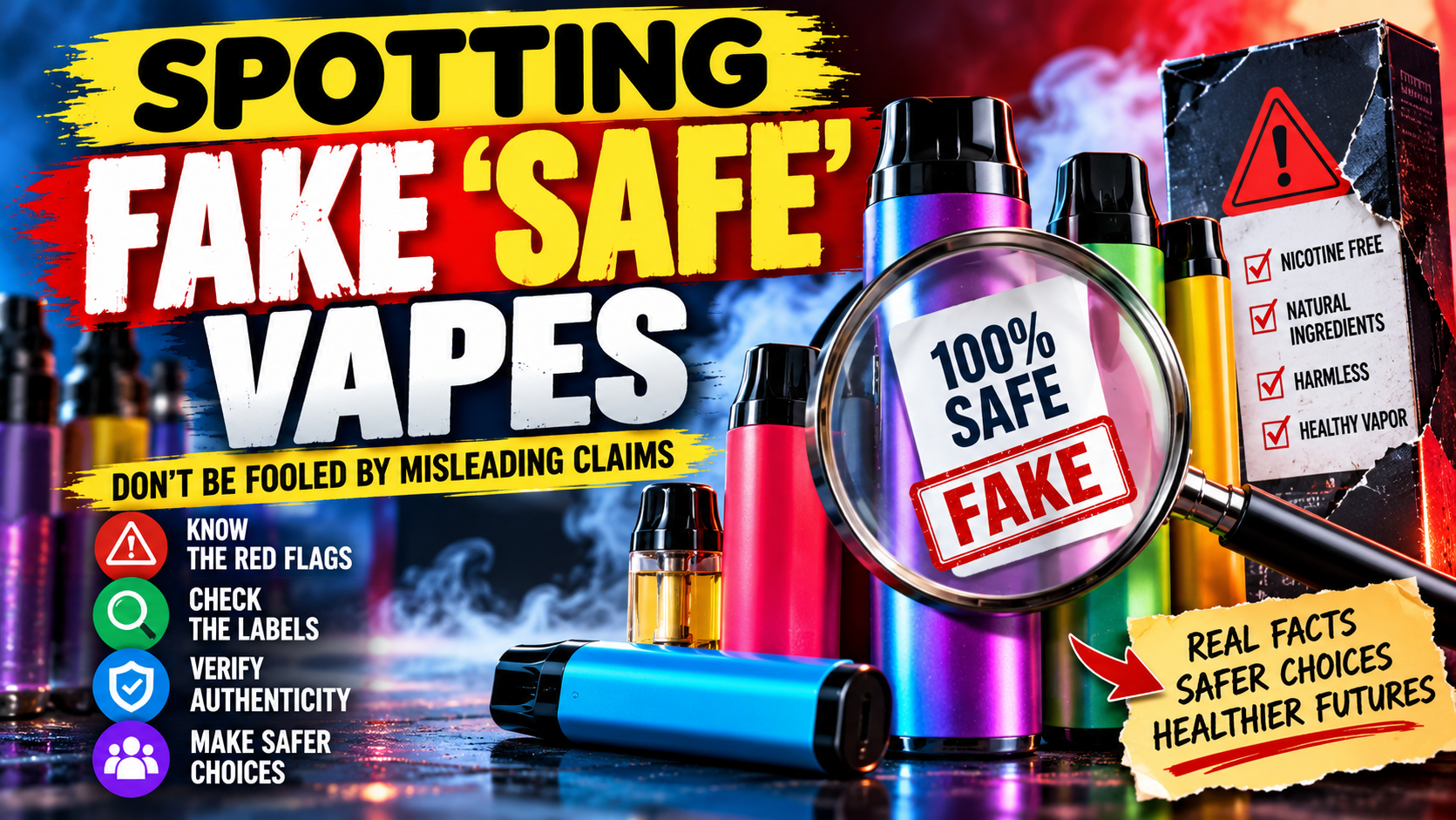
Vaping products are frequently marketed as modern, convenient, and supposedly safer alternatives to traditional cigarettes. Colorful packaging, appealing flavors, and advertising claims such as “nicotine-free,” “natural,” “clean vapor,” or “harmless ingredients” can make it seem like certain vaping products pose little or no health risk.
However, no vaping product is completely risk-free, and consumers should be cautious of misleading safety claims, counterfeit products, and devices with questionable ingredients or manufacturing standards.
Some products may contain nicotine despite claims to the contrary, while others may contain undisclosed substances, contaminants, or poorly regulated ingredients. Counterfeit vaping devices can also introduce additional concerns involving battery safety, product quality, and unreliable labeling.
For individuals recovering from nicotine addiction or other substance use disorders, misleading vape advertisements may encourage continued nicotine exposure, reinforce addictive behaviors, or complicate efforts to quit.
Learning to recognize warning signs can help individuals make informed decisions, protect their health, and support addiction recovery.
Importantly, no visual inspection can instantly prove that a vape is safe, authentic, or free of harmful chemicals. Recognizing red flags is a useful first step, but laboratory testing and reliable regulatory information are needed to verify many product claims.
What Are Fake “Safe” Vapes?
The term fake safe vapes can describe several different types of products, including counterfeit vaping devices, mislabeled products, and e-cigarettes marketed with exaggerated or unsupported health claims.
These products may appear legitimate because they resemble established brands, use professional packaging, or advertise wellness-associated ingredients.
Common examples include:
- Counterfeit devices: Products that imitate established brands without authorization.
- Misleading nicotine-free claims: Products labeled as containing no nicotine despite uncertainty about their actual contents.
- Unsubstantiated health claims: Advertisements describing vaping as harmless, healthy, or beneficial for lung function.
- Questionable ingredient labeling: Products that fail to clearly disclose their contents or manufacturer.
- Unauthorized products: E-cigarettes marketed without required regulatory authorization.
- Unverified herbal vapes: Devices advertised as natural or chemical-free despite limited safety evidence.
A product can be authentic and still pose health risks. Similarly, a product’s lack of marketing authorization does not automatically prove that it is counterfeit.
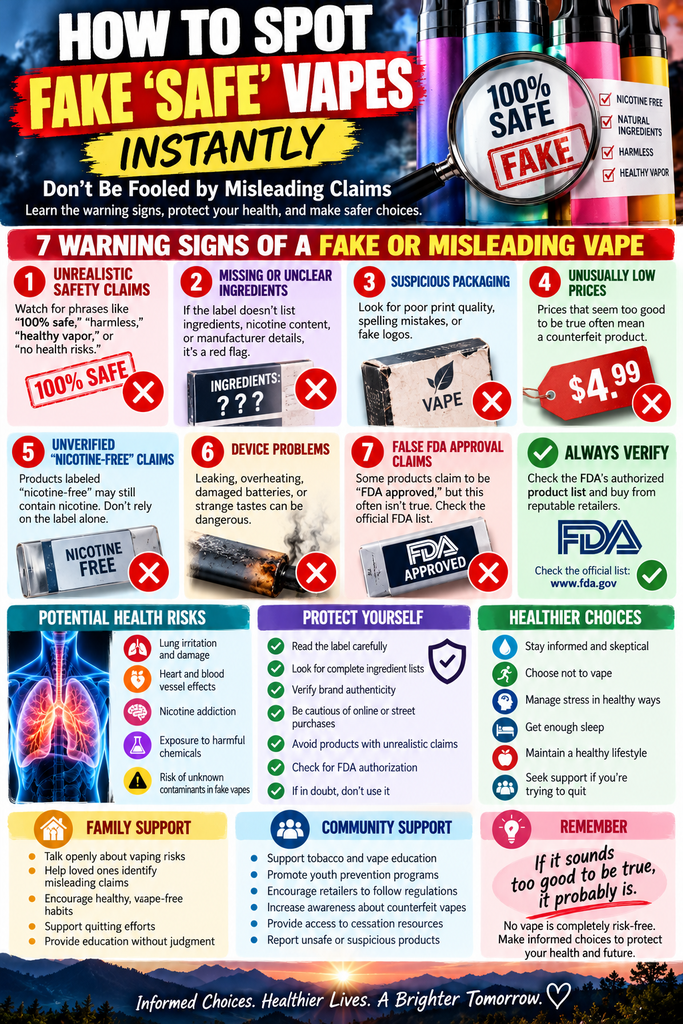
Seven Warning Signs of a Fake or Misleadingly Marketed Vape

1. Claims that the product is completely safe
Advertisements promising “100% harmless,” “zero health risks,” or “healthy vapor” should raise concerns. Inhaling aerosolized substances can expose the respiratory system to potentially harmful chemicals.

2. Missing or unclear ingredient information
Packaging that lacks basic product information, manufacturer identification, or nicotine disclosures deserves additional scrutiny. A complete ingredient list, however, does not guarantee safety.

3. Suspicious packaging or verification codes
Poor printing, spelling mistakes, inconsistent branding, and nonfunctional verification links can indicate a counterfeit product. QR codes and security labels can also be copied, so they don’t definitively prove authenticity.

4. Unusually low prices or unknown sellers
Extremely discounted products from unverifiable sellers may warrant caution. Price alone cannot establish whether a vape is genuine or safe.

5. Unverified “nicotine-free” promises
Don’t treat a zero-nicotine label as laboratory confirmation. Even products that genuinely contain no nicotine can expose users to potentially harmful aerosol constituents.

6. Leaking, overheating, or damaged devices
Battery swelling, excessive heat, leaking liquid, or damaged components can indicate a safety hazard. Stop using a malfunctioning device instead of trying to repair or recharge it.

7. Claims of FDA approval without verification
In the United States, some e-cigarettes have received FDA marketing authorization, but that does not mean they are FDA-approved as safe or approved for smoking cessation. Verify authorization through official FDA resources.
How Misleading Vape Marketing Can Influence Addiction
Nicotine is a highly addictive substance that acts on nicotinic acetylcholine receptors in the brain and influences dopamine signaling involved in reward and reinforcement.
Repeated nicotine exposure can produce dependence, cravings, and withdrawal symptoms. When individuals attempt to stop vaping, they may experience irritability, anxiety, difficulty concentrating, increased appetite, and sleep disturbances.
Marketing that presents vaping as harmless may encourage people to underestimate these effects.
Potential consequences include:
- Delayed recognition of nicotine dependence.
- Continued exposure to nicotine despite intentions to quit.
- Increased vaping frequency because a product is perceived as harmless.
- Difficulty identifying actual nicotine consumption.
- Reinforcement of habitual vaping behaviors.
- Greater confusion about the differences between reduced-risk products and risk-free products.
For adults who smoke cigarettes, completely switching to a regulated nicotine e-cigarette may reduce exposure to some toxicants compared with continued smoking. However, vaping is not harmless, and using both cigarettes and e-cigarettes may limit potential benefits.
People who do not use tobacco products should not begin vaping.
Self-Management Strategies: Protecting Yourself From Misleading Vape Claims
Self-management involves recognizing health risks, making informed decisions, and developing healthier behaviors. For individuals who vape or are recovering from nicotine addiction, understanding product marketing and personal nicotine dependence can support long-term health.
Practical self-management strategies
- Question safety claims: Be skeptical of products advertised as completely harmless, chemical-free, or medically beneficial without credible evidence.
- Verify regulatory status: Check the FDA’s current list of authorized e-cigarettes. Marketing authorization does not mean a product is safe.
- Recognize nicotine dependence: Monitor cravings, withdrawal symptoms, and difficulty controlling vaping.
- Identify personal triggers: Notice whether stress, anxiety, boredom, or social situations increase the urge to vape.
- Develop healthier coping mechanisms: Practice physical activity, relaxation techniques, mindfulness, and other stress-management strategies.
- Create a quitting plan: Establish realistic goals, identify potential obstacles, and seek professional guidance.
- Consider evidence-based treatment: Discuss nicotine replacement therapy, varenicline, or bupropion with a healthcare professional when appropriate.
- Avoid questionable products: Do not use devices with unknown contents, leaking liquids, damaged batteries, or unverifiable safety claims.
For adults trying to quit vaping, medication decisions should be individualized because evidence and regulatory indications differ from those for cigarette smoking cessation.
Family Support: Helping Loved Ones Recognize Vaping Risks
Families play an important role in preventing nicotine addiction and supporting individuals who want to stop vaping. Young people may be especially influenced by colorful packaging, appealing flavors, and social media ads that downplay potential health consequences.
Parents and caregivers can encourage healthier decisions by creating an environment where vaping can be discussed openly without fear of punishment or humiliation.
Family support strategies
- Educate family members: Explain nicotine addiction, vaping-related health concerns, and misleading marketing techniques.
- Discuss advertisements critically: Help children and teenagers recognize exaggerated health claims and promotional tactics.
- Encourage open communication: Ask questions about vaping experiences without immediately criticizing or blaming.
- Recognize nicotine dependence: Watch for cravings, irritability, withdrawal symptoms, or difficulty stopping use.
- Support quitting efforts: Encourage professional counseling and age-appropriate cessation resources.
- Model healthy behaviors: Demonstrate effective stress management and avoid normalizing nicotine use.
- Establish appropriate boundaries: Create clear household expectations about vaping while maintaining respectful communication.
- Celebrate progress: Recognize efforts to reduce nicotine dependence and develop healthier routines.
Families should remember that nicotine addiction is not simply a matter of poor judgment. Dependence can make quitting difficult, and compassionate support can improve engagement in treatment.
Community Support: Combating Vape Misinformation and Nicotine Addiction
Community organizations, schools, healthcare providers, and public health agencies can help reduce nicotine-related harm by providing accurate education and accessible cessation services.
Effective community initiatives should focus on evidence-based information rather than fear-based messaging.
Community support strategies
- Public education campaigns: Explain the differences between counterfeit, unauthorized, and legally marketed vaping products.
- School prevention programs: Teach students about nicotine dependence, advertising tactics, and vaping-related health risks.
- Healthcare screening: Encourage routine assessment of tobacco and nicotine use during medical appointments.
- Accessible cessation services: Provide counseling, quitlines, and appropriate treatment referrals.
- Retailer education: Promote compliance with age restrictions and tobacco marketing regulations.
- Product safety reporting: Encourage consumers to report suspected counterfeit products, adverse reactions, or device malfunctions.
- Youth-focused interventions: Provide confidential, age-appropriate education and quitting assistance.
- Community partnerships: Coordinate efforts among schools, families, healthcare professionals, and public health agencies.
Communities can help individuals recognize misleading advertisements while supporting those who are already experiencing nicotine dependence.
How to Check a Vape’s Regulatory Status
One of the most reliable ways to evaluate a vaping product’s marketing claims is to consult official regulatory information.
FDA product verification
The FDA maintains a list of e-cigarettes authorized for marketing in the United States. Authorization is based on a public health review; it does not mean the product is safe or FDA-approved as a smoking cessation treatment.
View FDA-authorized e-cigarettes
Consumers should compare the exact manufacturer, device, and product variant with official records. A brand name alone isn’t enough because authorization may apply only to specific products.
Even an authorized product can be counterfeited, so regulatory status alone cannot prove a particular package is genuine.
The Hidden Dangers of Unregulated Vape Ingredients
Vaping aerosol is not simply harmless water vapor. Depending on the product and how it’s used, it may contain nicotine, volatile organic compounds, fine particles, metals, and potentially harmful flavoring chemicals.
The CDC has also documented instances in which products advertised as containing zero nicotine were found to contain nicotine.
The 2019–2020 outbreak of e-cigarette or vaping product use-associated lung injury (EVALI) demonstrated the dangers of contaminated vaping products. THC-containing vaping products, particularly those obtained through informal sources, were linked to most cases, and vitamin E acetate was strongly associated with the outbreak.
Potential health concerns include:
- Nicotine dependence and withdrawal.
- Respiratory irritation and coughing.
- Exposure to potentially harmful aerosol constituents.
- Cardiovascular effects associated with nicotine exposure.
- Accidental nicotine poisoning from e-liquids.
- Battery-related burns, fires, or explosions.
- Exposure to undisclosed or contaminated ingredients.
These risks vary widely across products and use patterns. The historical EVALI outbreak should not be interpreted as evidence that all nicotine-only vaping products carry the same risk as contaminated THC products.
What to Do If You Suspect a Vape Is Counterfeit or Unsafe
If a vaping product appears counterfeit, contains suspicious ingredients, or malfunctions, avoid using it until you’ve had the concern evaluated.
Practical steps include:
- Stop using the suspicious device.
- Preserve the packaging and product information if you can handle it safely.
- Do not attempt to open, puncture, or repair a damaged battery.
- Compare the product’s claims with official FDA information.
- If authenticity is in question, contact the manufacturer through independently verified contact information.
- Report suspected product safety problems through the FDA Safety Reporting Portal.
- Seek medical evaluation for symptoms that develop after vaping.
Severe shortness of breath, chest pain, fainting, or other serious symptoms require urgent medical attention.
Key Lessons: Recognizing Vape Marketing Red Flags
The most important lesson is that attractive packaging, familiar branding, and reassuring advertisements don’t prove a vaping product is safe.
Consumers should understand several essential principles:
- No vape is completely risk-free. Even authentic products may expose users to potentially harmful substances.
- Nicotine-free does not mean harmless. Nicotine-free products can still produce potentially harmful aerosols.
- Natural ingredients are not automatically safe to inhale. The respiratory system responds differently to inhaled substances than the digestive system does to food ingredients.
- FDA authorization is not FDA approval for safety. Authorization permits specific tobacco products to be marketed under applicable regulatory standards.
- Counterfeit products may create additional hazards. Unknown manufacturing practices and unreliable labeling can increase uncertainty.
- Quitting support is available. Individuals experiencing nicotine dependence can benefit from behavioral counseling and appropriate medical treatment.
Conclusion: Don’t Let Misleading Vape Claims Put Your Health at Risk
The vaping industry offers products with increasingly sophisticated designs, appealing flavors, and persuasive advertising. Unfortunately, marketing messages can create confusion about nicotine dependence, product safety, and potential health consequences.
Recognizing suspicious packaging, misleading safety claims, unverifiable ingredients, and questionable regulatory statements can help consumers identify products that deserve closer scrutiny.
However, no visual checklist can instantly guarantee that a vaping product is safe. Reliable information, regulatory verification, and awareness of nicotine-related health risks remain essential.
Self-management strategies can help individuals recognize dependence and make healthier decisions. Family members can provide education, encouragement, and emotional support, while community organizations can expand access to prevention programs and cessation services.
The safest choice for someone who does not use tobacco is not to start vaping. For those already dependent on nicotine, informed decisions, compassionate support, and evidence-based treatment can create a healthier path forward.
Frequently Asked Questions and Answers
Understanding Counterfeit Vaping Products, Misleading Safety Claims, Nicotine Addiction, and Health Risks
1. What are fake “safe” vapes?
Fake “safe” vapes are products that are counterfeit, mislabeled, or marketed with misleading claims suggesting they are harmless. These devices may advertise themselves as “100% safe,” “nicotine-free,” “natural,” or “chemical-free” without reliable evidence to support those claims. Even authentic vaping products can expose users to harmful substances.
2. How can you spot a fake or misleadingly marketed vape?
Common warning signs include:
- Claims that the product is completely harmless.
- Missing manufacturer or ingredient information.
- Poor-quality packaging or spelling errors.
- Suspiciously low prices.
- Unverified “nicotine-free” labels.
- Leaking, overheating, or damaged devices.
- False claims of FDA approval.
These signs can help identify suspicious products, but appearance alone cannot prove whether a vape is authentic or safe.
3. Are vapes labeled “100% safe” actually safe?
No vaping product is completely risk-free. Vape aerosols may contain nicotine, ultrafine particles, metals, volatile organic compounds, and other potentially harmful substances. Claims such as “100% safe” or “harmless vapor” should be viewed skeptically because they do not accurately represent the potential health risks of vaping.
4. Can a vape labeled “nicotine-free” still contain nicotine?
Yes. Some products marketed as nicotine-free have been found to contain nicotine. Inaccurate labeling may expose consumers to nicotine without their knowledge, increasing the possibility of dependence. Laboratory testing is generally required to verify whether a product truly contains no nicotine.
5. What is the difference between counterfeit and unauthorized vapes?
A counterfeit vape imitates another manufacturer’s product or branding without authorization.
An unauthorized vape lacks the required FDA marketing authorization in the United States.
These categories are not identical. A vape can be unauthorized without being counterfeit, and a counterfeit product may imitate a legitimate, authorized device.
6. Are natural or herbal vapes safer than nicotine vapes?
Not necessarily. Products marketed as natural or herbal may still expose the lungs to irritating or potentially harmful substances. An ingredient safe to eat isn’t automatically safe to inhale. Many herbal vaping formulations have limited long-term safety research.
7. Can fake vapes cause serious lung problems?
Counterfeit or contaminated vaping products may pose additional respiratory risks because their ingredients and manufacturing standards can be uncertain.
Vaping aerosol itself can irritate the respiratory system. The 2019–2020 EVALI outbreak was strongly associated with vitamin E acetate in certain THC-containing vaping products, particularly those obtained through informal sources.
Not all vaping-related lung risks are identical, and the EVALI findings should not be generalized to every nicotine vaping product.
8. Can counterfeit vapes contain dangerous chemicals?
Yes. Products with unreliable manufacturing or inaccurate labeling may contain unexpected ingredients or contaminants.
Depending on the product, vaping aerosol can contain metals, volatile organic compounds, nicotine, and other potentially harmful chemicals. However, consumers cannot reliably determine a vape’s chemical composition by looking at its packaging.
9. Does FDA authorization mean a vape is safe?
No. FDA marketing authorization does not mean that a vaping product is harmless or approved as a smoking cessation medication.
Authorization means the FDA has determined that marketing the specific product is appropriate to protect public health under the applicable legal standard.
Consumers can review the FDA’s list of authorized e-cigarettes.
10. How can consumers verify whether a vape is authentic?
Consumers can compare product packaging and identification details with manufacturer information, check official FDA marketing authorization records, and contact the manufacturer through verified channels.
However, counterfeiters can copy QR codes, holograms, serial numbers, and professional packaging. These features cannot independently guarantee authenticity or safety.
11. Why are counterfeit vapes potentially more dangerous?
Counterfeit vaping devices may be manufactured without reliable quality controls. Potential concerns include inaccurate nicotine concentrations, undisclosed ingredients, defective batteries, leaking liquids, and inconsistent manufacturing.
The exact risks depend on the product. Not every counterfeit vape contains dangerous contaminants, but uncertainty about its composition and construction creates additional safety concerns.
12. Can fake “safe” vapes contribute to nicotine addiction?
Yes. A product that contains nicotine can contribute to dependence even when marketed as harmless or low-risk.
Nicotine affects brain pathways involved in reward and reinforcement. Repeated exposure can produce cravings, tolerance, and withdrawal symptoms.
Misleading labels may also cause individuals to underestimate their nicotine exposure.
13. What are the warning signs of nicotine addiction?
Common signs include:
- Strong cravings to vape.
- Difficulty reducing or stopping use.
- Irritability or anxiety when unable to vape.
- Frequent vaping throughout the day.
- Difficulty concentrating during nicotine withdrawal.
- Continuing to vape despite health concerns.
- Feeling dependent on vaping to manage stress.
A healthcare professional can help assess nicotine dependence and recommend appropriate treatment.
14. How can individuals protect themselves from misleading vape advertisements?
Self-management strategies include learning about nicotine risks, questioning unsupported health claims, checking regulatory information, and avoiding products with unknown ingredients.
Individuals who vape can also monitor their nicotine consumption, recognize personal triggers, develop healthier coping strategies, and seek professional cessation support when needed.
15. What should someone do if they suspect their vape is counterfeit?
Stop using the suspicious product and avoid opening or repairing it, especially if the battery is damaged.
When safe, preserve product information, contact the manufacturer through verified channels, and report suspected safety problems to the FDA.
If vaping is followed by severe shortness of breath, chest pain, fainting, or other serious symptoms, seek emergency medical care.
16. How can families help loved ones recognize unsafe vaping products?
Families can provide education about nicotine addiction, misleading advertisements, and product safety.
Helpful strategies include discussing vaping without judgment, teaching young people to evaluate marketing claims, encouraging nicotine-free routines, and supporting attempts to quit.
Family members should focus on communication and encouragement rather than shame or punishment.
17. What role do schools and communities play in preventing vaping addiction?
Schools and community organizations can offer evidence-based education about nicotine dependence, vaping-related health risks, and misleading product advertisements.
Healthcare providers, public health agencies, and community programs can also improve access to cessation counseling and support services.
These efforts are particularly important for preventing nicotine initiation among young people.
18. Are flavored vapes safer than unflavored vapes?
Not necessarily. Flavoring ingredients may make vaping products more appealing, but pleasant flavors do not make them safe.
Some flavoring chemicals can raise health concerns when inhaled, even if they are permitted in food.
Health risks depend on the product’s ingredients, nicotine content, aerosol composition, and patterns of use.
19. Is vaping safer than smoking traditional cigarettes?
For adults who already smoke cigarettes, completely switching to nicotine vaping products may reduce exposure to some harmful chemicals associated with combustible tobacco.
However, vaping is not risk-free, and long-term health effects continue to be studied. Using both cigarettes and vapes may reduce or eliminate some of the potential benefits of switching completely.
People who do not currently use tobacco should not begin vaping.
20. Can vaping products cause battery fires or explosions?
Yes. Lithium-ion batteries in vaping devices can overheat, catch fire, or explode, especially if damaged, improperly charged, or defective.
Warning signs include excessive heat, swelling, unusual noises, leaking, or visible damage.
Do not use, charge, puncture, or repair a malfunctioning device without appropriate expertise.
21. What self-management strategies help someone quit vaping?
Individuals trying to stop vaping may benefit from:
- Establishing a specific quit date.
- Identifying situations that trigger nicotine cravings.
- Practicing relaxation and stress-management techniques.
- Developing alternative activities to replace vaping.
- Seeking behavioral counseling.
- Building a supportive recovery network.
- Discussing medication options with a healthcare professional.
- Creating a plan for managing withdrawal symptoms.
Nicotine replacement therapy and other smoking cessation medications may be appropriate for some adults, although their use specifically for vaping cessation requires individualized clinical consideration.
22. How can community resources support someone recovering from nicotine addiction?
Community resources can provide education, counseling, peer encouragement, and access to treatment.
Programs such as state tobacco quitlines, Smokefree.gov, and healthcare-based cessation services can help individuals manage cravings and develop long-term nicotine-free habits.
Community support can also reduce stigma and encourage individuals to seek help before nicotine dependence becomes more severe.
23. Where can consumers report suspicious or unsafe vaping products?
In the United States, consumers can report vaping product problems through the FDA Safety Reporting Portal.
Reports may include suspected product defects, unexpected health effects, contamination concerns, or other safety problems.
Reporting suspicious products can help public health authorities identify potential hazards.
24. What is the biggest misconception about “safe” vaping products?
One of the biggest misconceptions is that a vape is harmless because it contains no tobacco leaf, has a pleasant flavor, or is advertised as natural.
Vaping products can expose the lungs to substances people don’t normally inhale. Nicotine-free products aren’t necessarily harmless, and authentic products aren’t automatically safe.
25. What is the most important lesson about spotting fake “safe” vapes?
The most important lesson is that no packaging, advertisement, or product label can instantly guarantee a vaping product’s safety.
Consumers should question unrealistic health claims, verify regulatory information, recognize signs of nicotine dependence, and seek trustworthy medical guidance.
For individuals who do not smoke or vape, avoiding nicotine initiation is the safest choice. For those already dependent on nicotine, evidence-based cessation support offers a path toward improved health.
Video: