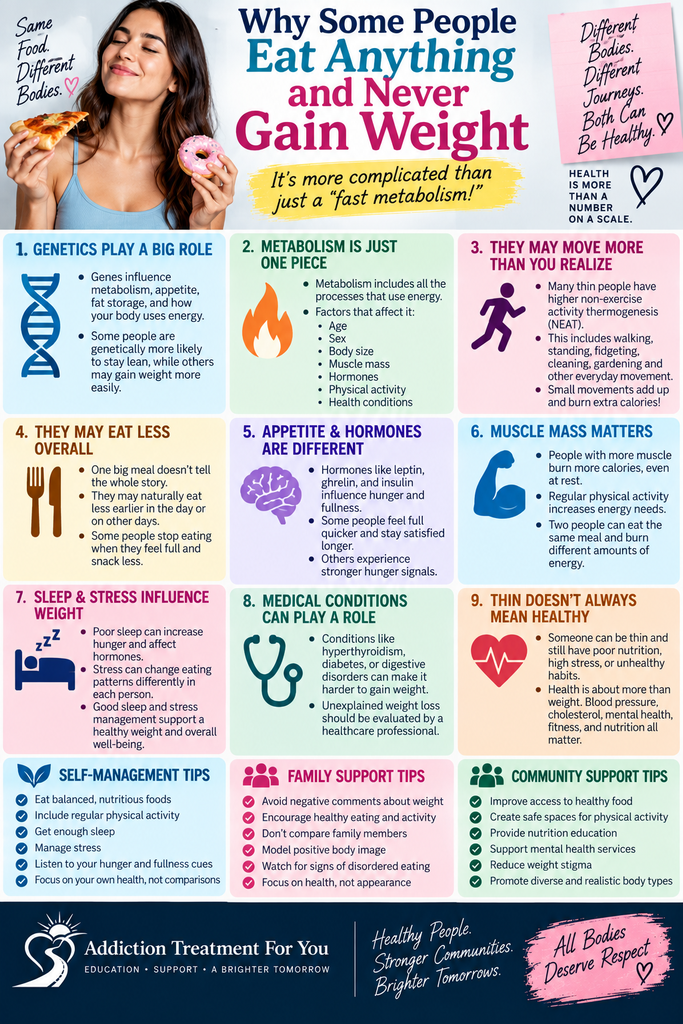
We all seem to know someone who can eat pizza, desserts, fast food, and large meals yet remain thin. Meanwhile, another person may feel that even small changes in eating habits affect their weight. It can be frustrating, but body weight is far more complicated than simply having a “fast” or “slow” metabolism. Genetics, appetite, activity, muscle mass, hormones, digestion, sleep, medications, and unconscious daily movement can all influence how much energy a person uses and how much they naturally eat.
Most importantly, being thin does not automatically mean someone is healthy, just as living in a larger body does not automatically mean someone is unhealthy. Understanding these differences can help replace comparison and shame with healthier, individualized choices.
Genetics Can Make a Difference
Genetics influence many characteristics related to body weight, including body composition, appetite, fat storage, energy expenditure, and responses to food.
Some people may be genetically predisposed to remain at a lower body weight. Others may have biological characteristics that make weight gain easier. Genetics do not completely determine someone’s future weight, but they can help explain why two people living similar lifestyles may have different bodies.
This is one reason simplistic advice such as “just eat less” or “just exercise more” does not capture the entire biology of weight regulation.
Metabolism Is Only Part of the Story
Metabolism describes the chemical processes the body uses to maintain life and produce energy. Even at rest, the body needs energy for breathing, circulation, brain activity, temperature regulation, and cellular functions.
Several factors influence energy expenditure, including:
- Age
- Sex
- Genetics
- Height and body size
- Muscle mass
- Hormonal function
- Physical activity
- Health conditions
People with more lean muscle generally expend more energy than those with less, because muscle tissue requires energy to maintain.
However, differences in metabolism alone usually do not account for all the dramatic differences we see in people’s weights.
They May Be Moving More Than You Realize
Exercise is not the only movement that burns energy.
Researchers use the term non-exercise activity thermogenesis (NEAT) to describe energy used through everyday movement that is not deliberate exercise. This includes walking around the house, standing instead of sitting, taking stairs, cleaning, gardening, pacing, changing posture, and fidgeting.
Someone who appears sedentary may actually accumulate considerably more movement throughout the day than someone who appears active.
These small movements can add up over time.
“They Eat Everything” May Not Mean They Eat a Lot Overall
Seeing someone eat a cheeseburger, pizza, or dessert tells us very little about their total diet.
Someone may eat a large dinner at a restaurant but have eaten very little earlier in the day. Another person may naturally stop eating when full, rarely snack, or consume fewer calories on subsequent days without consciously trying.
People often remember unusual meals while overlooking what happens during the other hours and days of the week.
Therefore, one meal is not someone’s entire eating pattern.
Appetite and Fullness Signals Differ
The brain and digestive system communicate continuously about hunger and fullness.
Hormones and signaling pathways involving leptin, ghrelin, insulin, and other systems participate in appetite and energy regulation. Genetics, sleep, stress, medications, food composition, and previous weight changes can influence these processes.
Some people naturally become full quickly and remain satisfied longer. Others experience stronger hunger or more frequent thoughts about food.
Neither experience reflects someone’s moral character or willpower.
Muscle Mass Can Affect Energy Needs
Muscle is metabolically active tissue. Someone with greater muscle mass may require more energy to maintain their body, even when resting.
Physical activity also increases energy expenditure. A person who regularly exercises, walks frequently, works a physically demanding job, or simply moves throughout the day may require considerably more food than someone with lower energy expenditure.
This is another reason comparing meals between two people can be misleading.
Sleep and Stress Matter Too
Poor sleep can influence hormones and brain systems involved in hunger, appetite, and food choices. Chronic stress may also influence eating behaviors differently among individuals.
Some people eat more during stressful periods. Others lose their appetite.
Maintaining consistent sleep and developing healthy stress-management strategies can therefore support overall metabolic and emotional health, regardless of a person’s weight.
Could a Medical Condition Explain Difficulty Gaining Weight?
Sometimes.
Someone who eats substantial amounts but unexpectedly loses weight or cannot maintain weight may have an underlying medical condition. Possibilities include hyperthyroidism, uncontrolled diabetes, gastrointestinal disorders that affect nutrient absorption, chronic infections, and other illnesses.
Unexplained weight loss should not simply be celebrated as “good metabolism.” It warrants appropriate medical evaluation, particularly when accompanied by symptoms such as fatigue, diarrhea, excessive thirst, rapid heartbeat, weakness, or significant changes in appetite.
Thin Does Not Automatically Mean Healthy
Body size is visible. Blood pressure, cholesterol, glucose regulation, liver health, nutrition, cardiovascular fitness, and mental health usually are not.
A person can remain thin while consuming a diet high in highly processed foods, smoking, drinking excessively, sleeping poorly, or rarely exercising.
Conversely, someone with a larger body mass may exercise regularly, eat nutritious foods, have favorable laboratory results, and engage in many health-promoting behaviors.
Health, therefore, deserves a broader assessment than a number on a scale.
Self-Management Strategies
Rather than comparing your body with someone else’s, concentrate on behaviors that support your individual health.
- Avoid comparing portions. Your energy requirements may differ considerably from another person’s.
- Prioritize nutritious foods. Include vegetables, fruits, whole grains, protein sources, and healthy fats.
- Include resistance exercise. Building and maintaining muscle supports strength, mobility, and metabolic health.
- Move throughout the day. Walking, standing, household activities, and recreational movement all count.
- Protect your sleep. Consistent, adequate sleep supports appetite regulation and overall health.
- Manage stress without relying solely on food. Exercise, relaxation, hobbies, social connection, and counseling can help.
- Pay attention to hunger and fullness. Learning your body’s signals may be more useful than copying another person’s eating pattern.
- Seek medical evaluation for unexplained changes. Unexpected weight gain or loss can sometimes signal an underlying condition.
Family Support Strategies
Weight conversations within families can strongly influence body image, particularly among children and teenagers.
Families can create healthier environments by:
- Avoiding jokes or criticism about someone’s weight or body shape.
- Avoiding labeling foods as morally “good” or “bad.”
- Eating balanced meals together when possible.
- Encouraging physical activity for health and enjoyment rather than punishment for eating.
- Avoiding comparisons between siblings or relatives.
- Recognizing that family members can have different nutritional needs.
- Encouraging medical guidance rather than extreme diets.
- Watching for signs of restrictive eating, binge eating, purging, or obsessive exercise.
Children should learn that food provides nourishment, energy, enjoyment, culture, and social connection—not that eating must be earned through exercise.
Community Support Strategies
Communities can help create healthier relationships with food and body image without focusing exclusively on weight.
- Improve access to affordable nutritious foods.
- Create safe parks, walking paths, and recreational spaces.
- Provide evidence-based nutrition education.
- Expand access to primary care and registered dietitians.
- Support prevention and treatment of eating disorders.
- Reduce weight-based bullying and stigma.
- Encourage schools to emphasize health rather than appearance.
- Promote realistic representations of different body types.
- Improve access to mental-health services for people struggling with body image or disordered eating.
Healthier communities make nutritious food, physical activity, healthcare, and psychological support easier to access.
When Body Comparison Becomes Harmful
Constantly wondering why another person can “eat whatever they want” can gradually turn into frustration with your own body.
That comparison is based on incomplete information. You cannot see another person’s genetics, metabolism, total weekly food intake, activity level, health conditions, stress, sleep, or internal relationship with food.
Instead of asking, “Why can’t my body look like theirs?” a more useful question may be, “What does my body need to function well?”
That shift moves the goal away from imitation and toward health.
Conclusion
People who appear to eat anything without gaining weight are not necessarily breaking the laws of biology. Their genetics, appetite, muscle mass, spontaneous movement, total food intake, energy expenditure, sleep, health, and other factors may simply differ from yours.
The biggest lesson is that body weight is an outcome influenced by many interacting factors—not a simple measurement of discipline or health.
Rather than chasing someone else’s metabolism, focus on what you can influence: nutritious eating, regular movement, strength, adequate sleep, stress management, medical care, and a healthier relationship with food.
Different bodies respond differently. The goal is not to have someone else’s body—it is to take good care of the one you have.
Frequently Asked Questions
Here are some common questions:
1. Why can some people eat a lot and never gain weight?
Body weight is influenced by more than food alone. Genetics, metabolism, appetite, muscle mass, physical activity, hormones, sleep, stress, medications, and everyday movement can all affect how much energy someone consumes and how much they use.
2. Do naturally thin people simply have faster metabolisms?
Sometimes metabolism contributes, but it is rarely the entire explanation. Resting energy expenditure varies according to body size, age, sex, muscle mass, genetics, and other biological factors.
3. How important are genetics?
Genetics can influence appetite, body composition, fat storage, metabolism, and the body’s regulation of weight. Some people are genetically more likely to remain lean, while others are more susceptible to gaining weight.
4. Can two people eat the same amount and gain different amounts of weight?
Yes. Two people can respond differently because their body size, muscle mass, activity, genetics, metabolism, and energy requirements differ. Their apparent intake in a single meal may not reflect what they consume over an entire week.
5. What is NEAT, and how does it affect weight?
Non-exercise activity thermogenesis (NEAT) is energy used during everyday activities that aren’t intentional exercise. Walking, standing, cleaning, gardening, changing posture, pacing, and fidgeting are examples. Small differences in daily movement can accumulate over time.
6. Could someone who appears to eat constantly actually eat less overall?
Yes. You might see someone eating pizza or dessert without seeing the rest of their diet. They may naturally eat smaller meals later, snack less, skip meals, or stop eating quickly when satisfied.
7. Do hunger hormones affect body weight?
Yes. Hormones and signaling systems, including ghrelin, leptin, and insulin, and other pathways, participate in hunger, fullness, and energy regulation. People can experience these signals differently.
8. Does muscle help people burn more calories?
Yes. Muscle requires energy to maintain. People with greater lean mass generally have higher energy requirements than otherwise similar people with less lean mass. Physical activity also increases energy expenditure.
9. Does fidgeting really burn meaningful energy?
It can contribute. Fidgeting is one component of NEAT. Although a single movement uses little energy, frequent movement throughout an entire day can contribute to differences in total daily energy expenditure.
10. Can sleep affect weight?
Yes. Inadequate sleep can affect appetite regulation, food choices, energy levels, and hormonal systems. Maintaining adequate, consistent sleep supports overall metabolic health.
11. Can stress cause weight changes?
Yes. Stress affects people differently. Some people eat more when stressed, while others lose their appetite. Chronic stress can also influence sleep, activity, eating patterns, and other behaviors associated with weight.
12. Does being thin mean someone is healthy?
No. Thinness and health are not the same thing. Someone can have a low body weight while experiencing high blood pressure, abnormal cholesterol, poor nutrition, diabetes, substance-related problems, or other medical conditions. Health should be evaluated more broadly than appearance or weight alone.
13. Can someone eat unhealthy foods and remain thin?
Yes. Maintaining a low body weight does not protect someone from all the consequences of an unhealthy diet. Diet quality can affect cardiovascular health, blood glucose levels, dental health, digestive health, and nutrient intake, even without significant weight gain.
14. Can medical conditions prevent weight gain?
Some conditions can cause unintended weight loss or difficulty gaining weight. Examples include hyperthyroidism, uncontrolled diabetes, gastrointestinal disorders that interfere with nutrient absorption, chronic illness, and certain infections.
15. When should unexplained weight loss be evaluated?
Unexpected or persistent weight loss without deliberately changing diet or activity deserves medical evaluation, particularly when accompanied by symptoms such as weakness, diarrhea, excessive thirst or urination, rapid heartbeat, persistent pain, fever, or significant fatigue.
16. Should I copy the diet of someone who stays naturally thin?
Not necessarily. Another person’s nutritional and energy needs may be very different from yours. A better approach is to focus on balanced nutrition, regular physical activity, adequate sleep, stress management, and your individual medical needs, rather than trying to replicate someone else’s eating habits.
17. How can families encourage a healthy relationship with weight?
Families can avoid criticizing bodies, comparing siblings, or labeling foods as morally “good” or “bad.” Instead, emphasize nutritious meals, enjoyable physical activity, adequate sleep, emotional well-being, and what the body can do rather than simply how it looks.
18. Can constantly comparing my body with thin people become harmful?
Yes. Frequent comparison can contribute to body dissatisfaction and unhealthy eating behaviors. Social media can intensify the problem because you rarely know another person’s complete diet, activity level, health history, or relationship with food.
19. What are healthier self-management strategies?
Focus on behaviors you can influence: eat a varied, nutritious diet; incorporate regular physical activity and resistance training; protect your sleep; manage stress; pay attention to hunger and fullness cues; and maintain routine healthcare.
20. What is the biggest lesson?
Someone who appears able to “eat anything” is not necessarily blessed with one magical metabolism. Body weight results from a complex interaction between biology, behavior, environment, and health.
Instead of asking, “Why can’t I eat like them and look like them?”, consider asking:
“What eating, movement, sleep, and self-care habits help my body function at its best?”
Different bodies have different needs. Health is more than a number on the scale, and thin does not automatically mean healthy.
Video: