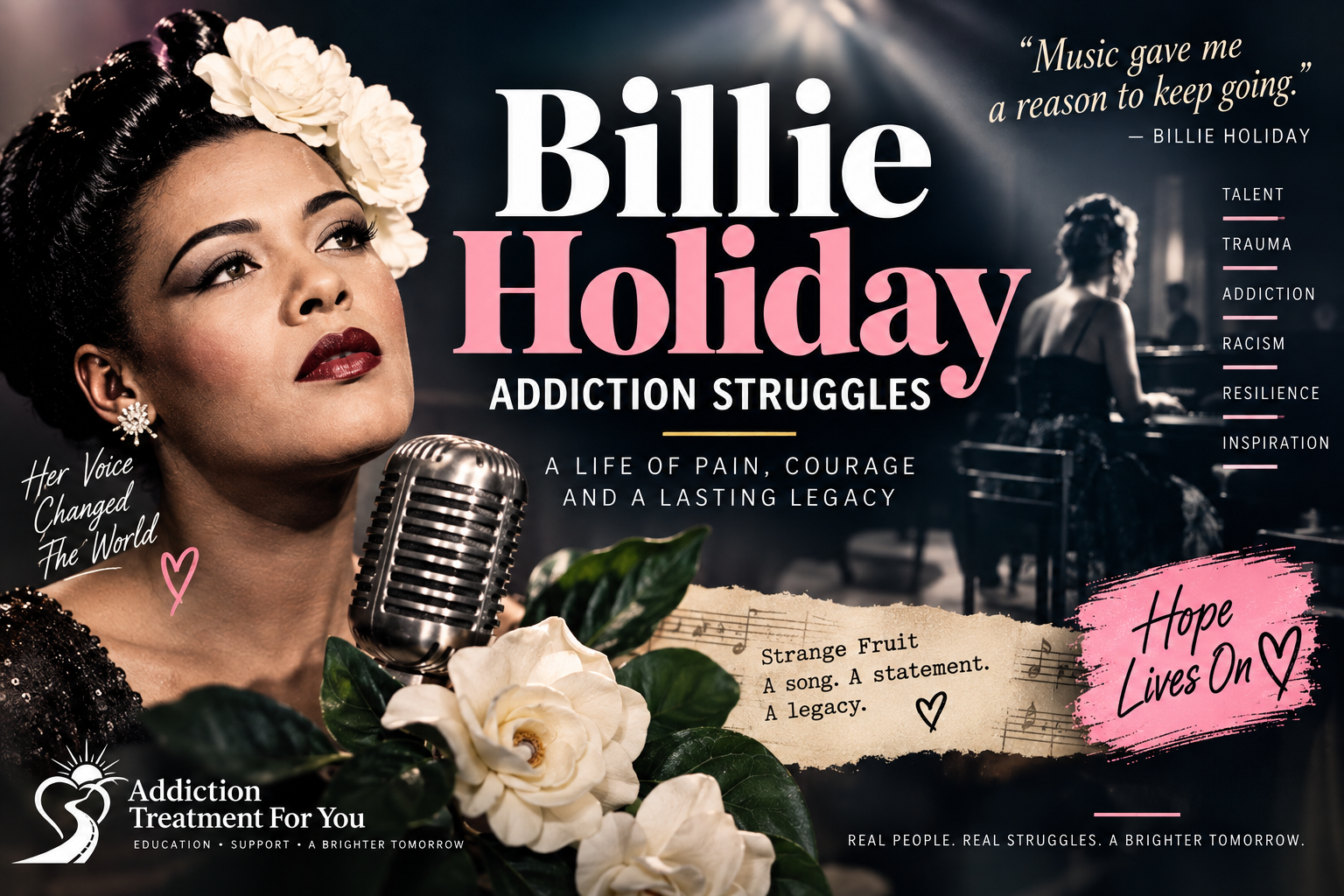
Billie Holiday, known as “Lady Day,” became one of the most influential jazz singers in American history. Behind her extraordinary voice was a life marked by childhood hardship, racism, abusive relationships, substance use, and repeated encounters with the criminal justice system. Historical accounts document her struggles with heroin and alcohol, but her life should not be reduced to addiction. The Library of Congress describes Holiday as a defining jazz vocalist whose recordings influenced generations of singers, while the Smithsonian notes that she struggled with heroin addiction while navigating fame and racism.
Early Hardship and Emotional Pain
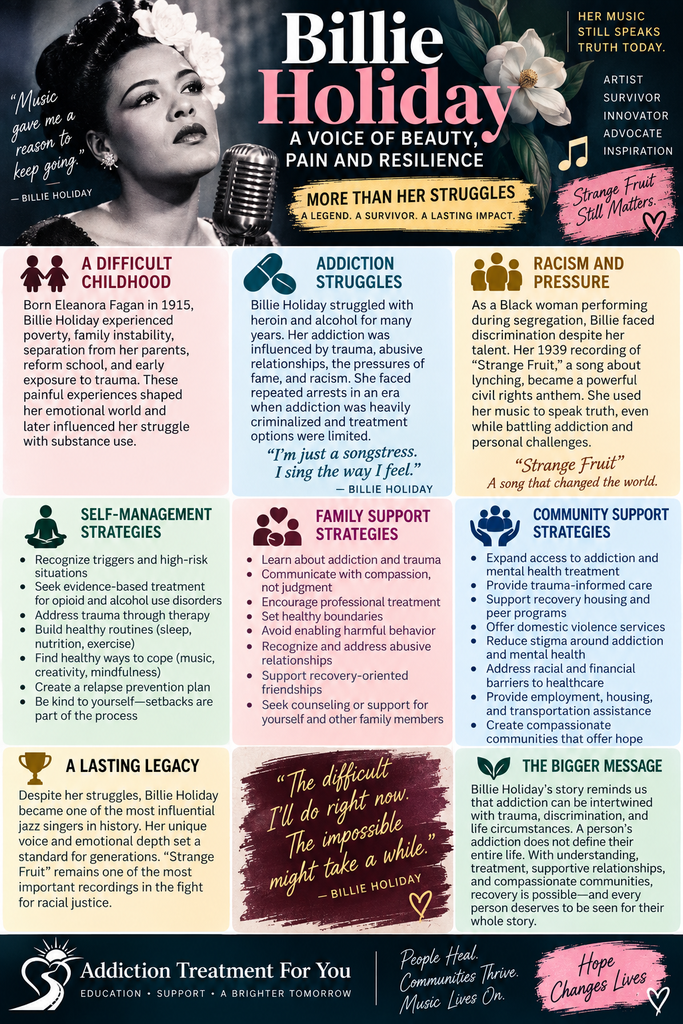
Born Eleanora Fagan in 1915, Holiday experienced considerable instability during childhood. Historical accounts describe poverty, separation from her parents, truancy, reform school, and other difficult circumstances during her youth.
It is tempting to draw a simple line from trauma to addiction, but substance use disorders rarely have one cause. Trauma, relationships, environment, mental health, availability of substances, genetics, and social conditions can interact in complicated ways. Holiday’s history illustrates why addiction should be understood within the context of a person’s whole life rather than treated simply as a failure of willpower.
Heroin and Alcohol Struggles
Holiday developed serious problems involving heroin and alcohol during her adult life. The Smithsonian describes her as having experienced drug addiction and abusive relationships, while accounts of her later career describe the physical toll of drug and alcohol use.
Her substance use also brought legal consequences. During an era when addiction was heavily criminalized, and effective treatment options were far more limited than they are today, Holiday repeatedly encountered law enforcement.
Her experience raises an issue that remains relevant: punishment alone does not treat the biological, psychological, and social factors contributing to substance use disorders.
Racism and the Pressures Surrounding Her Career
Holiday’s addiction cannot be understood entirely separately from the world in which she lived. As a Black woman performing during segregation, she encountered racial discrimination even as her fame increased. The Library of Congress notes that she sometimes performed for segregated audiences and faced the racial restrictions of her era.
Her 1939 recording of “Strange Fruit,” a song about lynching, became one of her most important performances. The Library of Congress recognizes it as an anthem for civil rights, while Smithsonian accounts describe how Holiday continued performing it while dealing with racism, fame, and heroin addiction.
Understanding these circumstances does not mean assuming that discrimination caused her addiction. It means recognizing that recovery takes place within social environments that can either increase stress or provide support.
Self-Management Strategies
If someone facing similar struggles were seeking recovery today, self-management would be only one part of a comprehensive treatment plan. Helpful strategies could include:
- Recognizing triggers: Identify people, places, memories, emotions, and situations associated with substance use.
- Seeking evidence-based treatment: Opioid use disorder can be treated with medications such as buprenorphine or methadone alongside appropriate medical and behavioral care.
- Addressing trauma: Trauma-informed therapy can help people process painful experiences without relying on substances to escape emotional distress.
- Building daily structure: Regular sleep, nutrition, exercise, appointments, and meaningful activities can support stability.
- Developing alternatives to substance use: Music, creativity, mindfulness, exercise, social connection, and other healthy coping strategies can provide ways to manage difficult emotions.
- Preparing for relapse risks: A written recovery plan can identify warning signs, coping strategies, emergency contacts, and treatment resources.
- Avoiding shame after setbacks: A return to substance use should prompt reassessment and additional treatment rather than abandonment of recovery.
Family and Relationship Support Strategies
Holiday’s life included complicated and sometimes abusive relationships. The Smithsonian’s National Portrait Gallery describes her as both a person with drug addiction and a survivor of abusive relationships.
Families and partners cannot cure another person’s addiction, but they can help create conditions that support recovery.
- Learn about substance use disorders rather than viewing addiction simply as bad behavior.
- Communicate concern without humiliation, threats, or degrading labels.
- Encourage professional addiction and mental-health treatment.
- Establish clear boundaries around violence, money, substance use, and other unsafe behaviors.
- Avoid repeatedly shielding someone from the natural consequences of harmful behavior.
- Recognize signs of abusive or exploitative relationships.
- Encourage healthy friendships and recovery-oriented relationships.
- Seek counseling or family support when addiction is affecting the entire household.
Supporting someone does not require tolerating abuse or sacrificing personal safety.
Community Support Strategies
Holiday lived during a period when addiction was frequently addressed through punishment and stigma. Modern communities have opportunities to respond differently.
- Expand affordable addiction and mental-health treatment.
- Increase access to medications for opioid use disorder.
- Provide trauma-informed healthcare.
- Support recovery housing and peer-recovery programs.
- Offer domestic-violence and sexual-assault resources.
- Reduce racial and financial barriers to healthcare.
- Provide employment, transportation, and housing assistance during recovery.
- Educate communities about addiction as a treatable health condition.
- Use compassionate language that separates a person’s identity from their illness.
Recovery becomes more difficult when someone is surrounded by instability, violence, stigma, or inadequate healthcare. Community support therefore complements individual responsibility rather than replacing it.
Billie Holiday Was More Than Her Addiction
Holiday died in 1959 at the age of 44. Smithsonian accounts note that alcohol and drug use took a serious toll on her health and voice during her later years.
But addiction should not become the headline of her entire life.
The Library of Congress describes Holiday as a vocalist whose recordings with musicians such as Teddy Wilson and Lester Young set a standard for jazz singers who followed. Her interpretation of “Strange Fruit” remains one of the most historically significant recordings associated with the struggle against racial violence.
The Smithsonian similarly cautions against remembering Holiday primarily through drug addiction rather than recognizing the musical achievement that transformed American culture.
Conclusion
Billie Holiday’s story demonstrates how addiction can become intertwined with trauma, relationships, discrimination, fame, and social circumstances without any one factor completely explaining the disease.
Today, someone experiencing opioid addiction has treatment options that were not available to Holiday in the same way during her lifetime. Evidence-based medication, behavioral healthcare, trauma-informed therapy, family education, peer support, and compassionate community services can all contribute to recovery.
Perhaps the most important lesson from Billie Holiday’s life is to see the whole person. She experienced addiction, but she was not simply “an addict.” She was an artist, survivor, innovator, and cultural figure whose voice permanently changed jazz.
Addiction can become part of someone’s story without becoming the definition of who they are.
Frequently Asked Questions
Here are some common questions:
1. Did Billie Holiday struggle with addiction?
Yes. Billie Holiday experienced serious problems with heroin and alcohol during her adult life. Her substance use affected her health and contributed to legal problems, but addiction was only one part of a complicated life that also included extraordinary musical achievement.
2. What substances did Billie Holiday use?
Holiday is particularly associated with heroin addiction and heavy alcohol use. Historical accounts also describe other drug use at different periods of her life.
3. When did Billie Holiday begin using heroin?
Historical accounts generally place Holiday’s heroin use in the 1940s, during a period when her career was flourishing but her personal life included difficult relationships and considerable instability.
4. Did childhood trauma contribute to Billie Holiday’s addiction?
Holiday experienced poverty, family instability, institutionalization, and other serious childhood adversity. These experiences provide important context, but it would be too simplistic to say that trauma alone caused her addiction. Substance use disorders usually develop through interacting biological, psychological, environmental, and social factors.
5. Did Billie Holiday experience abusive relationships?
Yes. Historical accounts describe Holiday experiencing abusive and exploitative relationships. Such environments can complicate recovery by increasing stress, reducing personal safety, and making it harder to establish stable support systems.
6. Was Billie Holiday arrested for drugs?
Yes. Holiday faced federal narcotics charges and was imprisoned in the late 1940s. Her experiences occurred during an era when drug dependence was treated primarily through criminalization rather than through the range of evidence-based healthcare available today.
7. Did her conviction affect her music career?
Yes. After her conviction, Holiday had difficulty obtaining the license required to perform in New York City establishments serving alcohol. Nevertheless, she continued recording and performing, including major concert appearances.
8. What role did racism play in Billie Holiday’s life?
Holiday lived and worked during segregation and encountered racial discrimination as a Black woman in the entertainment industry. Racism should not be described as the sole cause of her addiction, but discrimination and unequal treatment were important parts of the social environment in which she lived.
9. Why is “Strange Fruit” important to Billie Holiday’s story?
“Strange Fruit,” which Holiday famously recorded in 1939, protested the lynching of Black Americans. Her emotionally powerful performance became one of the most significant recordings associated with racial violence and the civil rights movement.
10. Did Billie Holiday recover from addiction?
Holiday experienced periods when she attempted to stop using drugs, but her substance-related problems continued during portions of her later life. Her experience therefore differs from a straightforward recovery story and demonstrates how chronic and relapsing substance use disorders can be.
11. What self-management strategies could help someone facing similar problems today?
Modern strategies could include:
- Identifying triggers and high-risk situations.
- Seeking professional addiction treatment.
- Using medications for opioid use disorder when clinically appropriate.
- Receiving trauma-informed mental-health care.
- Developing healthy sleep, nutrition, and exercise routines.
- Building relationships with recovery-supportive people.
- Creating a relapse-prevention and emergency plan.
- Finding healthier outlets for stress, grief, and painful emotions.
12. How can families support someone experiencing addiction?
Families can learn about substance use disorders, communicate without shame, encourage professional treatment, establish healthy boundaries, and avoid enabling dangerous behavior. They should also recognize that supporting someone does not require accepting violence, manipulation, or unsafe behavior.
13. How could communities better support people like Billie Holiday today?
Communities can expand access to addiction treatment, mental-health services, medications for opioid use disorder, trauma-informed care, peer recovery, safe housing, domestic-violence resources, transportation, and employment assistance. Reducing stigma can also make seeking treatment easier.
14. Did addiction damage Billie Holiday’s health?
Years of heavy alcohol and drug use contributed to serious health problems. Holiday’s health deteriorated significantly toward the end of her life, and she died in 1959 at age 44.
15. Should Billie Holiday be remembered primarily for addiction?
No. Addiction was an important part of Holiday’s personal history, but it does not adequately describe her life. She became one of the most influential vocalists in jazz, transforming songs through distinctive phrasing, timing, and emotional interpretation.
16. What can Billie Holiday’s life teach families affected by addiction?
Her story demonstrates that addiction rarely exists in isolation. Trauma, relationships, discrimination, financial circumstances, mental health, and access to healthcare can interact with substance use. Families benefit from looking beyond the substance itself and considering the person’s entire environment.
17. What is the larger recovery message from Billie Holiday’s story?
Billie Holiday’s life reminds us to see the person before the addiction. People experiencing substance use disorders still have talents, relationships, dreams, and dignity. Today’s evidence-based treatments offer opportunities that were far more limited during Holiday’s lifetime.
Video: