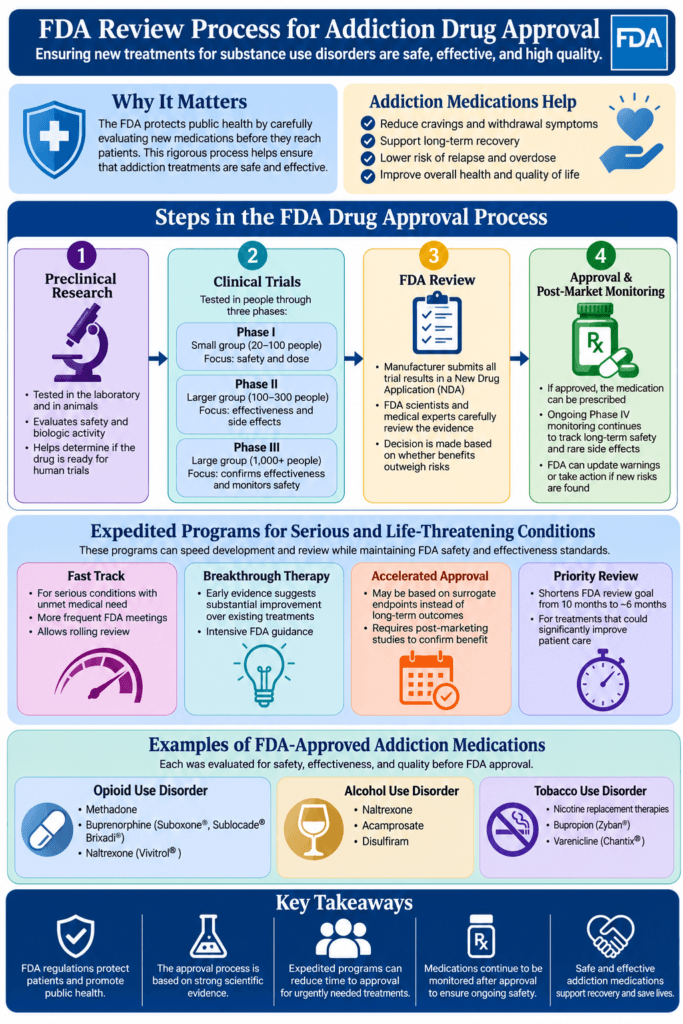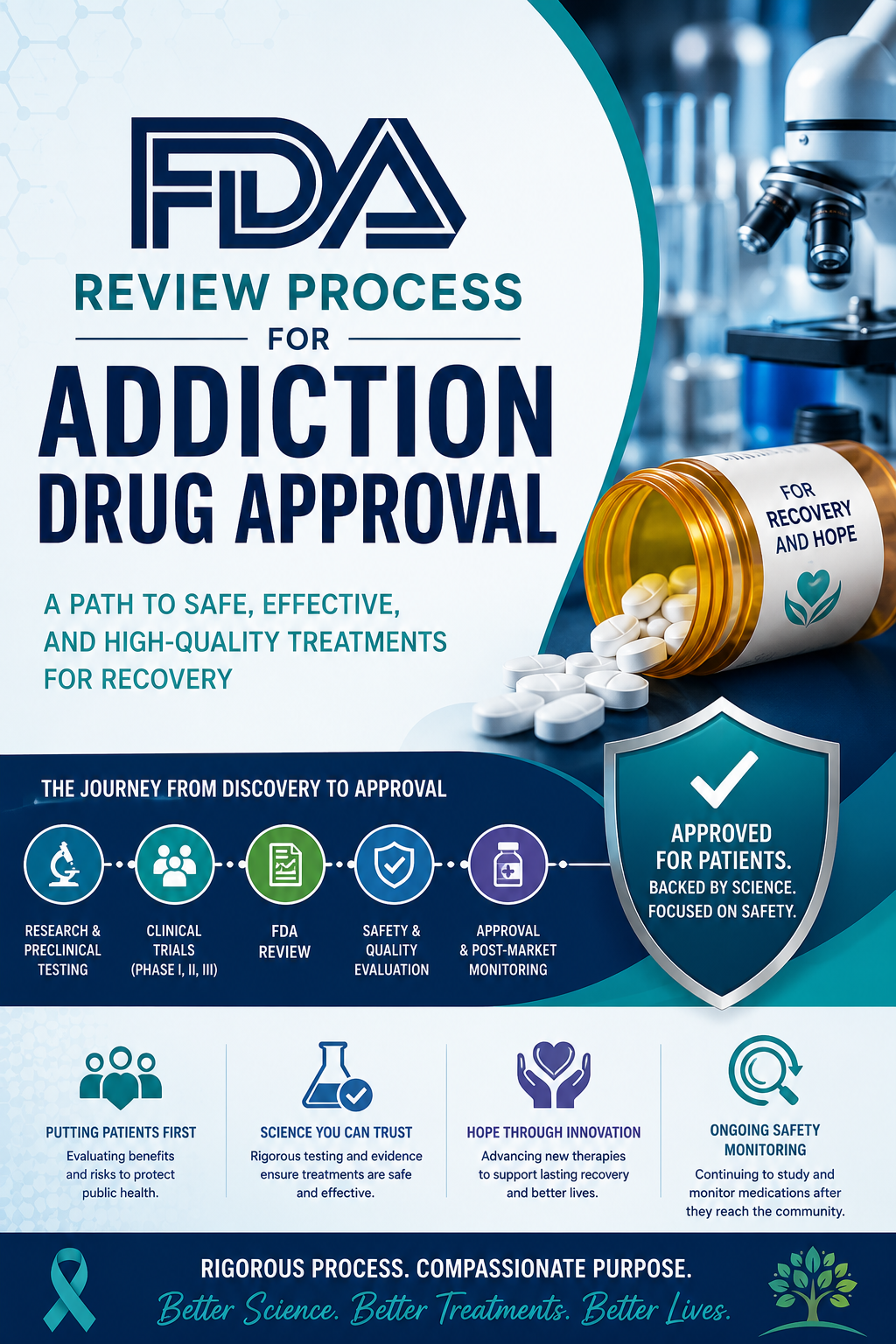
The U.S. Food and Drug Administration (FDA) plays a critical role in ensuring that medications used to treat substance use disorders are safe, effective, and manufactured to high-quality standards before they become available to patients. Addiction medications, including those used to treat opioid, alcohol, and tobacco use disorders, undergo years of scientific research, laboratory testing, and carefully designed clinical trials before receiving FDA approval. During this process, researchers evaluate a medication’s safety, effectiveness, appropriate dosage, potential side effects, and long-term benefits. For treatments that address urgent public health needs, such as the opioid overdose epidemic, the FDA may use expedited review programs to accelerate development and review without lowering scientific standards. Understanding the FDA review process helps patients, families, and healthcare professionals appreciate the rigorous evaluation required before new addiction treatments are introduced into clinical practice.
FDA’s Three-Phase Review
Before the U.S. Food and Drug Administration (FDA) approves a new drug or biologic for public use, it must undergo a rigorous process to demonstrate that it is both safe and effective for its intended purpose. Most products pass through three phases of clinical trials after extensive laboratory and animal testing. Each phase answers different scientific questions about the treatment.
Phase I: Safety and Dosage
Phase I clinical trials are the first studies conducted in humans. These trials typically involve 20 to 100 healthy volunteers, although some treatments, such as cancer drugs, are tested in patients with the disease. The primary goal is to determine whether the product is safe, identify side effects, understand how the body absorbs and eliminates the drug (pharmacokinetics), and establish a safe dosage range. Researchers closely monitor participants for adverse reactions and determine the highest dose that can be safely tolerated.
Phase II: Effectiveness and Continued Safety
If Phase I demonstrates acceptable safety, the drug advances to Phase II, which usually includes several hundred patients who have the condition the drug is intended to treat. Researchers evaluate whether the treatment is effective while continuing to monitor for side effects. Different doses may be compared to determine the optimal balance between effectiveness and safety. Phase II helps identify common adverse effects and provides preliminary evidence that the treatment produces the desired clinical benefit.
Phase III: Confirming Safety and Efficacy
Phase III trials are much larger, often enrolling hundreds to several thousand patients across multiple hospitals or countries. These randomized, controlled studies compare the new treatment with a placebo or the current standard of care. The primary objectives are to confirm effectiveness, detect less common side effects, evaluate long-term safety, and determine whether the benefits outweigh the risks in a diverse patient population. Data from Phase III trials provide the primary evidence used by the FDA when deciding whether to approve a drug or biologic.
FDA Review and Approval
After successfully completing Phase III, the manufacturer submits a comprehensive application to the FDA. Small-molecule drugs are reviewed through a New Drug Application (NDA), while biologic products are reviewed through a Biologics License Application (BLA). FDA experts—including physicians, statisticians, pharmacologists, chemists, and manufacturing specialists—carefully examine all clinical and manufacturing data. They evaluate whether the treatment consistently demonstrates meaningful benefits that outweigh its potential risks and whether it can be manufactured with high quality and consistency.
Post-Marketing Surveillance (Phase IV)
FDA oversight continues even after approval. During Phase IV, also known as post-marketing surveillance, researchers continue monitoring the drug or biologic in the general population. Rare or long-term side effects that may not have appeared during clinical trials can be identified. The FDA may require additional studies, update safety warnings, restrict use, or, in rare cases, remove a product from the market if significant safety concerns emerge.
Conclusion
The FDA’s phased clinical trial process is designed to protect public health by ensuring that new drugs and biologics undergo careful scientific evaluation before becoming widely available. Phase I focuses on safety, Phase II evaluates effectiveness while continuing safety monitoring, and Phase III confirms both safety and efficacy in larger populations. Even after approval, ongoing Phase IV monitoring helps ensure that treatments remain safe and beneficial for patients over time. This structured process provides healthcare professionals and patients with confidence that approved therapies have been rigorously tested using the best available scientific evidence.
FDA Timeline to Review All Phases
The FDA does not conduct the clinical trial phases itself and does not control how long Phases I, II, and III take. Those studies are performed by pharmaceutical or biotechnology companies and can last many years. The FDA reviews applications after the clinical trials have been completed.
Here is the typical timeline:
| Stage | Typical Duration |
|---|---|
| Preclinical laboratory and animal studies | 3–6 years |
| Phase I clinical trial | Several months to 1 year |
| Phase II clinical trial | 1–2 years |
| Phase III clinical trial | 2–4 years |
| FDA review of NDA or BLA | 6–10 months (standard), about 6 months (priority review) |
| Total time from discovery to approval | Approximately 10–15 years |
FDA Review Time
Once all clinical trials are complete, the manufacturer submits either a New Drug Application (NDA) for most drugs or a Biologics License Application (BLA) for biologic products.
The FDA review typically takes:
- Standard Review: Approximately 10 months from the time the FDA accepts the application for review.
- Priority Review: Approximately 6 months for therapies that could provide significant improvements in treating serious conditions.
These review periods are goals established under the Prescription Drug User Fee Act (PDUFA) and apply only after the application is complete and accepted for review.
Why Does Development Take So Long?
Developing a new drug or biologic usually requires 10 to 15 years because researchers must:
- Identify promising compounds.
- Conduct years of laboratory and animal testing.
- Complete three phases of human clinical trials.
- Analyze large amounts of safety and effectiveness data.
- Develop reliable manufacturing processes.
- Undergo FDA scientific review before marketing approval.
Many products never reach approval. In fact, only a small percentage of drugs entering Phase I clinical trials ultimately receive FDA approval, often because they are found to be ineffective, unsafe, or both.
Can the Process Be Faster?
Yes. For treatments addressing serious or life-threatening diseases, the FDA has several expedited programs that can shorten development and review times without lowering safety or efficacy standards. These include:
- Fast Track
- Breakthrough Therapy
- Accelerated Approval
- Priority Review
These programs can reduce the overall time to patient access by allowing more frequent communication with the FDA, rolling submission of data, or earlier approval based on surrogate endpoints, while still requiring evidence that the treatment’s benefits outweigh its risks.
FDA Shortcuts to the Review
The FDA offers several expedited development and review programs, but these are not shortcuts that bypass safety and efficacy standards. Instead, they are designed to speed the availability of promising treatments for serious or life-threatening diseases while maintaining rigorous scientific review.
1. Fast Track Designation
Fast Track is intended for drugs or biologics that treat serious conditions and address an unmet medical need.
Benefits include:
- More frequent meetings and communication with the FDA.
- The ability to submit portions of the application as they are completed (rolling review).
- Eligibility for Priority Review and Accelerated Approval if the product qualifies.
2. Breakthrough Therapy Designation
This designation is granted when early clinical evidence suggests a treatment may offer a substantial improvement over existing therapies.
Benefits include:
- Intensive FDA guidance throughout development.
- Close collaboration with senior FDA staff.
- Potentially more efficient clinical trial design.
- Eligibility for other expedited programs.
3. Accelerated Approval
Accelerated Approval allows certain drugs for serious illnesses to be approved based on a surrogate endpoint (such as a laboratory measurement or biomarker) that is reasonably likely to predict clinical benefit, rather than waiting for long-term outcomes.
Examples include:
- Tumor shrinkage in cancer trials.
- Reduction in viral load for certain infectious diseases.
Manufacturers must conduct post-marketing (Phase IV) confirmatory studies to verify the expected clinical benefit. If these studies fail to confirm benefit, the FDA can withdraw approval.
4. Priority Review
Priority Review shortens the FDA’s review goal from 10 months to approximately 6 months after the application is accepted for review.
A drug may qualify if it has the potential to:
- Improve survival.
- Reduce serious side effects.
- Provide a treatment where none previously existed.
- Significantly improve patient care.
5. Emergency Use Authorization (EUA)
During a declared public health emergency, the FDA may issue an Emergency Use Authorization for certain medical products when:
- Evidence suggests the product may be effective.
- The known and potential benefits outweigh the known and potential risks.
- No adequate, approved alternatives are available.
An EUA is not the same as full FDA approval. It is a temporary authorization that may later be replaced by full approval after additional evidence is collected.
Important Point
These programs do not eliminate the need for scientific evidence. Companies must still demonstrate that a drug or biologic is sufficiently safe and effective for its intended use. Expedited programs primarily reduce administrative delays, allow closer collaboration with the FDA, or permit earlier approval when the expected benefits clearly outweigh the risks, particularly for patients with serious or life-threatening illnesses. Ongoing studies and post-marketing surveillance continue to monitor safety after approval.
Medications with Expedited Review Program
Several addiction medications have benefited from the FDA’s expedited development and review programs, although not all received every type of expedited designation. Most established medications for substance use disorders (e.g., methadone, naltrexone, acamprosate) were approved before many of today’s expedited pathways existed.
| Medication | Addiction Treated | Expedited Program | Status |
|---|---|---|---|
| Brixadi® (extended-release buprenorphine) | Opioid Use Disorder | Priority Review | Approved in 2023 |
| Lucemyra® (lofexidine) | Opioid withdrawal symptoms | Priority Review | Approved in 2018 because it addressed an unmet need as the first non-opioid treatment for opioid withdrawal. |
| COMP360 (psilocybin) (investigational) | Treatment-resistant depression with addiction research implications | Breakthrough Therapy | Not approved for addiction; designation is for depression. |
| Noribogaine (investigational) | Alcohol Use Disorder | Early expedited development interest | Currently in clinical development; not FDA approved. |
FDA-Approved Medications for Opioid Use Disorder
The three medications considered the standard of care are:
- Methadone – Full opioid agonist used through certified opioid treatment programs. Approved long before the FDA created its current expedited review programs.
- Buprenorphine (Suboxone®, Sublocade®, Brixadi®, and others) – Partial opioid agonist. While earlier buprenorphine products were approved through the standard process, Brixadi received Priority Review, helping bring an additional long-acting treatment option to patients more quickly.
- Naltrexone (oral and extended-release Vivitrol®) – Opioid antagonist used for both opioid and alcohol use disorders. Approved through the standard review process.
FDA-Approved Medications for Alcohol Use Disorder
Current FDA-approved medications include:
- Naltrexone
- Acamprosate
- Disulfiram
These medications were approved through traditional FDA review rather than modern expedited pathways.
Emerging Addiction Treatments Receiving Expedited Attention
Several investigational therapies are receiving increased FDA attention because of the ongoing overdose crisis and the need for improved treatments:
- Noribogaine is being studied for alcohol use disorder and opioid use disorder but remains investigational.
- Additional psychedelic-derived compounds and novel non-opioid medications are being evaluated through Fast Track or Breakthrough Therapy programs when preliminary evidence suggests they may substantially improve existing treatments. The FDA’s expedited programs are intended to accelerate the development of therapies for serious conditions and unmet medical needs without lowering standards for safety or efficacy.
Key Point
The expedited programs do not guarantee approval. Every addiction medication must still complete appropriate clinical trials demonstrating that its benefits outweigh its risks. The FDA’s Fast Track, Breakthrough Therapy, Accelerated Approval, and Priority Review programs are designed to reduce administrative delays and increase communication with developers—not to reduce the scientific evidence required for approval.
FDA Reasons for Rigorous Drug Regulations
Several medications were initially approved by the FDA after clinical testing but were later withdrawn from the U.S. market when post-marketing surveillance (Phase IV) or additional studies revealed serious safety concerns. These cases illustrate why the FDA continues monitoring medications even after approval.
| Medication | Approved | Withdrawn | Reason for Withdrawal |
|---|---|---|---|
| Vioxx® (rofecoxib) | 1999 | 2004 | Increased risk of heart attack and stroke. |
| Propulsid® (cisapride) | 1993 | 2000 | Serious heart rhythm abnormalities (QT prolongation) and sudden cardiac death. |
| Rezulin® (troglitazone) | 1997 | 2000 | Severe liver failure requiring transplantation or causing death. |
| Baycol® (cerivastatin) | 1997 | 2001 | Rhabdomyolysis (severe muscle breakdown) leading to kidney failure and death. |
| Pondimin® (fenfluramine) | 1973 | 1997 | Heart valve disease and pulmonary hypertension. |
| Redux® (dexfenfluramine) | 1996 | 1997 | Heart valve disease and pulmonary hypertension. |
| Darvon® / Darvocet® (propoxyphene) | 1957 | 2010 | Dangerous heart rhythm abnormalities and overdose risk. |
| Duract® (bromfenac) | 1997 | 1998 | Severe liver toxicity after prolonged use. |
| Hismanal® (astemizole) | 1988 | 1999 | Life-threatening cardiac arrhythmias. |
| Seldane® (terfenadine) | 1985 | 1998 | Potentially fatal heart rhythm disturbances when combined with certain medications. |
Notable Examples
1. Vioxx® (rofecoxib)
Vioxx, a selective COX-2 inhibitor used to treat arthritis and pain, became one of the largest drug safety cases in FDA history. After millions of prescriptions, studies showed an increased risk of heart attack and stroke, leading the manufacturer to voluntarily withdraw the drug in 2004.
2. Rezulin® (troglitazone)
Rezulin was the first thiazolidinedione approved for type 2 diabetes. Post-marketing reports identified cases of acute liver failure, including deaths and liver transplants. It was withdrawn in 2000.
3. Baycol® (cerivastatin)
Baycol lowered cholesterol but was linked to a much higher rate of rhabdomyolysis, a condition in which muscle tissue breaks down, potentially causing kidney failure and death. The manufacturer withdrew it in 2001.
4. Fen-Phen Components
The weight-loss drugs fenfluramine (Pondimin) and dexfenfluramine (Redux) were widely prescribed in the 1990s. They were removed after being associated with heart valve damage and pulmonary hypertension.
5. Propulsid® (cisapride)
Used to treat severe acid reflux, Propulsid caused dangerous cardiac arrhythmias, especially when taken with medications that interfered with its metabolism.
Why Were These Problems Not Found Earlier?
Most adverse effects identified after approval were:
- Rare, occurring in only a small fraction of patients.
- Delayed, appearing only after months or years of use.
- Seen in specific populations, such as older adults or patients taking multiple medications.
- Undetectable in clinical trials, because even large Phase III studies may enroll only a few thousand participants, whereas millions of people may use the medication after approval.
FDA Response
When significant safety concerns emerge after approval, the FDA may:
- Update prescribing information with stronger warnings.
- Require a boxed warning (“black box warning”), the FDA’s strongest warning for prescription drugs.
- Restrict how the medication is prescribed or distributed through a Risk Evaluation and Mitigation Strategy (REMS).
- Require additional post-marketing studies.
- Request or mandate withdrawal of the medication if the risks outweigh the benefits.
Key Takeaway
Drug withdrawals are uncommon compared with the thousands of medications approved by the FDA. However, these cases demonstrate why Phase IV (post-marketing) surveillance is essential. Even after a medication is approved, ongoing monitoring allows the FDA to identify rare or long-term safety issues and take action to protect public health.
FDA approval with fetal abnormalities
Several FDA-approved medications have been associated with fetal abnormalities (teratogenicity) when taken during pregnancy. In many cases, these risks were identified after approval, leading the FDA to add boxed warnings, implement pregnancy prevention programs, or restrict their use. Most of these drugs remain approved because their benefits outweigh the risks for certain patients when appropriate precautions are taken.
| Medication | Primary Use | Fetal Risk |
|---|---|---|
| Thalidomide | Multiple myeloma, erythema nodosum leprosum | Severe limb defects, ear, eye, heart, and organ malformations |
| Isotretinoin | Severe acne | Craniofacial, brain, heart, and central nervous system abnormalities |
| Valproic acid | Epilepsy, bipolar disorder, migraine prevention | Neural tube defects, lower IQ, developmental delays |
| Warfarin | Blood clot prevention | Skeletal abnormalities, nasal hypoplasia, fetal bleeding |
| Methotrexate | Cancer, autoimmune diseases, ectopic pregnancy | Miscarriage, skull and limb abnormalities |
| Mycophenolate mofetil | Organ transplantation | Ear, facial, heart, and kidney defects; miscarriage |
| Lenalidomide | Multiple myeloma | Expected risk of severe birth defects because of its similarity to thalidomide |
Notable examples
Thalidomide
- In the late 1950s and early 1960s, thalidomide caused thousands of babies worldwide to be born with severe birth defects, especially shortened or absent limbs (phocomelia).
- The FDA did not approve thalidomide for sale in the United States during that period because reviewer Frances Oldham Kelsey requested additional safety data. Her decision prevented widespread fetal harm in the U.S.
- Years later, thalidomide was approved for specific conditions, but only under strict pregnancy prevention and risk management programs.
Isotretinoin
- Isotretinoin is one of the most potent known human teratogens.
- Exposure during pregnancy can result in major birth defects affecting the brain, face, heart, and ears.
- Because of this risk, the FDA requires a strict pregnancy prevention program called iPLEDGE, including pregnancy testing and contraception requirements before and during treatment.
Valproic acid
- Valproic acid increases the risk of neural tube defects, such as spina bifida, particularly when taken during the first trimester.
- It is also associated with cognitive impairment and neurodevelopmental disorders in exposed children.
- Current recommendations advise avoiding its use during pregnancy when safer alternatives are available, particularly for migraine prevention.
Warfarin
- Warfarin crosses the placenta and may cause fetal warfarin syndrome, characterized by skeletal abnormalities, facial abnormalities, and bleeding complications.
- Pregnant patients who require anticoagulation are often switched to medications such as low-molecular-weight heparin because it does not cross the placenta.
FDA safeguards today
To reduce the risk of fetal exposure, the FDA uses several safety measures:
- Boxed warnings for medications with serious pregnancy risks.
- Risk Evaluation and Mitigation Strategies (REMS) for selected drugs.
- Mandatory pregnancy testing for certain medications.
- Required contraception during treatment and, for some drugs, after treatment ends.
- Pregnancy exposure registries to monitor outcomes when exposure occurs.
Important distinction
Not every medication associated with fetal abnormalities has been withdrawn from the market. Many remain FDA-approved because they provide lifesaving or highly effective treatment for serious conditions. Instead, the FDA restricts their use, requires detailed patient counseling, and implements risk management programs to minimize fetal exposure while allowing patients who need these therapies to benefit.
Self-Management Strategies to Understand the FDA Review Process for Drug Approval
Understanding the FDA drug approval process can help patients, families, and healthcare professionals make informed decisions about medications. Learning how drugs are evaluated for safety and effectiveness also builds confidence in evidence-based medicine while encouraging realistic expectations about new treatments.
1. Learn the Stages of Drug Development
Become familiar with the journey from laboratory research to FDA approval. Understanding preclinical testing, Phase I, Phase II, Phase III, FDA review, and Phase IV post-marketing surveillance provides a clear picture of how medications are evaluated before and after they reach patients.
2. Use Reliable Sources of Information
Seek information from trusted organizations such as the FDA, the National Institutes of Health (NIH), the Centers for Disease Control and Prevention (CDC), professional medical organizations, and peer-reviewed medical journals. Avoid relying solely on social media, advertisements, or anecdotal reports.
3. Understand That Approval Does Not Mean “Risk-Free”
Every medication has potential side effects. FDA approval means that scientific evidence shows the medication’s benefits outweigh its known risks for the intended population. Continue to read medication guides and discuss concerns with your healthcare provider.
4. Learn the Purpose of Clinical Trials
Recognize that each clinical trial phase answers different questions:
- Phase I: Is the medication safe, and what dose should be used?
- Phase II: Does it appear to work while continuing to monitor safety?
- Phase III: Does it work better than placebo or current treatment, and are the benefits greater than the risks?
- Phase IV: Are there rare or long-term side effects after approval?
Understanding these phases helps explain why drug development often takes many years.
5. Recognize the Meaning of Expedited Review
Learn that programs such as Fast Track, Breakthrough Therapy, Accelerated Approval, and Priority Review speed the development or review process without lowering FDA standards for safety, effectiveness, or manufacturing quality.
6. Stay Informed About Drug Safety Updates
Medication safety information can change after approval. Review FDA Drug Safety Communications, updated prescribing information, boxed warnings, and medication guides, especially when taking long-term medications.
7. Discuss New Medications With Your Healthcare Provider
Before starting a newly approved medication, ask questions such as:
- What benefits can I expect?
- What are the most common side effects?
- Are there serious risks I should know about?
- Are there older treatments with longer safety records?
- How will we monitor whether the medication is working?
Shared decision-making helps ensure treatment aligns with your health needs and personal preferences.
8. Report Side Effects
If you experience an unexpected or serious side effect, notify your healthcare provider promptly. Patients and clinicians can also report adverse events through the FDA’s MedWatch program. These reports contribute to ongoing Phase IV safety monitoring and may identify rare adverse events not detected during clinical trials.
9. Be Cautious of Claims That a Drug Is “FDA Approved”
Verify exactly what FDA approval means. Some products may be:
- FDA approved for one condition but used “off-label” for another.
- Authorized under an Emergency Use Authorization (EUA) rather than fully approved.
- Still investigational and available only through clinical trials.
Understanding these distinctions helps prevent misinformation.
10. Continue Learning About Medical Research
Medical knowledge evolves over time. New evidence may lead to updated dosing recommendations, expanded indications, additional warnings, or, in rare cases, withdrawal of a medication from the market. Maintaining a lifelong learning approach supports informed healthcare decisions.
Key Takeaway
Developing an understanding of the FDA drug approval process empowers patients to become active participants in their healthcare. By learning how medications are tested, evaluated, approved, and continuously monitored, individuals can better interpret health information, ask informed questions, recognize misinformation, and work collaboratively with healthcare professionals to make safe, evidence-based treatment decisions.
Family Support Strategies to Understand the FDA Review Process for Drug Approval
Family members play an important role in helping loved ones understand how medications are approved and monitored for safety. Learning about the FDA review process together can improve medication adherence, reduce anxiety about new treatments, and support informed healthcare decisions.
1. Learn About the Drug Approval Process Together
Discuss the stages of FDA drug development as a family, including preclinical research, Phase I, Phase II, Phase III, FDA review, and Phase IV post-marketing surveillance. Understanding that medications undergo years of scientific evaluation can increase confidence in evidence-based treatments.
2. Encourage Questions During Medical Visits
Support your loved one by preparing questions before healthcare appointments. Consider asking:
- Why is this medication recommended?
- What evidence supports its effectiveness?
- What are the common and serious side effects?
- How will we know if the medication is working?
- Are there alternative treatment options?
Taking notes during appointments can help everyone remember important information.
3. Use Trusted Health Information Sources
Encourage family members to obtain information from reliable sources such as the FDA, National Institutes of Health (NIH), Centers for Disease Control and Prevention (CDC), professional medical organizations, and healthcare providers. Discuss information together and avoid making decisions based solely on social media or unverified internet sources.
4. Understand That All Medications Have Benefits and Risks
Help family members recognize that FDA approval does not mean a medication is completely free of side effects. Instead, approval indicates that scientific evidence shows the benefits outweigh the known risks for the intended use. Maintaining realistic expectations can reduce unnecessary fear or unrealistic optimism.
5. Support Medication Adherence
Families can assist by:
- Encouraging patients to take medications exactly as prescribed.
- Helping organize pillboxes or medication schedules.
- Reminding loved ones about follow-up appointments and laboratory testing.
- Monitoring for side effects or changes in symptoms.
Consistent support can improve treatment outcomes.
6. Monitor for Side Effects Together
Learn the common and serious adverse effects associated with prescribed medications. If concerning symptoms develop, encourage prompt communication with the healthcare provider rather than stopping the medication without medical guidance. Families can also support reporting significant adverse events through the FDA’s MedWatch program when appropriate.
7. Understand Expedited FDA Programs
Discuss the purpose of Fast Track, Breakthrough Therapy, Accelerated Approval, and Priority Review. Emphasize that these programs help speed access to promising therapies for serious conditions while maintaining FDA standards for safety, effectiveness, and manufacturing quality.
8. Be Patient With the Approval Process
Help family members understand that developing a new medication often takes 10 to 15 years because researchers must carefully evaluate safety, effectiveness, dosing, manufacturing quality, and long-term outcomes. Although the process may seem lengthy, these safeguards are designed to protect patients.
9. Respect Individual Treatment Decisions
Every person’s medical condition, health history, and treatment goals are unique. Encourage open communication and support shared decision-making between your loved one and their healthcare team without judgment or pressure.
10. Promote Lifelong Learning
Medical research continues after FDA approval. Encourage family members to stay informed about updated prescribing information, new safety warnings, expanded indications, and ongoing research. Viewing medical knowledge as continually evolving helps families make informed decisions over time.
Key Takeaway
Families can strengthen healthcare decision-making by understanding how the FDA evaluates medications before and after approval. Through education, open communication, reliable information, medication support, and partnership with healthcare professionals, families can help loved ones use medications safely while appreciating the scientific process that protects public health.
Community Resource Strategies to Understand the FDA Review Process for Drug Approval
Community resources play an important role in educating the public about how medications are developed, tested, approved, and monitored for safety. Access to reliable educational programs and healthcare professionals helps individuals make informed decisions while reducing misinformation about prescription drugs and biologic therapies.
1. Utilize the U.S. Food and Drug Administration (FDA)
The FDA provides free educational resources that explain the drug approval process, clinical trial phases, drug safety communications, medication guides, and post-marketing surveillance. The FDA also publishes information about newly approved medications, boxed warnings, recalls, and safety alerts that help patients and healthcare professionals stay informed.
2. Attend Community Health Education Programs
Hospitals, health departments, universities, and community health organizations frequently offer seminars, webinars, and educational workshops on medication safety, clinical research, and evidence-based healthcare. These programs help explain how new drugs are evaluated before becoming available to the public.
3. Consult Healthcare Professionals
Physicians, physician assistants, nurse practitioners, pharmacists, and nurses are valuable community resources for understanding FDA-approved medications. They can explain:
- Why a medication was prescribed.
- How clinical trial evidence supports its use.
- Potential benefits and risks.
- Common and serious side effects.
- Recommended monitoring during treatment.
4. Work With Pharmacists
Community pharmacists are among the most accessible healthcare professionals for medication education. They can explain FDA-approved indications, proper medication use, drug interactions, adverse effects, and recent safety updates. Pharmacists also help patients understand medication guides and answer questions about newly approved therapies.
5. Explore ClinicalTrials.gov
ClinicalTrials.gov is a publicly available database that allows patients and healthcare professionals to learn about ongoing and completed clinical trials. Reviewing trial information helps individuals understand how medications progress through Phase I, II, and III studies before FDA review.
6. Access Medical Libraries and Academic Institutions
Universities, medical schools, and public libraries often provide access to reliable health information, peer-reviewed journals, educational lectures, and consumer health materials that explain drug development, clinical research, and FDA regulations.
7. Participate in Patient Advocacy Organizations
Many disease-specific advocacy organizations provide educational materials about FDA-approved treatments, investigational therapies, and clinical research opportunities. These organizations often host webinars and support groups featuring medical experts who explain how new treatments are evaluated.
8. Learn About Medication Safety Reporting
Community members can become familiar with the FDA’s MedWatch program, which allows healthcare professionals and consumers to voluntarily report suspected adverse drug reactions and product quality concerns. These reports contribute to Phase IV post-marketing surveillance and help identify rare or long-term safety issues.
9. Evaluate Health Information Critically
Community organizations and educators can promote health literacy by teaching individuals how to distinguish evidence-based information from misinformation. Useful strategies include:
- Verifying information through reputable health organizations.
- Looking for peer-reviewed scientific evidence.
- Discussing questions with qualified healthcare professionals.
- Being cautious of sensational claims or unsupported testimonials on social media.
10. Support Public Health Education
Schools, community colleges, public health departments, and nonprofit organizations can increase awareness of the FDA approval process through educational campaigns, health fairs, continuing education programs, and community presentations. Improving public understanding of clinical research helps build trust in evidence-based medicine while encouraging informed participation in healthcare decisions.
Key Takeaway
Community resources help individuals understand that FDA approval is based on rigorous scientific evaluation of a medication’s safety, effectiveness, and manufacturing quality. By utilizing trusted organizations, healthcare professionals, pharmacists, educational programs, patient advocacy groups, and public health resources, community members can develop the knowledge needed to make informed decisions about medications and recognize the importance of ongoing drug safety monitoring after approval.
Frequently Asked Questions
Here are some common questions:
1. What is the FDA’s role in approving addiction medications?
The U.S. Food and Drug Administration (FDA) evaluates new addiction medications to ensure they are safe, effective, and manufactured to high-quality standards before they become available to patients.
2. Why does the FDA require clinical trials?
Clinical trials provide scientific evidence that a medication works as intended and that its benefits outweigh its risks. They also help identify side effects, determine the appropriate dose, and evaluate how well the medication performs in different patient populations.
3. What are the three phases of clinical trials?
- Phase I: Tests safety, dosage, and side effects in a small group of participants.
- Phase II: Evaluates effectiveness while continuing to monitor safety in patients with the condition.
- Phase III: Confirms safety and effectiveness in large groups of patients and compares the medication with standard treatment or placebo.
4. How long does it take for an addiction medication to receive FDA approval?
Developing and approving a new medication generally takes 10 to 15 years, including laboratory research, clinical trials, FDA review, and manufacturing evaluations.
5. What happens after Phase III clinical trials?
The manufacturer submits a New Drug Application (NDA) or Biologics License Application (BLA) to the FDA. Experts review all clinical, manufacturing, and quality data before deciding whether to approve the medication.
6. What does FDA approval mean?
FDA approval means that scientific evidence shows the medication’s benefits outweigh its known risks for its intended use when used as described in the approved labeling. It does not mean the medication is free of side effects.
7. Are addiction medications monitored after approval?
Yes. After approval, medications continue to be monitored during Phase IV (post-marketing surveillance). The FDA reviews reports of rare side effects, long-term safety concerns, and product quality issues.
8. What is Priority Review?
Priority Review is an FDA program that shortens the review goal for certain medications from about 10 months to approximately 6 months when they may provide significant improvements in treating serious conditions.
9. Does Fast Track or Breakthrough Therapy lower FDA safety standards?
No. These expedited programs help speed development and communication with the FDA but do not reduce the scientific evidence required to demonstrate safety, effectiveness, or manufacturing quality.
10. What is Accelerated Approval?
Accelerated Approval allows certain medications for serious conditions to be approved based on a surrogate endpoint that is reasonably likely to predict clinical benefit. Manufacturers must complete additional studies after approval to confirm the expected benefit.
11. Why do some approved medications later receive new warnings or get removed from the market?
Some rare or long-term side effects may only become apparent after millions of people use a medication. If new evidence shows that the risks outweigh the benefits, the FDA may update warnings, restrict use, require additional studies, or withdraw the medication.
12. What addiction medications are currently FDA-approved?
Examples include:
- Opioid Use Disorder: Methadone, buprenorphine, and naltrexone.
- Alcohol Use Disorder: Naltrexone, acamprosate, and disulfiram.
- Tobacco Use Disorder: Nicotine replacement therapies, bupropion SR, and varenicline.
13. Why are FDA regulations so rigorous?
Strict regulations help protect patients by ensuring medications are scientifically proven to be safe, effective, and consistently manufactured. The process also helps prevent harmful or ineffective drugs from reaching the public.
14. Can patients participate in clinical trials for addiction medications?
Yes. Eligible individuals may volunteer for clinical trials studying new addiction treatments. Participation is voluntary, and all studies must follow ethical guidelines and informed consent requirements.
15. How can patients report medication side effects?
Patients and healthcare professionals can report suspected side effects to the FDA through the MedWatch program. These reports help identify rare safety concerns and improve medication safety for everyone.
16. Why is post-marketing surveillance (Phase IV) important?
Phase IV monitoring allows researchers and the FDA to identify uncommon side effects, evaluate long-term safety, and determine how medications perform in real-world clinical settings. This ongoing surveillance helps ensure that approved addiction medications remain safe and effective over time.
17. Are all addiction medications reviewed the same way?
Yes. Regardless of the type of addiction being treated, all new prescription medications and biologics must meet FDA standards for safety, effectiveness, manufacturing quality, and labeling before approval. However, medications that address urgent public health needs may qualify for expedited review programs.
18. What is the most important takeaway about the FDA approval process?
The FDA review process is designed to balance timely access to innovative addiction treatments with rigorous scientific evaluation. Every approved medication must demonstrate that its benefits outweigh its risks, and monitoring continues even after approval to protect public health.
Conclusion
The FDA review process for addiction drug approval is designed to protect public health by ensuring that new medications provide meaningful clinical benefits while maintaining an acceptable safety profile. Through preclinical research, three phases of clinical trials, comprehensive FDA review, and ongoing post-marketing surveillance, each medication is continuously evaluated throughout its lifecycle. Although this process often takes many years, it helps ensure that patients receive treatments supported by strong scientific evidence. As addiction continues to affect millions of individuals and families, the development of safe and effective medications remains an essential part of comprehensive treatment. Understanding how the FDA evaluates addiction therapies promotes informed decision-making, strengthens confidence in evidence-based medicine, and highlights the importance of balancing timely access to innovative treatments with patient safety.
Video: What you don’t know about the FDA approval process #health