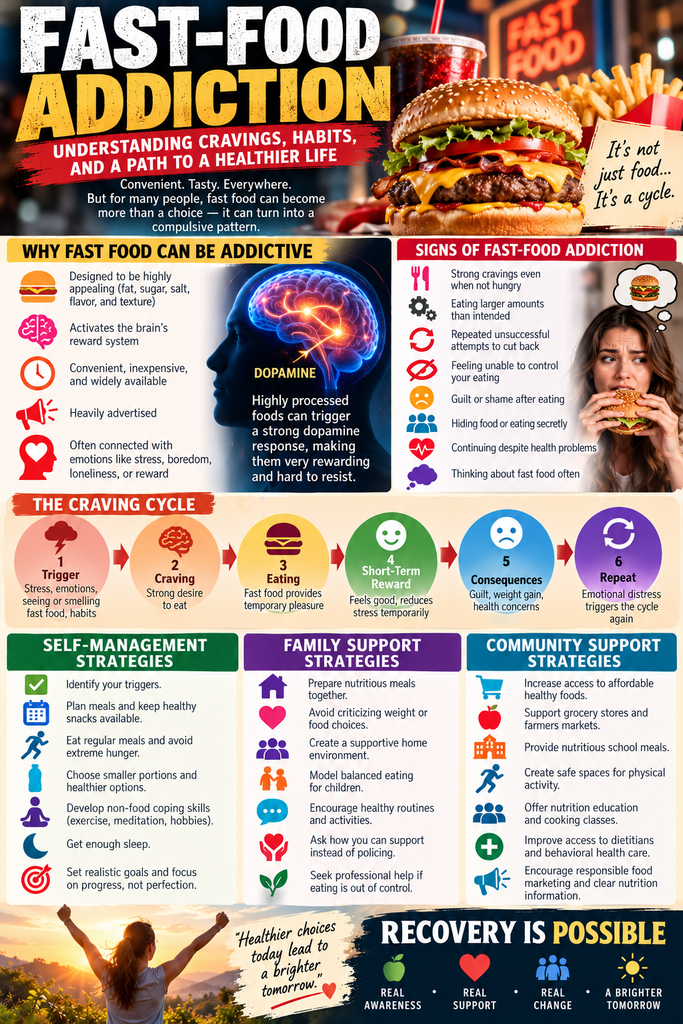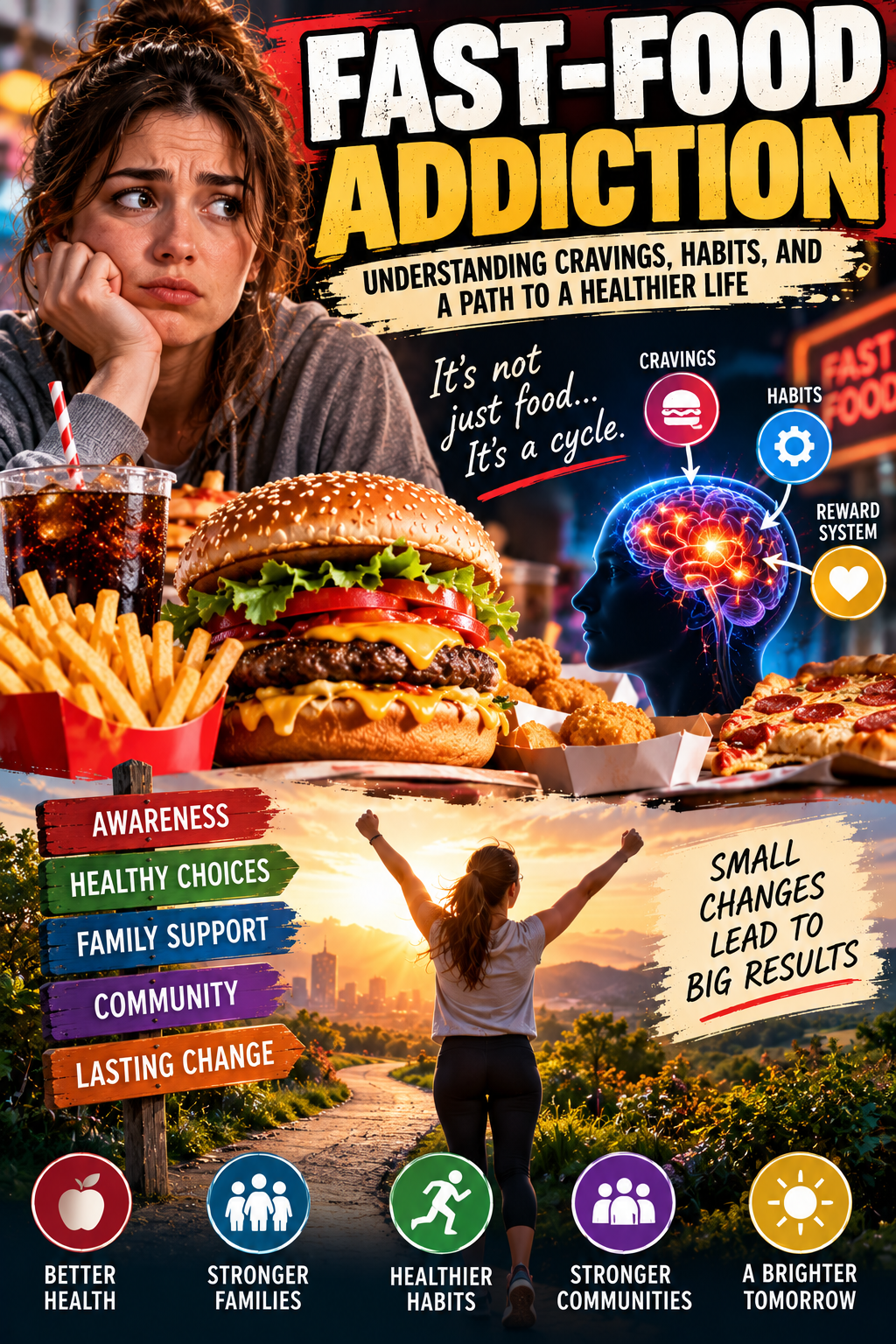
Fast food is designed around convenience. It is inexpensive, widely available, heavily advertised, and often engineered to be highly appealing through combinations of refined carbohydrates, fat, sodium, flavors, and textures. For many people, eating fast food occasionally does not create a significant problem. For others, however, highly processed foods can become connected with powerful cravings, emotional coping, habitual overeating, and a feeling of being unable to control consumption.
The phrase “fast-food addiction” is commonly used to describe these experiences, but it is important to distinguish it from formally recognized substance-use disorders. Fast-food addiction is not currently an official diagnosis in the Diagnostic and Statistical Manual of Mental Disorders (DSM-5-TR). Researchers continue to investigate whether certain patterns of compulsive consumption of highly processed foods share addiction-like characteristics.
Understanding these behaviors without shame can help people identify what is driving them and develop healthier relationships with food.
Why Can Fast Food Feel So Difficult to Resist?
Eating activates the brain’s reward system. Foods that combine refined carbohydrates and fats can be especially rewarding, and repeated exposure may strengthen learned associations between certain foods and pleasure, comfort, convenience, or relief from unpleasant emotions.
The environment also matters. Fast-food restaurants are common, ordering through an app takes seconds, advertisements are frequent, and large portions may be inexpensive. This creates repeated opportunities for cravings to turn into automatic behavior.
Someone may begin associating fast food with:
- Stress relief after work.
- Rewards after a difficult day.
- Comfort during sadness or loneliness.
- Entertainment while watching television.
- Convenience when exhausted.
- Socializing with friends or family.
- Late-night eating.
- Relief from boredom.
Eventually, seeing a restaurant sign, opening a delivery app, driving a familiar route, or experiencing a certain emotion may trigger an urge to eat even when physical hunger is minimal.
Is Fast-Food Addiction Real?
The science is still evolving.
Some people report addiction-like eating behaviors involving highly processed foods, including intense cravings, difficulty reducing consumption, repeated unsuccessful attempts to change, and continued overeating despite negative consequences.
However, food is fundamentally different from substances such as nicotine, alcohol, or opioids because eating is necessary for survival. Treatment therefore generally focuses on developing a healthier relationship with food rather than eliminating food itself.
It is also important not to assume that every person who frequently eats fast food has an addiction. Eating habits are influenced by affordability, work schedules, transportation, cooking facilities, neighborhood food availability, cultural preferences, health conditions, stress, and many other factors.
Warning Signs of a Problematic Relationship With Fast Food
A pattern may deserve attention when someone repeatedly feels unable to control their eating or experiences significant distress because of it.
Possible warning signs include:
- Strong cravings even when physically full.
- Eating larger amounts than originally intended.
- Frequently eating fast food in response to emotions.
- Feeling unable to cut back despite repeated attempts.
- Hiding food or eating secretly because of embarrassment.
- Spending excessive amounts of money on takeout or delivery.
- Continuing the behavior despite health concerns.
- Feeling guilt or shame after eating.
- Thinking excessively about the next meal or particular foods.
- Using food as the primary way to manage stress or emotional distress.
These behaviors can also occur with conditions such as binge-eating disorder, depression, anxiety, or chronic stress. Professional assessment can help determine what is actually happening.
The Craving Cycle
One way to understand compulsive fast-food consumption is through a simple cycle:
Trigger → Craving → Eating → Temporary Reward → Emotional or Physical Consequences → Trigger Again
For example, someone experiences a stressful day at work. On the drive home, they pass a restaurant associated with comfort. A craving develops, and they purchase a large meal. Eating temporarily reduces stress.
Later, they may feel guilty or disappointed about abandoning their nutrition goals. Those uncomfortable feelings create additional emotional distress—which can eventually trigger another episode of comfort eating.
Breaking this cycle usually requires addressing both the food behavior and the trigger behind it.
Self-Management Strategies
Healthy change does not require immediately banning every favorite food. Extremely restrictive approaches can sometimes increase preoccupation with food and contribute to cycles of restriction and overeating.
More sustainable strategies include:
- Identify triggers. Keep a brief record of when cravings occur and what emotions, situations, locations, or routines preceded them.
- Plan meals ahead. Having accessible meals or snacks available reduces the likelihood that extreme hunger will determine food choices.
- Eat regular meals. Skipping meals can increase hunger and make highly rewarding foods more difficult to resist later.
- Change automatic routines. If driving past a particular restaurant triggers eating, consider taking another route temporarily.
- Pause before ordering. Ask, “Am I physically hungry, emotionally hungry, or responding to a habit?”
- Make gradual substitutions. Choose smaller portions, water instead of sugary beverages, fruit or vegetables as sides, or grilled options when available.
- Reduce environmental cues. Turning off restaurant notifications or removing frequently used delivery apps can add helpful friction between craving and action.
- Develop non-food coping skills. Walking, calling someone, listening to music, journaling, relaxation exercises, hobbies, or counseling can help address emotional triggers.
- Prioritize sleep. Poor sleep can influence appetite, decision-making, mood, and food cravings.
- Avoid perfectionism. One fast-food meal does not erase progress. Look at eating patterns over time rather than judging a single meal.
Emotional Eating Deserves Attention
Sometimes the central problem is not the hamburger, fries, pizza, or dessert. It is what the person is trying to manage through eating.
Stress, grief, loneliness, boredom, trauma, depression, anxiety, and low self-esteem can all influence eating behaviors. Food may temporarily provide comfort without resolving the underlying emotional need.
Instead of asking only:
“Why can’t I stop eating this?”
It may be useful to also ask:
“What am I feeling immediately before I want this food?”
That question can reveal triggers that dieting alone may never address.
Family Support Strategies
Family members can influence eating behaviors positively or negatively. Criticizing someone’s weight, monitoring every bite, or labeling foods as evidence of personal failure can increase shame and secrecy.
More constructive family strategies include:
- Prepare nutritious meals together.
- Keep convenient healthy foods available.
- Avoid criticizing someone’s body or weight.
- Discuss health rather than appearance.
- Encourage regular family meals when possible.
- Participate in physical activities together.
- Avoid using food as the primary reward for children.
- Model balanced eating instead of extreme dieting.
- Ask how you can support change rather than policing another person’s food.
- Encourage professional help when eating behaviors cause significant distress.
Children especially learn by observing the behaviors around them. Families can teach that food provides nutrition and enjoyment without dividing every food into rigid categories of “good” and “bad.”
Community Support Strategies
Individual choices occur within larger environments. Telling people simply to “eat better” ignores the fact that healthy foods, time, transportation, cooking facilities, and nutrition education are not equally accessible to everyone.
Communities can help by:
- Improving access to affordable fruits, vegetables, and nutritious foods.
- Supporting grocery stores and farmers’ markets in underserved areas.
- Providing nutritious school meals.
- Offering practical nutrition and cooking education.
- Creating safe spaces for walking, recreation, and exercise.
- Supporting workplace wellness without weight stigma.
- Improving access to registered dietitians and behavioral-health professionals.
- Addressing food insecurity.
- Encouraging restaurants to provide transparent nutrition information.
- Supporting responsible food marketing, particularly advertising directed toward children.
Community strategies work best when they expand healthy choices rather than blaming individuals for living within environments where less nutritious options may be cheaper, faster, and easier to obtain.
When Professional Help May Be Needed
Consider talking with a healthcare professional when eating feels consistently out of control or begins affecting physical health, emotional well-being, relationships, or daily functioning.
Professional support may include a primary-care clinician, registered dietitian, psychologist, therapist, psychiatrist, or eating-disorder specialist.
Treatment can address nutritional habits while also evaluating conditions such as binge-eating disorder, depression, anxiety, ADHD, trauma-related symptoms, or other concerns that may contribute to compulsive eating.
People experiencing recurrent binge-eating episodes accompanied by loss of control and significant distress deserve appropriate evaluation rather than simply being told to exercise more self-control.
Avoiding the Shame Cycle
Shame rarely creates sustainable behavioral change.
A person may eat fast food, feel guilty, decide to follow an extremely restrictive diet, maintain the restriction temporarily, experience powerful cravings, overeat again, and then experience even greater shame.
The cycle becomes:
Overeating → Guilt → Extreme Restriction → Cravings → Overeating
A healthier approach replaces punishment with curiosity.
Instead of saying, “I failed again,” ask:
“What happened before I made this choice, and what could make the healthier choice easier next time?”
That shift transforms a setback into information.
Recovery Is About Balance, Not Perfection
Developing a healthier relationship with food does not necessarily mean never eating fast food again. For many people, an occasional restaurant meal can comfortably fit within an overall balanced eating pattern.
The goal is to make food choices intentional rather than compulsive.
A person can learn to recognize hunger and fullness, identify emotional triggers, plan ahead, manage stress differently, and enjoy food without letting it become the primary way to cope with life.
Key Takeaway
Fast-food “addiction” is more complicated than simply lacking discipline. Highly rewarding foods, learned habits, emotional coping, convenience, advertising, stress, sleep, finances, and the surrounding food environment can all influence eating behavior.
Successful change therefore needs to address more than the food.
Self-management can help people recognize triggers, establish regular eating patterns, plan meals, develop healthier coping strategies, and interrupt automatic habits.
Families can create supportive environments without shame, body criticism, or excessive food policing.
Communities can make nutritious foods, behavioral healthcare, education, recreation, and professional nutrition services more accessible.
Most importantly, struggling with compulsive eating should not become a reason for self-punishment. The better question is not simply “Why don’t I have enough willpower?”
It is:
“What is driving this behavior, and what support would make a healthier choice easier?”
Understanding that answer can be the beginning of lasting change.
Frequently Asked Questions and Answers
1. Is fast-food addiction a real addiction?
“Fast-food addiction” is not currently a formal diagnosis in the DSM-5-TR. However, researchers have identified addiction-like eating patterns in some people, particularly involving highly processed foods. These can include intense cravings, loss of control, repeated unsuccessful attempts to cut back, and continued overeating despite negative consequences.
2. Why can fast food be so difficult to resist?
Fast food often combines refined carbohydrates, fats, sodium, intense flavors, and appealing textures. These foods can strongly engage the brain’s reward system. Convenience, advertising, affordability, habits, and emotional associations can further reinforce repeated consumption.
3. Does fast food release dopamine?
Eating rewarding food can activate dopamine-related brain pathways involved in motivation, learning, and reinforcement. However, dopamine should not simply be described as a “pleasure chemical.” Its role is more complex and includes helping the brain learn which experiences are worth seeking again.
4. What are possible signs of problematic fast-food consumption?
Warning signs can include strong cravings when not physically hungry, eating more than intended, feeling unable to cut back, frequently eating in response to emotions, hiding food consumption, spending excessive money on delivery or takeout, and continuing the behavior despite health or emotional consequences.
5. Why do I crave fast food when I am stressed?
Stress can increase the desire for familiar, highly rewarding foods. If fast food has repeatedly provided temporary comfort during stressful situations, the brain can learn an association: stress → fast food → temporary relief. Eventually, stress itself may trigger cravings.
6. What is emotional eating?
Emotional eating occurs when food is used primarily to cope with emotions rather than physical hunger. Stress, boredom, loneliness, sadness, anxiety, anger, and even celebration can trigger eating.
7. What is the fast-food craving cycle?
A common pattern is:
Trigger → Craving → Eating → Temporary Reward → Consequences → Repeat
For example, stress may trigger a craving, fast food provides temporary comfort, guilt follows, and that emotional distress may eventually trigger another episode.
8. Is fast-food addiction the same as binge-eating disorder?
No. Binge-eating disorder is a recognized mental-health condition characterized by recurrent binge-eating episodes involving a sense of loss of control and significant distress, along with additional diagnostic criteria. Someone concerned about binge eating should seek professional evaluation rather than assuming the problem is simply fast-food addiction.
9. Does eating fast food mean someone has an addiction?
No. Eating fast food occasionally—or even regularly—does not automatically mean someone is addicted. Frequency, loss of control, distress, health effects, compulsive behavior, and the person’s overall relationship with food are more informative than simply whether they eat fast food.
10. Should someone completely eliminate fast food?
Not necessarily. For many people, an occasional fast-food meal can fit within an overall balanced eating pattern. Extreme restriction can sometimes increase food preoccupation and contribute to cycles of restriction and overeating.
11. What self-management strategies can help reduce compulsive fast-food eating?
Helpful approaches include planning meals, eating regularly, identifying emotional and environmental triggers, keeping convenient nutritious foods available, limiting delivery-app notifications, getting adequate sleep, developing non-food coping skills, and creating realistic rather than perfectionistic goals.
12. How can I tell whether I am physically hungry or emotionally hungry?
Physical hunger usually develops gradually and can be satisfied by different foods. Emotional cravings may appear suddenly, focus on a particular food, and occur even when the body has recently eaten. Keeping a hunger-and-emotion journal can help identify patterns.
13. Why can strict dieting sometimes make the problem worse?
Severe restriction can increase hunger and preoccupation with food. Some people enter a cycle of:
Restriction → Intense cravings → Overeating → Guilt → More restriction.
A balanced and sustainable eating pattern is often more helpful than repeatedly moving between extreme dieting and overeating.
14. How can families help?
Families can prepare balanced meals together, keep nutritious foods accessible, encourage regular meals and physical activity, avoid criticizing someone’s body or food choices, and ask how they can help rather than policing what the person eats.
15. Should parents use food as a reward for children?
Occasionally celebrating with food is not inherently harmful, but consistently using highly rewarding foods as the primary reward can strengthen emotional associations between food, comfort, achievement, and behavior. Families can also use experiences, praise, activities, or privileges as rewards.
16. How can communities help reduce unhealthy eating patterns?
Communities can improve access to affordable, nutritious foods; provide healthy school meals; support grocery stores and farmers markets; offer cooking and nutrition education; create safe recreational spaces; address food insecurity; and improve access to dietitians and behavioral-health services.
17. When should someone seek professional help?
Professional evaluation may be appropriate when eating repeatedly feels out of control, causes significant distress, involves secretive or binge eating, interferes with daily functioning, or contributes to health problems. A primary-care clinician, registered dietitian, therapist, or eating-disorder specialist can help determine what is happening.
18. Can someone recover from compulsive fast-food eating?
Yes. People can learn to recognize triggers, manage emotions differently, establish regular eating patterns, reduce automatic behaviors, and develop a healthier relationship with food. Progress does not require perfection.
Video: