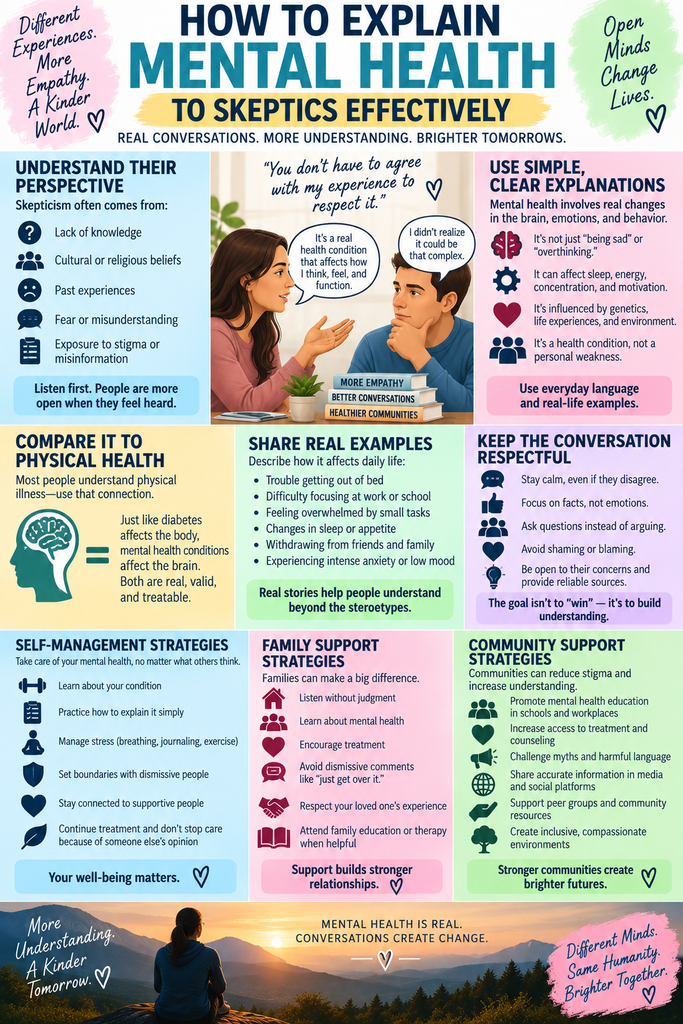
Mental health can be difficult to explain to someone who does not believe psychological conditions are “real.” A skeptic may view depression as sadness, anxiety as worrying too much, addiction as poor choices, or ADHD as a lack of discipline. Others may believe that people should simply become stronger, think positively, pray more, work harder, or “get over it.”
These attitudes can be frustrating, especially when someone is already struggling. However, skepticism does not always come from cruelty. It may develop from limited education, cultural beliefs, fear, previous experiences, stigma, or growing up in an environment where emotional problems were never discussed.
Effective mental-health communication is therefore less about winning an argument and more about helping another person understand something they may never have personally experienced.
Start With the Brain and Body
One helpful approach is explaining that mental health involves both the brain and the body.
The brain influences sleep, concentration, motivation, emotions, appetite, memory, decision-making, stress responses, and behavior. When these systems are disrupted, symptoms can impair a person’s ability to function.
Mental health conditions can involve a combination of biological, psychological, social, developmental, and environmental factors. Genetics, trauma, chronic stress, relationships, substance use, medical conditions, and life experiences may all contribute.
This makes mental health more complicated than simply deciding to feel differently.
Use Familiar Physical-Health Comparisons Carefully
Physical health comparisons can make mental health concepts easier to understand.
Someone would rarely tell a person with a broken leg to “walk normally because other people have it worse.” Similarly, telling someone experiencing severe depression to simply become happier does not address the underlying problem.
However, mental illnesses are not identical to physical illnesses. The comparison is useful because it illustrates one principle: symptoms deserve assessment and appropriate care rather than shame.
Explain the Difference Between Normal Emotions and Mental Illness
Skeptics sometimes ask, “Doesn’t everyone get sad or anxious?”
Yes.
Everyone experiences sadness, worry, distraction, stress, anger, and mood changes. A mental-health condition generally involves more than experiencing an ordinary emotion occasionally.
Important considerations include:
- How severe the symptoms are.
- How long they last.
- How frequently they occur.
- Whether they cause significant distress.
- Whether they interfere with work or school.
- Whether relationships are affected.
- Whether someone can manage everyday responsibilities.
- Whether physical health or personal safety is being affected.
The difference often lies in severity, persistence, pattern, and impairment, not simply in the presence of an emotion.
Avoid Turning the Conversation Into a Battle
When someone says, “I don’t believe in mental illness,” the natural reaction may be to immediately challenge them.
Sometimes that works. Often it does not.
People frequently become more defensive when they feel attacked or embarrassed. Instead, try asking what they mean.
Questions such as “What makes you feel that way?” can reveal whether the skepticism comes from misinformation, fear, cultural beliefs, previous experiences, or misunderstanding.
Once you understand the concern, you can respond to the actual issue rather than arguing against assumptions.
Use Real-Life Examples
Clinical terminology can sometimes feel abstract. Everyday examples make symptoms easier to understand.
Instead of only saying someone has depression, explain that the person may struggle to get out of bed, concentrate at work, prepare meals, enjoy activities, or maintain relationships.
Instead of simply saying someone has ADHD, explain how executive-function difficulties may affect planning, time management, impulse control, organization, and completing tasks.
Instead of describing addiction as “losing control,” explain how repeated substance use can continue despite serious consequences and become associated with cravings, tolerance, withdrawal, and changes in behavior.
Functioning often makes the condition easier to understand than diagnostic labels alone.
Self-Management Strategies
Someone living with a mental-health condition cannot control whether everyone understands their experience. They can, however, control how much energy they invest in explaining themselves.
Helpful strategies include:
- Learn about your condition. Reliable information can make conversations easier and reduce internalized stigma.
- Choose the right moment. Difficult conversations are usually more productive when everyone is calm.
- Use simple language. Explain symptoms through everyday experiences rather than overwhelming someone with terminology.
- Speak from personal experience. Statements such as “This is how anxiety affects me” can be more effective than debating general theories.
- Set boundaries. You do not have to repeatedly defend your diagnosis or treatment.
- Protect your treatment. Do not stop medication or therapy simply because someone else does not believe you need it.
- Recognize emotional limits. It is acceptable to end an unproductive conversation.
- Seek supportive relationships. Spend time with people who respect your experience even when they do not fully understand it.
Understanding from others is helpful, but recovery cannot depend entirely on receiving everyone’s approval.
Family Support Strategies
Families can significantly influence whether someone feels safe seeking treatment.
A dismissive family environment may increase shame and secrecy. A supportive family does not need to understand every symptom perfectly. Family members can begin by believing that the person’s distress deserves attention.
Families can help by:
- Listening before giving advice.
- Avoiding statements such as “Just get over it.”
- Learning about the diagnosed condition.
- Asking how symptoms affect everyday functioning.
- Encouraging appropriate professional treatment.
- Respecting medication and therapy decisions made with healthcare professionals.
- Recognizing small improvements.
- Avoiding comparisons with other people’s struggles.
- Participating in family therapy or education when appropriate.
- Taking conversations about suicide or self-harm seriously.
One of the most supportive things a family member can say is simply: “I may not completely understand what you’re experiencing, but I want to understand how I can help.”
Community Support Strategies
Mental-health stigma is not created by individuals alone. Schools, workplaces, healthcare systems, faith communities, media, and social organizations all influence how people understand psychological conditions.
Communities can reduce skepticism by:
- Providing evidence-based mental-health education.
- Teaching students about emotional wellness.
- Training workplaces to recognize mental-health concerns.
- Improving access to counseling and psychiatric care.
- Providing addiction and recovery services.
- Offering peer-support programs.
- Including families in education when appropriate.
- Encouraging responsible media representation.
- Challenging discriminatory language.
- Making crisis resources easy to access.
When mental health becomes part of ordinary health education, people may become less likely to interpret symptoms as personal weakness.
What If the Skeptic Still Doesn’t Believe You?
Not every conversation will change someone’s mind.
You can provide information, describe your experience, answer reasonable questions, and encourage reliable education. You cannot force another person to understand.
At some point, a boundary may become necessary.
You might communicate that disagreement does not give someone permission to ridicule symptoms, interfere with treatment, or disrespect personal decisions.
A person can remain skeptical while still behaving respectfully.
Mental Health Is Not an Excuse for Everything
Effective advocacy also requires balance.
Having a mental-health condition can explain why certain behaviors or responsibilities are more difficult, but a diagnosis does not automatically excuse every harmful action.
Treatment often involves learning coping strategies, accepting appropriate responsibility, improving communication, managing symptoms, and repairing relationships when possible.
Understanding and accountability can exist together.
This distinction can sometimes help skeptical people recognize that mental-health treatment is not about avoiding responsibility. It is often about developing the tools necessary to function more effectively.
When Professional Support Is Important
Professional help should be considered when mental-health symptoms cause significant distress, interfere with everyday functioning, contribute to substance misuse, damage relationships, or become difficult to manage independently.
Urgent help is necessary when someone is at immediate risk of harming themselves or another person, is experiencing severe confusion or psychosis, or cannot safely care for themselves.
Seeking professional care is not evidence that someone has failed to manage life. It is one available strategy for addressing a health problem.
Conclusion
Explaining mental health to a skeptic is rarely about finding a single perfect sentence that will suddenly change their beliefs. Understanding often develops gradually through education, personal experiences, respectful conversations, and exposure to people whose lives have been affected by mental-health conditions.
Self-management helps individuals communicate clearly while protecting their emotional well-being. Families can replace judgment with curiosity, education, and practical support. Communities can challenge stigma by making accurate mental-health information and treatment easier to access.
You do not need everyone to completely understand mental illness before supporting someone who is struggling.
Sometimes the most important starting point is much simpler:
“I don’t fully understand what you’re going through, but I believe that what you’re experiencing matters. How can I support you?”
Frequently Asked Questions
Here are some common questions:
1. Why are some people skeptical about mental health?
Mental-health skepticism can develop from limited education, cultural or family beliefs, stigma, fear, misinformation, or previous experiences with healthcare. Some people were raised in environments where emotional difficulties were rarely discussed, so mental-health conditions may be unfamiliar or misunderstood.
2. What is the simplest way to explain mental health?
Mental health involves how the brain, emotions, thoughts, behaviors, relationships, and environment affect a person’s ability to function and cope with everyday life. Just as physical health can change, mental health can also improve or deteriorate and sometimes requires professional care.
3. Are mental-health conditions real medical conditions?
Yes. Conditions such as depression, anxiety disorders, bipolar disorder, schizophrenia, ADHD, and substance-use disorders are recognized health conditions. Their causes are often complex and can involve biological, psychological, developmental, environmental, and social factors.
4. How do you respond when someone says, “Everyone gets sad”?
Acknowledge that sadness is a normal human emotion. Depression, however, involves more than simply feeling sad. Symptoms may persist, become severe, and interfere with sleep, energy, concentration, motivation, relationships, work, school, and everyday functioning.
The same principle applies to many mental-health conditions: severity, duration, pattern, distress, and impairment matter.
5. How should I respond to “Mental illness is all in your head”?
Mental-health conditions involve the brain, but that does not make them imaginary. The brain is an organ involved in thinking, emotions, memory, sleep, motivation, behavior, and physical responses to stress. Problems affecting these systems can produce significant symptoms and impairment.
6. What if someone says people with mental illness should just “get over it”?
You can explain that motivation alone does not always resolve a health condition. People can take responsibility for seeking treatment and developing coping skills, but severe symptoms may require therapy, medication, lifestyle changes, social support, or a combination of approaches.
7. Should I compare mental illness to physical illness?
Physical-health comparisons can sometimes help. For example, most people understand that someone cannot simply decide to eliminate diabetes or a broken bone through positive thinking.
The comparison is not perfect, but it illustrates an important principle: health problems deserve appropriate assessment and care rather than shame.
8. How can I explain mental health without starting an argument?
Try curiosity before confrontation. Ask the person why they hold their beliefs and listen to their answer. Then provide concise information and everyday examples rather than overwhelming them with medical terminology.
The goal should be greater understanding rather than winning a debate.
9. Are personal stories useful when talking to skeptics?
Yes. Personal experiences can make an abstract condition easier to understand. Instead of only describing depression clinically, someone might explain how it affected getting out of bed, concentrating at work, maintaining relationships, or enjoying activities they previously loved.
Personal stories should be shared voluntarily. Nobody is obligated to disclose private mental-health information to educate someone else.
10. What should I avoid when talking with a mental-health skeptic?
Try to avoid:
- Insulting or humiliating the person.
- Turning every disagreement into an argument.
- Overwhelming them with technical terminology.
- Making unsupported claims.
- Diagnosing other people during the conversation.
- Assuming skepticism always comes from cruelty.
- Sharing another person’s diagnosis without permission.
- Continuing a conversation that becomes abusive or disrespectful.
Respectful communication does not require tolerating mistreatment.
11. What self-management strategies can help when dealing with skeptical people?
Helpful strategies include:
- Learning reliable information about mental health.
- Practicing simple explanations before difficult conversations.
- Choosing calm moments for discussions.
- Using personal experiences when comfortable.
- Setting boundaries around disrespectful comments.
- Limiting repeated arguments that affect your well-being.
- Staying connected with supportive people.
- Continuing recommended treatment despite another person’s skepticism.
You do not need everyone’s agreement to take your mental health seriously.
12. How can families become more supportive?
Families can listen without immediately offering solutions, learn about the person’s condition, encourage appropriate treatment, avoid dismissive language, recognize progress, and ask what kind of support would actually be useful.
Sometimes the most meaningful response is: “I don’t completely understand what you’re experiencing, but I’m willing to learn.”
13. How can communities reduce mental-health skepticism?
Communities can improve mental-health education in schools and workplaces, provide accessible counseling, support peer programs, challenge discriminatory language, improve addiction services, educate families, and promote accurate information through healthcare and community organizations.
Greater familiarity can reduce fear and stigma.
14. Does having a mental-health condition excuse harmful behavior?
No. A mental-health condition can help explain why someone experiences certain symptoms or behaviors, but it does not automatically remove responsibility for every action.
Treatment can involve symptom management, accountability, communication, behavioral change, and repairing harm when appropriate. Compassion and accountability can exist together.
15. What if a skeptic refuses to change their mind?
You cannot force another person to understand mental illness. You can provide accurate information, explain your experience, answer respectful questions, and recommend trustworthy resources.
If the conversation repeatedly becomes insulting or harmful, establishing boundaries may be healthier than continuing to argue.
16. Should someone stop treatment if family members do not believe in mental illness?
Treatment decisions should be made with qualified healthcare professionals—not based solely on relatives’ opinions. Someone should not abruptly stop psychiatric medication or other prescribed treatment simply because another person questions the diagnosis.
17. When does a mental-health problem require professional help?
Professional evaluation should be considered when symptoms are persistent, severe, difficult to manage, or interfering with relationships, employment, education, sleep, self-care, substance use, or everyday functioning.
Immediate assistance is particularly important when someone is at risk of harming themselves or another person, experiencing severe psychosis or confusion, or unable to remain safe.
18. What is the most important message when explaining mental health to a skeptic?
You do not necessarily need to convince someone of every scientific detail in a single conversation. Start with a simpler principle:
A person’s suffering deserves to be taken seriously even when another person does not completely understand it.
Education can correct misinformation. Listening can reduce defensiveness. Families can replace judgment with curiosity, and communities can make accurate information and treatment easier to access.
Different perspectives do not prevent compassion. Understanding often begins when we listen before we judge.
Video: When you look fine but feel broken #mentalhealthmatters #relatable #shorts