Addiction rarely develops because of one emotion or one difficult relationship. Substance use disorders are influenced by a combination of biological, psychological, social, and environmental factors. However, powerful emotions such as envy, jealousy, resentment, rejection, and anger can become triggers for substance use—especially when a person has learned to use alcohol or drugs to escape emotional discomfort.
Feeling that other people are competing with you, criticizing you, betraying you, or hoping you fail can also create chronic stress. Sometimes these concerns stem from genuine interpersonal conflict. At other times, stress, insecurity, past trauma, substance use, or mental health symptoms can affect how social situations are interpreted.
Understanding the difference is important because recovery requires addressing both the substance use and the emotions surrounding relationships.
Understanding Envy
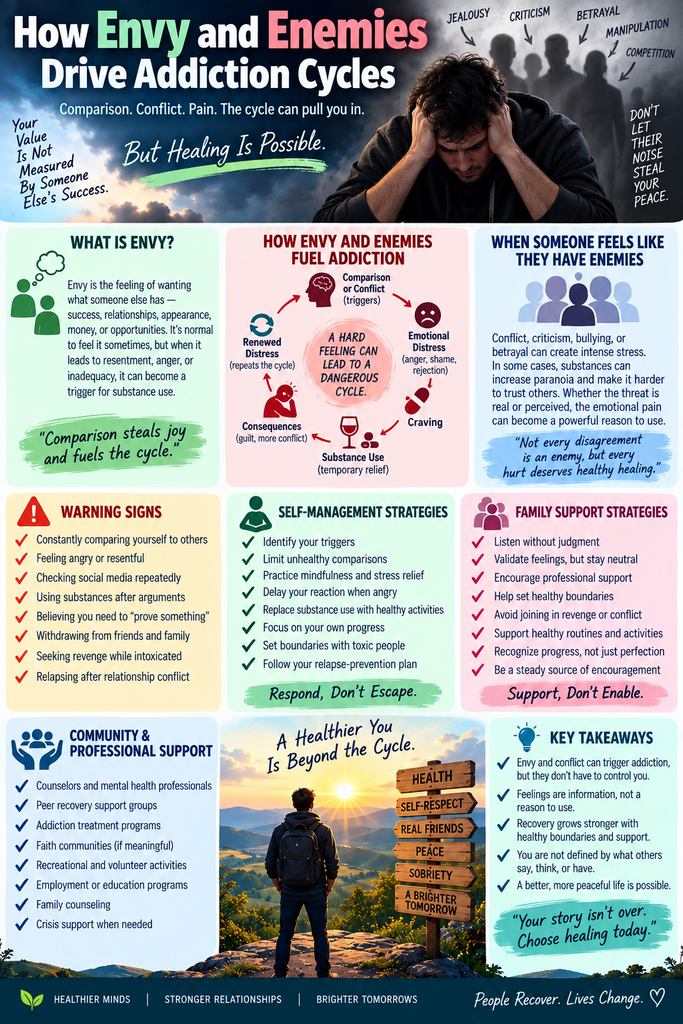
Envy occurs when someone wants something another person has, such as success, attention, appearance, relationships, money, recognition, or opportunities. Almost everyone experiences envy occasionally.
Problems can develop when envy becomes persistent and turns into resentment, shame, anger, or feelings of inadequacy.
Social media may intensify these emotions because people are constantly exposed to carefully curated versions of others’ lives. Someone struggling with addiction might compare their worst moments with another person’s best moments and conclude that they are falling behind.
These feelings can become powerful triggers.
When You Feel Like You Have Enemies
Interpersonal conflict can create significant emotional stress. Someone may genuinely experience bullying, manipulation, workplace conflict, unhealthy competition, betrayal, or criticism.
However, it is important not to automatically assume that every disagreement means someone is an enemy.
During periods of severe stress or substance use, perceptions can also become distorted. Certain substances—including stimulants and heavy alcohol use—can contribute to suspiciousness, paranoia, irritability, and misinterpretation of other people’s intentions.
Instead of immediately asking, “Who is against me?” it may be more helpful to ask:
“What happened, what evidence do I have, and how is this situation affecting my recovery?”
How These Emotions Can Feed the Addiction Cycle
A person may initially use substances to obtain temporary relief from jealousy, anger, humiliation, loneliness, or rejection.
The cycle might look like this:
Comparison or conflict → emotional distress → craving → substance use → temporary relief → consequences → shame or additional conflict → renewed distress → another craving.
Substances may temporarily change how someone feels, but they rarely resolve the original problem. In fact, intoxication can sometimes increase impulsivity and conflict, creating additional problems that reinforce the cycle.
Warning Signs That Social Stress Is Becoming a Recovery Trigger
Someone may notice:
- Constantly comparing themselves with other people
- Obsessing about what another person has
- Repeatedly checking another person’s social media
- Feeling intense anger after criticism or rejection
- Drinking or using drugs after arguments
- Using substances to stop thinking about another person
- Believing substance use will help prove something to others
- Becoming increasingly isolated or suspicious
- Seeking revenge while intoxicated
- Relapsing repeatedly following relationship conflicts
Recognizing these patterns creates an opportunity to intervene before the emotional trigger becomes substance use.
Self-Management Strategies
Recovery involves learning how to experience difficult emotions without automatically escaping them through substances.
Helpful strategies include:
- Identify your triggers. Keep track of situations involving jealousy, rejection, competition, or conflict that increase cravings.
- Separate facts from assumptions. Ask yourself what you actually know versus what you believe another person is thinking.
- Limit unhealthy comparisons. Reduce exposure to social media accounts or situations that repeatedly trigger resentment.
- Delay your reaction. Avoid sending messages, confronting someone, or making major decisions while angry or intoxicated.
- Practice emotional regulation. Breathing exercises, mindfulness, exercise, journaling, and grounding techniques may reduce emotional intensity.
- Focus on personal progress. Compare today’s recovery with where you were previously rather than measuring your life against someone else’s.
- Protect your sobriety. Distance yourself from relationships or environments strongly associated with substance use.
- Follow your relapse-prevention plan. Know who to contact when interpersonal stress triggers cravings.
One useful question is:
“Will my next decision move me toward recovery or deeper into the cycle?”
Turning Envy Into Information
Envy does not always have to become destructive.
Sometimes envy identifies something a person genuinely wants. Instead of thinking, “Why do they have that and I don’t?” the person can ask, “What does this feeling tell me about what I want to build?”
Envy about someone’s career might reveal a desire for greater purpose. Jealousy about relationships might reveal loneliness. Resentment toward someone’s health or sobriety might reveal frustration about one’s own recovery.
The emotion becomes information rather than an instruction to act.
Family Support Strategies
Families can help without becoming investigators, referees, or therapists.
Helpful approaches include:
- Listen without immediately agreeing with every interpretation of an interpersonal conflict.
- Validate emotions while remaining neutral about assumptions that cannot be verified.
- Ask calm questions such as, “What happened?” and “What evidence supports that conclusion?”
- Encourage the person to contact their counselor, sponsor, peer specialist, or treatment provider when conflict triggers cravings.
- Avoid participating in revenge, online arguments, or confrontations.
- Maintain clear boundaries around threatening, abusive, or substance-related behavior.
- Recognize improvements in coping rather than expecting perfection.
- Encourage healthy sleep, nutrition, exercise, treatment attendance, and sober activities.
A family member can acknowledge someone’s pain without reinforcing an inaccurate belief.
For example, saying “I can see how upsetting this feels” is different from saying “You’re right—everyone is against you.”
Community and Professional Support
Recovery becomes easier when a person’s entire coping system does not depend on one relationship.
Community resources can provide healthier connection, accountability, and perspective. Helpful options may include:
- Addiction counselors
- Primary care and behavioral health professionals
- Psychologists or psychiatrists when appropriate
- Peer recovery specialists
- Recovery support groups
- Community recovery organizations
- Faith communities when personally meaningful
- Recreational and volunteer programs
- Employment or educational programs
- Family counseling
Treatment can also help someone recognize whether repeated interpersonal conflicts are related to trauma, anxiety, depression, impulsivity, substance use, or another underlying issue.
When Suspicion Becomes More Serious
There is an important difference between ordinary interpersonal conflict and persistent beliefs that other people are monitoring, plotting against, following, or intentionally trying to cause harm.
New or severe paranoia—particularly during intoxication, withdrawal, prolonged sleep deprivation, or stimulant use—deserves prompt professional evaluation. If someone becomes extremely confused, threatening, suicidal, violent, or unable to distinguish what is happening around them, emergency evaluation may be necessary.
Building a Recovery Life That Is Bigger Than Conflict
Recovery becomes stronger when attention gradually shifts away from proving something to others and toward building a meaningful life.
That might mean repairing relationships, developing new friendships, returning to school, improving physical health, volunteering, finding meaningful work, rebuilding finances, exploring spirituality, or simply learning to enjoy ordinary life without substances.
The question changes from “What are they doing to me?” to “What can I do today to protect my recovery?”
Conclusion
Envy, jealousy, resentment, rejection, and interpersonal conflict can become powerful addiction triggers, but they do not have to control someone’s recovery. The emotional cycle becomes easier to interrupt when a person learns to recognize triggers, distinguish facts from assumptions, regulate difficult emotions, and seek support before turning to substances.
Families can provide compassion without reinforcing unhealthy interpretations, while counselors, healthcare professionals, peer recovery communities, and other support systems can help address the deeper issues behind repeated substance use.
Recovery is ultimately less about defeating perceived enemies or competing with other people and more about building a life in which someone else’s success, criticism, or behavior no longer determines your next drink, drug, or decision.
Frequently Asked Questions
Here are some common questions:
1. Can envy contribute to addiction?
Envy alone does not cause addiction. However, persistent comparison, resentment, shame, or feelings of inadequacy can create emotional distress. For someone vulnerable to substance misuse, alcohol or drugs may become a way of temporarily escaping those emotions.
2. How can conflict with other people trigger substance use?
Arguments, criticism, rejection, betrayal, bullying, or relationship problems can activate stress and strong emotions. If someone has learned to cope with distress through substances, these situations may increase cravings and relapse risk.
3. What does an envy-addiction cycle look like?
A common pattern might be comparison or conflict → anger, shame, or rejection → craving → substance use → temporary relief → consequences → additional shame or conflict → renewed substance use. Recognizing this pattern can help someone interrupt it earlier.
4. Does feeling like people are against you mean you actually have enemies?
Not necessarily. Some people experience genuine bullying, manipulation, or interpersonal conflict. However, stress, sleep deprivation, trauma, intoxication, withdrawal, and certain mental health conditions can also affect how someone’s behavior or intentions are interpreted.
5. Can drugs or alcohol increase suspiciousness or paranoia?
Yes. Some substances can contribute to suspiciousness, anxiety, agitation, or paranoia, particularly during heavy use, intoxication, or withdrawal. Stimulants can be especially associated with paranoia in some circumstances.
6. How can social media contribute to envy and addiction triggers?
Social media can encourage constant comparison with carefully selected versions of other people’s lives. Feelings of inadequacy, exclusion, jealousy, or resentment may become emotional triggers for someone who uses substances to cope.
7. How can someone manage envy without using substances?
Identify the underlying emotion and ask what it represents. Limiting unhealthy comparisons, reducing exposure to triggering social media, exercising, journaling, practicing mindfulness, talking with supportive people, and following a relapse-prevention plan can help.
8. Should someone confront a person they believe is trying to hurt them?
Not while intoxicated, extremely angry, or uncertain about what is happening. Creating distance, documenting verifiable events when appropriate, and discussing the situation with a trusted person or professional can provide perspective before deciding how to respond.
9. How can families support someone dealing with these triggers?
Families can listen without judgment, encourage healthy boundaries, support treatment, and help the person recognize relapse triggers. They can validate a person’s emotions without automatically confirming unverified assumptions.
10. What is the difference between validating feelings and reinforcing suspicious beliefs?
Validation acknowledges the emotional experience: “I can see that this situation is frightening and upsetting.” Reinforcement treats an uncertain interpretation as fact: “You’re right; everyone is plotting against you.” Families can provide emotional support while encouraging the person to examine evidence and seek professional guidance.
11. When should professional help be considered?
Professional support is appropriate when jealousy, resentment, interpersonal conflict, or suspiciousness repeatedly contributes to cravings, relapse, severe isolation, relationship problems, or difficulty functioning. Addiction counselors and mental health professionals can help address both substance use and underlying emotional concerns.
12. When does paranoia require urgent attention?
New or severe paranoia deserves prompt professional evaluation, particularly when associated with substance use, withdrawal, prolonged sleep deprivation, hallucinations, severe confusion, or extreme agitation. Emergency assistance may be necessary when someone is at immediate risk of harming themselves or another person.
13. Can envy ever be used constructively?
Yes. Instead of treating envy as a command to compete or retaliate, someone can use it as information. Asking “What does this person’s situation reveal about something I want for my own life?” can turn comparison into a goal for personal growth.
14. What is the most important recovery message?
Other people’s success, criticism, rejection, or behavior does not have to determine someone’s next decision. Recovery involves learning to recognize triggers, regulate emotions, establish healthy boundaries, seek support, and build a life increasingly guided by personal values rather than by comparison or conflict.
Video: When envy turns into conflict #relationshipadvice #mindset