Artificial intelligence chatbots have quickly become part of everyday life. People use them to answer questions, study, brainstorm ideas, solve problems, practice conversations, and find emotional support. For many people, these tools are useful and easy to control. However, some individuals may begin spending so much time interacting with chatbots that the behavior interferes with sleep, relationships, school, work, or other responsibilities.
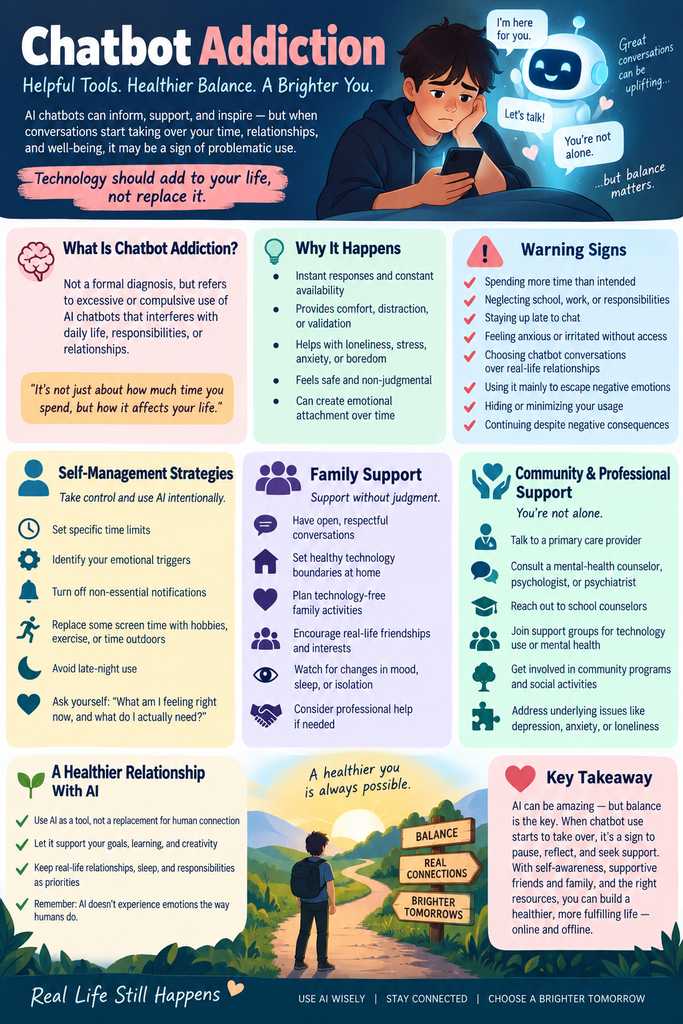
“Chatbot addiction” is not currently a formal psychiatric diagnosis. A more accurate way to describe the concern is problematic, compulsive, or excessive chatbot use. The important question is not simply how many hours someone spends using AI, but whether that behavior is becoming difficult to control and causing meaningful problems in daily life.
How Chatbot Use Can Become Compulsive
Chatbots are unusually easy to engage with. They are available around the clock, respond almost immediately, and can continue a conversation for as long as the user wants. Unlike human relationships, chatbot interactions generally do not require waiting for someone to become available or worrying about interrupting them.
For someone experiencing loneliness, anxiety, boredom, stress, grief, or low self-esteem, an AI conversation may temporarily provide distraction or comfort. The person may gradually begin turning to the chatbot whenever uncomfortable emotions appear.
A cycle can develop:
Stress or loneliness → chatbot use → temporary relief → increased reliance → less engagement with real life → more stress or isolation → more chatbot use.
The chatbot itself is not necessarily the underlying problem. The concern is when its use becomes the person’s primary way of coping.
Possible Warning Signs
Problematic chatbot use may look different from person to person. Warning signs can include:
- Spending much more time chatting with AI than originally intended
- Repeatedly trying and failing to reduce use
- Staying awake late into the night having chatbot conversations
- Checking the chatbot immediately after waking
- Becoming anxious, irritated, or uncomfortable when unable to access it
- Neglecting school, work, exercise, hygiene, meals, or household responsibilities
- Choosing chatbot conversations over spending time with family or friends
- Using AI primarily to escape loneliness, sadness, anxiety, anger, or boredom
- Becoming increasingly emotionally dependent on chatbot responses
- Hiding or minimizing the amount of time spent using AI
- Continuing excessive use despite recognizing negative consequences
One sign alone does not establish an addiction. The overall pattern and its effect on functioning matter more.
Why Someone Might Become Emotionally Attached to a Chatbot
Humans naturally respond socially to language. When something remembers the context of a conversation, responds sympathetically, and communicates in a humanlike way, the interaction can feel surprisingly personal.
For someone who feels misunderstood or socially isolated, AI may seem easier than talking with another person. There may be less fear of embarrassment, criticism, rejection, or conflict.
That emotional comfort can be valuable, but problems can arise if AI begins to replace rather than supplement human relationships.
Chatbots also have important limitations. They do not experience friendship, love, concern, or emotional attachment in the human sense. They can also misunderstand situations and provide inaccurate information. Important medical, mental-health, financial, or safety decisions should therefore not depend solely on chatbot responses.
Self-Management Strategies
The goal does not necessarily have to be eliminating AI. Instead, a person can learn to use it intentionally.
Helpful strategies include:
- Track chatbot use for several days to understand how much time is actually being spent.
- Identify emotional triggers such as loneliness, boredom, anxiety, anger, or insomnia.
- Establish specific periods for AI use rather than continuously checking throughout the day.
- Avoid chatbot conversations during meals, family activities, work, or school.
- Create a technology-free period before bedtime.
- Turn off unnecessary notifications.
- Keep the phone outside the bedroom when nighttime use becomes difficult to control.
- Replace some chatbot time with exercise, hobbies, reading, outdoor activities, or face-to-face interaction.
- Ask, “What am I feeling right now, and what do I actually need?” before opening a chatbot.
If attempts to reduce use repeatedly fail or the behavior is causing significant distress, professional support may be appropriate.
Family Support Strategies
Family members may notice behavioral changes before the individual recognizes them. Approaching the situation with curiosity rather than ridicule can make productive conversations more likely.
Instead of saying, “You’re addicted to that chatbot,” a family member might ask what the person enjoys about AI conversations and whether they have noticed changes in sleep, relationships, or responsibilities.
Families can help by:
- Discussing technology use without shaming the person
- Establishing reasonable household technology boundaries
- Planning regular technology-free family activities
- Encouraging friendships and activities outside the home
- Watching for worsening isolation, depression, anxiety, or sleep problems
- Modeling balanced technology use themselves
- Encouraging counseling when chatbot use significantly interferes with everyday functioning
Family members should also avoid abruptly taking away technology as the only solution without understanding what need the behavior may be meeting.
Community and Professional Support
Problematic chatbot use may sometimes occur alongside depression, anxiety, loneliness, social difficulties, compulsive behaviors, or other mental-health concerns. Addressing those underlying issues can be more effective than focusing exclusively on screen time.
Helpful resources may include:
- Primary care professionals
- Licensed mental-health counselors
- Psychologists
- Psychiatrists
- School counselors
- Behavioral health programs
- Support groups addressing problematic technology or internet use
- Community recreation and social programs
Professional assessment can help determine whether excessive technology use is the primary concern or part of another condition requiring treatment.
Creating a Healthier Relationship With AI
AI does not have to be viewed as either completely good or completely harmful. The goal is balance.
A chatbot can help someone learn, organize ideas, explore coping strategies, or prepare questions for a healthcare professional. It becomes concerning when virtual interaction consistently begins to replace sleep, responsibilities, independent decision-making, professional care, or meaningful human relationships.
Healthy AI use should support a person’s life rather than gradually become the center of it.
Conclusion
Chatbot addiction is an emerging concept rather than an established clinical diagnosis, but problematic chatbot use deserves attention when it becomes compulsive or begins interfering with everyday life. The underlying issue may involve more than technology itself. Loneliness, stress, anxiety, depression, boredom, or difficulty connecting with others can all contribute to excessive use.
Self-management begins with recognizing patterns, identifying triggers, setting realistic boundaries, and rebuilding offline activities and relationships. Families can help through supportive conversations and healthy boundaries, while mental-health professionals and community resources can address underlying emotional or behavioral concerns.
AI can be a powerful tool, but it works best as one resource within a person’s life—not a replacement for human connection, professional care, or the world outside the screen.
Frequently Asked Questions
Here are some common questions:
1. What is chatbot addiction?
Chatbot addiction is an informal term describing excessive or compulsive use of AI chatbots that begins interfering with daily life. It is not currently a formal mental health diagnosis. A more precise term is problematic chatbot use.
2. What are the warning signs of problematic chatbot use?
Possible signs include spending more time chatting than intended, losing sleep, neglecting responsibilities, repeatedly checking the chatbot, withdrawing from others, and continuing excessive use despite negative consequences.
3. Why can AI chatbots become difficult to stop using?
Chatbots provide immediate responses and are available around the clock. For some people, conversations may temporarily relieve boredom, loneliness, anxiety, or stress, encouraging them to return whenever they feel uncomfortable emotions.
4. Can someone become emotionally attached to a chatbot?
Yes. Humanlike conversations can foster a sense of connection, particularly when someone is lonely or distressed. However, a chatbot does not experience emotions, friendship, love, or attachment as a human does.
5. Is spending several hours using AI automatically a problem?
Not necessarily. Someone might use AI extensively for work, education, or creative projects without experiencing impairment. The more important question is whether use is difficult to control or negatively affects sleep, relationships, work, school, health, or responsibilities.
6. Can chatbot use affect mental health?
The relationship can be complicated. AI may provide useful information or temporary emotional support, but excessive reliance on it may contribute to isolation or the avoidance of real-life problems for some individuals. Chatbots should not replace appropriate professional mental health care.
7. Can chatbot use interfere with relationships?
It can if AI conversations consistently replace interactions with partners, family members, or friends. Healthy technology use should leave room for meaningful human relationships.
8. How can someone reduce excessive chatbot use?
Start by tracking usage and identifying triggers. Set designated times for AI, establish technology-free periods, avoid late-night conversations, turn off unnecessary notifications, and replace some screen time with exercise, hobbies, outdoor activities, or social interaction.
9. Should families simply take the chatbot away?
Usually, addressing only access may overlook why the person is using it excessively. Families can have nonjudgmental conversations, establish reasonable technology boundaries, encourage offline activities, and explore whether loneliness, anxiety, depression, or another concern is contributing.
10. When should someone seek professional help?
Consider professional support when chatbot use becomes difficult to control, causes significant distress, repeatedly disrupts sleep or responsibilities, contributes to severe social withdrawal, or occurs alongside significant anxiety, depression, or other mental health symptoms.
11. Does someone have to stop using AI completely?
Not necessarily. For many people, the goal can be balanced and intentional use rather than complete avoidance. AI can remain useful for learning, creativity, organization, and problem-solving without dominating daily life.
12. What is the healthiest way to think about AI chatbots?
Think of AI as a tool rather than a substitute for life outside the screen. Healthy use supports learning and personal goals while preserving sleep, responsibilities, independent thinking, professional care when needed, and real human connection.
Video: