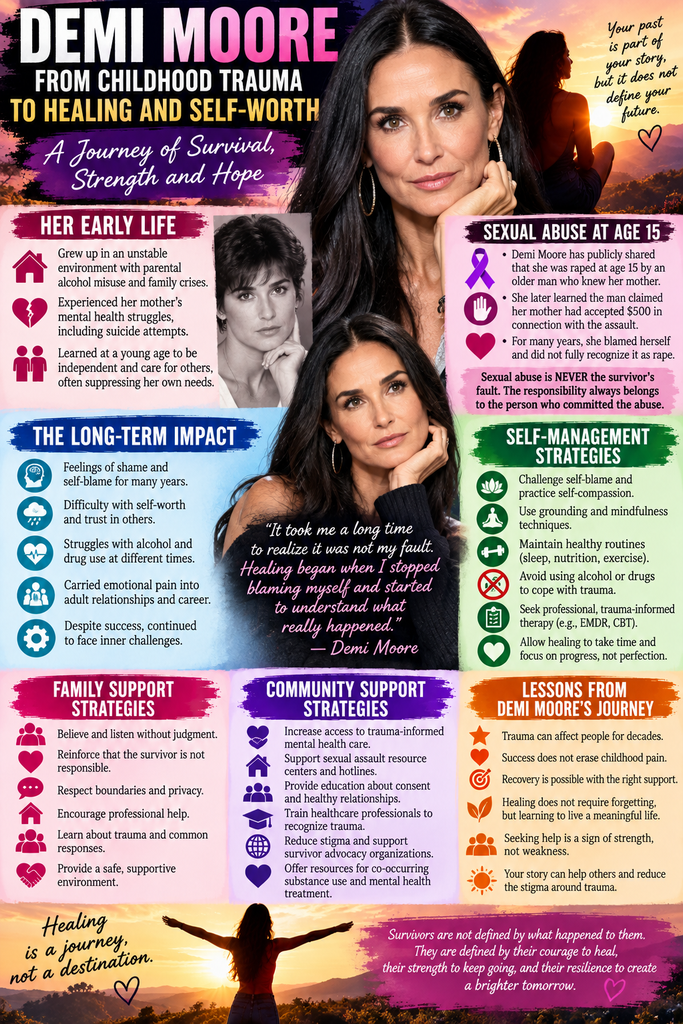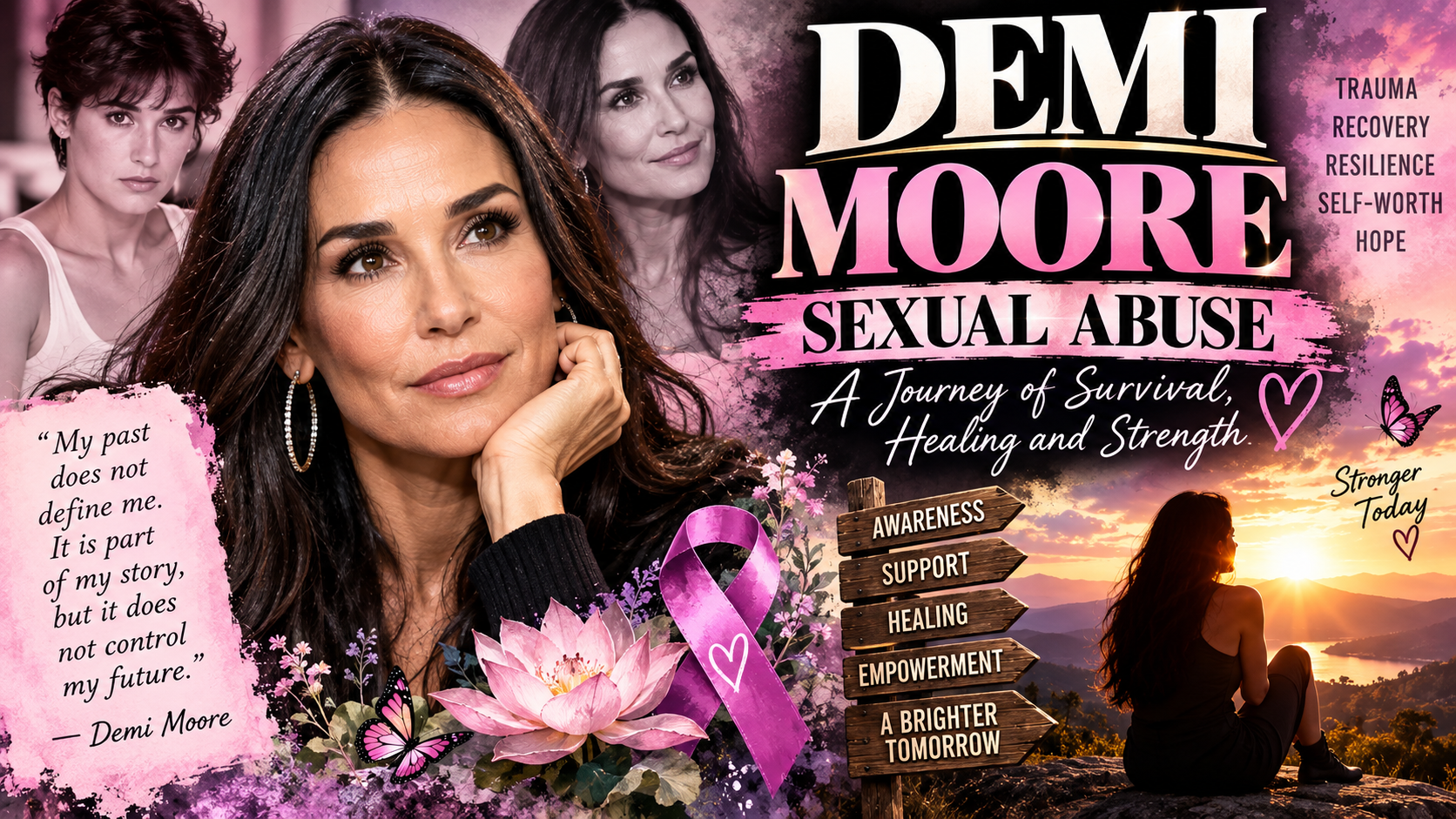
Demi Moore is widely recognized for her successful Hollywood career, but behind her public accomplishments is a childhood marked by instability, parental substance misuse, and sexual trauma. In her 2019 memoir Inside Out and subsequent interviews, Moore disclosed that she was raped at age 15 by an older man who knew her mother.
Moore has described carrying self-blame about the assault for much of her adult life. Her experience demonstrates an important reality about sexual trauma: the event may end, but feelings of shame, fear, mistrust, confusion, or diminished self-worth can persist for many years.
Her journey also offers an opportunity to discuss how self-management, supportive families, professional treatment, and compassionate communities can help survivors move toward healing.
A Childhood Marked by Instability
Moore has described growing up in an unstable environment in which alcohol misuse and family crises were common. She recalled her mother’s repeated suicide attempts and said that when she was 12, she intervened during one attempt by removing pills from her mother’s mouth. She also learned that the man she had believed was her biological father was not.
These experiences placed significant emotional responsibilities on Moore while she was still a child.
Children raised in unpredictable environments sometimes become extremely independent or learn to suppress their own needs because they focus on surviving the problems around them. What looks like extraordinary strength from the outside can sometimes coexist with considerable emotional pain.
Sexual Assault at Age 15
Moore has publicly said that when she was 15, an older man who knew her mother raped her after gaining access to their home.
According to Moore, the man later claimed her mother accepted $500 in connection with the encounter. Moore has been careful about this part of the story. She has said she does not believe there was necessarily a straightforward transaction in which her mother knowingly sold her, but believes her mother gave the man access and placed her in danger.
That distinction is important when discussing Moore’s experience. Her account should not be exaggerated beyond what she herself has said.
The Long-Term Effects of Self-Blame
One of the most significant aspects of Moore’s story is how long it took her to identify what happened as rape.
In a 2024 interview, Moore explained that for much of her adult life, she blamed herself, believing she had somehow put herself in the situation. She described compartmentalizing the experience and moving out shortly after turning 16.
This demonstrates something many sexual-assault survivors experience: self-blame can become part of the trauma.
A survivor may wonder:
- Why didn’t I recognize the danger?
- Why didn’t I fight harder?
- Did I somehow cause what happened?
- Why didn’t I tell someone?
- Why did I wait so long to understand or discuss it?
Sexual assault is the responsibility of the person who commits the assault—not the person who experiences it. Fear, freezing, confusion, compliance, or delayed disclosure do not make a survivor responsible.
Trauma, Self-Worth, and Later Life
Moore has discussed feelings of unworthiness that persisted despite tremendous professional success. In interviews surrounding Inside Out, she described examining the judgments she carried against herself and learning how difficult it could be to develop genuine self-love.
She has also publicly discussed periods of problematic alcohol and drug use. Her history should not be reduced to a simple claim that childhood sexual trauma directly caused later substance problems; addiction has multiple biological, psychological, and environmental influences. However, trauma and substance use can intersect when someone attempts to escape or numb difficult emotions.
For survivors, this is why treatment may need to address more than the traumatic event itself. Recovery may involve rebuilding identity, relationships, self-esteem, emotional regulation, and healthy coping skills.
Self-Management Strategies for Trauma Survivors
Self-management does not mean that survivors should handle trauma alone. Instead, these strategies can complement professional care and help people regain a sense of safety and control.
Helpful approaches include:
- Challenge self-blame. Responsibility belongs to the person who committed the abuse or assault.
- Recognize trauma triggers. Certain places, situations, smells, conversations, relationships, or sensations may unexpectedly produce distress.
- Practice grounding techniques. Slow breathing, mindfulness, sensory exercises, and focusing attention on the present can help during periods of heightened anxiety.
- Establish healthy boundaries. Survivors have the right to decide who has access to their time, bodies, personal information, and emotional space.
- Develop predictable routines. Sleep, nutrition, physical activity, and regular daily routines can create greater stability.
- Avoid relying on substances to numb emotional pain. Alcohol or drugs may provide temporary escape while creating additional difficulties.
- Seek trauma-informed professional care. Evidence-based psychotherapy can help survivors safely process traumatic experiences.
- Practice self-compassion. Healing may involve replacing shame and self-criticism with a more accurate understanding of what happened.
- Allow recovery to happen gradually. There is no required timeline for processing trauma.
Moore’s later reflections demonstrate how changing one’s interpretation of an experience can itself become part of healing. She has described eventually recognizing that what happened to her at 15 was rape rather than continuing to view herself as responsible.
Family Support Strategies
Families can play an important role in helping survivors recover, particularly by creating an environment where the survivor feels believed, respected, and safe.
Family members can:
- Believe survivors when they disclose abuse.
- Listen without demanding unnecessary details.
- Avoid questioning why the person did not leave, fight back, or disclose sooner.
- Reinforce that the survivor was not responsible for the abuse.
- Respect privacy and personal boundaries.
- Encourage professional counseling without forcing treatment.
- Ask what kind of support the survivor actually wants.
- Learn about common trauma responses.
- Avoid pressuring survivors to forgive the person who harmed them.
- Seek family counseling when trauma has affected the entire family.
Support should empower the survivor rather than take control away from them.
Breaking Harmful Family Patterns
Moore’s story also illustrates how trauma can exist within complicated family systems.
She has described growing up around parental alcohol misuse, instability, suicide attempts, and inappropriate situations while simultaneously trying to understand her relationship with her mother.
Healing does not always require viewing family members as entirely good or entirely bad. People can acknowledge that a parent had significant problems while also recognizing the harm that parent’s behavior caused.
For some survivors, healthy boundaries may involve maintaining relationships differently. For others, distance may be necessary. These decisions are highly personal and can benefit from professional guidance.
Community Support Strategies
Sexual trauma should not be treated solely as a private problem that survivors must manage by themselves. Communities can help create environments in which survivors feel safer seeking assistance.
Helpful community strategies include:
- Increase access to affordable trauma-informed mental health services.
- Provide sexual-assault crisis centers and confidential hotlines.
- Expand counseling and advocacy services for children and adolescents.
- Train healthcare professionals to recognize trauma responses.
- Provide age-appropriate education about consent and healthy relationships.
- Educate parents and caregivers about warning signs of abuse.
- Support survivor advocacy organizations.
- Improve access to substance-use treatment for survivors who develop co-occurring problems.
- Reduce stigma surrounding counseling and trauma treatment.
- Create environments where disclosures of abuse are taken seriously and handled appropriately.
Community responses should prioritize safety, dignity, confidentiality, and survivor choice.
The Importance of Speaking About Trauma
Moore eventually chose to discuss experiences that she had carried privately for decades.
Her memoir was not simply a collection of celebrity stories. She described it as part of understanding how she had arrived at difficult periods in her life and finding herself again.
Public disclosure can sometimes help reduce stigma, but survivors should never feel pressured to tell their stories publicly.
A person does not need to share traumatic experiences with the world to prove that healing has occurred.
Some survivors find strength through advocacy. Others heal privately through therapy, family, spirituality, friendships, creative expression, or other meaningful activities. Both approaches are valid.
Rebuilding Self-Worth
Perhaps one of the strongest themes in Moore’s journey is the gradual movement away from self-blame.
In discussing the assault decades later, Moore acknowledged how long she had believed that she somehow caused what happened.
Trauma can shape how people see themselves. Survivors may mistakenly interpret what happened as evidence that they are damaged, unworthy, powerless, or responsible.
Recovery challenges those beliefs.
The question can gradually shift from:
“What was wrong with me?”
to:
“What happened to me, how did it affect me, and what do I need now?”
That change can be an important part of reclaiming control.
Lessons From Demi Moore’s Journey
Demi Moore’s experiences demonstrate that professional success does not erase childhood trauma. Someone can build an extraordinary career while privately carrying unresolved shame, fear, grief, or questions about their own worth.
Her story also highlights several important lessons:
- Trauma can affect people for decades.
- Survivors may blame themselves even when they were not responsible.
- Childhood instability can influence later relationships and coping behaviors.
- Substance use may sometimes become intertwined with attempts to escape emotional distress.
- Professional treatment and healthy support systems can help survivors process trauma.
- Healing does not require forgetting what happened.
- Survivors have the right to determine when, how, and whether they share their experiences.
Conclusion
Demi Moore’s journey illustrates how childhood instability and sexual trauma can leave emotional effects that extend far beyond the original experience. She has described being raped at 15, carrying self-blame for decades, experiencing struggles with substance use and self-worth, and eventually confronting parts of her past through reflection and her memoir.
Her story also demonstrates why trauma recovery should not be viewed simply as “getting over” something painful.
Self-management can help survivors recognize triggers, establish boundaries, develop healthier coping strategies, and challenge self-blame. Family support can provide safety, validation, patience, and connection. Community support can ensure access to trauma-informed counseling, advocacy programs, crisis services, and education.
Most importantly, sexual abuse is never the survivor’s responsibility. Healing may take years and may involve setbacks, but survivors can gradually reclaim their sense of identity, safety, relationships, and self-worth.
The past remains part of a person’s story, but it does not have to determine the rest of that story.
Frequently Asked Questions
Here are some common questions:
1. Has Demi Moore publicly discussed experiencing sexual abuse?
Yes. Demi Moore has publicly disclosed that she was raped when she was 15 years old. She discussed the experience in her 2019 memoir Inside Out and in interviews surrounding its publication.
2. What did Demi Moore say happened when she was 15?
Moore has said that an older man who knew her mother raped her after gaining access to their home. She has described the experience as an important part of the childhood trauma she carried into adulthood.
3. Did Demi Moore say that her mother sold her for $500?
The situation requires careful wording. Moore said the man who assaulted her subsequently claimed that he had paid her mother $500. Moore has said she does not interpret this as a straightforward transaction in which her mother deliberately sold her, but she believes her mother put her in danger by allowing the man access to her.
4. Did Demi Moore blame herself for the assault?
Moore has discussed carrying significant self-blame and taking many years to fully recognize what happened to her as rape. Self-blame is not uncommon among sexual-assault survivors, but responsibility for sexual assault belongs to the perpetrator—not the survivor.
5. Why might survivors blame themselves after sexual abuse?
Trauma can alter how people interpret frightening experiences. Survivors may question why they did not fight, leave, recognize the danger, or disclose the assault immediately. Fear, freezing, confusion, delayed disclosure, or compliance during a threatening situation do not make someone responsible for being assaulted.
6. What other childhood difficulties has Demi Moore discussed?
Moore has described an unstable childhood involving frequent moves, parental alcohol misuse, family conflict, and her mother’s mental-health crises. She has also spoken about taking on significant responsibilities at a very young age.
7. Can childhood sexual trauma affect someone years later?
Yes. Sexual trauma can be associated with PTSD symptoms, depression, anxiety, difficulties with trust and relationships, shame, sleep disturbances, substance misuse, and problems with self-esteem. However, survivors respond differently, and experiencing sexual abuse does not mean a person will inevitably develop any particular mental-health condition.
8. Did Demi Moore experience problems with alcohol or drugs?
Moore has publicly discussed periods of problematic alcohol and drug use during her life. It is important not to assume that her sexual trauma directly caused these problems. Substance use disorders have multiple biological, psychological, environmental, and social influences.
9. Can trauma and substance use be connected?
They can be. Some trauma survivors use alcohol or drugs to temporarily numb anxiety, intrusive memories, shame, or emotional distress. Unfortunately, self-medication can eventually create additional mental-health, physical-health, and relationship problems.
10. What self-management strategies may help sexual-abuse survivors?
Helpful strategies can include:
- Challenging self-blaming thoughts.
- Recognizing emotional and environmental triggers.
- Practicing grounding, mindfulness, and relaxation techniques.
- Establishing healthy personal boundaries.
- Maintaining regular sleep, nutrition, and physical activity.
- Avoiding alcohol or drugs as a primary coping strategy.
- Seeking trauma-informed professional counseling.
- Developing supportive relationships.
- Practicing self-compassion rather than self-criticism.
Self-management should complement—not replace—professional care when trauma symptoms significantly interfere with daily life.
11. How can family members support a survivor?
Family members can listen without judgment, believe disclosures, respect privacy, reinforce that the survivor was not responsible, and ask what type of support the person wants. They can also encourage professional counseling while allowing the survivor to maintain control over personal treatment decisions.
12. What should families avoid saying to survivors?
Statements such as “Why didn’t you fight back?”, “Why didn’t you tell anyone?”, “You should have known better,” or “You need to forget about it” can reinforce shame. A more supportive response focuses on safety, listening, validation, and the survivor’s current needs.
13. Does a survivor have to forgive the person who harmed them in order to heal?
No. Forgiveness is an individual choice, not a requirement for psychological recovery. Trauma treatment can focus on safety, emotional regulation, self-worth, healthy relationships, and quality of life without requiring forgiveness.
14. Does a survivor have to publicly tell their story to recover?
No. Demi Moore chose to discuss her experiences publicly, but survivors are not obligated to disclose trauma publicly—or even to everyone close to them. Some people find advocacy empowering, while others prefer private healing. Both choices deserve respect.
15. How can communities better support sexual-abuse survivors?
Communities can increase access to trauma-informed counseling, sexual-assault crisis services, confidential advocacy, healthcare, substance-use treatment, and legal resources. Education about consent, healthy relationships, childhood abuse, and trauma responses can also help reduce stigma and victim-blaming.
16. Can someone heal after childhood sexual abuse?
Yes. Recovery may involve professional therapy, supportive relationships, healthier coping strategies, boundaries, and gradually rebuilding feelings of safety and self-worth. Healing does not necessarily mean forgetting what happened; it can mean reaching a point where the trauma no longer controls everyday life.
17. What can we learn from Demi Moore’s story?
Her public account illustrates that professional success does not necessarily reveal what someone has experienced privately. It also demonstrates how self-blame can persist for decades and why recognizing that responsibility belongs to the perpetrator can be an important part of healing.
Video: