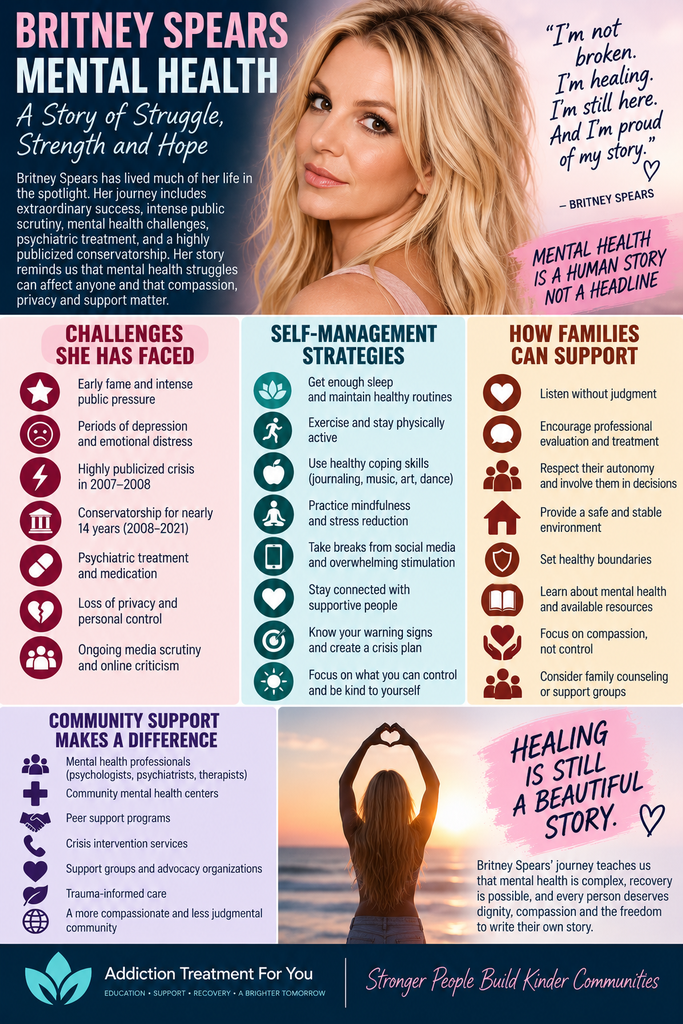
Britney Spears has spent much of her life under extraordinary public scrutiny. From becoming internationally famous as a teenager to highly publicized personal difficulties, psychiatric interventions, and nearly 14 years under a conservatorship, her experiences have generated worldwide discussion about mental health, personal autonomy, and the way society responds when a celebrity appears to be struggling.
One important distinction is necessary when discussing Spears: we should not diagnose her from a distance. Although various mental health diagnoses have been attributed to her in media reports and by other people, Spears herself has described experiences including depression, emotional distress, trauma, and psychiatric treatment. In her 2021 conservatorship testimony, she said she was depressed, had difficulty sleeping, and cried every day.
Her story therefore provides an opportunity to discuss mental health without turning someone’s behavior into a diagnosis.
Fame, Stress, and a Highly Publicized Crisis
Spears became one of the world’s most recognizable entertainers while still very young. Along with enormous professional success came relentless media attention surrounding her appearance, relationships, motherhood, and personal decisions.
During a particularly difficult period in 2007 and 2008, her behavior drew intense tabloid coverage. In January 2008, Spears was placed under psychiatric holds during a period involving a contentious custody battle.
These events eventually became connected with a court-ordered conservatorship established in 2008.
The conservatorship controlled significant aspects of Spears’ personal and financial life for nearly 14 years before a judge terminated it in November 2021. Spears later described the experience as deeply traumatic and wrote about it extensively in her memoir, The Woman in Me.
Mental Illness Should Not Be Diagnosed Through Social Media
Spears’ social media activity has frequently generated public speculation about her mental health. However, unusual behavior, appearance, or social media posts cannot establish a psychiatric diagnosis.
Mental health conditions require careful assessment by qualified professionals who can evaluate symptoms, duration, medical history, medications, substance use, functioning, and other possible explanations.
This is an important lesson extending far beyond Britney Spears: being concerned about someone is different from diagnosing them.
Britney Spears and Her Experiences With Treatment
Spears has publicly discussed psychiatric treatment and medication, but she has also described some treatment experiences as frightening and coercive.
She has alleged that during the conservatorship she was placed in a mental health facility against her wishes and given medications she did not want. She has specifically discussed lithium and restrictions she says were imposed on her while receiving treatment. Spears has subsequently described those experiences as traumatic.
Her experience highlights an important principle: effective mental healthcare should strive to combine safety with dignity, informed participation, and respect for the individual’s autonomy whenever clinically and legally possible.
Self-Management Strategies for Mental Wellness
No celebrity’s personal experience should become a universal treatment plan. However, several general self-management strategies can help people protect their mental health.
- Recognize personal warning signs. Changes in sleep, appetite, mood, energy, concentration, or behavior may signal that additional support is needed.
- Maintain consistent sleep. Irregular or inadequate sleep can worsen many psychiatric symptoms.
- Develop healthy routines. Exercise, nutritious meals, recreation, and predictable daily activities can provide stability.
- Limit overwhelming stimulation. Taking breaks from social media, conflict, or excessive public attention may reduce emotional overload.
- Use healthy emotional outlets. Journaling, music, art, dancing, meditation, and other meaningful activities can help process emotions.
- Stay connected. Isolation can make emotional difficulties harder to manage.
- Participate in treatment when appropriate. Psychotherapy, medication, or a combination of treatments may be helpful depending on the condition.
- Create a crisis plan. Know whom to contact when symptoms become overwhelming, or safety becomes a concern.
Self-management complements professional care; it does not replace it when significant psychiatric symptoms are present.
How Families Can Support Someone With Mental Health Challenges
Family relationships can profoundly influence recovery. Families may desperately want to protect someone they love, but support should ideally preserve as much independence and dignity as possible.
Helpful approaches include:
- Listen before immediately giving advice.
- Take concerning symptoms seriously without automatically assuming a diagnosis.
- Encourage appropriate professional evaluation.
- Ask the individual what kind of support would actually be helpful.
- Establish healthy boundaries when behavior becomes unsafe or destructive.
- Avoid humiliation, threats, and unnecessary public disclosure.
- Include the person in decisions whenever possible.
- Learn about mental health conditions and available treatments.
- Develop a crisis plan together.
- Seek counseling or family support when relationships become overwhelmed.
Family members should remember that support and control are not the same thing.
The Importance of Autonomy
Spears’ conservatorship became internationally controversial and helped generate broader conversations about autonomy and conservatorship law.
Her experience illustrates a complicated issue in mental healthcare: families and professionals may sometimes face situations involving genuine safety concerns, while individuals receiving treatment still have fundamental interests in privacy, dignity, and participation in decisions affecting their lives.
Good mental healthcare should not automatically reduce someone to a diagnosis. Whenever possible, the individual should remain an active participant in decisions about treatment and recovery.
Community Support Strategies
Families should not have to manage serious mental health concerns alone. Community resources can create additional layers of assistance.
Helpful resources may include:
- Primary care professionals
- Psychiatrists and psychiatric clinicians
- Psychologists and therapists
- Community mental health centers
- Peer-support programs
- Crisis intervention services
- Family education programs
- Support groups
- Trauma-informed treatment programs
- Social and vocational rehabilitation services
For people who have experienced involuntary treatment, loss of autonomy, or other traumatic experiences, trauma-informed care may be particularly important.
What Britney Spears’ Story Can Teach Us About Stigma
One of the most troubling aspects of Spears’ public struggles was the entertainment value placed on her distress.
Mental health symptoms should not be treated as entertainment.
When someone behaves unusually, the appropriate response is not automatically ridicule, amateur diagnosis, or viral speculation. More constructive questions include whether the person is safe, whether a professional assessment is appropriate, and what type of support might help.
This applies whether someone is an international celebrity or a member of our own family.
Mental Health Recovery Is Individual
Spears has continued to describe herself as healing from her past experiences. Her memoir gave her the opportunity to tell her story from her own perspective and reclaim a narrative that had often been constructed by others.
Recovery does not necessarily mean returning to the person someone was before a crisis. It may involve developing a new understanding of oneself, establishing boundaries, processing trauma, rebuilding relationships, and deciding what a meaningful future looks like.
Moving Forward
Britney Spears’ journey demonstrates how complicated mental health can become when psychiatric symptoms, family relationships, legal systems, celebrity, and public scrutiny intersect.
Her story should not lead us to conclude that a single diagnosis explains every behavior we see. Instead, it can teach a more valuable lesson: people experiencing mental health difficulties deserve appropriate treatment, compassion, dignity, privacy, and a meaningful voice in their own care.
Self-management can provide daily stability. Families can offer compassion while maintaining healthy boundaries. Mental health professionals and community organizations can provide treatment and additional support.
Most importantly, a psychiatric crisis should never become someone’s entire identity. Mental health challenges can be one part of a person’s story without defining the whole person.
Frequently Asked Questions
Here are some common questions:
1. Has Britney Spears been diagnosed with a mental illness?
Britney Spears’ mental health has been discussed extensively in the media, but the public should be cautious about assigning her a specific psychiatric diagnosis. She has publicly described depression, severe emotional distress, psychiatric treatment, and difficult experiences surrounding her mental healthcare. A diagnosis should come from qualified clinicians with access to the individual’s complete history.
2. What happened to Britney Spears’ mental health in 2007 and 2008?
During this period, Spears experienced intense public scrutiny, family and custody difficulties, and highly publicized personal crises. In 2008, she underwent psychiatric hospitalization, and a conservatorship was subsequently established. These events should be discussed carefully rather than assuming that individual behaviors prove a particular mental disorder.
3. Did Britney Spears experience depression?
Spears has publicly described feeling depressed and emotionally overwhelmed. During her 2021 conservatorship testimony, she said she was depressed, had difficulty sleeping, and frequently cried. Depression can affect mood, motivation, sleep, concentration, and everyday functioning.
4. Does Britney Spears have bipolar disorder?
Bipolar disorder has frequently been associated with Spears in media discussions, but it is inappropriate to diagnose a public figure based on reports, appearances, or social media behavior. Without reliable confirmation from Spears or appropriate clinical documentation, a specific diagnosis should not be presented as established fact.
5. What was Britney Spears’ conservatorship?
A court established a conservatorship over Spears in 2008 following a period of significant personal and psychiatric difficulties. It gave others substantial authority over aspects of her finances and personal affairs. The conservatorship remained in place for nearly 14 years before being terminated in November 2021.
6. How did Britney Spears describe the conservatorship?
Spears has described the experience as controlling and traumatic. During her public testimony and later in her memoir, she discussed restrictions involving her personal choices, medical treatment, and everyday life.
7. Did Britney Spears receive psychiatric medication?
Spears has publicly discussed receiving psychiatric medications, including lithium, during the conservatorship. She has described aspects of her medication treatment negatively. Medication decisions should always be individualized and made through appropriate clinical assessment and monitoring.
8. Can fame and constant media attention affect mental health?
Yes. Fame itself is not a psychiatric disorder, but chronic stress, loss of privacy, online harassment, sleep disruption, and intense public criticism can negatively affect psychological well-being. These pressures may be especially difficult for someone already experiencing emotional distress.
9. Can social media posts reveal whether Britney Spears has a mental illness?
No. Social media content cannot reliably establish a psychiatric diagnosis. A person’s clothing, dancing, speech, photographs, or unusual posts should not be used as substitutes for a professional mental health evaluation.
10. What self-management strategies can support mental wellness?
Helpful approaches may include maintaining a regular sleep schedule, exercising, eating consistently, reducing overwhelming stimulation, practicing mindfulness, journaling, engaging in meaningful activities, and staying connected with supportive people. Professional treatment may also be necessary depending on the person’s symptoms.
11. How can families support someone experiencing serious mental health difficulties?
Families can listen without ridicule, encourage professional assessment, learn about mental health conditions, and help create a safe environment. Whenever possible, the individual should participate meaningfully in decisions about their treatment and future.
12. When does family support become controlling?
Support becomes problematic when protecting someone unnecessarily removes their independence, privacy, or participation in decisions. Serious safety situations can sometimes require intervention, but mental healthcare should preserve autonomy and dignity as much as clinically and legally possible.
13. What is trauma-informed mental healthcare?
Trauma-informed care recognizes that previous experiences of fear, coercion, abuse, or loss of control can influence how someone responds to treatment. It emphasizes safety, trust, collaboration, empowerment, and respect for the person’s experiences.
14. What community resources can help people experiencing mental health problems?
Resources may include psychiatrists, psychologists, therapists, primary care professionals, community mental health centers, peer-support programs, crisis services, and family education organizations. Different people require different combinations of services.
15. What should families do during a serious mental health crisis?
If someone appears unable to remain safe, is threatening suicide or violence, is severely confused, or cannot adequately care for basic needs, urgent professional assessment may be necessary. In the United States, 988 provides access to the Suicide & Crisis Lifeline.
16. What can we learn from Britney Spears’ experience?
Her story encourages a broader conversation about the balance between mental healthcare, safety, autonomy, and dignity. Concern for someone’s well-being should not be taken as permission for public ridicule or amateur psychiatric diagnosis.
17. Why is it important not to label Britney Spears based on her behavior?
Psychiatric diagnoses are based on comprehensive clinical evaluations—not isolated videos, photographs, or news stories. Labeling someone without adequate information can reinforce stigma and spread misinformation about mental illness.
18. What is the central message of Britney Spears’ mental health journey?
One of the strongest lessons is that people experiencing psychological distress remain individuals deserving compassion, privacy, appropriate treatment, and a voice in decisions affecting their lives. Mental illness should never become a person’s entire identity.
Video: Britney Spears: A powerful look at mental health recovery #MentalHealthSupport #BritneySpears