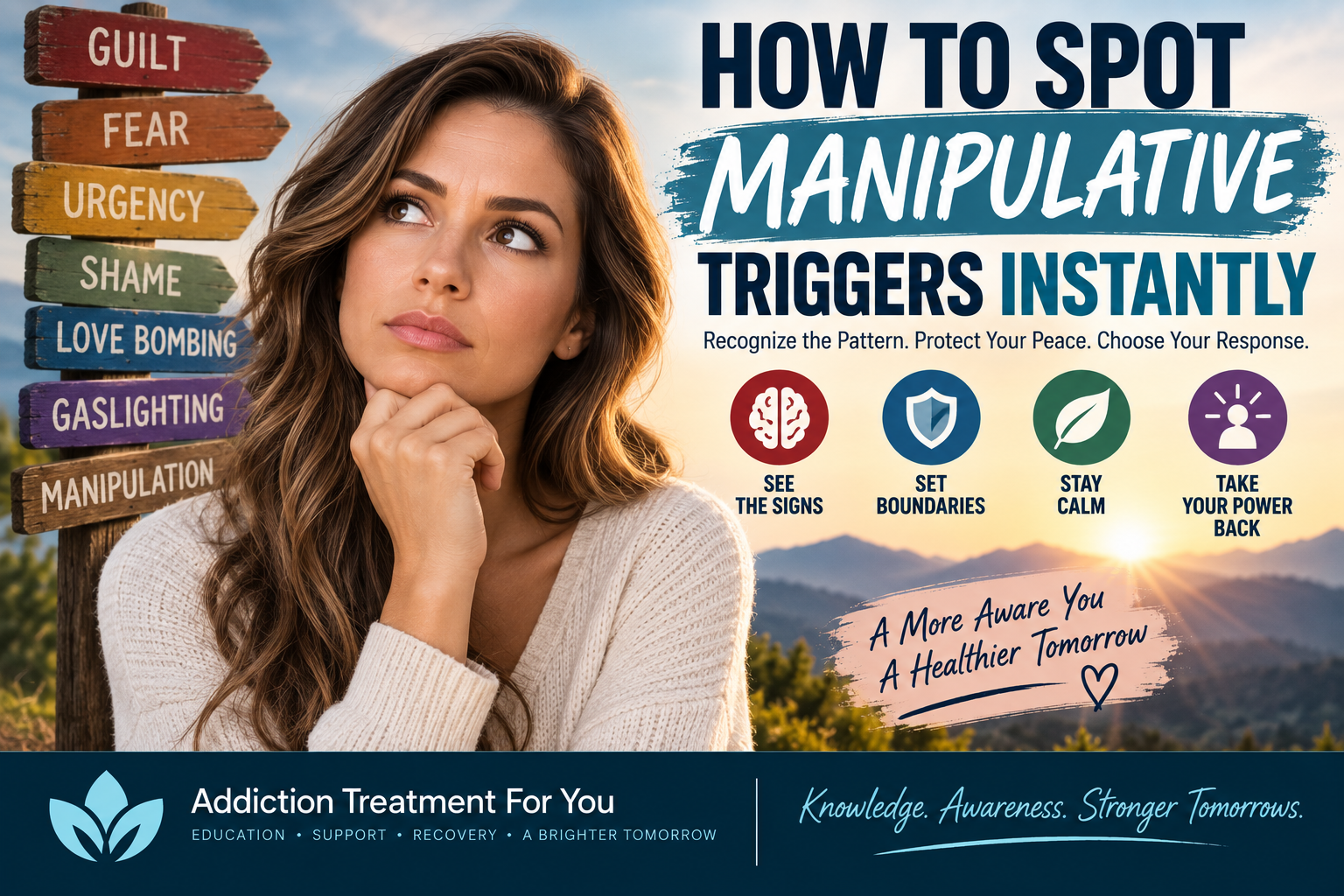
Manipulation is not always easy to identify because it may be subtle rather than openly controlling or threatening. It can appear through guilt, excessive compliments, silence, blame, fear, pressure to act quickly, or comments that cause you to question your own judgment. These emotional triggers may be used intentionally or unintentionally to influence how you think, feel, or respond.
Recognizing these patterns can be especially important during addiction recovery, mental health treatment, stressful relationships, or emotionally vulnerable periods. Feelings such as guilt, fear of rejection, loneliness, responsibility for others, or the need for approval can become powerful emotional pressure points when another person repeatedly uses them to influence your choices.
Recognizing manipulation does not mean assuming that every disagreement or uncomfortable interaction is unhealthy. Instead, the goal is to notice repeated patterns, pause before reacting, and protect your ability to make thoughtful decisions. Understanding your emotional triggers can help you establish healthier boundaries and make choices based on your needs, values, and well-being rather than guilt, fear, or pressure.
Why Manipulative Triggers Work
Manipulation often works by creating a strong emotion before you have time to evaluate what is happening.
You may suddenly feel guilty, afraid, confused, angry, ashamed, or responsible for another person’s happiness. Once that emotion becomes intense, you may agree to something you normally would refuse.
A useful question is:
“Would I make the same decision if I were calm and had time to think?”
If the answer is no, emotional pressure may be influencing the decision.
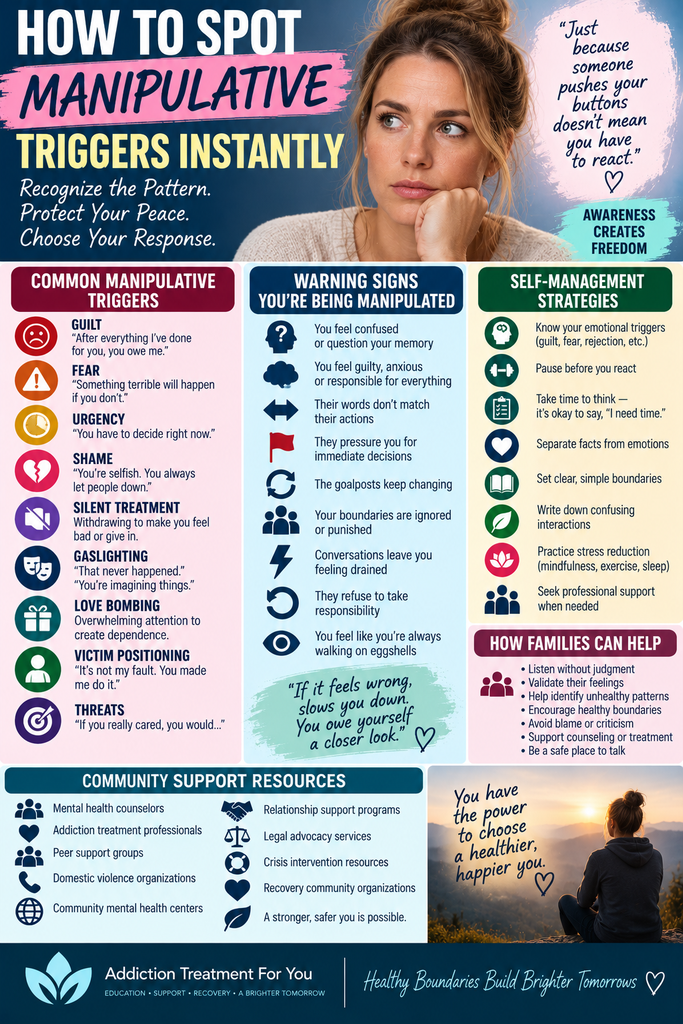
Common Manipulative Triggers to Recognize
Certain patterns deserve closer attention, especially when they happen repeatedly.
- Guilt: “After everything I’ve done for you, you owe me.”
- Fear: Suggesting terrible consequences will happen unless you cooperate.
- Urgency: “You have to decide right now.”
- Shame: Attacking your character instead of discussing the actual problem.
- Silent treatment: Withdrawing communication to pressure you into giving in.
- Gaslighting: Repeatedly denying or distorting events in ways that make you question your memory or perception.
- Love bombing: Using overwhelming attention, affection, praise, or promises to rapidly create emotional dependence or influence.
- Victim positioning: Making you responsible for solving every problem while avoiding personal accountability.
- Moving the goalposts: Changing expectations after you have already met the original request.
- Threatening abandonment: Using the possibility of ending a relationship to force compliance.
One behavior alone does not automatically prove manipulation. Look for repeated patterns, power imbalance, pressure, and what happens when you say no.
Watch What Happens When You Set a Boundary
One of the clearest ways to understand a relationship dynamic is to observe how someone responds to reasonable boundaries.
A healthy person may disagree with your boundary or feel disappointed, but they can usually discuss it.
A manipulative pattern may involve punishing someone for setting a boundary.
The person might become hostile, dramatically withdraw affection, increase guilt, threaten the relationship, repeatedly challenge your decision, or make you feel selfish simply for protecting yourself.
Your boundary does not require everyone else’s approval to be valid.
Self-Management: Pause Before You React
Recognizing manipulation becomes easier when you learn your own emotional vulnerabilities.
Ask yourself which emotions make you easiest to influence. Is it guilt? Fear of rejection? Loneliness? Anger? The need to keep everyone happy?
Helpful self-management strategies include:
- Identify situations that repeatedly leave you feeling pressured or confused.
- Notice physical reactions such as a racing heart, tension, or sudden anxiety.
- Avoid making major decisions during intense emotional moments.
- Give yourself permission to say, “I need time to think.”
- Write down what happened after confusing conversations.
- Separate facts from accusations and assumptions.
- Practice clear, short boundaries rather than lengthy explanations.
- Discuss difficult interactions with a trusted, objective person.
- Reduce contact when repeated manipulation is harming your well-being.
- Seek professional support when you feel unable to establish safe boundaries.
The objective is not to become emotionally detached. It is to prevent emotion from automatically controlling your decisions.
Manipulation and Addiction Recovery
Manipulative dynamics can become particularly dangerous during addiction recovery.
Someone may pressure a person in recovery to return to old environments, use substances, provide money, hide relapse, or abandon treatment.
Statements such as “One drink won’t hurt,” “You’ve changed since you got sober,” or “If you really cared about me, you’d come with us” can activate guilt and the desire to belong.
Recovery may require choosing personal safety even when other people dislike those choices.
Healthy recovery boundaries can include refusing substances, leaving risky environments, limiting contact with people who repeatedly undermine sobriety, and maintaining treatment appointments despite social pressure.
How Families Can Help
Families can support someone experiencing manipulation without automatically taking control of the situation.
Helpful family strategies include:
- Listen carefully before giving advice.
- Help identify repeated behavioral patterns.
- Validate emotions without automatically agreeing with every interpretation.
- Avoid criticizing the person for remaining in a complicated relationship.
- Encourage healthy boundaries.
- Help develop responses to predictable pressure tactics.
- Offer a safe place to discuss confusing interactions.
- Encourage counseling when manipulation is persistent or severe.
- Take threats, stalking, coercion, or violence seriously.
Instead of repeatedly saying, “Why do you keep letting this happen?” families can ask, “What makes it difficult for you to say no in this situation?”
That question may reveal fear, financial dependence, emotional attachment, trauma, isolation, or other barriers.
Community Support Makes a Difference
Sometimes personal insight and family support are not enough.
Community resources can provide education, perspective, safety planning, and professional guidance.
Helpful resources may include:
- Mental health counselors
- Addiction treatment professionals
- Peer recovery specialists
- Relationship support groups
- Domestic violence organizations
- Community mental health centers
- Family counseling programs
- Legal advocacy services when appropriate
- Crisis intervention resources
Seeking outside support does not automatically mean ending a relationship. Sometimes professional guidance helps people understand what is happening and determine which boundaries or safety measures are appropriate.
Manipulation Is Different From Disagreement
This distinction is important.
Someone disagreeing with you is not automatically gaslighting you. A partner asking for compromise is not necessarily controlling. A family member expressing disappointment is not always guilt-tripping.
Healthy relationships include disagreements.
The difference often lies in whether both people are allowed to have needs, boundaries, opinions, and the freedom to say no without intimidation or punishment.
Trust Patterns, Not Just Promises
Manipulation becomes easier to recognize when you stop evaluating isolated statements and start examining patterns.
Ask yourself:
Do their words consistently match their actions?
Can I disagree without being punished?
Am I allowed to say no?
Do I frequently leave conversations feeling guilty, confused, frightened, or responsible for everything?
Does this person accept responsibility for their own behavior?
Do I feel pressured to abandon my values, treatment, recovery, or boundaries to keep the relationship peaceful?
Your answers can reveal more than one argument ever could.
Moving From Reaction to Personal Power
Recognizing manipulative triggers is not about becoming suspicious of everyone around you. It is about developing enough self-awareness to notice when emotional pressure begins replacing healthy communication.
Pause before reacting. Identify the emotion being activated. Examine the facts. Set a boundary when necessary. Ask for outside perspective when you cannot see the situation clearly.
Self-management strengthens awareness. Families can provide perspective and emotional support. Community resources can offer professional guidance and protection when manipulation becomes coercive or dangerous.
The most powerful change may happen when you realize that another person’s urgency does not have to become your emergency, their guilt does not automatically become your responsibility, and their disappointment does not require you to abandon a healthy boundary.
Recognizing the trigger gives you something manipulation depends on you not having: time to choose your response.
Frequently Asked Questions
Here are some common questions:
1. What is a manipulative trigger?
A manipulative trigger is an emotional pressure point that influences someone’s behavior or decisions. Guilt, fear, shame, rejection, urgency, loneliness, or the desire for approval may be used—intentionally or habitually—to push someone toward a particular response.
2. What are the most common signs of manipulation?
Common patterns include guilt-tripping, intimidation, excessive urgency, repeated blame, silent treatment, gaslighting, love bombing, moving the goalposts, threatening abandonment, and refusing to respect reasonable boundaries.
3. How can I recognize manipulation quickly?
Pay attention to how you feel during the interaction. If you suddenly feel pressured, confused, guilty, frightened, or responsible for fixing everything, delay your response and examine what is happening. Ask yourself, “Would I make this decision if I felt calm and had more time?”
4. Is guilt-tripping a form of manipulation?
It can be. Statements such as “After everything I’ve done for you” may be manipulative when guilt is repeatedly used to obtain compliance. However, simply expressing disappointment or hurt is not automatically manipulation.
5. What is gaslighting?
Gaslighting is a pattern of psychological manipulation in which someone repeatedly distorts, denies, or challenges another person’s experiences in ways that can cause them to question their perceptions or memory. An ordinary disagreement or inaccurate recollection is not necessarily gaslighting.
6. What is love bombing?
Love bombing generally refers to overwhelming someone with affection, attention, praise, gifts, or promises to rapidly establish emotional influence or dependence. Generosity and affection alone are not manipulation; the broader pattern and what follows matter.
7. Why does urgency work so well as a manipulation tactic?
Urgency reduces the time available to evaluate a decision. Statements such as “You have to decide right now” can create anxiety and encourage an emotional rather than thoughtful response.
8. How can I tell manipulation from a normal disagreement?
Healthy disagreements allow both people to express opinions and establish boundaries. Manipulative interactions repeatedly use pressure, fear, punishment, deception, or emotional leverage to obtain compliance.
9. What happens when I set a boundary with a manipulative person?
Their reaction can provide useful information. Someone may reasonably feel disappointed by your boundary, but repeated intimidation, threats, guilt, retaliation, or withdrawal of affection designed to make you surrender the boundary can indicate an unhealthy pattern.
10. What should I do when I realize I am being emotionally triggered?
Avoid responding immediately when possible. Slow the conversation down, identify the emotion you are experiencing, separate facts from assumptions, and give yourself time to decide. A simple response such as “I need time to think about that” can interrupt the pressure.
11. Why do some people have difficulty recognizing manipulation?
Fear of rejection, people-pleasing, previous trauma, low self-confidence, financial dependence, loneliness, or growing up around unhealthy relationship patterns can make certain behaviors seem normal. Recognizing these vulnerabilities can strengthen self-awareness.
12. How can self-management protect me from manipulation?
Identify your emotional triggers, practice pausing before responding, maintain healthy boundaries, document confusing interactions when appropriate, manage stress, and seek an objective perspective from someone you trust.
13. How can manipulation affect addiction recovery?
People in recovery may encounter pressure to drink or use drugs, return to risky environments, lend money, conceal another person’s substance use, or abandon treatment. Learning to recognize guilt, social pressure, and fear of rejection can help protect recovery.
14. How can families help someone experiencing manipulation?
Families can listen without immediately criticizing, help identify repeated patterns, reinforce healthy boundaries, and encourage professional support. Asking “What makes it difficult to say no?” can be more helpful than blaming someone for remaining in a difficult relationship.
15. What community resources can help?
Mental health professionals, addiction treatment programs, peer-support groups, relationship counselors, community mental health centers, domestic violence organizations, crisis services, and legal advocacy programs may provide additional assistance depending on the situation.
16. Should I immediately end a relationship if I notice manipulation?
Not necessarily. Context, frequency, severity, willingness to change, and personal safety all matter. However, coercion, threats, stalking, physical violence, or escalating control should be taken seriously and may require professional safety planning.
17. Can someone manipulate others without realizing it?
Yes. Some people learn unhealthy communication patterns and may use guilt, withdrawal, or pressure without fully recognizing what they are doing. Lack of awareness does not mean the behavior should be ignored, but willingness to acknowledge and change it matters.
18. What is the fastest way to take back control during a manipulative interaction?
Slow down. Manipulation is often more effective when you feel you must react immediately. Pausing gives you time to recognize the trigger, evaluate the facts, and choose your response.
19. What questions can help me identify a manipulative pattern?
Ask yourself: Do I feel safe saying no? Are my boundaries respected? Do this person’s actions match their words? Am I frequently made responsible for their emotions? Do I repeatedly leave conversations feeling confused, frightened, ashamed, or guilty?
20. What is the most important lesson about manipulative triggers?
Recognizing manipulation is not about becoming suspicious of everyone. It is about developing enough awareness to recognize when emotional pressure begins replacing respectful communication. You cannot always control another person’s behavior, but you can learn to pause, protect your boundaries, and choose how you respond.
Video: How to Tell If You’re Being Manipulated #redflags #selfcare