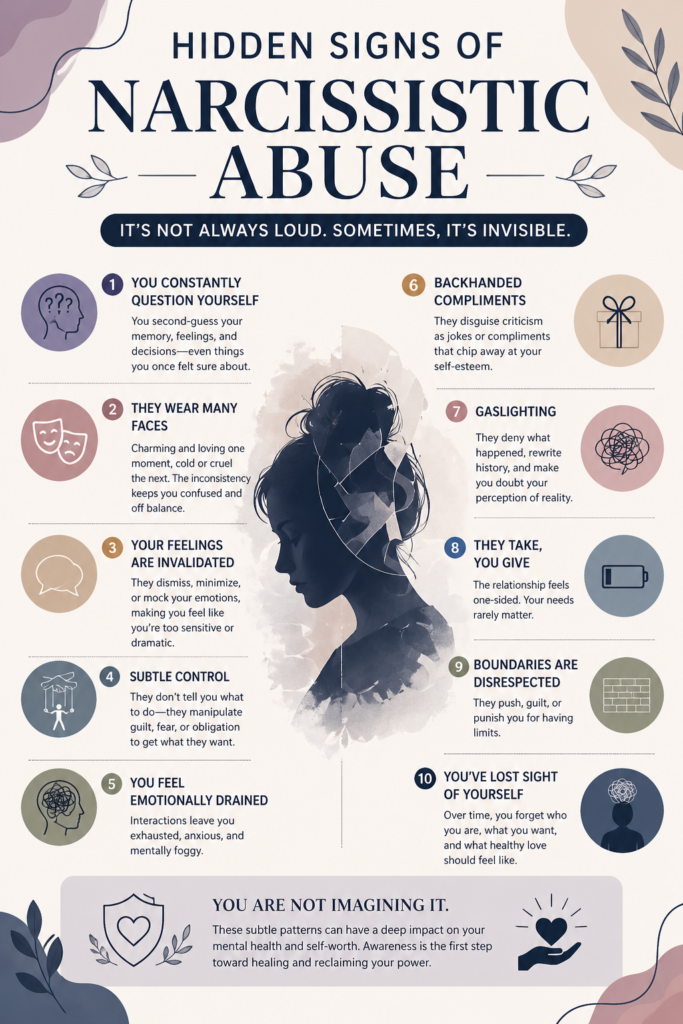
Hidden narcissistic abuse rarely presents in obvious or dramatic ways. Instead, it unfolds through subtle patterns—chronic self-doubt, emotional confusion, and a gradual erosion of confidence—that are easy to overlook or misinterpret. Because these behaviors are often indirect or disguised as concern, humor, or normal conflict, many people struggle to recognize what they are experiencing. While these dynamics are frequently associated with traits seen in Narcissistic Personality Disorder, the impact extends beyond any label. Understanding the hidden signs is essential, not only for identifying harmful patterns but also for reconnecting with your own sense of clarity and self-trust.
Invisible Damage: Recognizing the Hidden Signs of Narcissistic Abuse
Narcissistic abuse rarely looks like what people expect. There are no obvious bruises, no dramatic confrontations that clearly signal “this is wrong.” Instead, it often unfolds quietly—through subtle patterns that, over time, reshape how a person thinks, feels, and sees themselves. Because it’s so covert, many people don’t recognize it until they’re already deeply affected.
What Makes Narcissistic Abuse “Hidden”?
At its core, narcissistic abuse is about control, validation-seeking, and maintaining power—often associated with traits seen in Narcissistic Personality Disorder. But not everyone who engages in these behaviors has a diagnosis. The “hidden” part comes from how the behaviors are delivered: indirectly, inconsistently, and often disguised as care, humor, or concern.
This creates confusion. You may feel hurt, but struggle to explain why.
Subtle Signs You Might Be Experiencing Narcissistic Abuse
1. You Constantly Question Yourself
You second-guess your memory, your reactions, even your emotions. This often stems from gaslighting, where your reality is denied or rewritten.
You might hear:
- “That never happened.”
- “You’re too sensitive.”
- “You’re imagining things.”
Over time, your internal compass weakens.
2. Compliments Feel… Off
Praise comes with a hidden sting:
- “You look good today—finally.”
- “I didn’t expect you to do that well.”
This is often called negging—a tactic that lowers your confidence while keeping you seeking approval.
3. You Feel Drained After Interactions
You leave conversations feeling:
- Emotionally exhausted
- Confused about what just happened
- Like you somehow did something wrong
This happens because the interaction subtly revolves around their needs, emotions, or validation.
4. Boundaries Are Ignored (But Subtly)
Instead of outright violating your boundaries, they:
- Push “just a little.”
- Frame it as a joke or misunderstanding
- Make you feel guilty for having limits
You may find yourself giving in just to avoid tension.
5. You Feel Responsible for Their Emotions
Their moods become your responsibility. If they’re upset, you feel like you caused it—even when you didn’t.
This creates a pattern of emotional caretaking in which your needs slowly disappear.
6. The Relationship Feels Like a Rollercoaster
There are intense highs (attention, affection) followed by confusing lows (withdrawal, criticism). This cycle—often called intermittent reinforcement—can make the relationship feel addictive and hard to leave.
Why It’s Hard to Recognize
Narcissistic abuse doesn’t start harshly. It often begins with:
- Strong attention or admiration
- Feeling “seen” or special
- Rapid emotional closeness
That contrast makes later behaviors harder to identify as harmful. You may hold onto the early version of the relationship, hoping it returns.
The Psychological Impact
Over time, hidden abuse can lead to:
- Chronic self-doubt
- Anxiety or hypervigilance
- Emotional numbness
- Loss of identity
Many people describe it as feeling “disconnected from themselves” rather than as obvious abuse, which is why it often goes unnoticed.
Moving Toward Clarity and Recovery
Recognizing these patterns is a critical first step. You don’t need dramatic evidence for your experience to be valid. Subtle harm is still harm—especially when it’s repeated.
Helpful steps include:
- Rebuilding trust in your own perceptions
- Setting and maintaining small, clear boundaries
- Talking to a therapist or a trusted person
- Learning about relational patterns and emotional manipulation
Final Thought
Hidden narcissistic abuse works precisely because it’s hard to name. Once you begin to see the patterns, things often become clearer—and with clarity comes the ability to make more grounded, self-protective choices.
Reclaiming Your Reality: Self-Management Strategies for Hidden Narcissistic Abuse
Narcissistic abuse doesn’t always announce itself. It often shows up as confusion, self-doubt, emotional exhaustion, and a subtle loss of your sense of self. When the signs are hidden, the most powerful shift begins internally—how you manage your thoughts, boundaries, and emotional responses.
While these patterns are commonly associated with traits seen in Narcissistic Personality Disorder, you don’t need a diagnosis to be affected. What matters is how the behavior impacts you—and how you begin to take back control.
Why Self-Management Matters
When abuse is covert, you may not have clear external validation. That’s why self-management becomes essential. It helps you:
- Re-anchor your perception of reality
- Reduce emotional reactivity
- Protect your mental and physical energy
- Rebuild a stable sense of identity
This isn’t about “fixing” the other person—it’s about stabilizing you.
1. Strengthen Your Internal Reality
One of the most destabilizing aspects of hidden abuse is self-doubt. You may start questioning your memory, reactions, or intuition.
Strategies:
- Keep a daily journal of interactions and how they made you feel
- Write events as they happened, without filtering
- Revisit entries to identify patterns
This builds evidence-based self-trust—a critical counter to gaslighting.
2. Use the “Pause Before Responding” Rule
Narcissistic dynamics often pull you into quick emotional reactions. Slowing down disrupts that cycle.
Try this:
- Pause for 3–5 seconds before responding
- Ask yourself: “What is actually being said vs. what I feel?”
- Respond with intention—not impulse
This reduces emotional manipulation and keeps you grounded.
3. Set Micro-Boundaries (and Stick to Them)
Big boundaries can feel overwhelming at first. Start small.
Examples:
- “I’m not available to talk about this right now.”
- “I’ll think about it and get back to you.”
- Limiting how much personal information you share
Consistency matters more than intensity. Small, repeated boundaries reshape the dynamic over time.
4. Detach from Emotional Responsibility
A common hidden pattern is feeling responsible for someone else’s moods.
Reframe:
- Their emotions = their responsibility
- Your role = manage your response, not fix theirs
A helpful internal script:
“I can care, but I don’t have to carry.”
This reduces guilt-driven behavior.
5. Limit Over-Explaining
Over-explaining often invites more manipulation or debate.
Practice:
- Keep responses short and neutral
- Avoid defending every decision
- Repeat your boundary if needed (without adding new justification)
This is sometimes called the “broken record” technique—calm, consistent repetition.
6. Rebuild Emotional Awareness
Hidden abuse can disconnect you from your own feelings.
Daily check-in:
- What am I feeling right now?
- Where do I feel it in my body?
- What triggered it?
This reconnects you with your internal signals—your most reliable guide.
7. Create Psychological Distance
You don’t always need to physically leave to create distance.
Ways to do this:
- Mentally observe interactions like a third party
- Reduce emotional investment in their reactions
- Limit frequency or depth of engagement when possible
Distance brings clarity.
8. Anchor Yourself in External Support
When your internal reality has been challenged, an outside perspective helps recalibrate.
Consider:
- Talking with a therapist
- Connecting with a trusted friend
- Joining support groups (especially in recovery contexts)
The goal is not validation alone, but reality reinforcement.
The Bigger Picture: Regaining Control
Self-management isn’t about perfection. It’s about gradually shifting from:
- Reacting → Responding
- Doubting → Trusting yourself
- Absorbing → Observing
Over time, these small shifts rebuild autonomy and emotional stability.
Final Thought
Hidden narcissistic abuse works by slowly disconnecting you from yourself. Self-management strategies reverse that process—quietly, steadily, and powerfully.
You don’t need to win every interaction. You just need to stay connected to your reality.
Stronger Together: Family Support Strategies for Hidden Narcissistic Abuse
Narcissistic abuse is often difficult to see from the outside. It doesn’t always involve obvious conflict or visible harm—instead, it can show up as confusion, self-doubt, withdrawal, or subtle personality changes. For families, this creates a unique challenge: how do you support someone when the harm isn’t clearly visible?
While these patterns are often associated with traits seen in Narcissistic Personality Disorder, the focus here isn’t diagnosis—it’s impact. Families can play a powerful role in helping someone regain clarity, stability, and a sense of self.
Why Family Support Matters
When someone is experiencing hidden narcissistic abuse, they may:
- Doubt their own perceptions
- Minimize their experiences
- Feel isolated or misunderstood
- Struggle to explain what’s happening
Supportive family members can act as a grounding force, helping restore trust in reality and reinforcing emotional safety.
1. Lead With Belief, Not Judgment
One of the most impactful things you can do is simply believe them.
Even if the situation seems unclear, avoid responses like:
- “Are you sure that’s what happened?”
- “Maybe you’re overthinking it.”
Instead, try:
- “That sounds really confusing.”
- “I can see why that would affect you.”
Validation helps rebuild their trust in their own experiences.
2. Reflect, Don’t Interpret
People in these dynamics often feel told what to think. Avoid replacing one voice of control with another.
Helpful approach:
- Reflect what you hear: “It sounds like you felt dismissed when that happened.”
- Ask open-ended questions instead of giving conclusions
This supports autonomy rather than taking it over.
3. Watch for Subtle Behavioral Changes
Because the abuse is hidden, changes may be gradual:
- Increased anxiety or hesitation
- Apologizing excessively
- Withdrawing from activities or relationships
- Seeming “less like themselves.”
Gently noticing and naming these changes can help them connect the dots.
4. Avoid Forcing Decisions
It can be tempting to say:
- “You need to leave.”
- “Just cut them off.”
But pressure can increase stress and defensiveness.
Instead:
- Offer perspective, not ultimatums
- Respect their timing and readiness
- Stay consistent in your support
Empowerment is more effective than urgency.
5. Reinforce Their Sense of Self
Hidden narcissistic abuse often erodes identity.
You can help by:
- Reminding them of their strengths and values
- Encouraging activities they once enjoyed
- Supporting independent decision-making
This helps rebuild a stable internal foundation.
6. Model Healthy Boundaries
Sometimes the most powerful teaching is by example.
Show what healthy boundaries look like:
- Communicating clearly and calmly
- Respecting your own limits
- Not over-explaining or over-apologizing
This gives them a reference point for healthier dynamics.
7. Stay Calm During Emotional Spillover
They may bring confusion, frustration, or emotional overwhelm into conversations.
Your role isn’t to fix it—but to stabilize the environment:
- Stay calm and regulated
- Avoid escalating or reacting defensively
- Offer a steady, consistent presence
Calm is contagious in the best way.
8. Encourage Professional and Peer Support
Family support is important—but it’s not the only support needed.
Encourage:
- Therapy or counseling
- Support groups (especially in recovery settings)
- Educational resources about relational patterns
This broadens their support system and reduces dependency on any single source.
The Bigger Picture: Supporting Without Losing Yourself
Supporting someone through hidden narcissistic abuse can be emotionally demanding. It’s important to:
- Maintain your own boundaries
- Avoid becoming their sole emotional outlet
- Take care of your own mental health
You’re most helpful when you’re grounded yourself.
Final Thought
Hidden narcissistic abuse thrives in confusion and isolation. Family support brings clarity, stability, and connection back into the picture.
You don’t have to have all the answers. Being a consistent, calm, and validating presence is often more powerful than trying to solve the problem.
Beyond Isolation: Using Community Resources to Address Hidden Narcissistic Abuse
Hidden narcissistic abuse often thrives in silence. Because the signs are subtle—self-doubt, confusion, emotional exhaustion—it can be hard to name what’s happening, let alone seek help. That’s where community resources become essential. They offer perspective, validation, and practical support that can’t always be built alone.
While these patterns are commonly associated with traits seen in Narcissistic Personality Disorder, the focus here is on access to support systems that help individuals regain clarity and stability.
Why Community Support Matters
When someone is dealing with covert abuse, they may feel:
- Isolated or misunderstood
- Unsure if their experience “counts” as abuse
- Reluctant to speak up without proof
Community resources help by:
- Providing external validation
- Offering education and language for what’s happening
- Creating safe environments for processing experiences
In short, they help turn confusion into understanding.
1. Mental Health Professionals and Counseling
Therapists trained in trauma or relational dynamics can help identify patterns that are difficult to see on your own.
What to look for:
- Experience with emotional or psychological abuse
- Trauma-informed approaches
- A focus on rebuilding self-trust and boundaries
Therapy offers structured, confidential support and helps reframe distorted beliefs caused by manipulation.
2. Support Groups (In-Person or Online)
Hearing others describe similar experiences can be a turning point.
Benefits:
- Reduces isolation
- Normalizes your reactions
- Helps you recognize patterns faster
Many people report that support groups give them language for experiences they couldn’t previously explain.
3. Crisis and Helpline Services
Even when abuse is not physically dangerous, emotional distress can escalate.
In the U.S., you can contact the 988 Suicide & Crisis Lifeline by dialing or texting 988 for immediate support.
These services:
- Provide real-time emotional support
- Help you regulate overwhelming moments
- Offer guidance on next steps
They are available even if you’re unsure how serious your situation is.
4. Domestic Violence and Advocacy Organizations
Narcissistic abuse often overlaps with emotional or psychological abuse recognized by advocacy groups.
Organizations like the National Domestic Violence Hotline provide:
- Confidential chat and phone support
- Safety planning (even for non-physical abuse)
- Resource referrals in your area
They can help you assess your situation without pressure to act.
5. Educational Resources and Workshops
Understanding what’s happening reduces confusion and self-blame.
Look for:
- Workshops on boundaries and communication
- Psychoeducation on emotional manipulation
- Books and lectures by licensed professionals
Education turns vague discomfort into recognizable patterns.
6. Faith-Based and Community Centers
For some, support within a trusted community can feel more accessible.
These spaces may offer:
- Counseling or pastoral care
- Peer-led support groups
- A sense of belonging and stability
The key is ensuring the environment prioritizes emotional safety and autonomy.
7. Legal and Advocacy Resources (When Needed)
If the situation involves shared finances, housing, or custody, legal guidance may be helpful.
Community legal aid services can:
- Clarify your rights
- Help document patterns of behavior
- Offer protective options if necessary
Even if you’re not ready to act, information reduces uncertainty.
8. Recovery-Focused Communities
For individuals in addiction recovery, these dynamics can intersect with:
- Emotional triggers
- Codependency patterns
- Relapse risk
Recovery communities provide:
- Structured peer support
- Accountability
- Emotional regulation tools
This can be especially important when relationship stress affects the stability of recovery.
Building Your Personal Resource Network
You don’t need to use every resource. Start with one or two that feel safest.
A simple framework:
- Immediate support: Helplines or trusted individuals
- Ongoing support: Therapy or groups
- Educational support: Books, workshops, or courses
Layering support creates resilience.
Final Thought
Hidden narcissistic abuse isolates by design. Community resources reverse that—bringing in clarity, connection, and support from multiple directions.
You don’t have to figure it out alone. In fact, healing is often faster—and more stable—when you don’t.
Frequently Asked Questions
Here are some common questions:
1. What is narcissistic abuse?
Narcissistic abuse refers to a pattern of emotional, psychological, and sometimes verbal manipulation used to control or dominate another person. It is often linked to traits seen in Narcissistic Personality Disorder, but a formal diagnosis is not required for harmful behaviors to occur.
2. Why is narcissistic abuse hard to recognize?
Because it’s often subtle and indirect. Instead of obvious aggression, it may involve:
- Gaslighting
- Passive-aggressive comments
- Inconsistent affection
These behaviors create confusion rather than clear conflict.
3. What are the most common hidden signs?
Some key indicators include:
- Constant self-doubt
- Feeling “on edge” around the person
- Emotional exhaustion after interactions
- Difficulty trusting your own memory or feelings
- Feeling responsible for their emotions
4. Is gaslighting always intentional?
Not always. Some individuals may not fully recognize their behavior. However, intent does not change impact—if it causes confusion, self-doubt, or distress, it still matters.
5. How is this different from normal relationship conflict?
Healthy conflict:
- Allows both people to express themselves
- Leads to resolution or understanding
Narcissistic patterns:
- Shift blame
- Avoid accountability
- Leave one person consistently confused or diminished
6. Can someone experience this without realizing it?
Yes—very commonly. The gradual nature of the behavior makes it hard to detect. Many people only recognize it after:
- Talking to others
- Learning about manipulation patterns
- Noticing long-term emotional effects
7. Why do people stay in these relationships?
Several factors can contribute:
- Emotional attachment or early positive experiences
- Intermittent reinforcement (cycles of good and bad)
- Fear, guilt, or self-blame
- Loss of confidence in their own judgment
8. Does narcissistic abuse only happen in romantic relationships?
No. It can occur in:
- Family dynamics
- Friendships
- Work environments
Any relationship with a power imbalance or emotional manipulation can involve these patterns.
9. What are the long-term effects?
Over time, it can lead to:
- Anxiety and hypervigilance
- Low self-esteem
- Emotional numbness
- Difficulty trusting others
- Loss of identity
10. How can someone start protecting themselves?
Some initial steps include:
- Keeping track of interactions (journaling)
- Setting small, clear boundaries
- Reducing emotional reactivity
- Seeking outside perspective (trusted people or professionals)
11. Should you confront the person?
It depends. Confrontation can sometimes escalate into manipulation or defensiveness.
In many cases, it’s more effective to:
- Focus on your own boundaries
- Limit engagement in unhealthy dynamics
- Prioritize your safety and clarity
12. When should someone seek professional help?
Consider reaching out if:
- You feel persistently confused or emotionally drained
- Your self-esteem has significantly declined
- You’re struggling to make decisions or trust yourself
A therapist can help you rebuild clarity and emotional stability.
13. Is recovery possible?
Yes. With awareness and support, people can:
- Rebuild self-trust
- Establish healthier boundaries
- Form more balanced relationships
Recovery is often gradual, but very achievable.
14. What’s the most important thing to remember?
You don’t need visible proof for your experience to be valid.
If something consistently makes you feel confused, diminished, or emotionally unsafe—it’s worth paying attention to.
Conclusion
Recognizing hidden narcissistic abuse is less about proving something to others and more about validating your own experience. The absence of visible harm does not make the emotional impact any less real. By learning to identify subtle patterns—like persistent self-doubt, emotional exhaustion, and boundary erosion—you begin to reclaim your perspective and autonomy. Awareness is the first shift, but it often leads to deeper changes: stronger boundaries, healthier relationships, and a renewed sense of self. What starts as quiet confusion can, over time, be replaced with clarity, stability, and the confidence to trust your own reality again.
Video: The Abuse That Doesn’t Leave Bruises #toxicrelationships #emotionalabuse #narcissist