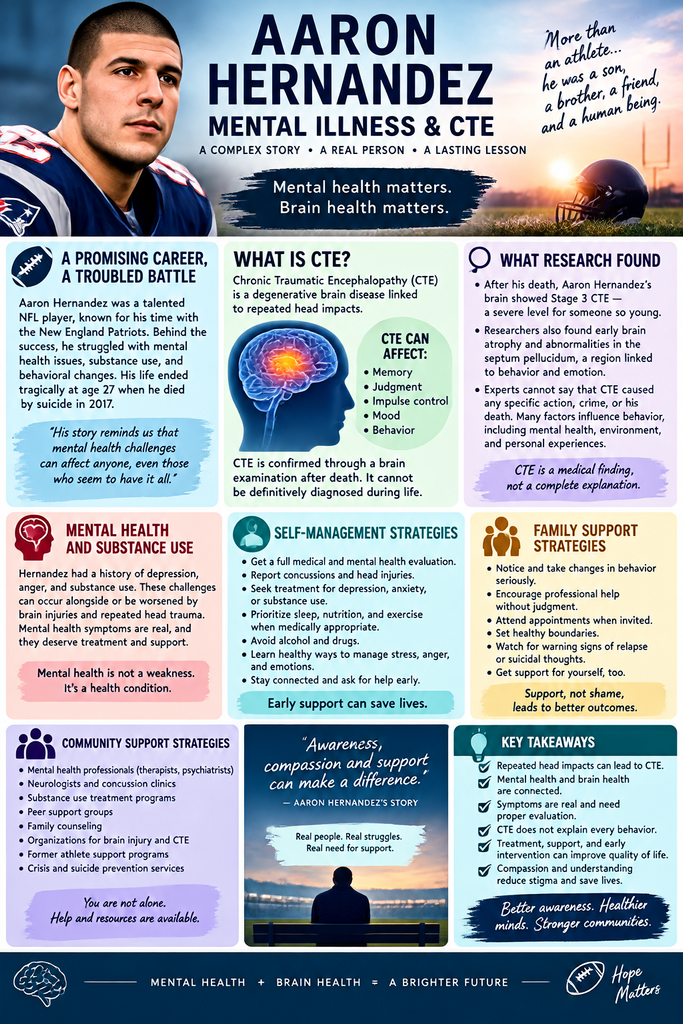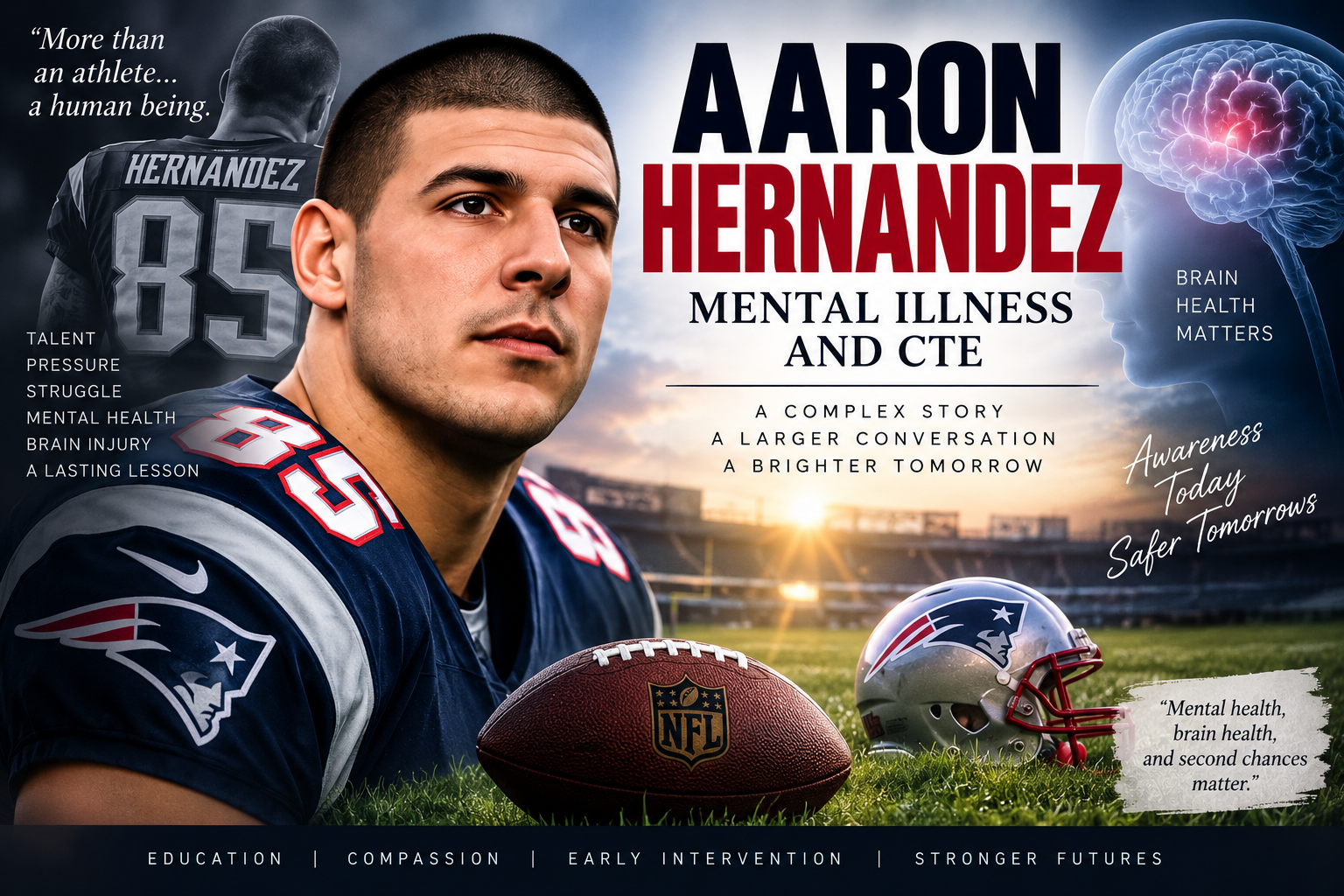
Aaron Hernandez was once one of professional football’s most recognizable young players. The former New England Patriots tight end appeared to have a promising athletic career, but his life eventually became associated with serious legal problems, imprisonment, and his death by suicide at age 27. After his death in 2017, examination of his brain revealed an especially significant finding: Stage 3 chronic traumatic encephalopathy (CTE).
His story has become part of a much broader discussion about repetitive head impacts, brain health, mental health symptoms, professional sports, and the importance of recognizing behavioral or cognitive changes before a crisis develops.
What Is CTE?
Chronic traumatic encephalopathy is a neurodegenerative disease associated with exposure to repetitive head impacts. Abnormal accumulation of a protein called tau occurs in characteristic patterns within the brain. Research involving deceased football players has identified associations between CTE pathology and cognitive, behavioral, and mood symptoms. Importantly, CTE is currently confirmed through neuropathological examination after death rather than through a definitive clinical test during life.
Possible problems reported among people later found to have CTE have included:
- Memory and concentration difficulties.
- Problems with judgment and executive functioning.
- Impulsivity and difficulty regulating behavior.
- Depression and other mood symptoms.
- Emotional instability.
- Aggressive or explosive behavior.
- Cognitive decline in more advanced disease.
These symptoms are not specific to CTE. Many medical and psychiatric conditions can produce similar symptoms, so experiencing depression, anger, forgetfulness, or impulsivity does not mean someone has CTE.
What Researchers Found in Aaron Hernandez’s Brain
After Hernandez’s death, his family donated his brain to the Boston University CTE Center. Neuropathologist Dr. Ann McKee and colleagues determined that Hernandez had Stage 3 CTE on a four-stage pathological scale. A second neuropathologist confirmed the diagnosis. Researchers also identified early brain atrophy and abnormalities involving the septum pellucidum.
The severity was particularly unusual because Hernandez was only 27. McKee reported that researchers had not previously encountered comparable CTE pathology in someone so young within the brains they had examined. Significant abnormalities were present in his frontal lobes, areas important for functions including judgment, decision-making, and impulse control.
Did CTE Explain Aaron Hernandez’s Behavior?
This question requires considerable caution.
CTE can be associated with problems involving impulse control, cognition, mood, and emotional regulation. However, researchers cannot examine Hernandez’s brain and determine that CTE caused a particular action, crime, psychiatric symptom, or his death by suicide.
Dr. McKee specifically cautioned against using his neuropathology to directly explain his behavior. She could describe the functions normally performed by the damaged brain regions and the symptoms observed in other people with severe CTE, but she could not establish that the disease caused Hernandez’s individual behaviors.
This distinction matters. Human behavior results from complex interactions among neurological health, mental health, developmental experiences, environment, relationships, substance use, and individual circumstances.
CTE should therefore neither be ignored nor treated as a complete explanation for someone’s actions.
Mental Health and Brain Health Are Connected
Mental health symptoms sometimes have multiple contributing factors. Depression, anxiety, irritability, impulsivity, substance misuse, trauma, and cognitive problems can overlap with neurological conditions.
Research involving former football players continues to investigate associations between years of football exposure, repetitive head impacts, and later cognitive and neuropsychiatric functioning. A 2026 study published in JAMA Network Open, for example, found an association between football participation and poorer later-life cognitive and neuropsychiatric functioning among participants. Such observational findings identify associations rather than proving that football caused every symptom an individual player experienced.
Hernandez’s case reinforces the importance of considering both neurological and psychological health when significant changes in mood, memory, judgment, or behavior occur.
Self-Management Strategies for Brain and Mental Health
Anyone with a history of repeated head impacts who develops new cognitive, emotional, or behavioral symptoms should consider discussing them with a healthcare professional rather than assuming they are simply stress or a normal part of life.
Helpful strategies may include:
- Report concussions and significant head impacts rather than hiding symptoms.
- Seek medical evaluation for persistent headaches, memory problems, or cognitive changes.
- Pay attention to significant changes in mood, sleep, judgment, and impulse control.
- Keep a record of symptoms and when they occur.
- Avoid returning to contact sports before being medically cleared after a concussion.
- Maintain consistent sleep, nutrition, and physical activity when medically appropriate.
- Avoid using alcohol or drugs to manage emotional or neurological symptoms.
- Seek mental health treatment for depression, anxiety, trauma, or substance use.
- Develop healthy strategies for managing anger and stress.
- Maintain supportive relationships instead of withdrawing when symptoms become difficult.
- Seek urgent assistance when there are thoughts of suicide, violence, or an inability to remain safe.
A history of football or concussions does not automatically mean someone has CTE. Symptoms deserve an individualized medical evaluation because potentially treatable conditions may be responsible.
Family Support Strategies
Family members are often among the first people to recognize that someone’s personality, memory, or behavior has changed.
Loved ones can help by:
- Taking significant personality or behavioral changes seriously.
- Documenting noticeable changes in memory, judgment, sleep, or mood.
- Encouraging neurological and mental health evaluations.
- Listening without immediately criticizing or dismissing symptoms.
- Learning about concussion and repetitive head-impact exposure.
- Encouraging treatment for substance use or psychiatric symptoms when present.
- Helping the individual maintain appointments and treatment plans.
- Establishing boundaries when behavior becomes threatening or unsafe.
- Developing a safety plan when suicide or violence is a concern.
- Seeking counseling and emotional support for caregivers themselves.
Support does not mean tolerating dangerous behavior. Compassion, appropriate boundaries, and safety can exist together.
Community Support Strategies
Brain injuries and mental health problems can require expertise from several areas of healthcare. Community support may include:
- Primary-care professionals.
- Neurologists and neuropsychologists.
- Psychiatrists and therapists.
- Concussion and traumatic brain injury clinics.
- Substance-use treatment services.
- Suicide-prevention and crisis services.
- Peer-support programs.
- Family counseling.
- School and athletic concussion programs.
- Community brain-injury organizations.
- Programs supporting former athletes and their families.
A multidisciplinary approach can be especially valuable because symptoms involving cognition, mood, substance use, and behavior may overlap.
What Hernandez’s Case Has Taught Researchers
Hernandez’s brain provided researchers with an unusual example of advanced CTE pathology in a very young adult. The findings added to concerns about cumulative exposure to repetitive head impacts and encouraged further research into how such exposure may affect the brain over time.
At the same time, CTE research has important limitations. One widely cited study found CTE pathology in 177 of 202 donated brains from former football players, including 110 of 111 former NFL players. However, this was a brain-donation convenience sample, not a representative sample of everyone who has played football. The results, therefore, cannot be interpreted as meaning that 99% of all NFL players will develop CTE.
That distinction is essential when discussing CTE accurately.
Reducing Stigma Around Mental and Neurological Symptoms
Athletes may sometimes feel pressure to appear physically and emotionally strong. Headaches, depression, memory difficulties, anxiety, substance misuse or personality changes should not be viewed as weaknesses that need to be hidden.
Early recognition creates opportunities to identify treatable conditions, address substance use, provide psychological care and reduce additional head injury.
Families, coaches and healthcare professionals can reinforce a healthier message: reporting symptoms is an act of protecting health, not a sign of weakness.
Conclusion
Aaron Hernandez’s life was extraordinarily complicated, and CTE should not be used as a simple explanation for everything that happened.
What medical science can establish is that Hernandez had Stage 3 CTE at only 27 years old, with substantial abnormalities affecting brain regions involved in important cognitive and behavioral functions. What science cannot establish is that those abnormalities caused any particular crime, decision, or behavior.
His case nevertheless offers an important public-health lesson. Repeated head impacts deserve serious attention, and changes in memory, mood, judgment, or behavior deserve appropriate evaluation.
Protecting brain health requires more than recognizing concussions. It involves athletes reporting symptoms, families noticing meaningful changes, healthcare professionals evaluating neurological and psychiatric possibilities, and communities providing accessible mental health and brain-injury resources.
Brain health is mental health, and both deserve attention before a person reaches a crisis.
Frequently Asked Questions
Here are some common questions:
1. Who was Aaron Hernandez?
Aaron Hernandez was a professional football player who played tight end for the New England Patriots. His career ended after his arrest in 2013, and he was convicted in 2015 of murdering Odin Lloyd. Hernandez died by suicide in prison in April 2017 at age 27.
2. Did Aaron Hernandez have CTE?
Yes. After his death, Boston University neuropathologist Dr. Ann McKee examined his brain and diagnosed Stage 3 chronic traumatic encephalopathy (CTE) on a four-stage pathological scale. A second neuropathologist confirmed the diagnosis.
3. Was the severity of his CTE unusual for his age?
Yes. Boston University researchers reported that Hernandez had the most severe CTE pathology they had encountered at that time in someone so young. Researchers found substantial abnormalities despite Hernandez being only 27.
4. What is CTE?
Chronic traumatic encephalopathy is a brain disease associated with long-term exposure to repeated head impacts. It involves abnormal protein accumulation and progressive damage to brain tissue. Sports such as football can expose athletes to repeated impacts, including impacts that do not produce obvious concussion symptoms.
5. What did researchers find in Aaron Hernandez’s brain?
Researchers found extensive abnormal tau protein deposits, particularly in his frontal lobes. They also identified early brain atrophy and abnormalities of the septum pellucidum.
6. Could CTE have affected Hernandez’s judgment and impulse control?
The areas of Hernandez’s brain that were severely affected normally contribute to judgment, problem-solving, impulse control, and social behavior. However, Dr. McKee specifically cautioned against directly connecting his brain pathology to particular behaviors during his life.
7. Did CTE cause Aaron Hernandez to commit murder?
Science cannot establish that. Finding CTE in Hernandez’s brain does not demonstrate that the disease caused a particular crime or decision. Human behavior can involve neurological, psychological, developmental, environmental, social, and substance-related factors.
8. Did CTE cause Aaron Hernandez’s suicide?
That also cannot be concluded. The CDC notes that scientists remain uncertain about which symptoms are directly attributable to CTE and that the relationship between CTE and suicidal thoughts or behaviors is not sufficiently understood to establish individual causation.
9. What symptoms have been reported in people later diagnosed with CTE?
Families of people subsequently diagnosed with CTE have reported problems involving thinking, memory, emotions, mood, and behavior. These symptoms are not unique to CTE and can occur with many other neurological and psychiatric conditions.
10. Can doctors diagnose CTE while someone is alive?
Currently, CTE can only be definitively confirmed through examination of brain tissue after death. Researchers continue investigating imaging, biomarkers, and other methods that could eventually help identify the disease during life.
11. Does having several concussions mean someone will develop CTE?
No. The CDC states that research suggests CTE is associated with long-term exposure to repeated head impacts, but there is not strong evidence that one or several concussions alone inevitably cause CTE. Scientists are still investigating why some heavily exposed individuals develop the disease while others do not.
12. What should athletes do if they notice changes in memory, mood, or behavior?
They should report symptoms and obtain appropriate medical evaluation. Persistent headaches, memory difficulties, depression, anxiety, sleep changes, impulsivity, or personality changes can have many possible causes, including conditions that are treatable. Having these symptoms does not automatically mean someone has CTE.
13. How can families support someone experiencing behavioral or mental health changes after repeated head injuries?
Families can take changes seriously, encourage neurological and mental-health evaluations, document significant changes in memory or behavior, support treatment, and maintain healthy boundaries. Immediate assistance is appropriate when someone expresses suicidal thoughts, violent intentions, or an inability to remain safe.
14. What community resources can help athletes and families?
Support may include primary care professionals, neurologists, neuropsychologists, psychiatrists, therapists, concussion clinics, brain injury organizations, substance use treatment programs, and peer support services. For an immediate mental-health or suicide crisis in the United States, the CDC directs people to call or text 988 for the 988 Suicide & Crisis Lifeline.
15. What is the main lesson from Aaron Hernandez’s CTE findings?
His case demonstrates that severe CTE pathology can occur in a young person with extensive exposure to repetitive head impacts. At the same time, his case should not be used to assume that CTE explains every aspect of his mental health, behavior, criminal conduct, or death. The broader lesson is the importance of protecting brain health, reporting head injuries, recognizing behavioral changes, and seeking neurological and mental-health care when concerns develop.
Video: What Really Happened To Aaron Hernandez’s Brain #aaronhernandez #nfl #truecrime