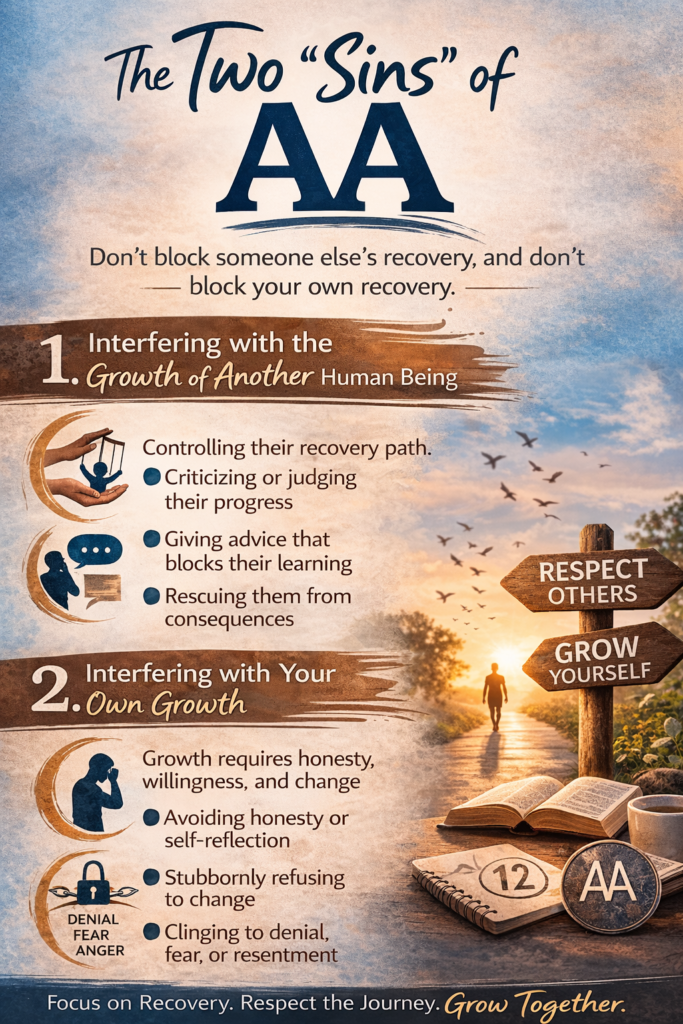
In Alcoholics Anonymous (AA), recovery is built on the foundations of personal responsibility, spiritual growth, and the support of a caring community. Members are encouraged to examine their behaviors, develop honesty about their struggles, and commit to meaningful personal change. Within this philosophy, a widely held idea is that there are two “sins”: interfering with another human being’s growth and with your own. In AA, the term “sin” is not used in a harsh moral sense but rather to describe actions that impede recovery and personal development. When someone tries to control another person’s journey or refuses to work on their own healing, it can disrupt the recovery process. Instead, AA emphasizes humility, self-reflection, and respect for each person’s path toward healing. By embracing these principles, individuals learn to focus on their own growth while supporting others without judgment or interference. This mindset helps create healthier relationships, strengthens self-awareness, and fosters an environment where individuals can continue growing emotionally, mentally, and spiritually in their recovery journey.
The Only Two “Sins” in Alcoholics Anonymous: Blocking Growth
In Alcoholics Anonymous (AA), the word sin is not used in a harsh or religiously judgmental way. Instead, it refers to behaviors that impede the spiritual and emotional growth on which recovery depends. A commonly quoted idea within AA is that there are only two real “sins”:
- Interfering with the growth of another human being.
- Interfering with your own growth.
While simple, this concept carries a powerful message about how recovery works and how people support one another within the program.
Recovery Is About Growth
At its core, AA is a program of personal and spiritual growth. The Twelve Steps guide members toward honesty, accountability, humility, and service. Progress in recovery happens when people are willing to change, learn from mistakes, and grow emotionally and spiritually.
When AA talks about these “two sins,” it is essentially warning against anything that blocks that growth—either in ourselves or in others.
Interfering With Someone Else’s Growth
One of the principles in AA is that everyone’s recovery journey is personal. No two people experience addiction or healing in exactly the same way.
Interfering with someone else’s growth might look like:
- Trying to control someone else’s recovery
- Judging their progress or lack of progress
- Giving unsolicited advice or forcing solutions
- Rescuing someone from consequences they need to face
AA encourages members to share their experience rather than control someone else’s path. Sponsors, for example, guide newcomers but ultimately allow them to make their own decisions and learn through their own experiences.
Interfering With Your Own Growth
The second “sin” is often the one people struggle with the most: blocking their own progress.
This can happen when someone:
- Avoids honesty with themselves
- Refuses to work the Twelve Steps
- Holds onto resentment, pride, or denial
- Resists change out of fear
Recovery requires willingness—a willingness to look inward, admit mistakes, and grow. When someone refuses that process, they are essentially standing in the way of their own healing.
The Spirit Behind the Idea
The message behind these two “sins” reflects a core AA principle: focus on your own recovery while respecting the recovery of others.
Members are encouraged to:
- Practice humility
- Offer support without control
- Take responsibility for their own growth
- Allow others the dignity of their own journey
In this way, the AA community becomes a place where people grow together while respecting individual paths.
A Simple Guiding Principle
Many AA members summarize the idea like this:
“Don’t get in the way of someone else’s recovery—and don’t get in the way of your own.”
When people follow this principle, the environment becomes one where honesty, compassion, and personal growth can thrive—exactly the conditions that make long-term recovery possible.
Living the Principle: Self-Management Strategies for the Two “Sins” of AA
In Alcoholics Anonymous (AA), a powerful idea often shared in meetings and recovery literature is that there are only two real “sins”: interfering with the growth of another human being and interfering with your own growth. Rather than focusing on moral judgment, this concept highlights the importance of personal responsibility and mutual respect in recovery.
Implementing these principles requires more than intellectual understanding—it requires active self-management. By developing awareness, emotional regulation, and intentional habits, individuals in recovery can better support their own growth while allowing others the space to grow as well.
Understanding Self-Management in Recovery
Self-management refers to the ability to monitor, regulate, and guide one’s thoughts, emotions, and behaviors toward healthier outcomes. In recovery, this means recognizing patterns that block growth and replacing them with actions that support healing and progress.
Practicing self-management aligns closely with many AA principles, such as honesty, humility, willingness, and accountability. These practices help individuals stay focused on their own recovery while maintaining respect for others’ journeys.
Strategies to Avoid Interfering With Someone Else’s Growth
A key part of recovery is learning to support others without controlling them. People in AA often want to help others who are struggling, but growth ultimately happens through personal experience.
Several self-management strategies can help maintain this balance:
Practice mindful listening.
Instead of immediately offering advice or solutions, listen attentively to what others are sharing. This allows them to process their own thoughts and emotions while feeling supported.
Share experience rather than directives.
AA emphasizes sharing personal stories rather than telling others what they should do. Saying “this is what worked for me” invites reflection without pressure.
Recognize the urge to control.
When the impulse arises to “fix” someone else’s situation, pause and ask whether the intervention supports their growth or simply satisfies your own discomfort.
Respect personal timing.
Recovery unfolds differently for everyone. Allowing others to move at their own pace fosters autonomy and long-term change.
Strategies to Avoid Interfering With Your Own Growth
The second principle—avoiding interference with your own growth—requires ongoing self-reflection and discipline. Recovery is strengthened when individuals take responsibility for their own development.
Helpful strategies include:
Daily self-reflection.
Many people in recovery benefit from reviewing their day and identifying where they acted in alignment with their values and where improvement is needed.
Emotional awareness.
Recognizing emotions such as resentment, fear, or shame early can prevent them from influencing harmful behaviors.
Commitment to the recovery process.
Working the Twelve Steps, attending meetings, and engaging with a sponsor or support network provide structure and accountability.
Setting realistic personal goals.
Small, achievable goals encourage consistent growth and help maintain motivation over time.
Building a Growth-Focused Recovery Mindset
Implementing the two “sins” of AA ultimately requires a shift toward a growth-oriented mindset. Instead of focusing on control or perfection, individuals learn to prioritize learning, humility, and progress.
This mindset encourages people to:
- Take responsibility for their own behavior
- Allow others the dignity of their own experiences
- View challenges as opportunities for growth
- Practice patience with themselves and others
A Practical Guiding Philosophy
At its heart, the message is simple yet profound: recovery thrives when individuals focus on improving themselves while respecting others’ autonomy.
By practicing self-management strategies such as reflection, emotional awareness, mindful communication, and accountability, individuals can live out this principle in everyday life.
In doing so, they create an environment where both personal growth and community support can flourish—two essential elements for lasting recovery.
Supporting Recovery at Home: Family Strategies for Honoring the Two “Sins” of AA
Recovery from addiction rarely happens in isolation. Family members often play a critical role in creating an environment that supports healing and long-term sobriety. Within Alcoholics Anonymous (AA), a commonly shared idea is that there are two “sins”: interfering with the growth of another human being and interfering with your own growth.
For families supporting someone in recovery, this concept offers a helpful framework. It reminds loved ones to encourage progress without controlling it while also caring for their own emotional and personal development.
Understanding the Family’s Role in Recovery
Families often want to protect their loved ones from pain, relapse, or failure. While this instinct comes from love, it can sometimes lead to behaviors that unintentionally interfere with recovery. Examples may include over-monitoring, rescuing someone from consequences, or trying to force progress.
Supporting recovery means learning to balance support with healthy boundaries. Families can create an environment that encourages growth while respecting the recovering person’s responsibility for their own journey.
Strategies for Avoiding Interference With Someone Else’s Growth
One of the most important ways families can support recovery is by allowing the individual to take ownership of their process.
Encourage accountability rather than control.
Offer encouragement and support, but allow the recovering person to make their own choices and accept the outcomes.
Practice supportive communication.
Listening without judgment helps build trust and allows the recovering individual to feel understood rather than criticized.
Avoid rescuing behaviors.
Stepping in to solve every problem can prevent someone from learning important lessons that support long-term sobriety.
Respect recovery boundaries.
Recovery often involves meetings, therapy, and personal reflection. Supporting these activities without pressure or interference shows respect for the process.
Strategies for Avoiding Interference With Your Own Growth
Family members are also deeply affected by addiction. Supporting someone in recovery can be emotionally demanding, making it important for families to prioritize their own well-being.
Seek support for yourself.
Groups such as Al-Anon or family counseling can provide guidance, connection, and emotional support.
Develop healthy boundaries.
Clear boundaries protect both the recovering individual and the family from patterns that contributed to addiction.
Practice self-care.
Maintaining physical and emotional health helps family members remain supportive without becoming overwhelmed.
Continue personal growth.
Education about addiction, communication skills, and emotional resilience can help families grow alongside their loved ones.
Creating a Growth-Oriented Family Environment
When families apply the principles behind the two “sins” of AA, the home environment can become a place of mutual growth and understanding. Instead of focusing on control or blame, families focus on learning, patience, and support.
This approach encourages:
- Respect for individual recovery journeys
- Open and honest communication
- Personal responsibility for growth
- Compassion and empathy within the family system
A Shared Path Forward
Recovery is often strongest when both individuals and families commit to growth. By supporting without controlling and caring for their own well-being, families help create a stable foundation for lasting change.
In this way, honoring the two guiding principles of AA—not interfering with another person’s growth and not interfering with your own—can help families and individuals move forward together toward healthier and more fulfilling lives.
Building Recovery Together: Community Resource Strategies for Living the Two Principles of AA
Recovery from addiction is rarely achieved alone. While Alcoholics Anonymous (AA) emphasizes personal responsibility and spiritual growth, it also recognizes the importance of community support systems. A well-known idea in AA is that there are only two real “sins”: interfering with the growth of another human being and interfering with your own growth.
Communities play a critical role in helping individuals live out these principles. By providing supportive environments, accessible services, and educational resources, communities can encourage recovery while respecting each person’s autonomy and journey.
The Role of Community in Recovery
Addiction affects not only individuals but also families, workplaces, and neighborhoods. Community-based resources—such as recovery groups, counseling services, health programs, and peer support networks—create spaces where people can grow without judgment or unnecessary interference.
Communities that promote recovery-focused strategies recognize two key goals:
- Empowering individuals to take responsibility for their own recovery
- Providing support that does not control or limit personal growth
Strategies That Support Personal Growth
Community resources can help individuals avoid interfering with their own growth by providing opportunities for learning, accountability, and connection.
Accessible recovery meetings and peer support groups.
Regular meeting spaces allow individuals to share experiences, receive encouragement, and learn from others who understand the recovery process.
Education and skill-building programs.
Workshops on coping skills, relapse prevention, stress management, and emotional regulation help individuals develop tools that support long-term sobriety.
Integrated health services.
Access to mental health care, medical treatment, and substance use counseling ensures that individuals can address the underlying challenges that often accompany addiction.
Recovery-friendly environments.
Community organizations and workplaces that support recovery create safe environments where individuals can rebuild stability and confidence.
Strategies That Respect the Growth of Others
Communities also play an important role in ensuring that support systems empower rather than control those in recovery.
Peer-led programs.
Peer support groups allow individuals with lived experience to guide others through shared understanding rather than authority.
Nonjudgmental spaces.
Creating environments where people can speak openly about their struggles helps reduce stigma and encourages honest self-reflection.
Collaborative care networks.
Partnerships among healthcare providers, social services, and recovery organizations ensure that individuals receive support while maintaining personal choice and dignity.
Community education.
Public awareness campaigns about addiction and recovery can reduce stigma and promote compassion within the broader community.
Strengthening the Recovery Ecosystem
When communities align their resources with the principle of supporting growth without interference, they create what many professionals call a recovery ecosystem—a network of services and relationships that work together to support long-term healing.
Such ecosystems often include:
- Recovery support groups and peer mentoring programs
- Counseling and mental health services
- Housing and employment assistance
- Family education and support programs
- Community outreach and awareness initiatives
Together, these resources help individuals build stable, healthy lives while respecting their independence and personal responsibility.
A Community Philosophy of Growth
The principle behind the two “sins” of AA extends beyond individual recovery—it offers a valuable lesson for entire communities. When communities focus on empowerment rather than control, they help individuals develop resilience, accountability, and hope.
In this way, recovery becomes not just a personal journey but a shared community effort, where individuals, families, and organizations work together to support growth while honoring each person’s path toward healing.
Frequently Asked Questions
Here are some common questions:
1. What are the two “sins” in Alcoholics Anonymous (AA)?
In AA, a commonly shared idea is that there are two “sins”: interfering with the growth of another human being and interfering with your own growth. These are not meant as religious judgments but as reminders to avoid behaviors that block recovery and personal development.
2. Where does the idea of the two “sins” come from?
The concept is often attributed to early AA teachings and is frequently quoted in recovery discussions and AA literature. It reflects the program’s focus on personal responsibility and spiritual growth.
3. Why does AA use the word “sin”?
In this context, the word “sin” refers to actions that hinder growth rather than moral wrongdoing. It highlights behaviors that can damage recovery, relationships, or personal progress.
4. What does interfering with another person’s growth look like?
Examples may include:
- Trying to control someone else’s recovery
- Judging or criticizing their progress
- Giving unsolicited advice that pressures them
- Preventing them from learning from their own experiences
AA encourages members to share their experiences rather than direct others’ choices.
5. What does interfering with your own growth mean?
This refers to behaviors that block personal recovery, such as:
- Avoiding honesty or self-reflection
- Refusing to work the Twelve Steps
- Holding onto resentment or fear
- Resisting change
These actions can prevent individuals from progressing in their recovery journey.
6. How can someone avoid interfering with another person’s growth?
Helpful practices include:
- Listening without judgment
- Respecting others’ recovery timelines
- Offering support rather than control
- Sharing personal experiences instead of giving directives
7. How can someone avoid interfering with their own growth?
People in recovery can support their growth by:
- Practicing honest self-reflection
- Staying committed to meetings and the Twelve Steps
- Seeking guidance from sponsors or mentors
- Being willing to change behaviors and attitudes
8. Why are these principles important in recovery?
Recovery thrives in environments where individuals feel supported but not controlled. These principles help maintain mutual respect, accountability, and personal responsibility within the recovery community.
9. Do these principles apply outside of AA meetings?
Yes. Many people apply these ideas to family life, work relationships, and personal development. The principle of respecting others’ growth while focusing on one’s own improvement is valuable in many areas of life.
10. What is the main lesson behind the two “sins”?
The core message is simple:
Focus on your own recovery and allow others the freedom to grow in their own way.
This mindset encourages humility, patience, and compassion—qualities that support lasting recovery and healthier relationships.
Conclusion
The two guiding principles of AA emphasize the importance of balancing self-improvement with respect for others’ journeys. Recovery thrives when individuals take responsibility for their own growth while allowing others the freedom to learn and change in their own way. By practicing patience, accountability, and empathy, people in recovery—and those who support them—can foster an atmosphere of encouragement rather than control. Ultimately, the message behind the two “sins” of AA reminds us that meaningful recovery happens when we focus on our own progress while supporting, rather than interfering with, the growth of those around us.
Video: Why You Can’t Rush Someone’s Recovery (and shouldn’t try) #healing #recovery #mentalhealth