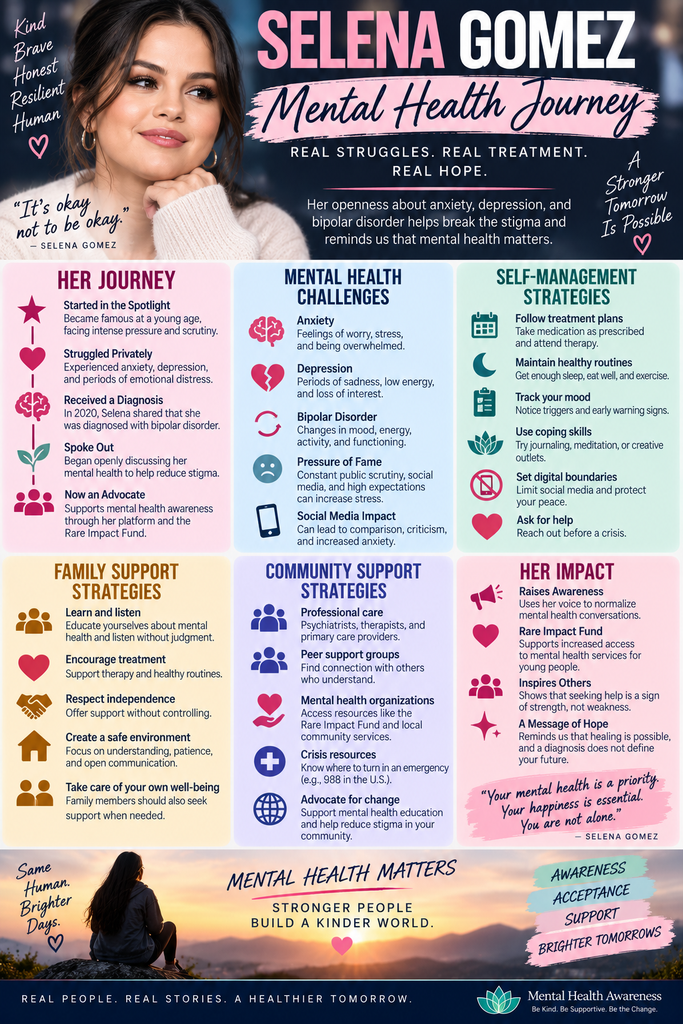
Selena Gomez has spent much of her life in the public eye, first becoming famous as a young actress and later building an international career in music. Behind that success, she has publicly discussed significant mental health challenges, including anxiety, depression, and bipolar disorder. Her willingness to talk about treatment and emotional struggles has helped bring mental health conversations into spaces where stigma once encouraged silence.
Gomez’s journey demonstrates an important lesson: professional success does not protect someone from mental illness. A person can appear confident and accomplished while privately experiencing symptoms that interfere with everyday life.
Her story also illustrates how recovery and mental health management are often ongoing processes rather than a single moment when someone becomes permanently “better.”
Selena Gomez’s Mental Health Struggles
Gomez has publicly discussed experiencing anxiety and depression and receiving mental health treatment at different points in her life. In 2020, she revealed that she had been diagnosed with bipolar disorder.
For Gomez, learning more about her condition appears to have helped reduce some of the fear surrounding it. She has described gaining greater understanding of what was happening to her rather than simply remaining frightened by symptoms she did not fully understand.
Bipolar disorder is a mental health condition involving significant changes in mood, energy, activity, and functioning. It is important, however, not to assume that every emotional experience Gomez has discussed publicly resulted from bipolar disorder. Only she and her healthcare professionals know the complete details of her health.
The Pressure of Living in the Public Eye
Being famous does not cause bipolar disorder, depression, or anxiety. However, celebrity life can introduce additional stress.
For someone already experiencing mental health difficulties, constant scrutiny may make emotional regulation and recovery more complicated.
Potential pressures associated with fame can include:
- Constant public criticism
- Social media scrutiny
- Demanding work schedules
- Limited personal privacy
- Pressure to maintain a particular appearance
- Online comparisons and rumors
- Fear of disappointing fans or employers
- Difficulty separating a public identity from a private life
These pressures should be understood as possible stressors rather than explanations for someone’s diagnosis.
Social Media and Mental Health
Gomez has repeatedly discussed the complicated relationship between social media and emotional well-being. Although social platforms can create connection, they can also expose people to criticism, comparison, unrealistic expectations, and constant stimulation.
Learning when to disconnect can become an important self-management skill.
For anyone experiencing anxiety, depression, or mood instability, healthier digital boundaries might include:
- Limiting time spent scrolling
- Unfollowing accounts that consistently trigger negative comparisons
- Turning off unnecessary notifications
- Avoiding arguments with strangers online
- Protecting private parts of life from public discussion
- Taking intentional breaks from social platforms
Digital boundaries are not a replacement for mental health treatment, but they may help reduce unnecessary stress.
Receiving a Bipolar Disorder Diagnosis
Gomez publicly revealed her bipolar disorder diagnosis during a conversation with Miley Cyrus in 2020. She explained that receiving information about the diagnosis helped her understand herself better.
Her experience demonstrates why accurate mental health education matters.
A diagnosis can initially feel frightening, but understanding a condition can help someone recognize symptoms, communicate more effectively with healthcare professionals, and participate more actively in treatment decisions.
Mental illness should not become someone’s entire identity.
A diagnosis describes a health condition. It does not determine someone’s intelligence, creativity, relationships, career potential, or personal worth.
Self-Management Strategies: Learning Your Patterns
Living successfully with a mental health condition often requires learning personal triggers, warning signs, and coping strategies.
Self-management strategies may include:
- Learn about your diagnosis from reliable sources.
- Attend scheduled mental health appointments.
- Take prescribed medication as directed and discuss side effects with the prescriber.
- Maintain consistent sleep and waking schedules.
- Monitor significant changes in mood, energy, and behavior.
- Identify situations that increase anxiety or emotional distress.
- Develop healthy stress-management techniques.
- Limit alcohol and recreational drugs, which may worsen symptoms or interfere with treatment.
- Establish appropriate social media boundaries.
- Create a plan for what to do if symptoms begin worsening.
- Ask for help before reaching a crisis.
Mood tracking can sometimes be particularly useful. Recording sleep, mood, energy, medications, stressors, and significant behavioral changes may help someone identify patterns that are difficult to recognize from memory alone.
Family Support: Listen Before Trying to Fix Everything
Mental illness affects families as well as individuals. Loved ones may feel frightened or uncertain about what to say or do.
Family support is most helpful when it combines compassion with education.
Families can:
- Learn about the person’s diagnosed condition.
- Listen without immediately judging or correcting.
- Encourage treatment rather than demanding that someone simply “cheer up.”
- Respect appropriate privacy and independence.
- Learn the person’s early warning signs.
- Encourage healthy sleep and everyday routines.
- Ask how they can help instead of assuming.
- Develop a crisis plan together when appropriate.
- Avoid stigmatizing language.
- Seek their own counseling or support when needed.
Family members should also understand their limitations. Love and encouragement can be extremely important, but relatives cannot replace psychiatrists, therapists, or other qualified mental health professionals.
Supporting Without Controlling
When someone has experienced significant mental health symptoms, family members may become overly protective.
Their intentions may be loving, but excessive monitoring can sometimes make the person feel powerless.
Healthy support respects autonomy whenever possible.
Instead of saying:
“I know what’s best for you.”
Families can ask:
“What kind of support would be most helpful right now?”
That small change encourages collaboration rather than control.
Community Support: Mental Health Recovery Needs Connection
Gomez has become involved in mental health advocacy and has helped promote conversations about mental health education and access to support.
Community resources can make mental healthcare less isolating.
Useful resources may include:
- Psychiatrists and psychiatric clinicians
- Primary care professionals
- Individual psychotherapy
- Group therapy
- Peer-support programs
- Community mental health centers
- School or workplace counseling programs
- Crisis services
- Mental health advocacy organizations
- Support groups for families
- Telehealth mental health services
For people who have difficulty accessing specialists, primary care can often provide an important starting point for assessment and referral.
The Importance of Professional Treatment
Self-care is valuable, but serious mental health conditions cannot always be managed through lifestyle changes alone.
Meditation, exercise, journaling, sleep routines, and supportive relationships may complement treatment, but they should not automatically replace evidence-based professional care.
Treatment for bipolar disorder, for example, can involve medication, psychotherapy, education, lifestyle management, and regular monitoring depending on an individual’s clinical needs.
Treatment plans should always be personalized.
Turning Personal Struggle Into Advocacy
One meaningful part of Gomez’s public journey has been her willingness to discuss mental health openly.
She has been involved with Rare Impact Fund, an initiative connected with Rare Beauty that supports efforts to expand mental health services and education for young people.
Public figures cannot represent everyone’s experience with mental illness, but their openness can have an important effect: it can make seeking help feel less shameful.
When someone admired by millions acknowledges needing mental health care, it challenges the idea that successful people should always be able to handle everything themselves.
Recovery Is Not Always a Straight Line
Mental health management can involve periods of stability followed by periods when symptoms become more difficult.
Needing additional therapy, medication adjustments, time away from work, or greater support does not automatically mean treatment has failed.
Sometimes it simply means needs have changed.
The goal is not necessarily to eliminate every difficult emotion. It is to develop the knowledge, treatment, coping strategies, and support systems necessary to manage symptoms while maintaining the best possible quality of life.
What Selena Gomez’s Journey Can Teach Us
Gomez’s public experiences offer several broader lessons:
- Mental illness can affect anyone, including highly successful people.
- Understanding a diagnosis can reduce fear and uncertainty.
- Asking for professional help is an appropriate health decision.
- Social media boundaries can protect emotional well-being.
- Families can provide support without taking away independence.
- Community resources can reduce isolation and stigma.
- Mental health management may require continuing treatment.
- A diagnosis does not define someone’s future.
Conclusion
Selena Gomez’s mental health journey is more than a celebrity story. Her public discussions about anxiety, depression, bipolar disorder, treatment, and emotional well-being demonstrate why mental health deserves the same seriousness and compassion as physical health.
Self-management can help individuals understand symptoms, recognize triggers, maintain healthy routines, and know when additional assistance is necessary. Family support can provide understanding, stability, and encouragement without replacing professional care. Community support can connect individuals and families with treatment, education, peer support, and crisis resources.
Perhaps the most important lesson is that managing mental illness does not require pretending difficult periods never happen. It involves developing the tools and support necessary to respond when they do.
A diagnosis can become the beginning of understanding—not the end of possibility.
Frequently Asked Questions
Here are some common questions:
1. What mental health conditions has Selena Gomez publicly discussed?
Selena Gomez has publicly discussed experiencing anxiety and depression and has said she was diagnosed with bipolar disorder. Her openness has helped encourage broader conversations about mental health and stigma.
2. When did Selena Gomez reveal her bipolar disorder diagnosis?
In 2020, Gomez publicly shared that she had been diagnosed with bipolar disorder. She explained that learning more about the condition helped her better understand what she was experiencing.
3. What is bipolar disorder?
Bipolar disorder is a mental health condition involving episodes of significant changes in mood, energy, activity, and functioning. Symptoms and severity differ among individuals, so Gomez’s experience should not be assumed to represent everyone living with bipolar disorder.
4. Has Selena Gomez experienced anxiety and depression?
Yes. Gomez has openly discussed struggles with anxiety and depression and periods when she needed professional treatment and time to focus on her mental health.
5. Has Selena Gomez received professional mental health treatment?
Yes. Gomez has publicly discussed seeking professional treatment at different points in her life. Her experience demonstrates that returning for additional care when symptoms become difficult does not mean someone has failed.
6. How has fame affected Selena Gomez’s mental health?
Gomez has discussed difficulties associated with living under intense public scrutiny. Celebrity does not cause bipolar disorder, but criticism, demanding schedules, limited privacy, and constant attention can create additional stress for someone managing mental health challenges.
7. How has social media affected her mental well-being?
Gomez has spoken about stepping away from social media and creating boundaries around its use. Constant comparison, criticism, and online attention can contribute to emotional distress for some people.
8. What self-management strategies may help someone living with mental illness?
Strategies should complement rather than replace professional treatment. Helpful approaches may include:
- Following an individualized treatment plan
- Taking prescribed medication as directed
- Maintaining consistent sleep and daily routines
- Tracking significant mood and energy changes
- Recognizing personal triggers and warning signs
- Developing healthy stress-management techniques
- Setting boundaries with social media
- Avoiding alcohol and recreational drugs when they worsen symptoms or interfere with treatment
- Reaching out for help when symptoms begin worsening
9. Why is sleep particularly important for bipolar disorder?
Sleep and mood can strongly influence one another. Significant sleep disruption can sometimes accompany or contribute to mood instability, making consistent sleep routines an important part of many bipolar disorder management plans.
10. How can families support someone experiencing mental illness?
Families can learn about the diagnosed condition, listen without judgment, encourage appropriate treatment, respect independence, recognize warning signs, and, when appropriate, develop a crisis plan.
11. What should families avoid doing?
Families should avoid telling someone simply to “snap out of it,” blaming them for symptoms, using stigmatizing labels, or assuming love alone can replace professional care. Support should encourage treatment without unnecessarily controlling the person’s life.
12. Why is community support important?
Mental health recovery can become isolating. Therapists, psychiatrists, primary care clinicians, peer-support programs, community mental health centers, support groups, and advocacy organizations can provide professional assistance and meaningful connection.
13. What mental health advocacy work has Selena Gomez supported?
Gomez has used her public platform to encourage conversations about mental health. She is also associated with the Rare Impact Fund, which works to expand access to mental health services and education for young people.
14. Can someone have a successful career while living with bipolar disorder?
Yes. A bipolar disorder diagnosis does not determine someone’s intelligence, creativity, relationships, or ability to pursue meaningful goals. Appropriate treatment and ongoing management can help many people maintain productive and fulfilling lives.
15. Does needing treatment again mean recovery has failed?
No. Mental health needs can change over time. Someone may require medication adjustments, additional therapy, greater support, or periods of more intensive treatment. Seeking additional care can be a responsible response to changing symptoms.
16. Can self-care replace professional treatment?
Not necessarily. Exercise, meditation, journaling, healthy nutrition, sleep routines, and social connection may support emotional well-being, but significant mental health conditions often require professional assessment and treatment.
17. What can Selena Gomez’s story teach young people?
Her public discussions demonstrate that experiencing mental illness is not something that needs to be hidden in shame. Learning about symptoms, communicating with trusted people, and seeking help from qualified professionals can be important steps toward managing mental health.
18. What is the biggest lesson from Selena Gomez’s mental health journey?
One of the strongest lessons is that understanding your mental health can create opportunities for better management rather than defining your future. Gomez’s willingness to discuss diagnosis, treatment, boundaries, and advocacy reinforces the importance of education, appropriate professional care, family support, and community connection.
Video: Is a diagnosis the end? Selena Gomez shares the truth #mentalhealth #shorts