Eric Clapton is regarded as one of the most influential guitarists in rock music, but behind his extraordinary career was a prolonged struggle with addiction. During the 1970s and 1980s, Clapton experienced serious problems involving heroin and alcohol that affected his health, relationships, personal life, and music.
His recovery did not occur in one perfect attempt. Clapton overcame heroin addiction in the early 1970s but subsequently developed serious problems with alcohol. He entered treatment, experienced a setback, returned to rehabilitation, and ultimately established long-term sobriety.
His journey provides an important lesson about substance use disorders: stopping one substance does not necessarily address all of the psychological, behavioral, and environmental factors underlying addiction. Long-term recovery often requires continuing self-management, family involvement, professional treatment, peer support, and a meaningful life beyond substances.
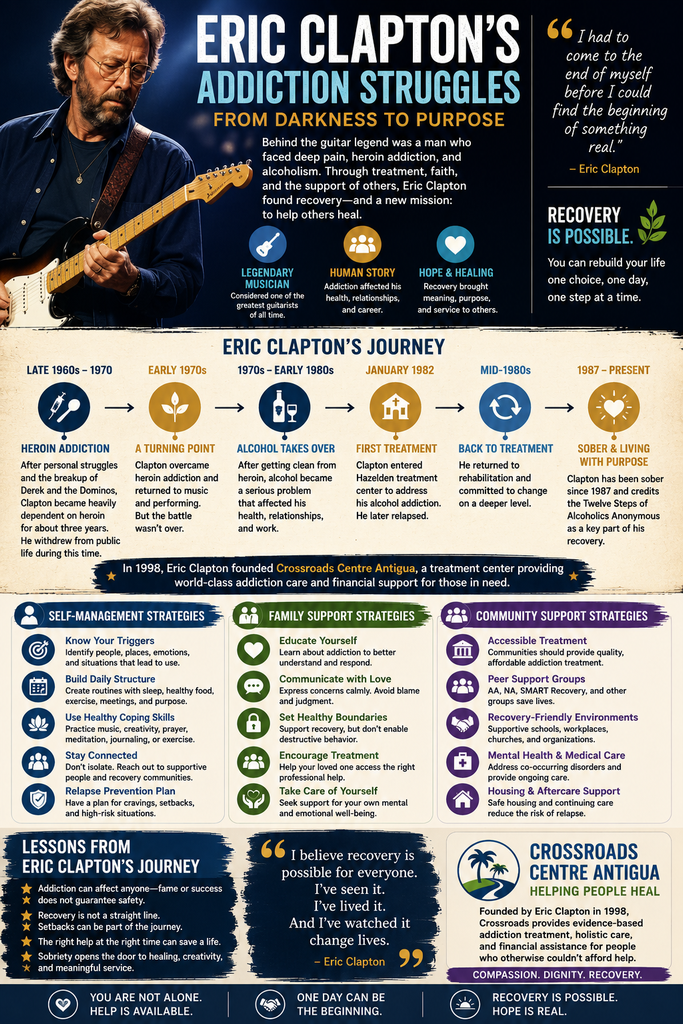
Eric Clapton’s Heroin Addiction
Following the breakup of Derek and the Dominos and during a difficult period in his personal life, Clapton became heavily dependent on heroin.
His official biography describes approximately three years of heroin addiction during which he largely withdrew from public life.
Isolation is an important warning sign in many addiction stories. Substance use can gradually replace relationships, responsibilities, hobbies, and other sources of meaning.
A person may begin organizing everyday life around obtaining, using, recovering from, or hiding substances.
Getting Away From Heroin Wasn’t the End
Clapton eventually stopped using heroin and returned to performing in the early 1970s.
From the outside, this might have looked like recovery was complete.
It wasn’t.
According to his official biography, after overcoming heroin addiction, alcohol became another serious problem. His drinking affected his personal life and work through the remainder of the 1970s and into the 1980s.
This pattern demonstrates something important about addiction:
Changing substances is not necessarily the same as recovering from addiction.
A person may stop using one drug but continue relying on another substance to manage stress, emotions, loneliness, trauma, or discomfort.
Alcohol Became the Next Battle
Clapton’s alcohol use eventually became severe enough that professional treatment was necessary.
In January 1982, he entered the Hazelden treatment center.
However, treatment did not immediately produce permanent sobriety. Clapton later returned to alcohol and eventually entered rehabilitation again.
This part of his story deserves attention because it challenges the idea that relapse means treatment is hopeless.
Sometimes a setback indicates that recovery supports need to become stronger, more consistent, or better suited to the individual’s needs.
Long-Term Sobriety
Clapton’s official biography states that he has been sober since 1987 and credits the Twelve Steps of Alcoholics Anonymous as an important part of his recovery.
Recovery became more than simply not drinking or using drugs.
Over time, helping other people affected by addiction became an important part of his life.
In 1998, Clapton founded Crossroads Center Antigua, an addiction treatment center. He has explained that his vision was to create professional treatment that could help people in the Caribbean and around the world, including providing assistance to those who could not otherwise afford it.
His personal struggle eventually became connected to a larger purpose: helping other people find recovery.
Self-Management Strategies: Lessons From Clapton’s Journey
Long-term recovery requires decisions and behaviors that extend far beyond the initial treatment experience.
Several broader self-management lessons can be drawn from Clapton’s journey.
Recognize Substance Switching
Stopping one drug while increasing another can create the illusion of improvement.
Ask yourself:
“Am I recovering, or have I simply changed what I use to cope?”
Watch for:
- Replacing illicit drugs with excessive alcohol
- Increasing use of another intoxicating substance
- Developing compulsive behaviors to escape uncomfortable emotions
- Rationalizing one substance because it appears less dangerous
- Using prescribed medications differently than directed
Recovery should address the underlying pattern, not simply the substance.
Accept That Another Treatment Attempt May Be Necessary
Returning to treatment is not evidence that someone is incapable of recovery.
Clapton required more than one treatment episode before establishing sustained sobriety.
If symptoms return:
- Contact treatment providers early
- Reassess the recovery plan
- Identify what changed before the relapse
- Reconnect with peer support
- Increase structure and accountability
- Address untreated mental health concerns
- Remove substances from the immediate environment when possible
The safest response to recurrence is action rather than shame.
Build Daily Recovery Structure
Treatment provides a foundation, but recovery occurs in everyday life.
Helpful routines may include:
- Regular sleep
- Healthy meals
- Physical activity
- Recovery meetings
- Therapy
- Medical appointments
- Creative activities
- Time with supportive people
- Stress-management practices
- Meaningful responsibilities
Consistency can provide stability when motivation fluctuates.
Know Your Triggers
Triggers may include people, places, memories, emotional distress, celebrations, relationship conflict, grief, loneliness, or exposure to substances.
A relapse-prevention plan should identify both the trigger and the response.
Instead of only writing:
Trigger: Stress
add:
Response: Call my support person, leave the high-risk environment, attend a meeting, exercise, or contact my counselor.
Maintain Connection
Isolation can make addiction easier to hide and harder to interrupt.
Long-term recovery is often strengthened through connection with:
- Family
- Friends
- Treatment professionals
- Sponsors
- Recovery peers
- Faith communities
- Support groups
- Recovery organizations
Asking for help early can prevent a difficult period from becoming a larger crisis.
Develop Purpose Beyond Sobriety
Recovery becomes stronger when life contains something worth protecting.
For Clapton, music continued to provide meaning, and eventually addiction advocacy and helping others became part of his recovery legacy.
Purpose might come from:
- Family
- Career
- Education
- Creativity
- Volunteering
- Mentoring
- Spirituality
- Community service
- Recovery advocacy
The question eventually changes from “How do I stop using?” to “What kind of life am I building?”
Family Support Strategies
Addiction rarely affects only one individual. Partners, children, parents, siblings, and friends may experience fear, anger, distrust, financial problems, uncertainty, and emotional exhaustion.
Families can help without taking responsibility for another person’s recovery.
Helpful strategies include:
- Learn about substance use disorders
- Encourage professional treatment
- Communicate concerns when the person is sober
- Use specific observations rather than accusations
- Establish clear boundaries
- Avoid providing money that facilitates substance use
- Do not repeatedly cover up consequences
- Encourage continuing care after rehabilitation
- Recognize meaningful recovery progress
- Develop an emergency plan when overdose is a concern
- Seek counseling or support for yourself
Don’t Confuse Support With Rescue
Families sometimes become so focused on preventing consequences that they unintentionally make continued substance use easier.
Support might sound like:
“I will help you find treatment.”
A healthy boundary might sound like:
“I love you, but I cannot give you money while you are actively using substances.”
Compassion and boundaries can exist together.
Families Need Their Own Recovery
Crossroads Center Antigua recognizes family involvement as an important component of addiction treatment.
Family members may need help addressing:
- Broken trust
- Communication problems
- Fear of relapse
- Anger and resentment
- Caregiver exhaustion
- Financial consequences
- Unhealthy relationship patterns
Family therapy, Al-Anon, SMART Recovery Family & Friends, counseling, and other support resources may help families develop healthier responses.
Community Support Strategies
Clapton’s story eventually expanded beyond his individual recovery.
He founded Crossroads Center Antigua in 1998 to provide structured addiction treatment. The organization has also described a commitment to making treatment accessible by providing financial assistance to people who otherwise could not afford it.
Communities can similarly strengthen recovery by providing:
- Affordable addiction treatment
- Medically supervised withdrawal management when necessary
- Residential and outpatient programs
- Addiction medicine services
- Mental health treatment
- Peer recovery specialists
- Mutual-support groups
- Family education and therapy
- Recovery housing
- Employment assistance
- Naloxone and overdose education
- Continuing-care programs
- Recovery-friendly recreational activities
Treatment should not end when someone leaves rehabilitation.
Continuing support is particularly important during transitions back into everyday life.
Turning Recovery Into Service
One of the most meaningful aspects of Clapton’s story is what he eventually did with his experience.
Rather than hiding his history, he became involved in helping other people affected by addiction. Crossroads Center opened in Antigua in 1998, and fundraising initiatives associated with Clapton have supported its work.
Helping others is not required for recovery, but service can provide purpose, connection, and meaning for some people.
Someone’s most difficult experiences can eventually become a source of understanding for another person.
What Eric Clapton’s Journey Teaches Us
Several lessons stand out:
- Addiction can affect extraordinarily talented and successful people.
- Isolation can allow substance use to become increasingly dominant.
- Stopping one drug does not necessarily resolve addiction.
- Alcohol can become dangerous even after someone stops using illicit drugs.
- One treatment episode does not guarantee permanent recovery.
- A return to treatment can be a sign of renewed commitment rather than failure.
- Peer and professional support can contribute to sustained recovery.
- Families need education and recovery support too.
- Long-term recovery involves building a different lifestyle.
- Personal recovery can eventually become a source of service to others.
Recovery Is a Continuing Process
Clapton’s history demonstrates why recovery should not be viewed as a single dramatic moment.
His path included heroin addiction, stopping heroin, serious alcohol problems, treatment, a return to drinking, another treatment attempt, and ultimately decades of sobriety.
Recovery therefore might be better represented as:
Recognition → Treatment → Daily change → Support → Setback if it occurs → Reassessment → Continued recovery
A setback does not erase everything learned previously.
What matters is what happens next.
Conclusion
Eric Clapton’s addiction journey was not a simple transformation from addiction to permanent sobriety. He experienced heroin addiction, later struggled severely with alcohol, entered treatment, experienced a setback, returned for additional help, and ultimately established long-term recovery.
His experience illustrates why addiction treatment must address more than a particular substance. Sustainable recovery involves changing coping strategies, recognizing triggers, developing supportive relationships, accepting professional help, maintaining accountability, and creating meaning beyond substance use.
Families can contribute through education, appropriate boundaries, and encouragement without becoming responsible for another person’s sobriety. Communities can make recovery more achievable by providing accessible treatment, continuing care, peer support, and family resources.
Perhaps the most significant chapter of Clapton’s recovery came after he became sober. His experiences eventually contributed to the creation of a treatment center designed to help others struggling with addiction.
Recovery did not erase his past. It changed what he could do with it.
Frequently Asked Questions
Here are some common questions:
1. Did Eric Clapton struggle with addiction?
Yes. Eric Clapton has publicly discussed serious struggles with heroin and alcohol. His substance use affected his personal life and career before he eventually established long-term sobriety.
2. What substances did Eric Clapton struggle with?
Clapton has described becoming addicted to heroin during the early 1970s. After stopping heroin, alcohol became a major problem and eventually led him to seek professional treatment.
3. How long did Eric Clapton struggle with heroin addiction?
Clapton’s official biography describes approximately three years of heroin addiction. During this period, he largely withdrew from public life, and his music career was significantly disrupted.
4. Did quitting heroin end his addiction problems?
No. Although Clapton stopped using heroin and returned to performing, he subsequently developed serious problems with alcohol. His experience illustrates why stopping one drug does not necessarily address the broader behavioral and psychological patterns associated with addiction.
5. When did Eric Clapton first enter treatment for alcohol addiction?
Clapton entered the Hazelden treatment center in January 1982 for alcoholism. This became an important step in his recovery, although it was not the end of his difficulties with alcohol.
6. Did Eric Clapton relapse after treatment?
Yes. Clapton has openly discussed returning to alcohol after his first treatment experience. He eventually sought treatment again. His story demonstrates that relapse does not mean long-term recovery is impossible.
7. When did Eric Clapton become sober?
According to his official biography, Clapton has maintained sobriety since 1987.
8. What role did Alcoholics Anonymous play in his recovery?
Clapton has credited the Twelve Steps of Alcoholics Anonymous as an important part of his recovery. Peer-support communities can provide connection, accountability, shared experience, and ongoing encouragement for some people.
9. Did fame and musical success protect Clapton from addiction?
No. His experience demonstrates that talent, wealth, professional success, and fame do not protect someone from developing a substance use disorder. Addiction can affect people from every background.
10. Why is substance switching important in Clapton’s story?
After overcoming heroin addiction, alcohol became increasingly problematic. This illustrates why recovery needs to address more than one particular substance. A person may stop one drug while continuing to use another substance as a way of coping.
11. What self-management lessons can be learned from his recovery?
Useful strategies include recognizing triggers, establishing a daily structure, maintaining supportive relationships, avoiding high-risk environments, participating in ongoing care, using healthy coping strategies, and seeking help early if warning signs return.
12. How can families support someone experiencing addiction?
Families can educate themselves about substance use disorders, communicate concerns without humiliation, encourage professional treatment, establish healthy boundaries, avoid enabling substance use, and support continuing recovery efforts.
13. Should families protect someone from every consequence of addiction?
No. Support and enabling are different. Helping someone access treatment is supportive; repeatedly providing money for substances, lying to conceal dangerous behavior, or continually removing consequences can unintentionally maintain unhealthy patterns.
14. What did Clapton do to help other people with addiction?
In 1998, Clapton founded Crossroads Center Antigua, a treatment center focused on helping people affected by alcohol and drug addiction.
15. Why did Clapton establish Crossroads Center Antigua?
His own experiences with addiction and recovery contributed to his desire to make professional addiction treatment available to others. The center has also supported access to treatment for people who might otherwise have difficulty affording care.
16. What community resources can support recovery?
Community support can include addiction medicine providers, mental health professionals, residential and outpatient treatment, recovery housing, peer recovery specialists, AA, NA, SMART Recovery, family programs, and other recovery community organizations.
17. Does someone need to hit “rock bottom” before seeking treatment?
No. A person does not need to lose everything before getting help. Earlier intervention may prevent medical, psychological, occupational, legal, and relationship consequences from becoming more severe.
18. Does relapse mean addiction treatment has failed?
Not necessarily. Relapse may signal that the treatment or recovery plan needs reassessment. The appropriate response is to address the return to substance use, identify contributing factors, and reconnect with treatment and support.
19. What is one of the most important lessons from Eric Clapton’s recovery?
Recovery may require persistence. Clapton’s path involved heroin addiction, serious alcohol problems, treatment, a return to drinking, additional treatment, and ultimately decades of sobriety. Recovery did not have to be perfect to become lasting.
20. What is the overall message of Eric Clapton’s addiction journey?
Clapton’s experience demonstrates that addiction can profoundly affect even highly successful people, but it does not have to determine the rest of their lives. Treatment, accountability, supportive relationships, continuing recovery efforts, and meaningful purpose can help someone build a very different future.
Video: Inside Eric Clapton’s toughest battle #ericclapton #addiction #shorts