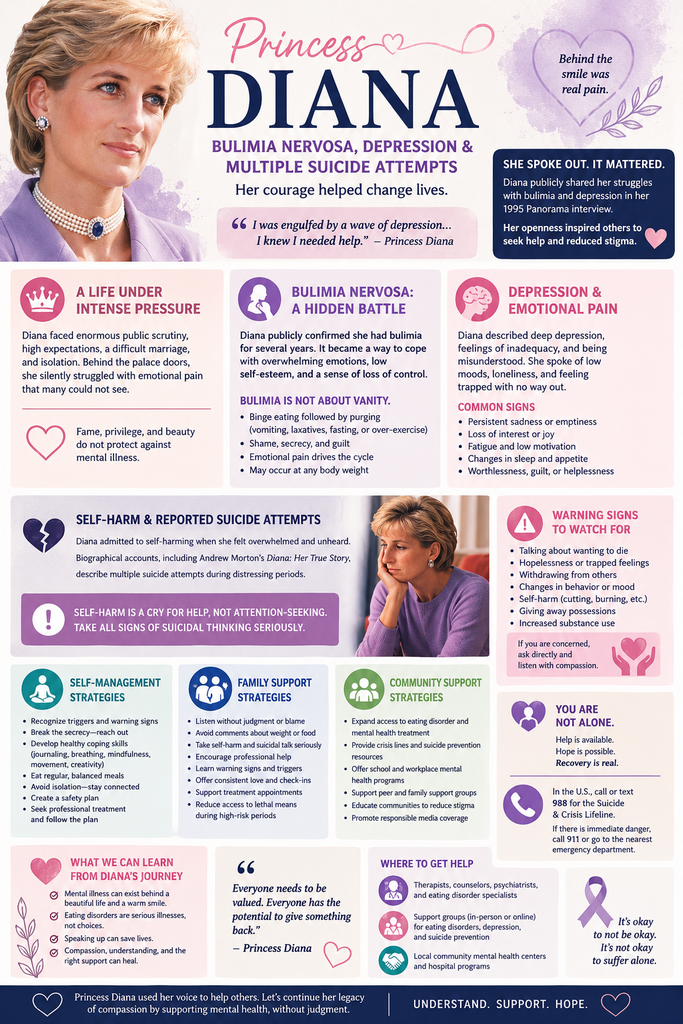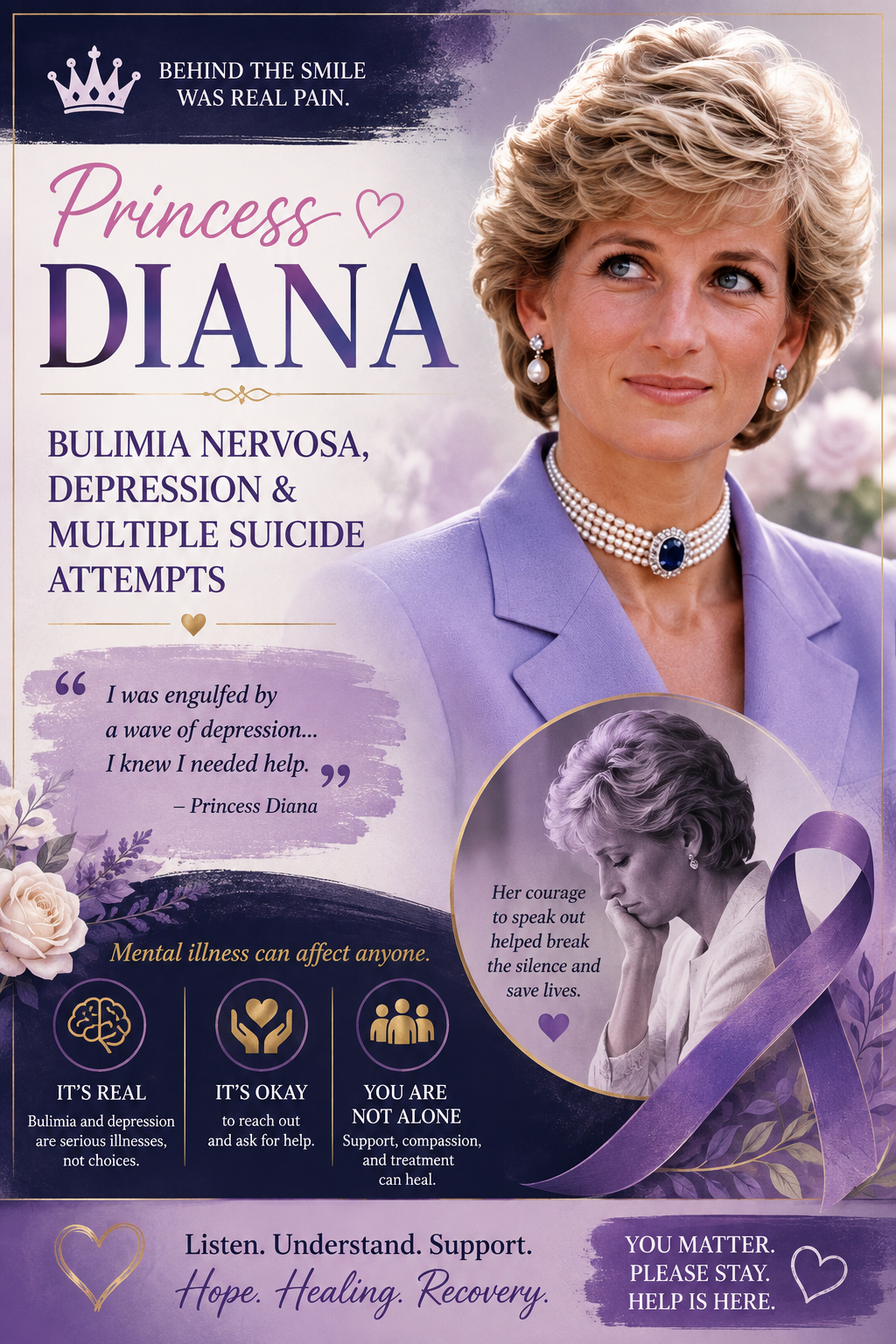
Princess Diana was admired worldwide for her compassion and humanitarian work, but behind her public image, she experienced serious emotional struggles. She openly discussed bulimia nervosa, depression, self-harm, and low self-esteem, while biographical accounts also described suicide attempts during periods of severe distress. By speaking publicly about her experiences, Diana helped challenge the stigma surrounding eating disorders and mental illness and showed that fame, wealth, and privilege do not protect someone from emotional suffering.
Depression Behind the Royal Image
Diana’s life changed dramatically after marrying Prince Charles in 1981. She suddenly faced worldwide attention, intense media scrutiny, royal responsibilities, marital difficulties, and the expectations that come with becoming Princess of Wales.
In her famous 1995 Panorama interview, Diana described experiencing depression after the birth of Prince William. She recalled feeling extremely low and misunderstood and said she received considerable treatment. She also described the difficulty of being openly distressed in an environment that did not necessarily understand how to respond to depression.
Her experience illustrates an important point: depression does not always match a person’s outward circumstances. Someone may appear successful, privileged, productive, and socially engaged while experiencing severe emotional pain privately.
Diana’s Struggle With Bulimia Nervosa
Diana publicly confirmed that she experienced bulimia for several years. She described it as a secretive and destructive cycle connected with low self-esteem and emotional distress. She also explained that binge eating temporarily provided comfort before being followed by purging and feelings of disgust.
Bulimia nervosa is a serious eating disorder involving recurrent episodes of binge eating followed by behaviors intended to compensate for the food consumed. These can include self-induced vomiting, misuse of laxatives, fasting, or excessive exercise.
Diana’s experience highlights several characteristics that can accompany eating disorders:
- Shame and secrecy
- Low self-esteem
- Feeling emotionally overwhelmed
- Using eating behaviors to cope with distress
- Fear of judgment
- Difficulty asking for help
- Feeling out of control
- Maintaining an outward appearance that hides the illness
Importantly, someone with bulimia may remain at an average or relatively stable body weight. This can make the disorder difficult for others to recognize.
Emotional Pain, Self-Harm & Reported Suicide Attempts
Diana also spoke publicly about deliberately hurting herself during periods when she felt unheard and overwhelmed. In the Panorama interview, she explained that intense internal pain sometimes led her to hurt herself physically as a way of communicating distress and seeking help.
Accounts surrounding Andrew Morton’s Diana: Her True Story went further, describing multiple suicide attempts. Contemporary reporting about the book referred to accounts of several attempts, including an episode involving a fall down stairs.
These reports should be discussed with some caution. Diana directly confirmed depression, bulimia, and self-harming behavior in her televised interview, while some of the more specific descriptions and number of suicide attempts come primarily from biographical accounts rather than a complete publicly available medical record.
The distinction is important because discussions of someone’s mental health should avoid turning uncertain historical details into established clinical facts.
Understanding Self-Harm and Suicidal Behavior
Self-harm and suicide attempts are not simply “attention-seeking.” They can indicate profound psychological distress and should always be taken seriously.
A person experiencing a crisis may feel:
- Hopeless about the future
- Emotionally trapped
- Worthless or burdensome
- Unable to communicate their suffering
- Overwhelmed by relationship conflict
- Increasingly isolated
- Unable to imagine circumstances improving
Self-harm does not automatically mean someone intends to die, but people who self-harm can have an increased risk of suicidal behavior. Professional assessment is therefore important.
Self-Management Strategies
People experiencing depression, bulimia, self-harm urges, or suicidal thoughts need professional support. Self-management strategies can complement treatment but should not replace it.
Helpful approaches include:
- Identify emotional triggers. Notice situations, relationships, thoughts, or pressures that increase urges to binge, purge, self-harm, or withdraw.
- Break secrecy. Eating disorders and self-harm often become stronger when hidden. Consider identifying at least one trusted person who can provide support.
- Develop healthier coping methods. Journaling, grounding exercises, relaxation techniques, creative activities, movement, and talking with supportive people can provide alternatives for managing distress.
- Establish regular nutrition. Structured meals and snacks may be an important component of eating-disorder recovery under professional guidance.
- Avoid isolation. Maintain contact with supportive friends, relatives, therapists, or recovery communities.
- Create a safety plan. Identify warning signs, coping strategies, supportive contacts, crisis resources, and ways to reduce access to lethal means.
- Seek specialized treatment. Eating disorders, depression, and suicidal behavior may require coordinated medical, nutritional, and psychological care.
Recovery usually involves more than simply telling someone to “stop” bingeing, purging, or self-harming. Treatment needs to address the underlying emotional distress as well as the behavior.
Family Support Strategies
Diana’s story demonstrates how damaging it can feel when someone believes their distress is misunderstood or dismissed.
Families can provide healthier support by:
- Listening without judgment, ridicule, or blame.
- Avoiding comments about weight, appearance, calories, or food consumption.
- Recognizing eating disorders as mental-health conditions rather than lifestyle choices.
- Taking self-harm and suicidal statements seriously.
- Asking directly about suicidal thoughts when concerned.
- Encouraging professional treatment without shaming the person.
- Learning the person’s warning signs and emotional triggers.
- Checking in regularly rather than waiting for a crisis.
- Supporting treatment appointments and recovery routines.
- Reducing access to potentially lethal means during periods of elevated suicide risk.
Families should also remember that they cannot provide all treatment themselves. Professional help may be necessary even when a family is loving and supportive.
Community Support Strategies
Princess Diana’s openness had an impact beyond her personal recovery. Mental-health professionals described increased awareness and treatment-seeking for eating disorders after she discussed bulimia publicly—sometimes called the “Diana effect.”
Communities can continue this work by:
- Expanding affordable eating-disorder and mental-health treatment.
- Training healthcare professionals to recognize eating disorders at different body sizes.
- Providing suicide-prevention and crisis-intervention services.
- Creating school and workplace mental-health programs.
- Supporting peer and family support groups.
- Teaching people how to recognize depression and self-harm warning signs.
- Challenging stigma surrounding psychiatric treatment.
- Encouraging responsible media coverage of eating disorders and suicide.
- Connecting primary care, psychiatry, nutrition, and eating-disorder specialists.
Diana herself later spoke publicly about eating disorders, emphasizing that they involve deeper emotional problems rather than simply vanity. Her willingness to discuss the issue helped shift the public conversation.
What Princess Diana’s Journey Can Teach Us
Diana’s story demonstrates that mental illness can exist behind an apparently extraordinary life. A person can smile for cameras, perform demanding responsibilities, care deeply about others, and still struggle internally.
Her experience also teaches us that behaviors such as bulimia and self-harm should not be viewed only as “bad behaviors” that need to stop. They may represent attempts to manage overwhelming emotions when healthier coping strategies and adequate support are unavailable.
Perhaps one of Diana’s most important contributions was eventually speaking about what had previously been hidden. By publicly acknowledging bulimia, she helped other people recognize that eating disorders were genuine illnesses worthy of treatment rather than sources of shame.
Conclusion
Princess Diana’s mental-health journey was complicated by enormous public scrutiny, relationship difficulties, royal expectations, depression, bulimia nervosa, and episodes of self-harm, alongside biographical reports of suicide attempts. Her experience should not be reduced to tragedy. It can instead help us understand the importance of listening, recognizing emotional distress early, reducing stigma, providing evidence-based treatment, and taking suicidal behavior seriously.
Diana eventually used her public platform to speak about subjects that many people were afraid to discuss. Her willingness to acknowledge bulimia helped change public attitudes toward eating disorders and encouraged others to seek treatment.
Her story leaves a valuable mental-health message: do not assume that someone’s public appearance tells you what they are experiencing privately. Listen to the person behind the image, take cries for help seriously, and make compassionate support easier to reach.
Crisis support: In the United States, anyone experiencing suicidal thoughts or concerned about someone at risk can call or text 988 for the Suicide & Crisis Lifeline. If there is immediate danger or a suicide attempt has occurred, call 911 or go to the nearest emergency department.
Frequently Asked Questions
Here are some common questions:
1. Did Princess Diana have bulimia nervosa?
Yes. Diana, Princess of Wales publicly discussed experiencing bulimia nervosa for several years. She described binge eating and purging as being connected with emotional distress, low self-esteem, and difficulties in her personal life.
2. What is bulimia nervosa?
Bulimia nervosa is a serious eating disorder characterized by repeated episodes of binge eating followed by attempts to compensate, such as self-induced vomiting, fasting, excessive exercise, or misuse of laxatives. It can cause serious psychological and physical complications.
3. Why did Princess Diana develop bulimia?
There was probably no single cause. Diana described enormous emotional pressure, insecurity, relationship difficulties, public scrutiny, and low self-esteem during this period. Eating disorders generally develop through a combination of psychological, biological, interpersonal, and environmental factors.
4. Did Princess Diana experience depression?
Yes. Diana publicly described periods of significant depression and emotional distress. In her 1995 Panorama interview, she discussed depression following the birth of Prince William and receiving professional treatment.
5. Did Princess Diana experience postpartum depression?
Diana described depression after Prince William’s birth, commonly discussed as postnatal or postpartum depression. Postpartum depression can involve persistent sadness, anxiety, hopelessness, exhaustion, difficulty functioning, and feelings of inadequacy.
6. Did Princess Diana self-harm?
Yes. Diana publicly acknowledged deliberately hurting herself during periods of intense emotional distress. She described feeling overwhelmed and struggling to communicate how much emotional pain she was experiencing.
7. Did Princess Diana attempt suicide multiple times?
Accounts associated with Andrew Morton’s biography Diana: Her True Story described multiple suicide attempts or suicidal behaviors during highly distressed periods. However, the exact number and circumstances should be presented cautiously, as they largely come from biographical accounts rather than from a publicly available medical record.
8. Is self-harm the same as a suicide attempt?
Not necessarily. Some people self-harm without intending to die, often as a way of coping with overwhelming emotions. However, self-harm is associated with increased suicide risk and should always be taken seriously.
9. Did royal life contribute to Diana’s mental-health difficulties?
Diana described intense media attention, marital difficulties, isolation, expectations surrounding royal life, and feeling misunderstood. These pressures may have contributed to her distress, but it would be overly simplistic to identify royal life as the sole cause of her mental-health problems.
10. Can someone with bulimia look healthy?
Yes. A person with bulimia can be underweight, average weight, or overweight. You cannot determine whether someone has an eating disorder simply by looking at them. This is one reason bulimia can remain hidden for long periods.
11. What are warning signs of bulimia?
Possible warning signs include:
- Recurrent binge-eating episodes
- Frequent trips to the bathroom after eating
- Secretive eating behaviors
- Excessive concern about weight or body shape
- Restrictive dieting between binges
- Excessive exercise
- Misuse of laxatives or other medications
- Feelings of shame surrounding eating
- Dental problems, dehydration, or other physical changes
12. Can bulimia become medically dangerous?
Yes. Repeated vomiting or other purging behaviors can cause dehydration and dangerous electrolyte abnormalities, which may affect the heart. Bulimia can also damage the teeth and digestive system and contribute to other serious medical complications.
13. What treatment can help someone with bulimia and depression?
Treatment may combine psychotherapy, medical monitoring, nutritional support, and psychiatric care. When depression, self-harm, or suicidal thoughts are also present, treatment should address these conditions together rather than focusing exclusively on eating behavior.
14. What self-management strategies can support recovery?
Professional treatment remains important, but individuals can support recovery by maintaining regular meals, identifying emotional triggers, reducing isolation, developing healthier coping skills, following prescribed treatment, avoiding purging behaviors, and creating a safety plan when suicidal thoughts are a concern.
15. How can families support someone with an eating disorder?
Families can listen without judgment, avoid criticizing the person’s body or eating habits, learn about eating disorders, encourage professional care, support treatment appointments, and recognize that an eating disorder is not simply a choice or lack of willpower.
16. What should families do if someone talks about suicide?
Take the statement seriously. Ask directly whether the person is thinking about suicide, stay with them when immediate risk is present, reduce access to potentially lethal means when it can be done safely, and obtain professional or emergency assistance.
17. Did Diana’s openness about bulimia make a difference?
Yes. Her willingness to publicly discuss bulimia helped bring unprecedented attention to eating disorders. Researchers and commentators have sometimes referred to increased awareness and treatment-seeking following her disclosure as the “Diana effect.”
18. What can communities learn from Princess Diana’s experience?
Communities can reduce stigma by treating eating disorders, depression, self-harm, and suicidal thoughts as legitimate health concerns. Schools, healthcare organizations, workplaces, and community programs can improve access to counseling, eating-disorder specialists, crisis services, and family education.
19. What is the biggest lesson from Princess Diana’s mental-health journey?
Her experience demonstrates that mental illness does not have a particular appearance. Wealth, beauty, fame, relationships, or social status cannot guarantee emotional well-being. Listening to someone’s distress rather than judging their outward circumstances can be an important first step toward helping them.
20. Where can someone get immediate help for suicidal thoughts?
In the United States, call or text 988 to reach the Suicide & Crisis Lifeline. If a person has attempted suicide, has an immediate plan, or cannot remain safe, call 911 or go to the nearest emergency department.
Video: What they didn’t tell you about Princess Diana #history #scandal #royals