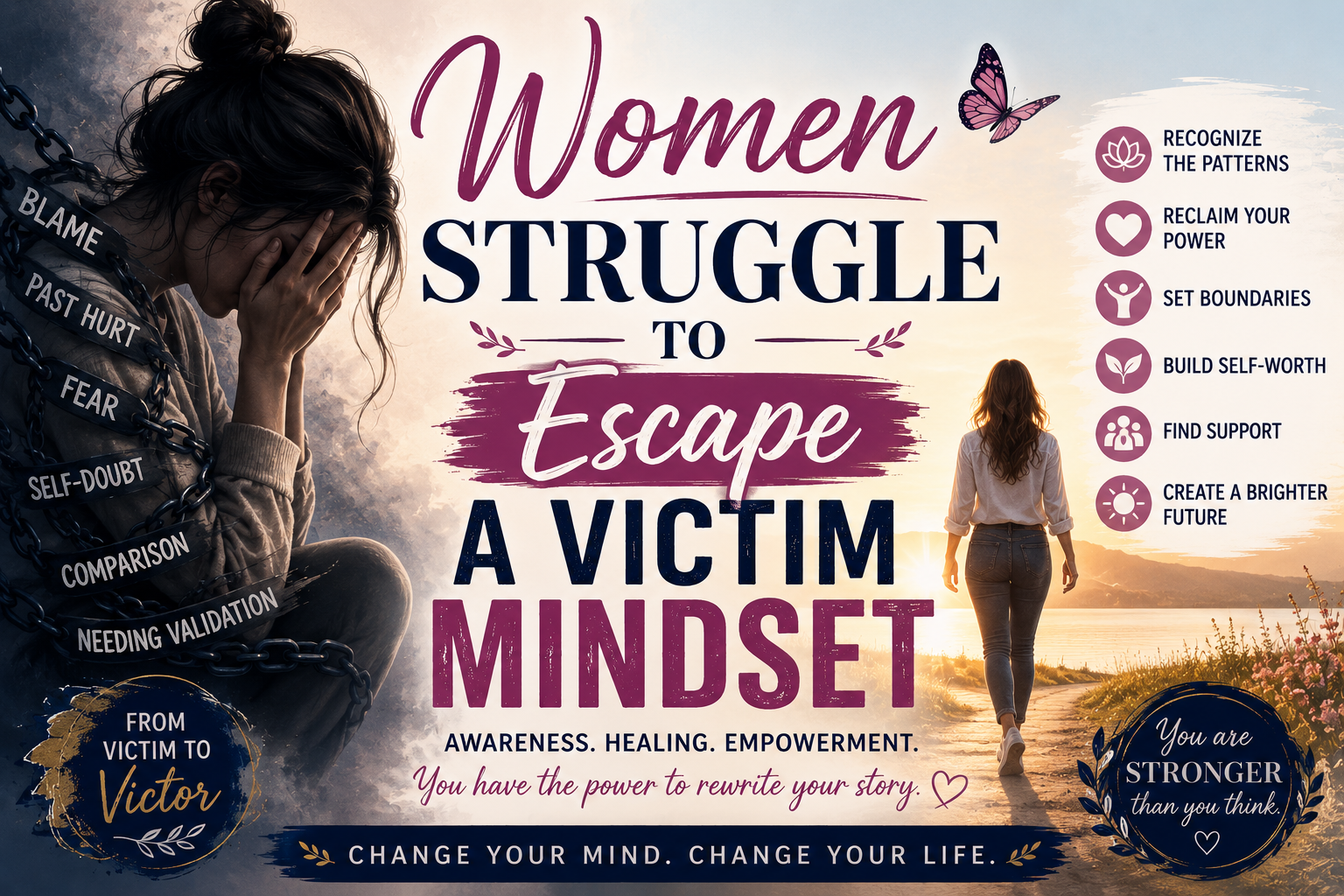
Modern women navigate a complicated environment of career expectations, relationships, family responsibilities, financial pressures, social media, beauty standards, and competing messages about independence and success. For some women, repeated disappointments, trauma, rejection, unhealthy relationships, or chronic stress can contribute to a pattern in which they increasingly view themselves as powerless over what happens in their lives.
Sometimes described informally as a “victim mentality,” this pattern is not a formal mental health diagnosis. Likewise, everyday distorted beliefs should not automatically be called delusions. In psychiatry, a delusion has a specific clinical meaning and can occur with conditions requiring professional assessment. A more accurate discussion focuses on victim thinking, cognitive distortions, externalization of responsibility, and reduced personal agency.
Understanding these patterns is not about blaming women for genuine mistreatment. Abuse, discrimination, exploitation, betrayal, and trauma are real. The goal is to distinguish acknowledging genuine harm from developing a persistent belief that personal choices can never influence what happens next.
Understanding Victim Thinking
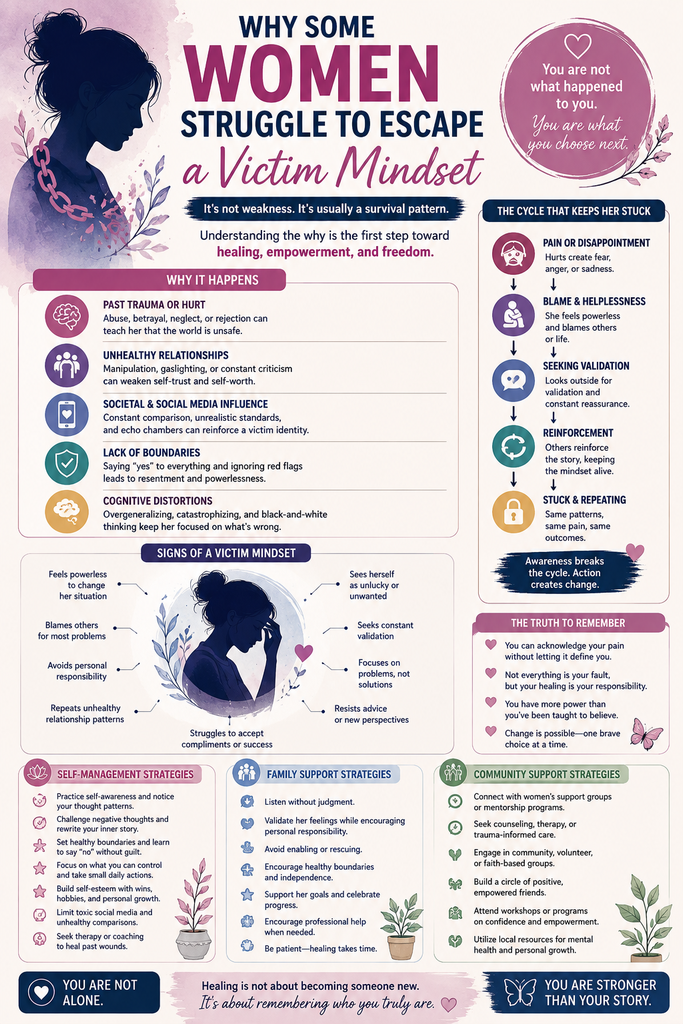
Victim thinking can develop when someone begins interpreting many negative experiences primarily through helplessness, unfairness, or the actions of other people.
Possible patterns include:
- Frequently believing other people are responsible for personal unhappiness
- Feeling powerless to improve difficult circumstances
- Expecting rejection or mistreatment before it happens
- Repeatedly focusing on unfairness without considering possible solutions
- Having difficulty acknowledging one’s contribution to conflicts
- Seeking constant validation for negative interpretations
- Rejecting advice because change feels impossible
- Repeating unhealthy relationship patterns
- Viewing constructive criticism as a personal attack
- Comparing one’s life constantly with other people’s lives
These behaviors can occur in women and men and may arise from a variety of experiences.
How Trauma Can Influence the Pattern
Some women who appear stuck in victim thinking have experienced genuine victimization.
Childhood abuse, domestic violence, sexual assault, emotional manipulation, neglect, bullying, abandonment, or repeated betrayal can influence how someone understands relationships and personal safety.
After repeated experiences of having little control, a person may begin expecting powerlessness even when circumstances change. She may become hyperalert to rejection, criticism, manipulation, or abandonment.
This does not mean she is imagining her past experiences. Instead, survival strategies that were once protective may continue to operate even when they are no longer helpful.
Trauma-informed counseling can help a person separate past danger from present circumstances while rebuilding a sense of control.
Social Media and Reinforcement
Digital environments can influence how people interpret their experiences. Algorithms often present users with increasingly similar content based on what they watch, like, share, or comment on.
If someone repeatedly consumes content telling her that every disagreement is abuse, every former partner is narcissistic, or every uncomfortable interaction proves she is being targeted, complex situations may gradually become interpreted through an overly simplified framework.
The opposite extreme is equally problematic. Content telling women that they are responsible for every relationship problem can reinforce shame and discourage legitimate victims from seeking help.
Healthy thinking requires room for complexity.
Sometimes another person behaved badly. Sometimes we made poor decisions. Sometimes both are true.
Cognitive Distortions
Cognitive distortions are thinking patterns that can influence how situations are interpreted.
Examples include:
- All-or-nothing thinking: “If this relationship failed, I will always be alone.”
- Overgeneralization: “One man betrayed me, so nobody can be trusted.”
- Mind reading: “I know everyone is judging me.”
- Catastrophizing: “This mistake has destroyed my entire future.”
- Personalization: “Everything that went wrong happened because something is wrong with me.”
- Externalization: “Nothing in my life can improve unless everyone else changes.”
Learning to identify these patterns can help a woman respond to situations based on evidence rather than automatic assumptions.
Accountability Is Not Self-Blame
One of the most important distinctions is between accountability and blame.
Self-blame says:
“Everything is my fault.”
Victim thinking may say:
“Nothing is my responsibility.”
Healthy accountability says:
“Some things were outside my control, but I can decide what I do next.”
This middle ground protects people from unnecessary shame while restoring personal agency.
Self-Management Strategies
Changing deeply established thinking patterns takes time. The goal is not to deny painful experiences but to identify where personal choices can create change.
Helpful strategies include:
- Separate facts from interpretations. Ask, “What actually happened, and what meaning am I adding to it?”
- Identify cognitive distortions. Notice catastrophizing, overgeneralization, mind reading, and all-or-nothing thinking.
- Focus on controllable factors. Other people’s behavior cannot always be changed, but boundaries and personal responses can.
- Reduce unhealthy social media exposure. Unfollow content that repeatedly increases anger, fear, resentment, or hopelessness.
- Practice personal accountability. Consider what could be handled differently next time without assuming responsibility for another person’s harmful behavior.
- Set healthy boundaries. Personal agency includes learning when to say no or leave unhealthy situations.
- Keep a journal. Writing down situations, thoughts, emotions, evidence, and alternative interpretations can reveal recurring patterns.
- Develop independent goals. Education, career development, hobbies, friendships, financial stability, and physical health can strengthen identity outside relationships.
- Practice self-compassion. Accountability works better when it is combined with respect rather than humiliation.
- Seek professional help when thinking patterns significantly interfere with everyday life.
Family Support Strategies
Family members may become frustrated when someone repeatedly describes herself as powerless while rejecting possible solutions. Criticism and ridicule, however, can strengthen defensiveness.
Families can:
- Listen to painful experiences without automatically agreeing with every interpretation.
- Validate emotions while gently discussing facts.
- Avoid labeling the person as “crazy,” “delusional,” or “attention-seeking.”
- Encourage problem-solving instead of repeatedly reinforcing helplessness.
- Ask, “What part of this situation can you control?”
- Encourage healthy independence.
- Maintain boundaries around repeated conflict or harmful behavior.
- Avoid rescuing the person from every consequence.
- Encourage professional counseling when patterns become persistent.
- Take threats of self-harm, violence, abuse, or severe psychiatric symptoms seriously.
Supporting someone does not require agreeing with everything she believes. Compassion and accountability can exist together.
Community Support Strategies
Community connections can provide perspectives beyond those found on social media and in unhealthy relationships.
Helpful resources may include:
- Licensed mental health professionals
- Trauma-informed therapists
- Domestic violence and sexual assault services
- Women’s support organizations
- Peer-support groups
- Relationship education programs
- Community mental health centers
- Career and educational programs
- Financial counseling and independence programs
- Faith communities when consistent with personal preferences
- Crisis services when immediate safety concerns exist
Healthy communities should promote both support and empowerment rather than encouraging permanent identification with helplessness.
When “Delusions” Require Professional Attention
The word delusion should be used carefully. Clinically, a delusion is not simply an opinion that seems unrealistic or an interpretation with which other people disagree.
If someone develops firmly held false beliefs accompanied by significant paranoia, hallucinations, severe behavioral changes, inability to function, or loss of contact with reality, professional mental health evaluation is important. Sudden symptoms can also have medical or substance-related causes and may require urgent assessment.
Moving From Victimhood to Personal Agency
A woman can acknowledge:
“Something harmful happened to me.”
without concluding:
“Therefore, I will always be powerless.”
Healing involves recognizing what cannot be changed while becoming increasingly intentional about what can.
A healthier internal message becomes:
“I cannot control everything that happened to me, but I can influence what happens next.”
Conclusion
Some women become trapped in patterns of helplessness, distorted thinking, or externalized responsibility after experiencing trauma, unhealthy relationships, chronic stress, repeated disappointment, or reinforcing social environments. These patterns should be approached with neither ridicule nor unquestioning validation.
Real empowerment combines compassion with accountability. Women can acknowledge genuine injustice while examining their own choices, challenge distorted beliefs without denying painful experiences, and seek help without considering themselves weak.
Through self-awareness, healthier boundaries, supportive relationships, community resources, and professional care when needed, a woman can move from repeatedly asking “Why does this always happen to me?” toward the more empowering question:
“What can I do next to build the life I want?”
Frequently Asked Questions
Here are some common questions:
1. What is a victim mindset?
A victim mindset is an informal term for a persistent pattern of feeling powerless, focusing heavily on what others have done wrong, and believing there is little personal ability to influence future outcomes. It is not a formal mental health diagnosis.
2. Why might some women develop a victim mindset?
There is no single cause. Past trauma, abuse, betrayal, chronic criticism, unhealthy relationships, low self-esteem, learned helplessness, social isolation, and repeated experiences of having little control may contribute. These patterns can occur in people of any gender.
3. Is acknowledging that you were victimized the same as having a victim mindset?
No. Someone can genuinely be a victim of abuse, assault, discrimination, manipulation, or another harmful experience. A victim mindset refers instead to a broader pattern in which feelings of powerlessness continue to influence many situations and future decisions.
4. Can trauma contribute to feelings of helplessness?
Yes. Repeated trauma can affect how a person perceives safety, trust, relationships, and control. Behaviors that appear irrational to outsiders may have originally developed as survival strategies.
5. What are common signs of persistent victim thinking?
Possible patterns include:
- Frequently feeling powerless to change circumstances
- Blaming others for most personal difficulties
- Expecting rejection or mistreatment
- Focusing on problems while rejecting possible solutions
- Seeking repeated reassurance or validation
- Having difficulty accepting constructive feedback
- Repeating unhealthy relationship patterns
- Believing that meaningful change is impossible
These behaviors alone do not establish a mental health diagnosis.
6. Can social media reinforce victim thinking?
It can sometimes reinforce existing beliefs. Algorithms may repeatedly expose someone to similar messages and communities. Content that labels every disagreement as abuse or encourages constant blame can oversimplify complicated relationships. Social media can also provide valuable education and support, so its influence depends greatly on the content being consumed.
7. Why can it be difficult to leave this mindset?
Familiar thinking patterns can provide predictability and emotional protection. Accepting personal agency can also feel frightening because it requires making decisions, tolerating uncertainty, establishing boundaries, and accepting that choices sometimes have consequences.
8. Does personal accountability mean blaming yourself?
No. Accountability and self-blame are different. A person can recognize that someone treated her unfairly while also asking what choices she can make now to protect herself and improve her future.
A healthier perspective is: “I may not be responsible for what happened to me, but I can take responsibility for how I move forward.”
9. How can women begin breaking the cycle?
Helpful strategies may include:
- Identifying recurring thought patterns
- Separating facts from assumptions
- Challenging all-or-nothing thinking
- Establishing healthier boundaries
- Developing independent goals
- Reducing unhealthy social media exposure
- Building supportive relationships
- Practicing self-compassion
- Taking small actions toward controllable goals
- Seeking counseling when needed
10. How can family members provide support?
Families can listen without ridicule, acknowledge legitimate pain, encourage problem-solving, maintain appropriate boundaries, and avoid continually rescuing someone from the consequences of unhealthy choices. Support should promote independence rather than helplessness.
11. Should families challenge inaccurate beliefs?
They can do so respectfully. Instead of saying, “You’re wrong,” it may be more productive to ask, “What evidence supports that conclusion?” or “Is there another way we could interpret what happened?”
12. Can therapy help?
Yes. Therapy may help someone understand how trauma, relationships, self-esteem, or cognitive distortions influence current behavior. Approaches such as cognitive behavioral therapy may also help people recognize unhelpful thinking patterns and develop more adaptive responses.
13. What community resources may help?
Mental health professionals, trauma-informed counseling, women’s support organizations, domestic violence resources, peer-support programs, community mental health centers, educational programs, and healthy social networks may all provide valuable support depending on the person’s circumstances.
14. Is a victim mindset the same as being delusional?
No. A victim mindset is not a psychiatric diagnosis, and distorted thinking should not automatically be described as a delusion. Clinically, delusions are firmly held false beliefs that can occur in certain psychiatric, neurological, medical, or substance-related conditions and may require professional evaluation.
15. Can someone completely change these patterns?
Yes, thinking and behavioral patterns can change. Progress usually involves awareness, healthier boundaries, supportive relationships, personal responsibility, and repeated opportunities to make different choices.
16. What is the goal of overcoming a victim mindset?
The goal is not to deny trauma or pretend that unfair experiences never occurred. It is to restore personal agency. A person can acknowledge what happened while recognizing that the past does not have to control every future decision.
Video: From Victimhood to Personal Power