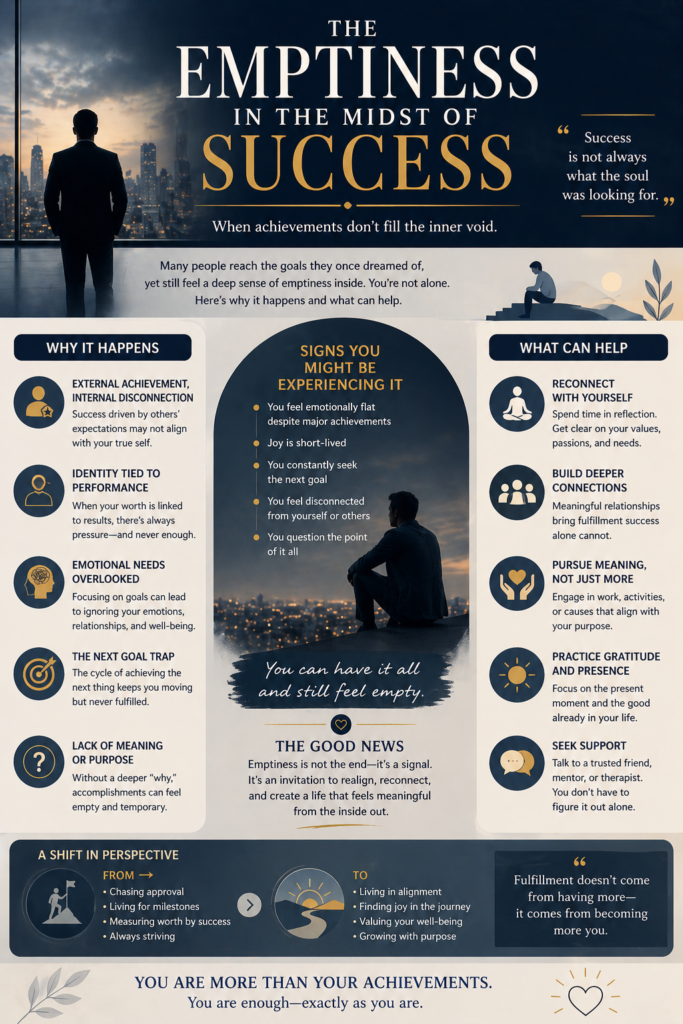
Emptiness in the midst of success is a paradox that many people struggle to understand. On the surface, life may appear complete—goals achieved, stability secured, and recognition earned. Yet internally, there can be a lingering sense that something is missing. This feeling often brings confusion, guilt, or even shame, especially when success is supposed to equal fulfillment. The disconnect lies in the difference between external achievement and internal meaning. While success measures what has been accomplished, fulfillment reflects how deeply those accomplishments align with one’s identity, values, and emotional needs.
Full on the Outside, Empty Within: Understanding Emptiness in the Midst of Success
Success is often seen as the ultimate goal—a marker that you’ve “made it.” Whether it’s career advancement, financial stability, academic achievement, or recognition, these milestones are supposed to bring fulfillment. Yet, for many people, success arrives with an unexpected companion: a persistent sense of emptiness.
This experience can feel confusing, even unsettling. You’ve done everything right. You’ve reached the goals you once believed would make you feel complete. So why does something still feel missing?
The Paradox of Achievement and Emptiness
At a surface level, success provides external rewards—status, security, validation. But internally, fulfillment operates differently. It is shaped by meaning, connection, identity, and emotional alignment.
When there’s a gap between external achievement and internal experience, people may feel:
- Disconnected from their accomplishments
- Unsure why they’re not satisfied
- Guilty for feeling ungrateful despite success
This disconnect is sometimes referred to as an achievement–fulfillment gap—where outward success doesn’t translate into inner well-being.
Why Emptiness Can Persist Despite Success
1. Success Was Driven by External Validation
If goals are shaped primarily by expectations—family, society, or pressure—the outcome may not reflect your authentic desires.
You may find yourself asking:
- Did I want this, or was I supposed to want this?
2. Identity Becomes Tied to Achievement
When success defines your identity, there’s little space left for who you are beyond performance.
Without constant achievement, you may feel:
- Directionless
- Uncertain of your worth
- Afraid of slowing down
3. Emotional Needs Were Overlooked
Focusing heavily on goals can unintentionally suppress emotional awareness.
Over time, this can lead to:
- Difficulty identifying what you feel
- Emotional numbness
- A sense of inner “flatness.”
4. The “Arrival Fallacy.”
There’s a common belief: “Once I achieve this, I’ll feel fulfilled.”
But fulfillment isn’t a destination—it’s an ongoing process.
When the expected emotional payoff doesn’t arrive, it can create disappointment or confusion.
5. Lack of Meaning or Purpose
Achievement without meaning often feels hollow.
Success answers the question:
- “What have I done?”
But fulfillment answers:
- “Why does it matter?”
Without that deeper connection, accomplishments can feel empty.
Signs You May Be Experiencing This
- You feel emotionally flat despite major achievements
- Celebrations feel short-lived or unimportant
- You quickly move to the “next goal” without satisfaction
- You struggle to feel joy or pride in your success
- You feel disconnected from yourself or others
Rebuilding a Sense of Fulfillment
1. Redefine Success Internally
Shift from:
- External markers (titles, money, recognition)
to - Internal markers (peace, alignment, purpose)
Ask yourself:
- What actually feels meaningful to me?
2. Reconnect With Your Identity
Explore who you are outside of what you achieve:
- Interests
- Values
- Personal beliefs
This helps rebuild a more stable sense of self.
3. Develop Emotional Awareness
Make space to notice your internal state:
- What am I feeling right now?
- When do I feel most alive?
Emotional awareness reconnects you to your experience.
4. Focus on Meaningful Connections
Relationships often provide a deeper sense of fulfillment than achievement alone.
Prioritize:
- Authentic conversations
- Emotional presence
- Shared experiences
5. Slow Down the Achievement Cycle
Constant striving can prevent you from processing success.
Practice:
- Pausing after milestones
- Reflecting on what you’ve accomplished
- Allowing yourself to feel it
The Role of Mental Health
Persistent emptiness can sometimes overlap with conditions like Depression, especially if it includes numbness, lack of motivation, or loss of interest in previously meaningful activities.
If the feeling is ongoing or intensifying, professional support can help clarify what’s underneath the surface.
A Different Perspective on Success
Success is not inherently empty—but it becomes so when it’s disconnected from identity, meaning, and emotional experience.
The goal isn’t to abandon success. It’s to integrate it with:
- Who you are
- What you value
- What gives your life meaning
Final Thought
Feeling empty despite success doesn’t mean something is wrong with you—it means something important is missing from the equation.
When you begin to shift from achievement alone to alignment and meaning, success stops feeling like an endpoint—and starts becoming part of a more fulfilling, balanced life.
From Achievement to Alignment: Self-Management Strategies for Emptiness in the Midst of Success
Reaching success is often expected to bring fulfillment, clarity, and satisfaction. Yet for many, it brings something unexpected—a quiet sense of emptiness. This feeling can be confusing and even uncomfortable, especially when everything on the outside appears “right.”
Understanding and managing this experience isn’t about abandoning success—it’s about learning how to reconnect your internal world with your external achievements. Self-management becomes the bridge between the two.
Why Self-Management Matters
When emptiness shows up despite success, it often signals a disconnect between:
- What you’ve achieved
- What you actually need emotionally and psychologically
Self-management helps you:
- Rebuild self-awareness
- Reconnect with meaning and identity
- Create a more sustainable sense of fulfillment
1. Identify the Source of the Emptiness
Not all emptiness comes from the same place.
Ask yourself:
- Do I feel disconnected, numb, or unmotivated?
- Did I pursue this goal for myself or others?
- What did I expect to feel—and what do I actually feel?
Clarity reduces confusion and helps you respond intentionally rather than react emotionally.
2. Redefine Success on Your Own Terms
External success doesn’t always equal internal fulfillment.
Shift from:
- “What should I achieve?”
to - “What actually matters to me?”
Create a personal definition of success that includes:
- Emotional well-being
- Meaningful relationships
- Personal values
3. Reconnect With Your Identity Beyond Achievement
When identity is tied only to success, emptiness often follows.
Explore:
- Interests you enjoy without performance pressure
- Values that define who you are—not what you do
- Activities that feel engaging, not just productive
This builds a more stable and authentic sense of self.
4. Develop Emotional Awareness
Emptiness is often linked to emotional disconnection.
Practice:
- Daily emotional check-ins (“What am I feeling right now?”)
- Noticing physical sensations linked to emotions
- Naming feelings without judgment
This helps restore your connection to your internal experience.
5. Slow Down the Constant Achievement Cycle
Constant striving can prevent you from processing success.
Try:
- Pausing after completing goals
- Reflecting on what you’ve accomplished
- Allowing yourself to experience satisfaction—even briefly
Without pauses, success becomes a cycle rather than a source of fulfillment.
6. Build Meaning Into Your Daily Life
Meaning doesn’t always come from big achievements—it often comes from small, consistent actions.
Focus on:
- Helping others
- Engaging in purposeful routines
- Connecting your work to a larger impact
Meaning creates depth where achievement alone cannot.
7. Strengthen Genuine Connections
Emptiness often grows in isolation—even when you’re successful.
Prioritize:
- Honest conversations
- Emotional vulnerability
- Time with people who see you beyond your achievements
Connection reinforces a sense of belonging and purpose.
8. Know When to Seek Support
If emptiness persists or deepens, it may overlap with conditions like Depression.
Support can help you:
- Understand underlying causes
- Rebuild emotional connection
- Develop personalized coping strategies
Seeking help is not a setback—it’s a step toward clarity.
The Bigger Shift: From Doing to Being
Self-management is not about achieving more—it’s about realigning.
Over time, the shift looks like:
- Constant striving → Intentional living
- External validation → Internal alignment
- Emptiness → Meaningful engagement
Final Thought
Feeling empty in the midst of success is not a failure—it’s feedback. It signals that achievement alone isn’t enough to sustain fulfillment.
When you begin to manage your internal world with the same intention you applied to your external success, something changes. Life becomes less about chasing the next milestone—and more about experiencing meaning in the present.
Supporting From the Inside Out: Family Strategies to Understand Emptiness in the Midst of Success
Success is often celebrated as the solution to life’s struggles. From the outside, it can look like everything is in place—career, achievements, recognition. But within families, a different reality may quietly unfold: a loved one who appears successful yet feels emotionally empty, disconnected, or unfulfilled.
This disconnect can be confusing for everyone involved. Family members may wonder, “How can they feel this way when they have so much?” Understanding this experience is the first step toward offering meaningful support.
Why Family Support Matters
When someone feels empty despite success, they may struggle to express it due to:
- Guilt (“I should be grateful”)
- Fear of being misunderstood
- Difficulty identifying their own emotions
Supportive families can help by:
- Creating a safe space for honesty
- Reducing pressure tied to achievement
- Reinforcing identity beyond success
1. Validate the Feeling—Not Just the Achievement
It’s natural to want to highlight their accomplishments—but that can unintentionally dismiss their emotional experience.
Instead of saying:
- “But you’ve done so well!”
Try:
- “It sounds like something still feels off, even with everything you’ve achieved.”
Validation helps them feel understood, not corrected.
2. Shift the Focus Away From Constant Performance
Some individuals grow up in environments where worth is tied to success. Even unintentionally, families can reinforce this pattern.
Supported by:
- Celebrating effort, not just outcomes
- Creating spaces where achievement isn’t the topic
- Encouraging rest and balance
This helps separate identity from performance.
3. Encourage Open Conversations About Meaning and Purpose
Emptiness often relates to a lack of meaning rather than a lack of success.
Ask questions like:
- “What feels meaningful to you right now?”
- “What do you wish felt different in your life?”
These conversations help shift focus from doing to being.
4. Watch for Emotional Withdrawal
Signs may include:
- Reduced enthusiasm
- Isolation despite success
- Emotional flatness
Gently acknowledging changes can open the door:
- “You seem a bit distant lately—want to talk?”
Awareness without pressure is key.
5. Model a Balanced Definition of Success
Family culture plays a powerful role in shaping beliefs about success.
Model:
- Prioritizing well-being alongside achievement
- Talking openly about stress, rest, and boundaries
- Valuing relationships as much as accomplishments
This creates a broader, healthier framework.
6. Support Identity Beyond Roles
When someone is defined by their success (job title, achievements), they may lose touch with who they are beyond it.
Encourage:
- Hobbies or creative outlets
- Activities without pressure to excel
- Exploration of personal interests
This helps rebuild a more complete sense of self.
7. Normalize Mental Health Conversations
Persistent emptiness can sometimes overlap with conditions like Depression.
Families can help by:
- Speaking openly about mental health
- Reducing stigma around seeking help
- Encouraging professional support when needed
This makes it easier for someone to reach out without shame.
8. Be Patient With the Process
Understanding and addressing emptiness is not immediate.
Avoid:
- Trying to “fix” the feeling quickly
- Offering constant solutions
Instead:
- Stay consistent
- Be present
- Allow space for gradual clarity
Support is most effective when it feels steady, not rushed.
The Bigger Picture: From Pressure to Presence
Family support can either reinforce the pressure of success or relieve it.
The shift looks like:
- Achievement-focused → Person-focused
- Fixing → Listening
- Pressure → Presence
These changes create an environment where fulfillment can grow naturally.
Final Thought
Emptiness in the midst of success isn’t a contradiction—it’s a signal. It points to a need for deeper connection, meaning, and identity.
Families don’t need to have all the answers. What matters most is creating a space where success isn’t the only measure of worth—and where a person feels valued simply for who they are, not just what they’ve achieved.
Finding Meaning Through Connection: Community Resource Strategies for Emptiness in the Midst of Success
Success can provide structure, stability, and recognition—but it doesn’t always provide meaning. For many individuals, especially high achievers, there comes a moment when outward accomplishments no longer translate into inner fulfillment. This sense of emptiness can feel isolating, confusing, and difficult to explain.
Community resources play a critical role in bridging that gap. They offer connection, perspective, and support systems that help transform success from something that looks good into something that feels meaningful.
Why Community Resources Matter
When emptiness persists despite success, individuals may:
- Feel disconnected from others
- Struggle to express what’s missing
- Question their purpose or identity
- Isolate despite being socially or professionally active
Community-based support helps by:
- Providing shared understanding
- Encouraging authentic connection
- Offering spaces for reflection and growth
1. Mental Health and Counseling Services
Therapists can help unpack the deeper layers behind emptiness, such as identity, purpose, and emotional disconnection.
Benefits include:
- Clarifying internal vs. external motivations
- Rebuilding emotional awareness
- Developing personalized strategies for fulfillment
If emptiness is persistent, it may overlap with conditions like Depression, making professional support especially valuable.
2. Peer Support Groups
Connecting with others who feel similarly can normalize the experience.
Why it helps:
- Reduces isolation
- Provides shared language for complex feelings
- Encourages honest, judgment-free conversations
These groups often reveal that emptiness is more common than people realize—even among successful individuals.
3. Purpose-Driven Community Involvement
Achievement answers “What have I done?”—but purpose answers “Why does it matter?”
Engaging in:
- Volunteering
- Mentorship
- Community service
can create a sense of contribution that goes beyond personal success.
4. Educational Workshops and Personal Development Programs
Structured learning environments help individuals explore deeper questions about meaning and identity.
Topics to explore:
- Values clarification
- Life purpose and direction
- Emotional intelligence
Education provides tools to better understand internal experiences.
5. Creative and Expressive Communities
Creativity offers a non-achievement-based way to reconnect with yourself.
Participating in:
- Art groups
- Writing circles
- Music or performance communities
helps shift focus from productivity to expression.
6. Faith-Based or Spiritual Communities
For some, emptiness is tied to a lack of deeper meaning or existential direction.
Spiritual communities can offer:
- Reflection on purpose and values
- A sense of belonging
- Practices that promote inner peace
The emphasis is on connection—to self, others, or something larger.
7. Wellness and Mindfulness Programs
Mindfulness-based communities help reconnect you to the present moment.
Benefits include:
- Increased emotional awareness
- Reduced mental overload from constant striving
- Greater appreciation for everyday experiences
These practices help shift focus from achievement to experience.
8. Networking With Authentic Intent
Traditional networking often reinforces performance and status. But an authentic connection focuses on:
- Real conversations
- Shared values
- Mutual growth
Reframing networking as relationship-building can reduce feelings of emptiness tied to superficial success.
Building a Supportive Community Ecosystem
You don’t need every resource—just the right combination.
A balanced approach might include:
- Professional support: therapy or counseling
- Peer support: groups or communities
- Purpose engagement: volunteering or mentoring
- Personal growth: workshops or mindfulness
Layering these creates a more meaningful, connected life structure.
Final Thought
Emptiness in the midst of success isn’t a sign of failure—it’s a signal that something deeper is needed. Community resources help meet that need by adding connection, purpose, and perspective to achievement.
Success may open doors—but it’s connection and meaning that make what’s behind those doors worth experiencing.
Frequently Asked Questions
Here are some common questions:
1. What does “emptiness in the midst of success” mean?
It refers to feeling emotionally unfulfilled, disconnected, or numb despite achieving goals like career success, financial stability, or recognition. Outwardly, things look successful—but internally, something feels missing.
2. Why do people feel empty even after achieving their goals?
Common reasons include:
- Goals driven by external expectations rather than personal values
- Lack of meaningful connection or purpose
- Emotional needs being overlooked during the pursuit of success
- Constant focus on “what’s next” instead of appreciating the present
3. Is this feeling normal?
Yes—more common than people realize. Many high achievers experience this at some point. It often reflects a misalignment between achievement and personal meaning, not a personal failure.
4. How is this different from burnout?
- Burnout is typically linked to exhaustion, stress, and overwork
- Emptiness is more about a lack of fulfillment or meaning, even if you’re not physically exhausted
They can overlap, but they are not the same.
5. Can this be related to mental health conditions?
Yes. Persistent emptiness may overlap with conditions like Depression, especially if it includes:
- Ongoing numbness
- Loss of interest in things you used to enjoy
- Low motivation
If it continues or worsens, professional support can be helpful.
6. Why do I feel guilty for feeling this way?
Because success is often associated with gratitude and happiness. When your internal experience doesn’t match expectations, it can create guilt or self-judgment.
But emotions don’t follow social rules—your experience is still valid.
7. What are the signs that someone is experiencing this?
- Feeling emotionally flat despite achievements
- Quickly moving to the next goal without satisfaction
- Questioning the meaning or purpose of accomplishments
- Feeling disconnected from self or others
- Difficulty experiencing joy
8. Does this mean my success was meaningless?
Not necessarily. It often means your success is incomplete without alignment—you may need to integrate purpose, identity, and emotional fulfillment alongside achievement.
9. How can someone start addressing this feeling?
Some helpful starting points:
- Reflect on personal values and what truly matters
- Slow down and process achievements instead of chasing the next goal
- Reconnect with activities that feel meaningful (not just productive)
- Build deeper, more authentic relationships
10. Can changing goals fix the emptiness?
Sometimes—but not always. The issue is often not which goals you pursue, but why and how you pursue them. Without internal alignment, new goals can lead to the same feeling.
11. Why do achievements feel satisfying only briefly?
This is often due to adaptation—once a goal is reached, it quickly becomes the new normal. Without deeper meaning, satisfaction fades, and the cycle repeats.
12. Is it possible to feel fulfilled and still be successful?
Yes. Fulfillment and success can coexist when:
- Your goals align with your values
- You prioritize emotional well-being
- You cultivate meaning beyond achievement
13. Should I talk to someone about this?
Yes, especially if:
- The feeling is persistent
- It’s affecting your motivation or relationships
- You feel stuck or confused
Talking to a therapist, mentor, or trusted person can provide clarity and support.
14. What’s the most important thing to remember?
Emptiness in the midst of success is not a sign that you’ve failed—it’s a signal that something deeper needs attention.
It’s less about doing more and more and more about realigning with what truly brings meaning, connection, and fulfillment.
Conclusion
Recognizing emptiness despite success is not a sign of failure—it is a signal for deeper awareness. It invites a shift from chasing external milestones to cultivating internal alignment, purpose, and connection. By acknowledging the gap between achievement and fulfillment, individuals can begin to redefine what success truly means for them. Over time, this awareness can lead to a more balanced life—one where accomplishments are not just impressive on the outside, but meaningful and satisfying on the inside.
Video: You Climbed the Ladder—It Was Against the Wrong Wall #Purpose #Fulfillment #WakeUpCall