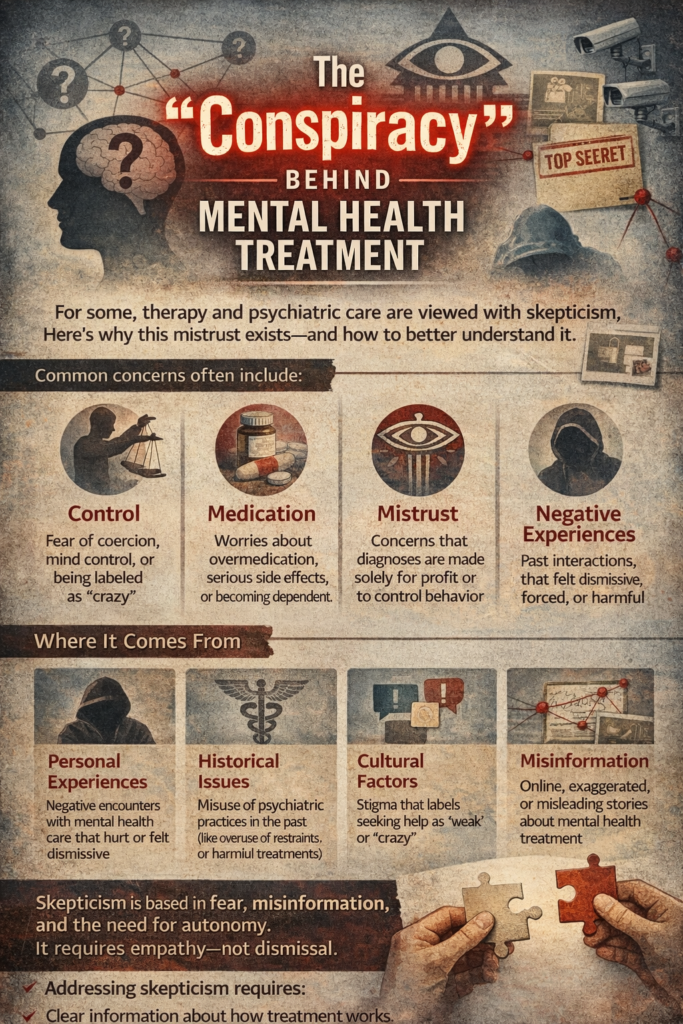
The idea of a “conspiracy” in mental health treatment often reflects concerns about trust, control, and vulnerability rather than simple misunderstanding. Fears about misdiagnosis, overmedication, or loss of autonomy are often shaped by personal experiences, cultural narratives, and mixed information.
Instead of dismissing these concerns, exploring their roots allows for a more balanced view—one that recognizes both the limits and benefits of mental health care, while building trust through transparency and informed choice.
Deconstructing the “Conspiracy” Behind Mental Health Treatment
Mental health treatment is designed to help—but not everyone sees it that way.
For some, therapy and psychiatric care are viewed with skepticism, even suspicion. Questions arise: Is it really about helping people—or controlling them? Are medications overprescribed? Can professionals truly understand individual experiences?
These concerns are often labeled as “conspiracy thinking,” but they don’t emerge out of nowhere. They are shaped by personal experiences, cultural narratives, and broader mistrust in institutions.
Understanding these perspectives doesn’t mean agreeing with them—it means looking more deeply into where they come from.
Where the Skepticism Begins
Distrust in mental health treatment is often rooted in:
- Past negative experiences (feeling misunderstood or dismissed)
- Historical misuse of psychiatric practices
- Cultural stigma around mental health care
- Fear of being labeled or judged
When people feel that their autonomy or identity might be threatened, hesitation is a natural response.
The Role of Misinformation
In today’s digital world, information spreads quickly—but not always accurately.
Common misconceptions include:
- Therapy is about controlling thoughts
- Medication changes who you are
- Mental health diagnoses are arbitrary or exaggerated
These narratives can create fear, especially when they are repeated without context or balanced information.
The Complexity of Mental Health Treatment
Mental health care is not one-size-fits-all.
It includes:
- Talk therapy
- Medication (when appropriate)
- Behavioral strategies
- Support systems
Effective treatment is collaborative—it involves input, consent, and adjustment based on individual needs. When this collaboration is missing, mistrust can grow.
Why the “Conspiracy” Narrative Persists
The idea of a “conspiracy” often reflects deeper concerns about:
- Control vs. autonomy
- Trust in professionals and institutions
- Fear of vulnerability
When people don’t feel fully informed or involved, they may fill in the gaps with suspicion.
Rebuilding Trust Through Transparency
Addressing these concerns requires more than dismissing them.
Helpful approaches include:
- Open conversations about treatment options
- Clear explanations of diagnoses and recommendations
- Encouraging questions and informed decision-making
- Respecting individual experiences and concerns
Trust grows when people feel heard—not overridden.
Balancing Skepticism and Openness
Healthy skepticism can be valuable—it encourages people to ask questions and seek understanding.
But when skepticism turns into outright rejection, it can prevent access to potentially beneficial support.
The goal is balance:
- Questioning without assuming the worst
- Exploring options without closing off possibilities
Final Thought
The idea of a “conspiracy” behind mental health treatment often reflects a deeper issue: a gap between what people need and what they feel they’re receiving.
Bridging that gap requires empathy, transparency, and communication.
Because mental health care works best not when it’s imposed—
…but when it’s understood, trusted, and chosen.
From Doubt to Understanding: Self-Management Strategies for Navigating Mental Health “Conspiracy” Beliefs
Skepticism about mental health treatment is more common than many people realize. Concerns about medication, therapy, or diagnoses can sometimes evolve into broader beliefs that the system is misleading, controlling, or untrustworthy.
While these thoughts are often labeled as “conspiracy thinking,” they usually stem from something deeper—uncertainty, past experiences, or fear of losing control.
Self-management in this context isn’t about blindly trusting yourself. It’s about learning to evaluate, understand, and respond to your thoughts in ways that support informed, balanced decisions.
1. Acknowledge Your Concerns Without Dismissing Them
The first step is not to shut down your doubts—but to recognize them.
Ask yourself:
- What specifically am I worried about?
- Where did this belief come from?
Your concerns may be rooted in real experiences or valid questions. Acknowledging them creates a starting point for clarity rather than confusion.
2. Separate Emotion from Evidence
Strong emotions—like fear, distrust, or frustration—can make certain beliefs feel more convincing.
Try to distinguish:
- What do I feel?
- What do I know based on reliable information?
This doesn’t invalidate your emotions—it simply prevents them from becoming the only source of truth.
3. Seek Balanced, Credible Information
Instead of relying on a single perspective, explore multiple sources:
- Licensed mental health professionals
- Evidence-based articles or educational materials
- Reputable organizations
Look for consistency across sources rather than isolated claims. Balanced information helps counter extreme or one-sided narratives.
4. Avoid All-or-Nothing Thinking
Mental health treatment is not:
- Completely perfect
- Completely harmful
It exists in a spectrum.
Challenge thoughts like:
- “It’s all a scam.”
- “It’s the only solution.”
Replace them with:
- “Some aspects may help, others may not—what fits me?”
Nuanced thinking supports better decision-making.
5. Reflect on Personal Experiences Objectively
If you’ve had a negative experience with mental health care, it’s valid to feel hesitant.
But ask:
- Was this one experience—or a consistent pattern?
- Could a different approach or provider lead to a different outcome?
Avoid generalizing one experience to the entire system.
6. Maintain a Sense of Personal Control
One of the biggest fears behind skepticism is loss of autonomy.
Remember:
- You can ask questions
- You can seek second opinions
- You can accept or decline treatment options
Mental health care is most effective when it is collaborative—not imposed.
7. Monitor the Impact of Your Beliefs
Ask yourself:
- Are these beliefs helping me feel more informed—or more fearful?
- Are they supporting my well-being—or preventing me from seeking help?
Self-management involves evaluating not just what you believe, but how those beliefs affect your life.
8. Stay Open to Adjustment
Your perspective doesn’t have to stay fixed.
As you gather new information or experiences, allow your understanding to evolve. Flexibility is a strength—not a weakness.
9. Consider Support in Processing These Thoughts
If distrust or fear feels overwhelming, talking it through can help.
This might include:
- A mental health professional
- A trusted individual
- A support group
The goal isn’t to change your beliefs for you—but to help you explore them more clearly.
Final Thought
Questioning mental health treatment doesn’t make you wrong—it makes you thoughtful.
But staying stuck in fear or mistrust can limit your options.
Self-management is about finding the balance between:
- Blind trust and complete rejection
Because the most empowering place to be isn’t on either extreme—
…it’s an informed, intentional choice.
From Doubt to Dialogue: Family Support Strategies for Understanding Mental Health “Conspiracy” Beliefs
When a loved one expresses distrust or skepticism about mental health treatment, it can be difficult to know how to respond. You may feel concerned, frustrated, or even tempted to correct their thinking immediately.
But what’s often labeled as “conspiracy thinking” is rarely just about misinformation—it’s usually rooted in fear, past experiences, or a desire to maintain control.
For families, the goal isn’t to win an argument. It’s to build understanding, maintain connection, and gently support more balanced perspectives.
1. Start with Listening, Not Correcting
When someone feels strongly about their beliefs, immediate correction can lead to defensiveness.
Instead:
- Let them explain their concerns fully
- Avoid interrupting or dismissing
- Show that you’re genuinely trying to understand
Statements like:
- “Can you tell me more about what worries you?”
…open the door for dialogue rather than shutting it down.
2. Validate the Emotion, Not Necessarily the Belief
You don’t have to agree with the belief to acknowledge the feeling behind it.
For example:
- “It sounds like you’re worried about being misunderstood or losing control.”
Validation helps reduce emotional intensity, making it easier to have a productive conversation.
3. Avoid Power Struggles
Trying to “prove them wrong” can often reinforce their position.
Instead of:
- Debating facts aggressively
Try:
- Asking thoughtful questions
- Offering information gently, not forcefully
The goal is to encourage reflection—not resistance.
4. Encourage Critical Thinking Together
Rather than presenting yourself as the authority, explore the topic collaboratively.
You might ask:
- “What sources have you seen?”
- “How do we know which information is reliable?”
This shifts the focus from who is right to how we evaluate information.
5. Share Information Without Overwhelming
If you offer information, keep it:
- Clear
- Relevant
- Non-judgmental
Avoid overwhelming them with too many facts at once. Small, digestible insights are more effective than large amounts of data.
6. Emphasize Personal Choice and Control
A major concern behind skepticism is loss of autonomy.
Reassure them:
- They can ask questions
- They can seek second opinions
- They can make decisions about their own care
Framing treatment as a choice rather than something imposed can reduce resistance.
7. Focus on Their Goals, Not Just the Belief
Instead of focusing only on whether their belief is accurate, shift the conversation to:
- “What do you want to feel better?”
- “What kind of support would help you right now?”
This connects the discussion to their well-being, not just their viewpoint.
8. Maintain the Relationship First
Even if you disagree, preserving trust and connection is more important than immediate agreement.
Consistency, patience, and respect create a foundation where perspectives can evolve over time.
9. Know When to Encourage Outside Support
If distrust is preventing someone from getting needed help, you can gently suggest:
- Talking to a different provider
- Seeking a second opinion
- Exploring alternative but credible support options
Present this as an opportunity—not a correction.
Final Thought
Family support in the face of mental health skepticism isn’t about forcing belief—it’s about creating space for understanding.
When people feel heard, respected, and in control, they’re more open to reconsidering their views.
Because change rarely happens through pressure—
…it happens through connection, trust, and the willingness to keep the conversation going.
Bridging the Trust Gap: Community Resource Strategies for Understanding Mental Health “Conspiracy” Beliefs
Skepticism about mental health treatment doesn’t exist in isolation—it is shaped by culture, shared experiences, and access to information. When communities carry narratives of mistrust or fear around therapy and psychiatric care, those beliefs can spread, influencing how individuals perceive and approach help.
What is often labeled as a “conspiracy” is frequently a reflection of deeper issues: lack of access, poor past experiences, misinformation, or a disconnect between providers and the people they serve.
Communities have a unique role in addressing these gaps—not by dismissing concerns, but by creating environments where understanding, transparency, and trust can grow.
1. Promote Open, Stigma-Free Conversations
Silence can reinforce fear and misunderstanding.
Communities can:
- Host discussions about mental health experiences
- Encourage storytelling from diverse perspectives
- Normalize both positive and negative experiences with treatment
When people hear a range of real experiences, extreme or one-sided narratives lose some of their power.
2. Provide Accessible, Clear Mental Health Education
Misinformation often fills the space where clear information is lacking.
Community initiatives can offer:
- Workshops explaining how therapy and medication work
- Educational materials that break down common misconceptions
- Q&A sessions with qualified professionals
Understanding reduces uncertainty—and uncertainty often fuels mistrust.
3. Increase Transparency in Mental Health Services
Trust grows when systems are understandable.
Communities and organizations can:
- Clearly explain treatment options and processes
- Emphasize patient rights and informed consent
- Encourage questions and active participation
When people feel included in the process, they are less likely to feel controlled by it.
4. Improve Access to Diverse and Culturally Competent Care
Mistrust often comes from feeling misunderstood or unrepresented.
Communities can advocate for:
- Providers from diverse backgrounds
- Culturally sensitive approaches to treatment
- Language-accessible services
When care feels relevant and respectful, trust becomes more possible.
5. Create Peer-Led Support Spaces
Peer support can bridge the gap between skepticism and acceptance.
These spaces allow individuals to:
- Share concerns without judgment
- Learn from others who have navigated similar doubts
- Explore options in a less formal, more relatable setting
Hearing from peers can feel more approachable than hearing only from professionals.
6. Partner with Trusted Community Figures
People are more likely to trust information delivered by familiar and respected voices.
Communities can collaborate with:
- Educators
- Religious or spiritual leaders
- Local advocates
These individuals can help communicate balanced perspectives in a way that feels safe and credible.
7. Encourage Critical Thinking, Not Blind Acceptance
The goal is not to eliminate skepticism—but to guide it productively.
Community programs can teach:
- How to evaluate sources of information
- How to distinguish between evidence and opinion
- How to ask informed questions about care
Empowered individuals are less likely to rely on extreme or unfounded beliefs.
8. Offer Multiple Pathways to Support
Not everyone is ready to engage with traditional mental health treatment.
Communities can provide:
- Alternative support options (group programs, wellness workshops)
- Gradual entry points into care
- Flexible services that meet people where they are
This reduces resistance by offering choice rather than pressure.
Final Thought
Mental health “conspiracy” beliefs are rarely just about misinformation—they’re about trust.
Communities have the power to rebuild that trust by creating spaces where questions are welcomed, information is clear, and support is accessible.
Because when people feel informed, respected, and included, skepticism doesn’t have to turn into avoidance—
…it can become the starting point for understanding.
Frequently Asked Questions
Here are some common questions:
1. What does the “conspiracy” behind mental health treatment refer to?
It refers to the belief that mental health systems (therapy, psychiatry, medication) are intentionally misleading, controlling, or harmful rather than helpful. These beliefs often stem from mistrust, misinformation, or negative experiences.
2. Are these concerns always unfounded?
Not entirely. Some concerns come from:
- Real negative personal experiences
- Historical misuse of psychiatric practices
- System limitations (e.g., access, misdiagnosis)
However, these do not necessarily indicate a coordinated or intentional “conspiracy.”
3. Why do some people distrust mental health treatment?
Common reasons include:
- Fear of losing control or autonomy
- Concerns about medication side effects
- Feeling misunderstood or dismissed in past care
- Cultural stigma or negative narratives
Distrust is often emotional and experiential—not just informational.
4. Is mental health treatment meant to control people?
No. Ethical mental health care is designed to:
- Support well-being
- Improve functioning
- Respect patient autonomy
Most treatment approaches are collaborative, meaning individuals have a say in their care.
5. Are mental health medications overprescribed?
There are ongoing debates about prescribing practices, and in some cases, concerns about overuse exist. However:
- Medications are often evidence-based
- They are typically prescribed when the benefits outweigh the risks
- They are one option among many, not the only solution
6. Can therapy or diagnosis be inaccurate?
Yes, like any field, mental health care is not perfect. Misdiagnosis or poor therapeutic fit can occur. This is why:
- Second opinions are encouraged
- Treatment plans can be adjusted
- Finding the right provider is important
7. How does misinformation contribute to “conspiracy” beliefs?
Misinformation—especially online—can:
- Exaggerate negative experiences
- Present extreme or one-sided views
- Spread quickly without context
This can reinforce fear and mistrust, especially when balanced information is lacking.
8. Is it okay to question mental health treatment?
Yes. Healthy skepticism is important.
You can:
- Ask questions
- Seek multiple opinions
- Research treatment options
The goal is informed decision-making, not blind acceptance.
9. How can someone evaluate whether a belief is accurate or fear-based?
Ask:
- What evidence supports this belief?
- Are there credible sources confirming it?
- Is this based on one experience or a broader pattern?
Separating emotion from evidence can provide clarity.
10. What are the signs that skepticism is becoming harmful?
It may be harmful if it:
- Prevents someone from seeking needed help
- Increases fear or isolation
- Leads to rejecting all forms of support without evaluation
11. What role do trust and communication play?
They are central. When individuals feel:
- Heard
- Informed
- Respected
…they are more likely to engage with treatment and less likely to view it with suspicion.
12. How can trust in mental health treatment be improved?
Trust can be strengthened through:
- Transparency in care
- Open dialogue between providers and patients
- Culturally sensitive approaches
- Access to accurate, balanced information
Conclusion
Examining the “conspiracy” behind mental health treatment is not about proving or disproving a single narrative—it is about addressing the underlying issues of trust, communication, and understanding. When individuals feel informed, respected, and involved in their care, skepticism becomes less about fear and more about thoughtful inquiry. By fostering transparency, encouraging open dialogue, and improving access to accurate information, both individuals and communities can move beyond suspicion toward informed decision-making. Ultimately, the goal is not blind trust, but balanced awareness—where mental health care is approached with both critical thinking and openness to support.
Video: Why You’re Actually Afraid of Therapy #mentalhealthcare #psychology #endthestigma