Co-occurring disorders, which involve the presence of both mental health conditions and substance use disorders, are frequently clouded by myths and misunderstandings. These misconceptions contribute to stigma, flawed treatment approaches, and obstacles to recovery for those affected. Many individuals wrongly assume that co-occurring disorders are rare, a result of personal weakness, or can be resolved by focusing on just one issue. By addressing and debunking these myths, we can gain a clearer, more accurate understanding of co-occurring disorders and the complex ways they affect both individuals and families.
Breaking the Stigma: 5 Myths About Co-Occurring Disorders Debunked
Co-occurring disorders, also known as dual diagnosis, refer to the presence of both a mental health condition and a substance use disorder in the same individual. Despite being common, these conditions are often misunderstood due to stigma, misinformation, and oversimplified views of addiction and mental health. Misconceptions can prevent individuals from seeking help or receiving proper treatment. By debunking common myths, we can foster a more accurate understanding and support more effective, compassionate approaches to recovery.
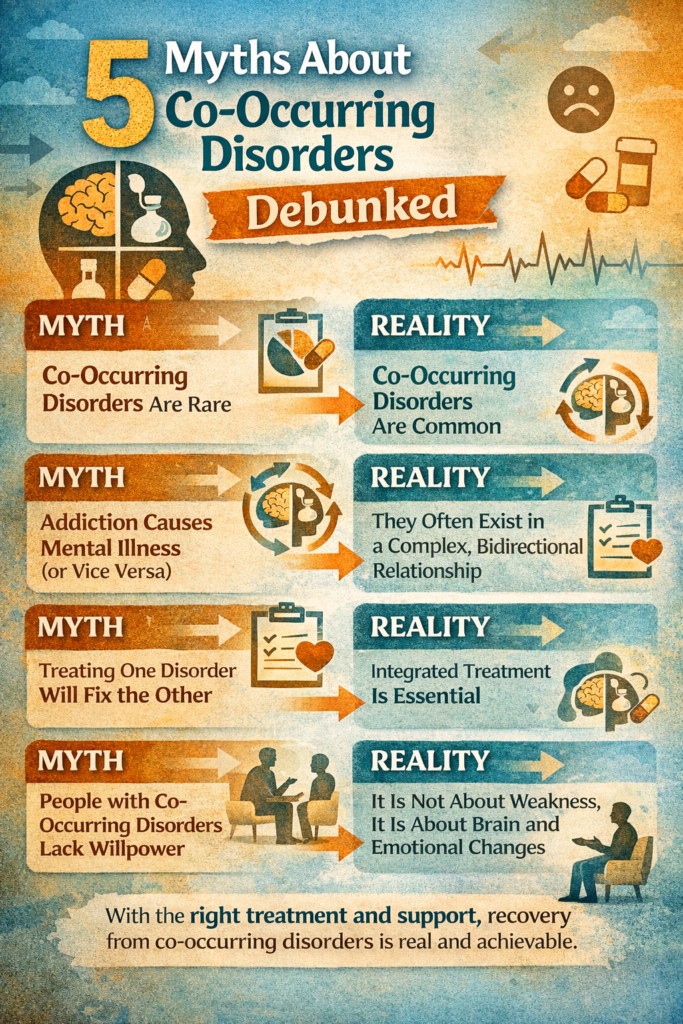
Myth 1: Co-Occurring Disorders Are Rare
Reality: Co-occurring disorders are actually very common. Many individuals who struggle with addiction also experience mental health conditions such as anxiety, depression, or PTSD. These conditions often interact and influence each other, making integrated treatment essential.
Myth 2: Addiction Causes Mental Illness (or Vice Versa)
Reality: It is not always one or the other. Mental health issues can lead to substance use as a coping mechanism, while substance use can worsen or trigger mental health symptoms. Like the “cause vs. consequence” concept, these conditions often exist in a complex, bidirectional relationship.
Myth 3: Treating One Disorder Will Fix the Other
Reality: Treating only addiction or only mental health is usually not enough. Effective recovery requires integrated treatment that addresses both conditions simultaneously. Ignoring one can lead to relapse or worsening symptoms.
Myth 4: People with Co-Occurring Disorders Lack Willpower
Reality: Co-occurring disorders are not a result of weakness or lack of motivation. They involve changes in brain chemistry, emotional regulation, and behavior. Recovery requires treatment, support, and time—not just willpower.
Myth 5: Recovery Is Not Possible
Reality: Recovery is absolutely possible with the right support. Many individuals successfully manage both mental health and substance use disorders through therapy, medication (when appropriate), support systems, and lifestyle changes. Progress may take time, but long-term recovery is achievable.
Why These Myths Matter
Believing these myths can lead to:
- Increased stigma and shame
- Delayed or avoided treatment
- Misunderstanding from family and community
- Ineffective or incomplete care
By challenging these misconceptions, we create a more supportive environment for recovery.
Moving Toward Better Understanding
To better support individuals with co-occurring disorders, it is important to:
- Promote education and awareness
- Encourage integrated treatment approaches
- Reduce stigma סביב mental health and addiction
- Support individuals with empathy and patience
Understanding leads to more effective care and better outcomes.
Conclusion
Co-occurring disorders are complex but treatable conditions that require a deeper understanding beyond common myths. By debunking misconceptions, we can shift the conversation from judgment to compassion and from confusion to clarity.
Recognizing that mental health and addiction are interconnected allows for more comprehensive and effective support. Ultimately, breaking these myths is not just about correcting misinformation—it’s about creating pathways to healing, hope, and lasting recovery.
Taking Charge of Understanding: Self-Management Strategies for Debunking Myths About Co-Occurring Disorders
Misconceptions about co-occurring disorders—when mental health conditions and substance use disorders exist together—can create confusion, stigma, and barriers to recovery. Believing myths such as “it’s just a lack of willpower” or “treating one issue will fix the other” can prevent individuals from seeking appropriate help. Self-management strategies are essential for recognizing and challenging these misconceptions. By developing awareness, critical thinking, and emotional regulation, individuals can better understand the realities of co-occurring disorders and take an active role in their recovery or support journey.
Why Self-Management Matters
Self-management empowers individuals to move beyond misinformation and take control of their understanding and actions. In the context of co-occurring disorders, it helps individuals:
- Identify and question harmful beliefs or myths
- Make informed decisions about treatment and support
- Reduce self-blame and stigma
- Develop healthier coping and thinking patterns
Without self-management, individuals may unknowingly adopt beliefs that hinder recovery.
Key Self-Management Strategies
1. Build Self-Awareness
Understanding your own thoughts and beliefs is the first step. Ask yourself:
- Do I believe addiction or mental health struggles are a personal failure?
- Do I expect quick fixes instead of long-term care?
Recognizing these beliefs allows you to challenge myths and replace them with an accurate understanding.
2. Educate Yourself with Reliable Information
Seek out evidence-based resources about co-occurring disorders. This helps you:
- Understand the connection between mental health and substance use
- Recognize that both conditions require integrated treatment
- Replace misinformation with factual knowledge
Education is one of the most powerful tools for debunking myths.
3. Practice Critical Thinking
Not all information—especially online—is accurate. Self-management involves:
- Questioning sources of information
- Being cautious of oversimplified explanations
- Looking for scientific or professional support for claims
This prevents you from accepting myths as truth.
4. Reframe Negative Thinking Patterns
Myths often lead to harmful thinking, such as self-blame or hopelessness. Reframing involves:
- Viewing co-occurring disorders as medical and psychological conditions
- Recognizing that recovery takes time and support
- Replacing judgment with understanding
This shift promotes a healthier mindset.
5. Manage Emotional Responses
Learning the truth about co-occurring disorders can bring up strong emotions like frustration, guilt, or confusion. Self-management includes:
- Practicing mindfulness or relaxation techniques
- Journaling thoughts and feelings
- Allowing yourself time to process a new understanding
Emotional regulation supports clearer thinking.
6. Set Realistic Expectations for Recovery
One common myth is that recovery should be quick or simple. Self-management helps you:
- Accept that recovery is a gradual process
- Understand that both conditions need ongoing attention
- Focus on progress rather than perfection
Realistic expectations reduce disappointment and increase persistence.
7. Seek Support and Feedback
Self-management does not mean doing everything alone. Engaging with:
- Therapists or counselors
- Support groups
- Trusted individuals
can help reinforce accurate understanding and challenge lingering myths.
Overcoming Challenges in Self-Management
Changing deeply held beliefs can be difficult. Common challenges include:
- Emotional attachment to certain beliefs
- Influence from social stigma or misinformation
- Frustration when progress feels slow
Recognizing these challenges helps individuals approach change with patience and self-compassion.
The Impact of Self-Management
When individuals actively manage their understanding of co-occurring disorders, they often experience:
- Greater clarity and confidence in decision-making
- Reduced stigma and self-judgment
- More effective engagement in treatment
- Improved long-term recovery outcomes
Self-management transforms knowledge into meaningful action.
Conclusion
Debunking myths about co-occurring disorders is not just about learning new information—it’s about changing how we think, feel, and respond. Self-management strategies provide the tools needed to challenge misconceptions, regulate emotions, and develop a more accurate understanding of these complex conditions.
By taking an active role in learning and self-reflection, individuals can move beyond stigma and misinformation toward empowerment and informed recovery. In the end, understanding is not just knowledge—it is a key step toward healing and lasting change.
Stronger Together: Family Support in Understanding the Truth About Co-Occurring Disorders
Co-occurring disorders—when mental health and substance use disorders occur together—are often surrounded by myths and misunderstandings. These misconceptions can create confusion, stigma, and barriers to effective treatment, not only for individuals but also for their families. Families play a critical role in shaping how these conditions are understood and addressed. By learning to recognize and challenge common myths, families can become a powerful source of support, helping their loved ones move toward recovery with greater clarity and compassion.
Why Family Understanding Matters
Families are often the first line of support, but without accurate knowledge, they may unintentionally reinforce harmful beliefs such as:
- “It’s just a matter of willpower.”
- “Treat one issue and the other will go away.”
- “Recovery isn’t possible.”
When families understand the realities of co-occurring disorders, they can:
- Reduce stigma and blame
- Encourage appropriate, integrated treatment
- Provide more effective emotional support
- Strengthen the recovery environment
Key Family Support Strategies
1. Educate the Entire Family
Understanding that co-occurring disorders are complex and interconnected is essential. Families should learn that:
- Mental health and addiction influence each other
- Both conditions require treatment—not just one
- Recovery is a long-term, multifaceted process
Education replaces myths with informed perspectives.
2. Encourage Open and Honest Communication
Misunderstandings often grow in silence. Families can:
- Ask questions without judgment
- Listen actively to their loved one’s experiences
- Create a safe space for discussing both mental health and substance use
Open communication builds trust and reduces stigma.
3. Challenge Myths and Stigma Together
Families can actively work to debunk myths by:
- Correcting misinformation when it arises
- Avoiding language that blames or labels
- Promoting understanding rather than judgment
This creates a healthier emotional environment for recovery.
4. Support Integrated Treatment
One of the biggest myths is that treating one disorder is enough. Families should:
- Encourage treatment plans that address both mental health and substance use
- Support therapy, counseling, and medical care
- Stay involved when appropriate (e.g., family therapy)
Comprehensive care leads to better outcomes.
5. Practice Patience and Realistic Expectations
Recovery from co-occurring disorders takes time. Families should:
- Understand that progress may be gradual
- Expect setbacks without losing hope
- Focus on long-term improvement rather than quick fixes
Patience helps reduce pressure and frustration.
6. Avoid Blame and Personalization
Myths often lead to blame—either toward the individual or within the family. Instead, families should:
- Recognize that these are medical and psychological conditions
- Avoid taking symptoms or behaviors personally
- Focus on support rather than fault
This shift fosters empathy and connection.
7. Prioritize Family Self-Care and Support
Supporting someone with co-occurring disorders can be emotionally demanding. Families should:
- Seek their own support (e.g., counseling, support groups)
- Maintain personal boundaries
- Practice self-care to prevent burnout
Healthy families provide stronger, more consistent support.
Challenges Families May Face
Families may encounter:
- Confusion about complex information
- Emotional stress and frustration
- Conflicting beliefs among family members
- Difficulty letting go of long-held myths
Acknowledging these challenges helps families approach them with patience and openness.
The Impact of Informed Family Support
When families understand and challenge myths about co-occurring disorders, they can:
- Improve communication and relationships
- Encourage appropriate and effective treatment
- Reduce stigma and shame
- Support long-term recovery success
Family involvement becomes a source of strength rather than misunderstanding.
Conclusion
Debunking myths about co-occurring disorders is not just an individual task—it is a family process. When families commit to learning, communicating, and supporting with empathy, they create an environment where recovery is more achievable.
By replacing misinformation with understanding and judgment with compassion, families can play a transformative role in the recovery journey. In the end, informed support is one of the most powerful tools for overcoming both stigma and the challenges of co-occurring disorders.
Community in Action: Resource Strategies for Debunking Myths About Co-Occurring Disorders
Misconceptions about co-occurring disorders—where mental health conditions and substance use disorders exist together—are widespread and can significantly hinder recovery. Myths such as “it’s just a lack of willpower” or “treat one issue and the other will disappear” often prevent individuals from seeking proper help. Community resources play a vital role in correcting these misunderstandings by providing education, support, and access to evidence-based care. Through community-driven strategies, individuals and families can gain a clearer, more accurate understanding of co-occurring disorders and move beyond stigma toward effective recovery.
Why Community Resources Matter
Community resources serve as a bridge between misinformation and understanding. They help individuals:
- Access accurate, research-based information
- Challenge harmful myths and stigma
- Connect with others facing similar challenges
- Find appropriate, integrated treatment options
These resources create a supportive environment where learning and healing can occur together.
Key Community Resource Strategies
1. Community Education Programs
Workshops, seminars, and public health initiatives help debunk myths by:
- Explaining the connection between mental health and substance use
- Clarifying that co-occurring disorders are common and treatable
- Promoting evidence-based approaches to care
Education replaces confusion with clarity.
2. Support Groups and Peer Networks
Community support groups allow individuals and families to:
- Share real-life experiences that challenge common myths
- Learn from others who have navigated co-occurring disorders
- Build understanding through shared stories
Peer support makes complex concepts more relatable and less stigmatized.
3. Access to Integrated Treatment Services
Community-based healthcare providers often offer integrated care that addresses both mental health and substance use. These services:
- Reinforce that both conditions must be treated together
- Provide personalized treatment plans
- Help individuals understand the reality behind common misconceptions
This directly counters the myth that one issue can be treated in isolation.
4. Public Awareness Campaigns
Community campaigns play a powerful role in shifting public perception by:
- Challenging stereotypes and misinformation
- Promoting accurate language حول mental health and addiction
- Encouraging people to seek help without fear of judgment
Awareness reduces stigma and increases understanding.
5. Schools and Educational Institutions
Schools, colleges, and training programs can incorporate education about co-occurring disorders by:
- Teaching students about mental health and substance use connections
- Promoting early awareness and prevention
- Encouraging critical thinking about common myths
Early education helps prevent misinformation from taking hold.
6. Community Resource Centers and Hotlines
Local organizations and helplines provide:
- Immediate access to information and support
- Referrals to treatment programs
- Guidance for individuals and families navigating co-occurring disorders
These services help make health care accessible and reduce barriers to care.
Overcoming Barriers to Community Engagement
Despite their value, community resources may be underused بسبب:
- Lack of awareness about available services
- Stigma surrounding mental health and addiction
- Fear of judgment
- Limited access in certain areas
Addressing these barriers requires outreach, inclusivity, and continued education.
The Impact of Community-Based Understanding
When communities actively engage in debunking myths, they can:
- Improve access to appropriate treatment
- Reduce stigma and discrimination
- Strengthen support systems for individuals and families
- Promote long-term recovery outcomes
Communities become environments of learning, acceptance, and growth.
Conclusion
Understanding co-occurring disorders requires more than individual effort—it requires community involvement. By leveraging education programs, support networks, integrated care, and awareness campaigns, communities can effectively challenge and replace harmful myths.
In doing so, they create a culture where individuals are supported, informed, and empowered to seek help. Ultimately, community resource strategies are not just about sharing information—they are about transforming understanding into action and building pathways toward recovery and resilience.
Frequently Asked Questions
Here are some common questions:
1. What are co-occurring disorders?
Co-occurring disorders (also called dual diagnosis) refer to the presence of both a mental health disorder and a substance use disorder in the same individual. These conditions often interact and influence each other.
2. Are co-occurring disorders really common?
Yes. One of the biggest myths is that they are rare, but in reality, they are very common. Many people who struggle with addiction also experience mental health conditions like anxiety, depression, or PTSD.
3. Does addiction cause mental illness, or is it the other way around?
It can be both. Mental health issues may lead someone to use substances as a coping mechanism, while substance use can worsen or trigger mental health symptoms. This creates a bidirectional relationship, not a one-way cause.
4. Can treating one disorder fix the other?
No. Treating only one condition is usually not effective. Integrated treatment, which addresses both mental health and substance use at the same time, is essential for successful recovery.
5. Are co-occurring disorders caused by a lack of willpower?
No. This is a harmful myth. These disorders involve brain chemistry, emotional regulation, and environmental factors. They are medical and psychological conditions—not a sign of weakness.
6. Why are these myths so harmful?
These myths can:
- Increase stigma and shame
- Prevent people from seeking help
- Lead to incomplete or ineffective treatment
- Causes misunderstanding among families and communities
Correcting these myths improves support and recovery outcomes.
7. What does effective treatment look like for co-occurring disorders?
Effective treatment often includes:
- Therapy (individual and group)
- Medication (when appropriate)
- Integrated care addressing both conditions
- Support groups and long-term recovery planning
A combined approach leads to better results.
8. Can people recover from co-occurring disorders?
Yes. Recovery is absolutely possible. With proper treatment, support, and time, individuals can successfully manage both conditions and lead stable, healthy lives.
9. How can families help debunk these myths?
Families can:
- Educate themselves about co-occurring disorders
- Avoid blame and judgment
- Encourage professional, integrated treatment
- Provide emotional support and patience
Family understanding plays a major role in recovery.
10. What role does stigma play in co-occurring disorders?
Stigma can prevent individuals from seeking help and make them feel ashamed. Debunking myths helps reduce stigma and creates a more supportive environment for recovery.
11. Why is education important in addressing these myths?
Education helps replace misinformation with facts, allowing individuals, families, and communities to:
- Understand the complexity of these disorders
- Support appropriate treatment
- Promote compassion and empathy
Knowledge leads to better outcomes.
12. What is the key takeaway from these myths?
The key takeaway is that co-occurring disorders are common, complex, and treatable. Recovery requires understanding, integrated care, and support—not judgment or oversimplified beliefs.
Conclusion
Video: Misconceptions Keeping People From Recovery #DualDiagnosis #BreakingStigma
Video: