Some people find themselves repeatedly caught up in arguments, relationship conflicts, gossip, social media disputes, or emotional highs and lows. Over time, this level of intensity can become so familiar that a peaceful environment feels uncomfortable or even dull. This pattern is sometimes described as “drama addiction,” although it is not an officially recognized medical or psychiatric diagnosis. Rather than simply a desire for attention, repeated involvement in drama may be influenced by stress responses, learned rewards, impulsivity, past experiences, relationship patterns, and difficulties with emotion regulation.
Why Can Drama Feel Exciting?
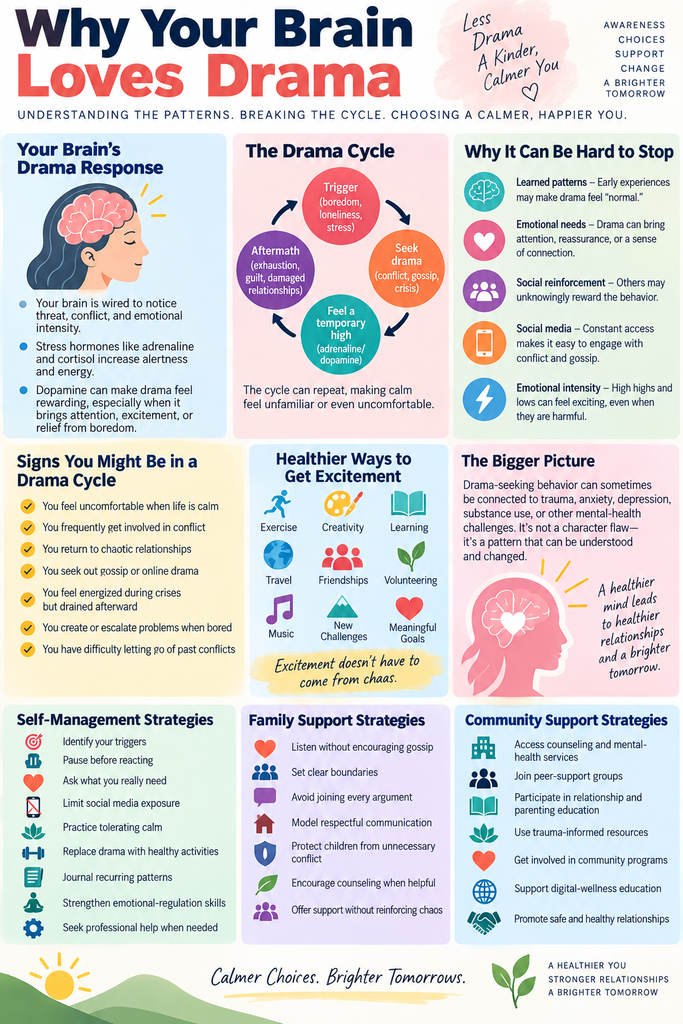
The brain is designed to notice emotionally important events. Conflict and uncertainty can quickly capture attention because the nervous system interprets them as situations requiring a response.
During stressful situations, the body activates its stress-response system. Adrenaline and other stress hormones can increase alertness, heart rate, and energy. At the same time, anticipation and rewarding social experiences can involve dopamine pathways associated with motivation and learning.
If emotional intensity repeatedly brings attention, reassurance, excitement, social connection, or temporary relief from boredom, the brain may learn that conflict is rewarding in some way.
Over time, calm environments may feel unfamiliar compared with the intensity a person has learned to expect.
The Stress–Drama Cycle
A recurring drama cycle might begin with boredom, loneliness, insecurity, jealousy, rejection, or another uncomfortable emotion.
The person may then seek stimulation by starting an argument, checking someone’s social media, spreading gossip, contacting a difficult relationship, or becoming involved in someone else’s conflict.
The resulting emotional intensity temporarily replaces the original uncomfortable feeling. Afterward, however, the person may experience exhaustion, guilt, damaged relationships, or loneliness.
Those uncomfortable feelings can eventually trigger another search for emotional stimulation, restarting the cycle.
Trauma and Unpredictable Environments
For some people, repeated exposure to unstable or conflict-filled environments can shape what feels normal.
Someone raised around frequent arguments, unpredictable caregiving, emotional volatility, or unsafe relationships may become highly sensitive to changes in other people’s moods. Later in life, stable relationships can sometimes feel unfamiliar.
This does not mean that everyone who experienced childhood adversity will seek drama. It means that earlier experiences can influence expectations about relationships, safety, and emotional intensity.
Trauma-informed therapy may help people recognize these patterns without blaming themselves or others.
Social Media Can Amplify Drama
Digital platforms can make emotionally charged content difficult to ignore.
Controversial posts, arguments, gossip, relationship updates, and shocking stories may repeatedly capture attention. Likes, comments, shares, and notifications can provide rapid feedback that encourages continued engagement.
Someone may begin checking social media whenever they feel bored, anxious, lonely, or angry.
What begins as entertainment can become a repetitive behavioral pattern that interferes with sleep, relationships, productivity, or emotional well-being.
Drama Versus Healthy Excitement
People need stimulation. A peaceful life does not have to mean a boring life.
Healthy excitement can come from exercise, travel, creativity, learning, friendships, hobbies, sports, volunteering, music, or challenging personal goals.
The difference is that healthy stimulation generally adds meaning without repeatedly creating emotional damage.
Signs You May Be Caught in a Drama Cycle
Possible warning signs include:
- Frequently becoming involved in other people’s conflicts
- Feeling uncomfortable when relationships are peaceful
- Repeatedly returning to chaotic relationships
- Starting arguments when feeling bored or insecure
- Constantly checking social media for conflict or gossip
- Feeling energized during crises but emotionally depleted afterward
- Sharing private information to generate reactions
- Interpreting minor disagreements as major betrayals
- Seeking reassurance through conflict
- Feeling that something is “missing” when life becomes calm
- Repeatedly creating emergencies that could have been prevented
- Losing friendships because of recurring conflict
These behaviors do not automatically indicate a mental-health disorder. The important questions are whether the pattern is repetitive, difficult to control, and causing significant problems.
Self-Management Strategies
Breaking a drama cycle begins with recognizing what happens immediately before the urge for emotional intensity.
Helpful strategies include:
- Identify your triggers. Notice whether conflict tends to begin when you feel bored, lonely, rejected, anxious, jealous, or ignored.
- Delay your reaction. Give yourself time before responding to an upsetting text, comment, or social-media post.
- Ask what you actually need. You may need reassurance, attention, connection, stimulation, or rest rather than an argument.
- Reduce unnecessary social-media exposure. Consider limiting accounts or conversations that repeatedly increase anger or anxiety.
- Practice tolerating calm. Quiet can initially feel uncomfortable when someone is accustomed to emotional intensity.
- Replace destructive stimulation. Exercise, creative projects, hobbies, learning, and social activities can provide a healthier kind of excitement.
- Journal recurring patterns. Record the trigger, your reaction, the immediate reward, and the eventual consequence.
- Strengthen emotional-regulation skills. Mindfulness, breathing exercises, grounding techniques, and therapy can help create space between emotion and action.
- Establish relationship boundaries. Not every disagreement requires participation.
- Seek professional help when necessary. Persistent relationship chaos may be connected to trauma, anxiety, depression, impulsivity, or other concerns that deserve assessment.
Family Support Strategies
Families can support change without becoming participants in repeated conflict.
Helpful approaches include:
- Avoid automatically joining every argument.
- Listen without encouraging gossip or retaliation.
- Set clear limits on yelling, threats, insults, or abusive behavior.
- Encourage calm conversations after emotions have settled.
- Avoid rewarding manufactured crises with excessive attention.
- Acknowledge genuine emotional needs without reinforcing destructive behavior.
- Encourage counseling when conflict repeatedly damages relationships.
- Model respectful disagreement and healthy problem-solving.
- Protect children from unnecessary adult conflict.
- Maintain boundaries while remaining emotionally supportive.
Support does not require participating in chaos.
Community Support Strategies
Communities can help people develop healthier ways of managing emotions and relationships.
Useful resources may include:
- Affordable counseling and behavioral-health services
- Trauma-informed treatment programs
- Anger-management and emotional-regulation programs
- Parenting and relationship education
- Peer-support groups
- School-based social-emotional learning
- Domestic-violence resources when relationships become unsafe
- Community recreation and creative programs
- Digital-wellness education
- Conflict-resolution programs
Communities can also teach an important distinction: healthy relationships can contain disagreement without requiring constant crisis.
When Drama May Signal Something Deeper
Repeated conflict can sometimes occur alongside untreated mental-health problems, trauma, substance use, impulsivity, or unhealthy relationship dynamics.
However, labeling someone a “drama addict” can oversimplify the situation. A healthcare or mental health professional can help determine whether another condition or environmental factor is contributing to the behavior.
If a relationship involves threats, stalking, coercive control, physical violence, or fear for personal safety, the problem should not simply be described as drama. Safety and professional support should become priorities.
Learning to Feel Safe in Calm
One of the hardest parts of changing a high-conflict pattern may be learning that calm is not the same as emptiness.
Healthy relationships can feel less intense because they depend on consistency rather than repeated emotional emergencies. With time, people can learn to find stimulation through curiosity, creativity, meaningful relationships, achievement, and new experiences rather than conflict.
The goal is not to eliminate excitement. It is to build a life where excitement does not require chaos.
Conclusion
The phrase “drama addiction” describes a pattern rather than a formal diagnosis. Still, repeated exposure to conflict, emotional rewards, stress responses, social reinforcement, and learned relationship habits can make high-intensity situations surprisingly difficult to leave behind.
Change begins by recognizing the cycle. Self-management can help identify triggers and replace destructive stimulation. Families can provide support without reinforcing unnecessary conflict. Communities can offer mental-health services, relationship education, trauma-informed care, and healthier opportunities for connection.
Your brain may learn to expect drama, but learned patterns can change. Peace may initially feel unfamiliar—but over time, calm can become something you value rather than something you need to escape.
Frequently Asked Questions
Here are some common questions:
1. What is “drama addiction”?
“Drama addiction” is an informal term used to describe a repeated attraction to conflict, crisis, gossip, emotional intensity, or chaotic relationships. It is not a recognized clinical diagnosis. However, patterns of repeatedly seeking or creating emotional intensity can become difficult to change and may negatively affect relationships and well-being.
2. Why does the brain seem to enjoy drama?
Emotionally intense situations quickly capture the brain’s attention. Conflict and uncertainty can activate the body’s stress response, increasing alertness and preparing a person to react. When dramatic situations also provide excitement, attention, reassurance, or social connection, the brain may learn to repeat behaviors associated with those rewards.
3. Is dopamine responsible for drama addiction?
Dopamine is involved in motivation, reward learning, and anticipating rewarding experiences, but it is inaccurate to say that one chemical causes someone to become “addicted to drama.” Human behavior involves complex interactions among brain systems, emotions, past experiences, relationships, environment, and learned habits.
4. Why can drama feel exciting?
Conflict can create emotional and physical arousal. A rapidly beating heart, heightened attention, anticipation, anger, or excitement can make a situation feel intense and stimulating.
For someone accustomed to emotional highs and lows, this stimulation may temporarily relieve boredom, loneliness, insecurity, or emotional numbness.
5. Why does a peaceful life sometimes feel boring?
People become accustomed to familiar emotional environments. Someone who has spent years around unpredictable relationships or repeated conflict may initially find stability unfamiliar.
This does not mean the person consciously wants to suffer. It may mean that the nervous system and learned expectations need time to adjust to healthier patterns.
6. Can childhood experiences contribute to drama-seeking behavior?
They can for some people. Growing up around frequent arguments, unpredictable caregiving, emotional instability, or unsafe relationships may influence expectations about relationships later in life.
However, childhood adversity does not mean someone will inevitably develop chaotic relationships. People can learn healthier patterns through supportive relationships, self-awareness, and professional treatment when needed.
7. Can trauma make someone attracted to chaotic relationships?
Past trauma can influence how someone interprets safety, intimacy, rejection, and emotional intensity. Familiar patterns may sometimes feel more predictable than unfamiliar healthy ones, even when those patterns are harmful.
Trauma-informed therapy can help people understand these reactions without blaming themselves for what happened to them.
8. Can social media reinforce drama?
Yes. Social media provides constant opportunities to encounter arguments, gossip, controversial posts, relationship conflicts, and emotionally provocative content.
Notifications, comments, likes, and shares can also reinforce the habit of repeated checking. Setting limits on emotionally draining online interactions can help reduce unnecessary stress.
9. What are signs that someone may be caught in a drama cycle?
Possible signs include repeatedly becoming involved in conflicts, returning to chaotic relationships, constantly following gossip, starting arguments when bored, feeling energized by crises, struggling when relationships become peaceful, or repeatedly escalating minor disagreements.
The key concern is whether these patterns are persistent and causing distress or problems in everyday life.
10. What is the drama cycle?
A drama cycle may begin with an uncomfortable emotion such as boredom, loneliness, insecurity, jealousy, anger, or rejection.
The person seeks emotional stimulation through conflict, gossip, social media, or another intense interaction. This may produce temporary excitement or attention, followed by exhaustion, regret, damaged relationships, or loneliness. Those uncomfortable feelings may eventually trigger another episode, allowing the cycle to repeat.
11. How can someone break the drama cycle?
The first step is recognizing the pattern. Notice what you were feeling immediately before the conflict began and what emotional reward you received afterward.
Pausing before responding, limiting unnecessary social media engagement, practicing emotional-regulation skills, journaling, establishing healthier boundaries, and finding constructive sources of excitement can help change the pattern.
12. What are healthier alternatives to drama?
Healthy stimulation can come from activities that create excitement without unnecessary emotional damage.
Exercise, travel, music, art, hobbies, learning, volunteering, friendships, outdoor activities, sports, and meaningful personal goals can provide novelty and emotional engagement without requiring conflict.
13. How can families respond to someone who constantly creates conflict?
Families can remain supportive without participating in every argument. Clear boundaries, calm communication, and refusing to engage with gossip or unnecessary escalation can help prevent reinforcement of unhealthy patterns.
Families can acknowledge genuine emotions while still making it clear that yelling, threats, manipulation, or abusive behavior are unacceptable.
14. Should families ignore someone who seems to be seeking attention?
Not necessarily. Attention-seeking behavior may reflect an unmet emotional need, loneliness, insecurity, or another underlying difficulty.
Instead of ignoring the person completely, families can respond to the underlying need while avoiding reinforcement of harmful behavior. For example, they can provide attention during calm conversations rather than only during crises.
15. Can therapy help with repeated drama and conflict?
Yes. Therapy may help identify triggers, improve emotional regulation, strengthen communication skills, process trauma, establish boundaries, and develop healthier relationship patterns.
Professional evaluation may be especially helpful when recurring conflict is accompanied by depression, anxiety, trauma symptoms, substance use, impulsivity, or severe relationship problems.
16. Is drama-seeking behavior a personality disorder?
Not necessarily. Repeated conflict by itself does not establish any psychiatric diagnosis.
Many different circumstances can contribute to chaotic behavior. Diagnosing a personality disorder or another mental-health condition requires a comprehensive evaluation by a qualified professional.
17. Can substance use contribute to relationship drama?
Yes. Alcohol and other substances can affect judgment, inhibition, emotional regulation, and communication. Substance use may also contribute to secrecy, financial problems, broken commitments, and relationship conflict.
When substance use repeatedly contributes to chaos, an addiction assessment may be appropriate.
18. How can communities help?
Communities can provide affordable mental health services, trauma-informed counseling, relationship education, parenting programs, peer support groups, substance use treatment, conflict resolution programs, and healthy recreational opportunities.
Schools and community organizations can also teach emotional regulation, communication, and digital wellness skills before destructive patterns become deeply entrenched.
19. When is “drama” actually abuse?
Threats, stalking, intimidation, coercive control, sexual violence, and physical violence should not be dismissed as relationship drama.
When someone is afraid for their safety, the priority should be protection and appropriate professional assistance rather than simply improving communication between the people involved.
20. What is the most important lesson about “drama addiction”?
The most important lesson is that a learned pattern does not have to become a permanent lifestyle.
Someone who has become accustomed to emotional intensity can learn to recognize triggers, tolerate calm, communicate more effectively, establish healthier boundaries, and find positive sources of excitement.
The goal is not to eliminate emotion or excitement from life. It is to stop depending on chaos to create them.
Video: Why your relationships feel like a roller coaster #drama #relationships #mentalhealth