Opioid use disorder (OUD) is a chronic and relapsing condition that requires effective, evidence-based treatment to reduce withdrawal symptoms, cravings, and the risk of overdose. Among the most widely used treatments are methadone, a long-established opioid agonist therapy, and slow-release oral morphine (SROM), an emerging alternative that offers a different pharmacological profile. Both medications aim to stabilize brain function and support recovery, yet they differ in terms of metabolism, side effects, accessibility, and patient experience. Understanding these differences is essential for developing individualized treatment plans that meet the diverse needs of people living with OUD.
Comparing Treatment Options: SROM vs. Methadone in Opioid Use Disorder Care
Opioid use disorder (OUD) continues to be a major public health challenge, requiring effective, evidence-based treatments to reduce withdrawal symptoms, cravings, and the risk of relapse. Among the most established treatments is methadone, a long-acting opioid agonist that has been used for decades. More recently, slow-release oral morphine (SROM) has emerged as an alternative option in opioid agonist therapy, offering a different pharmacological profile that may benefit certain patients.
Understanding the similarities and differences between SROM and methadone can help clinicians and patients make more informed decisions about treatment.
What Are Methadone and SROM?
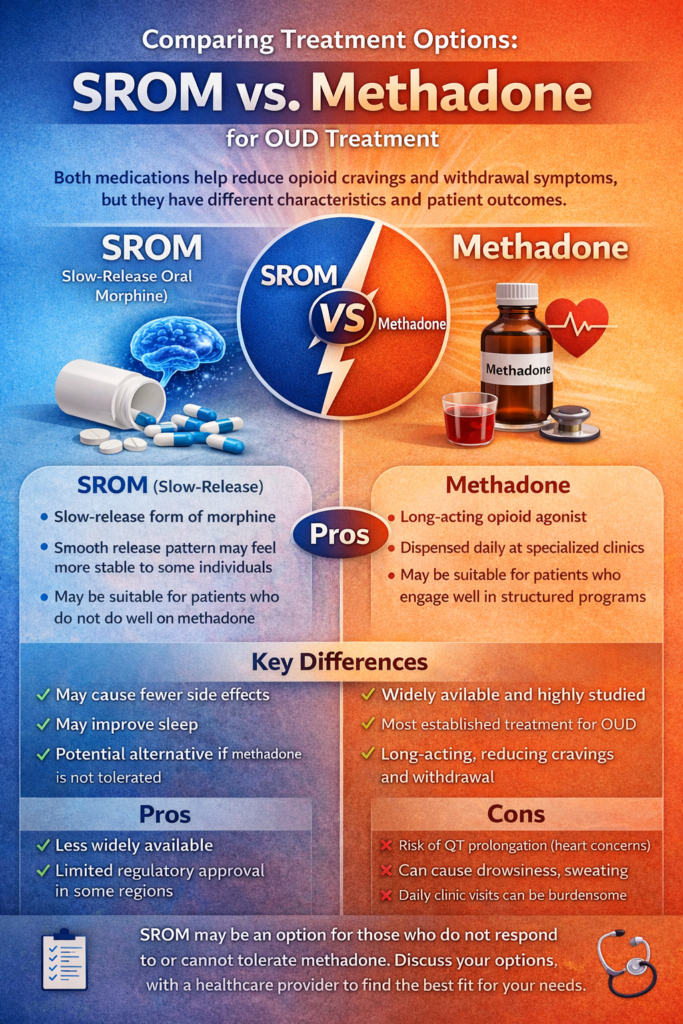
Methadone is a full opioid agonist that works by activating opioid receptors in the brain, reducing withdrawal symptoms and cravings without producing the intense euphoria associated with illicit opioids when taken as prescribed. It is typically dispensed through specialized clinics and requires careful monitoring.
Slow-release oral morphine (SROM) is also a long-acting opioid agonist, but it releases morphine gradually over time. This steady release helps maintain stable opioid levels in the body, which may reduce fluctuations that contribute to cravings and withdrawal.
Key Differences Between SROM and Methadone
1. 🧪 Pharmacological Profile
- Methadone: Long half-life, accumulates in the body, requires careful dose titration
- SROM: More predictable metabolism for some patients, with a smoother release pattern
2. 📊 Treatment Retention and Effectiveness
Research suggests that SROM may have similar retention rates compared to methadone, meaning patients are just as likely to stay in treatment. Some studies also indicate:
- Comparable reduction in illicit opioid use
- Potential improvements in patient satisfaction with SROM
3. 🧠 Side Effects and Tolerability
- Methadone: Can cause sedation, sweating, and in some cases cardiac concerns (e.g., QT prolongation)
- SROM: May be better tolerated by some individuals, especially those who do not respond well to methadone
4. 🔄 Craving and Withdrawal Management
Both medications are effective at:
- Reducing withdrawal symptoms
- Decreasing opioid cravings
However, some patients report more stable symptom control with SROM due to its steady release.
5. 🏥 Accessibility and Availability
- Methadone: Widely available and considered a standard of care in many countries
- SROM: Less widely available and often used as a second-line treatment when methadone is not effective or tolerated
When Might SROM Be Considered?
SROM may be an option for individuals who:
- Do not respond well to methadone
- Experience intolerable side effects
- Prefer an alternative with a different pharmacokinetic profile
Clinical decisions should always be individualized and guided by a healthcare provider.
Benefits of Having Multiple Treatment Options
The availability of both methadone and SROM reflects a broader shift in addiction care toward personalized treatment. Not all patients respond the same way to a single medication, and having alternatives:
- Increases treatment engagement
- Improves patient satisfaction
- Enhances long-term recovery outcomes
Challenges and Considerations
Despite its potential, SROM faces several limitations:
- Limited regulatory approval in some regions
- Less familiarity among providers
- Variability in access and insurance coverage
Methadone, while effective, also requires structured clinic access, which can be a barrier for some individuals.
The Bigger Picture: Individualized OUD Treatment
Both SROM and methadone are valuable tools in treating opioid use disorder. Rather than viewing them as competing options, they should be seen as part of a continuum of care that adapts to individual patient needs.
Final Thoughts
There is no one-size-fits-all approach to opioid use disorder treatment. While methadone remains a cornerstone therapy, SROM offers a promising alternative for those who need a different option. Expanding access to both treatments can improve outcomes and provide individuals with a better chance at sustained recovery.
Taking Charge of Recovery: Self-Management Strategies for Understanding SROM vs. Methadone in OUD Treatment
Opioid use disorder (OUD) treatment is not one-size-fits-all. Medications like methadone and slow-release oral morphine (SROM) are both effective options, but they work slightly differently and may be better suited to different individuals. Understanding these differences—and actively managing your treatment—can empower you to take control of your recovery journey.
Self-management strategies help individuals not only stay engaged in treatment but also better understand how medications like SROM and methadone affect their bodies, cravings, and daily life.
Why Self-Management Matters in OUD Treatment
Medication is a powerful tool, but recovery goes beyond simply taking a prescribed dose. Self-management allows individuals to:
- Monitor how their body responds to treatment
- Recognize patterns in cravings and triggers
- Communicate effectively with healthcare providers
- Stay consistent and motivated לאורך recovery
Being informed helps you become an active participant, not just a passive recipient, in your care.
Understanding SROM vs. Methadone
Before applying self-management strategies, it’s important to understand the basics:
- Methadone: A long-acting opioid agonist with a long half-life, often requiring structured clinic visits
- SROM: A slow-release form of morphine that provides steady opioid levels and may feel more stable for some individuals
Each medication has its own benefits, side effects, and lifestyle considerations.
Key Self-Management Strategies
1. 📘 Educate Yourself About Your Medication
Knowledge reduces uncertainty and builds confidence. Learn:
- How your medication works in the brain
- Expected benefits (e.g., reduced cravings, fewer withdrawal symptoms)
- Possible side effects
Understanding whether you are taking SROM or methadone—and why—helps you stay engaged and informed.
2. 📊 Track Your Symptoms and Progress
Keeping a daily log can help you identify what’s working and what’s not.
Track:
- Craving levels
- Withdrawal symptoms
- Mood and energy
- Side effects
For example, if you notice more stable cravings on SROM or increased fatigue on methadone, this information can guide treatment adjustments.
3. 🗣️ Communicate Openly with Your Provider
Self-management includes advocating for yourself. Be honest about:
- How do you feel about your medication
- Any side effects or concerns
- Whether your current treatment is meeting your needs
This is especially important when comparing options like SROM and methadone, as adjustments may improve outcomes.
4. 📅 Build Consistent Routines
Consistency strengthens recovery. Try to:
- Take medication at the same time each day
- Attend clinic appointments regularly
- Incorporate structure into your daily schedule
Routine helps stabilize both physical and psychological aspects of recovery.
5. 🧘 Develop Coping Skills Alongside Medication
Medication reduces cravings—but coping skills help you manage life.
Helpful strategies include:
- Mindfulness or breathing exercises
- Journaling
- Physical activity
- Therapy or counseling
These reinforce the benefits of both SROM and methadone.
6. ⚖️ Reflect on What Works Best for You
Recovery is personal. Ask yourself:
- Do I feel stable throughout the day?
- Are my cravings manageable?
- Are side effects interfering with my life?
Some individuals prefer methadone’s structure, while others benefit from SROM’s steady release. Self-reflection helps guide decisions.
Challenges to Expect
Even with strong self-management:
- Adjusting to medication can take time
- Side effects may occur
- Motivation may fluctuate
These challenges are normal and part of the recovery process.
The Bigger Picture: Empowered Treatment Choices
Understanding the differences between SROM and methadone allows individuals to make informed, personalized decisions about their care. Self-management bridges the gap between treatment and real-life experience—helping individuals stay engaged, informed, and in control.
Final Thoughts
Recovery from opioid use disorder is a journey that requires both medical support and personal effort. Medications like SROM and methadone provide stability, but self-management transforms that stability into lasting progress.
By learning, tracking, communicating, and reflecting, individuals can better understand their treatment and take meaningful steps toward long-term recovery.
Supporting Recovery Together: Family Strategies for Understanding SROM vs. Methadone in OUD Treatment
Opioid use disorder (OUD) affects not only the individual but also their family, relationships, and support system. Medications like methadone and slow-release oral morphine (SROM) are effective treatments, but understanding how they work—and how they differ—can be confusing for loved ones. Family support plays a critical role in helping individuals stay engaged in treatment, manage challenges, and maintain long-term recovery.
By learning about these medications and adopting supportive strategies, families can become a powerful part of the recovery process.
Why Family Understanding Matters
Both methadone and SROM are forms of opioid agonist therapy, meaning they work by stabilizing brain chemistry, reducing cravings, and preventing withdrawal. However, families may sometimes misunderstand these medications as “replacing one drug with another,” which can lead to stigma or conflict.
When families understand that these treatments are:
- Medically supervised
- Evidence-based
- Designed to support recovery—not create addiction
They are better able to provide informed, compassionate support.
Understanding the Basics: SROM vs. Methadone
- Methadone: A long-acting medication often dispensed through structured clinics, with strict monitoring
- SROM: A slow-release form of morphine that provides steady effects and may be used when methadone is not well tolerated
Both medications aim to:
- Reduce cravings
- Prevent withdrawal
- Support stability and recovery
The choice between them depends on individual needs, treatment response, and clinical guidance.
Key Family Support Strategies
1. 📘 Educate Yourself About Both Medications
Take time to learn:
- How methadone and SROM work
- Why one may be chosen over the other
- What side effects or changes to expect
Understanding reduces fear, confusion, and stigma—and helps families respond with empathy rather than judgment.
2. 🗣️ Communicate with Compassion
Recovery can be emotional and challenging. Supportive communication includes:
- Listening without interrupting or criticizing
- Avoiding blame or shame
- Asking how you can help rather than assuming
For example:
Instead of “Why are you still on medication?”
Try “How is your treatment working for you?”
3. 🚗 Support Treatment Consistency
Both methadone and SROM require consistency to be effective. Families can help by:
- Assisting with transportation to clinics or appointments
- Helping maintain a routine
- Offering reminders in a supportive (not controlling) way
Consistency improves outcomes and reduces relapse risk.
4. 🏡 Create a Stable Home Environment
A supportive environment can reinforce treatment success. Families can:
- Reduce stress and conflict when possible
- Encourage healthy routines (sleep, meals, structure)
- Provide a safe and substance-free space
Stability at home complements the stability provided by medication.
5. 🤝 Encourage Holistic Recovery
Medication is just one part of recovery. Families can encourage:
- Therapy or counseling
- Support groups
- Healthy coping strategies (exercise, mindfulness, hobbies)
This helps address the emotional and behavioral aspects of addiction.
6. ⚖️ Set Healthy Boundaries
Supporting recovery does not mean enabling harmful behavior. Healthy boundaries include:
- Being clear about expectations
- Avoiding covering up or minimizing risky behaviors
- Taking care of your own well-being
Boundaries create accountability while maintaining support.
Challenges Families May Face
Supporting someone in OUD treatment can be difficult:
- Progress may be slow or uneven
- There may be misunderstandings about medication
- Emotional stress and burnout can occur
Seeking your own support—such as family counseling or support groups—can help you stay balanced and effective.
The Bigger Picture: Recovery as a Shared Effort
Medications like SROM and methadone provide a foundation for recovery, but family support strengthens that foundation. When families are informed and engaged, they help reduce stigma, improve treatment adherence, and create a more supportive path forward.
Final Thoughts
You don’t need medical training to support a loved one in recovery—just understanding, patience, and consistency. By learning about SROM and methadone and applying supportive strategies, families can make a meaningful difference in long-term outcomes.
Recovery is not a solo journey—it grows stronger with support.
Connecting Care: Community Resource Strategies for Understanding SROM vs. Methadone in OUD Treatment
Opioid use disorder (OUD) is a complex condition that requires more than individual effort—it demands strong, accessible community support systems. Medications like methadone and slow-release oral morphine (SROM) are effective treatments, but many individuals and families struggle to understand their differences, access them, or navigate the systems that provide them.
Community resources play a critical role in bridging this gap by increasing awareness, improving access, and supporting individuals throughout their recovery journey.
Why Community Understanding Matters
Methadone and SROM are both forms of opioid agonist therapy, designed to reduce cravings and stabilize brain function. However, differences in availability, regulations, and public awareness can make them difficult to access or understand.
Community-based strategies help:
- Reduce stigma around medication-assisted treatment
- Educate individuals about available options
- Connect people to appropriate care
- Support long-term recovery beyond clinical settings
Key Community Resource Strategies
1. 🏥 Strengthen Partnerships with Treatment Providers
Community organizations can collaborate with:
- Methadone clinics
- Addiction treatment centers
- Mental health providers
- Primary care clinics
These partnerships ensure individuals receive accurate information about both methadone and SROM and are referred to the most appropriate treatment.
2. 📢 Promote Public Education and Awareness
Many misconceptions exist about OUD medications. Community education efforts can include:
- Workshops or seminars
- Outreach events
- Social media campaigns
- Informational materials in clinics and community centers
Clear messaging helps people understand that both SROM and methadone are evidence-based treatments, not substitutes for addiction.
3. 🚍 Address Barriers to Access
Access is one of the biggest challenges in OUD treatment. Communities can help by:
- Providing transportation services to clinics
- Offering mobile treatment units
- Supporting telehealth options where available
Because methadone often requires daily clinic visits, and SROM may not be widely available, reducing these barriers is essential.
4. 🤝 Integrate Peer Support Programs
Peer support groups allow individuals to:
- Share experiences with methadone or SROM
- Learn from others in recovery
- Build motivation and accountability
Hearing real-life experiences can make treatment options feel more approachable and less intimidating.
5. 📋 Provide Case Management and Navigation Support
Navigating treatment systems can be overwhelming. Community case managers can assist with:
- Scheduling appointments
- Understanding insurance or payment options
- Coordinating care across multiple providers
This is especially helpful when individuals are deciding between or transitioning between medications like SROM and methadone.
6. 🏫 Reduce Stigma Through Community Engagement
Stigma remains a major barrier to treatment. Communities can:
- Promote addiction as a medical condition
- Highlight recovery success stories
- Encourage open, non-judgmental conversations
Reducing stigma increases the likelihood that individuals will seek help and stay in treatment.
Challenges to Consider
Even with strong community support:
- SROM may not be widely available in all regions
- Methadone access may be limited by clinic regulations
- Insurance coverage can vary
- Awareness among providers and the public may be inconsistent
Addressing these challenges requires ongoing advocacy and collaboration.
The Bigger Picture: Community as a Foundation for Recovery
Medications like SROM and methadone are powerful tools—but they are most effective when supported by a strong community network. Community resources ensure that individuals not only access treatment, but also understand and sustain it.
Final Thoughts
Recovery from opioid use disorder is not just an individual journey—it is a shared effort supported by healthcare systems, families, and communities. By improving education, access, and support, communities can help individuals better understand their treatment options and stay engaged in recovery.
When communities invest in awareness and connection, treatments like SROM and methadone become more than medical options—they become pathways to lasting recovery.
Frequently Asked Questions
Here are some common questions:
1. What are SROM and methadone?
Answer:
Both are medications used in opioid agonist therapy (OAT) to treat opioid use disorder.
- Methadone is a long-acting opioid agonist widely used as a standard treatment.
- SROM (slow-release oral morphine) is an alternative that releases morphine gradually over time.
2. How do these medications help with OUD?
Answer:
Both medications:
- Reduce opioid cravings
- Prevent withdrawal symptoms
- Stabilize brain chemistry
This allows individuals to focus on recovery and daily functioning.
3. What is the main difference between SROM and methadone?
Answer:
The main differences include:
- Pharmacokinetics: Methadone has a long half-life and can accumulate, while SROM provides a steadier release
- Patient experience: Some individuals feel more stable on SROM
- Availability: Methadone is more widely available
4. Is one more effective than the other?
Answer:
Research suggests that SROM and methadone are similarly effective in reducing opioid use and retaining patients in treatment. However, effectiveness can vary from person to person.
5. Who might benefit more from SROM?
Answer:
SROM may be helpful for individuals who:
- Do not respond well to methadone
- Experience side effects from methadone
- Need an alternative treatment option
6. What are the side effects of methadone?
Answer:
Common side effects include:
- Drowsiness
- Sweating
- Constipation
- Risk of heart rhythm issues (QT prolongation in some cases)
7. What are the side effects of SROM?
Answer:
SROM side effects are similar to other opioids and may include:
- Constipation
- Mild sedation
- Nausea
Some patients report fewer or more manageable side effects compared to methadone.
8. Do both medications require daily dosing?
Answer:
- Methadone: Often requires daily supervised dosing at a clinic (especially early in treatment)
- SROM: Usually taken daily, but may have more flexible dispensing depending on regulations
9. Is methadone more regulated than SROM?
Answer:
Yes. Methadone is typically dispensed through specialized clinics with strict regulations, while SROM may be prescribed in different settings depending on the region.
10. Can I switch from methadone to SROM?
Answer:
Yes, switching is possible, but it must be done under medical supervision to ensure safety and proper dosing.
11. Is SROM widely available?
Answer:
No. SROM is less widely available and may not be approved or accessible in all countries or regions.
12. Which treatment is better for long-term recovery?
Answer:
Neither is universally “better.” The best treatment depends on:
- Individual response
- Side effects
- Access to care
- Personal preferences
Both can support long-term recovery when combined with counseling and support services.
13. Are these medications just replacing one addiction with another?
Answer:
No. These medications are:
- Prescribed and monitored by healthcare providers
- Taken at controlled doses
- Designed to stabilize brain function, not produce euphoria
They are evidence-based treatments that reduce harm and improve outcomes.
14. Can I stop taking these medications once I feel better?
Answer:
Stopping medication should always be done gradually and under medical supervision. Abrupt discontinuation can lead to withdrawal and increased relapse risk.
15. Can SROM or methadone be combined with therapy?
Answer:
Yes—and they should be. The most effective treatment includes:
- Medication
- Behavioral therapy
- Social and community support
16. Which one is more accessible?
Answer:
Methadone is generally more accessible due to its long-standing use and established treatment programs. SROM access is more limited.
17. Does insurance cover these treatments?
Answer:
- Methadone: Often covered by insurance or public programs
- SROM: Coverage varies and may be limited depending on location
18. How do I know which one is right for me?
Answer:
The best choice depends on your:
- Medical history
- Treatment response
- Lifestyle and access to care
A healthcare provider will help determine the most appropriate option.
Conclusion
Both SROM and methadone play important roles in the treatment of opioid use disorder, offering effective options for reducing cravings and supporting long-term recovery. While methadone remains the standard of care in many settings, SROM provides a valuable alternative for individuals who do not respond well or cannot tolerate traditional treatment. Rather than viewing these medications as competing approaches, they should be seen as complementary tools within a broader, patient-centered framework. Expanding access to and understanding of both options can improve treatment engagement, enhance outcomes, and ultimately support more sustainable recovery pathways.
Video: Don’t Pick the Wrong Treatment Path #Methadone #SROM #OpioidAddiction