Politics plays an important role in how addiction science is funded, interpreted, and translated into real-world policies and healthcare services. Scientific research helps explain the biological, psychological, and social factors involved in substance use disorders, while policymakers make decisions about research funding, drug laws, treatment regulations, insurance coverage, prevention programs, harm reduction, and criminal justice responses. These decisions can determine whether evidence-based treatments are widely available or difficult to access. Political ideology, public opinion, stigma, economic interests, and concerns about community safety may also influence addiction policies. Understanding this relationship helps people distinguish scientific evidence from political debate and recognize how government decisions can directly affect prevention, treatment, and recovery.
How Politics Is Involved in Addiction Science
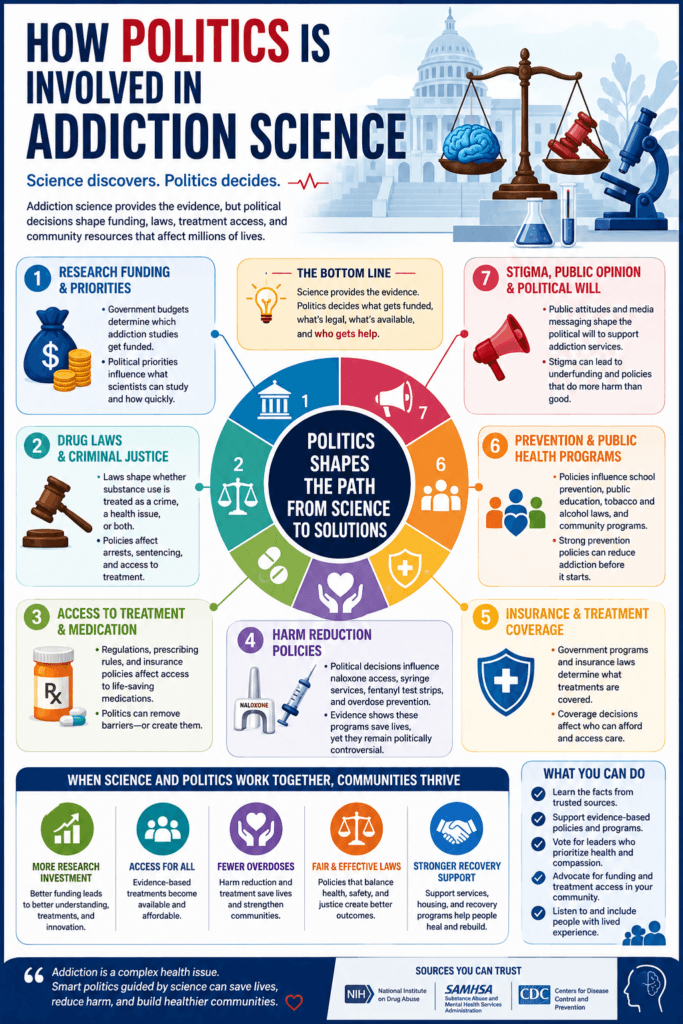
Politics and addiction science are closely connected because scientific discoveries do not automatically become healthcare services or public policy. Government decisions influence which addiction studies receive funding, which treatments are approved or supported, how controlled substances are regulated, and whether people can access prevention, treatment, recovery services, and harm-reduction programs. At the same time, addiction policy can be shaped by public opinion, economic priorities, ideology, stigma, and concerns about public safety.
Research Funding and Scientific Priorities
Government agencies provide substantial funding for addiction research. Political decisions about budgets can therefore influence which questions scientists can investigate.
- Governments determine funding levels for addiction and mental health research.
- Funding priorities may emphasize opioids, stimulants, alcohol, nicotine, prevention, treatment, or emerging substances.
- Public health emergencies can rapidly redirect research funding.
- Long-term research can become more difficult when funding priorities change.
- Policymakers rely on scientific research when deciding which interventions deserve additional investment.
Drug Laws and Criminal Justice
Politics strongly influences whether substance use is approached primarily through healthcare, criminal justice, or a combination of both.
Historically, many drug policies have emphasized prohibition, arrest, and incarceration. Modern addiction science increasingly recognizes substance use disorder as a chronic, treatable health condition influenced by biological, psychological, environmental, and social factors.
Political debates therefore involve questions such as:
- Should possession of certain drugs result in criminal penalties?
- Should people with substance use disorders be diverted from jail into treatment?
- How should drug trafficking and personal drug use be treated differently?
- How should governments balance individual liberty, treatment, and public safety?
Access to Addiction Medications
Politics can directly influence access to medications used to treat substance use disorders.
For opioid use disorder, medications such as buprenorphine, methadone, and naltrexone have substantial scientific evidence supporting their use. However, laws, regulations, insurance policies, prescribing requirements, and treatment infrastructure can determine how easily patients receive them.
This creates an important distinction: a treatment can be scientifically effective yet remain difficult to access due to policy barriers.
Harm Reduction
Harm reduction is one of the clearest areas where science and politics intersect.
Programs may include:
- Naloxone distribution.
- Syringe service programs.
- Fentanyl test strips and drug-checking approaches.
- Overdose education.
- Connections to medical care and addiction treatment.
Supporters emphasize evidence showing that harm-reduction interventions can prevent deaths and connect people with healthcare. Critics may worry that certain approaches normalize drug use, inadequately address community disorder, or fail to emphasize abstinence sufficiently. Policymakers must decide how scientific evidence, community concerns, legal issues, and implementation outcomes should influence policy.
Insurance and Treatment Coverage
Scientific evidence has limited impact if people cannot obtain treatment. Federal and state policies can influence:
- Insurance coverage for addiction treatment.
- Medicaid-funded services.
- Residential and outpatient treatment availability.
- Mental health and substance-use parity.
- Medication coverage.
- Treatment for incarcerated individuals.
- Recovery and peer-support services.
Political decisions can therefore determine whether evidence-based treatment exists only theoretically or is actually available in communities.
Addiction Prevention
Politics also influences how prevention is delivered.
Governments establish policies involving alcohol and tobacco sales, age restrictions, prescription drug monitoring, medication prescribing, school prevention programs, advertising, taxation, and public education.
Effective prevention requires policymakers to evaluate whether these strategies actually reduce substance-related harm rather than simply appearing tough on drugs.
Pharmaceutical Industry and Regulation
Addiction science also intersects with commercial interests. Pharmaceutical manufacturers, healthcare organizations, insurers, advocacy groups, and professional associations may attempt to influence legislation and regulation.
The opioid crisis demonstrated why transparent relationships among pharmaceutical companies, regulators, clinicians, researchers, and policymakers are important. Scientific evidence should be evaluated independently rather than allowing commercial or political interests to determine conclusions.
Stigma and Political Language
The language political leaders use can influence how society views addiction. Describing people primarily as criminals or morally deficient can reinforce stigma. Treating substance use disorder exclusively as a medical problem, however, can also overlook legitimate issues involving impaired driving, illegal markets, violence, and community safety.
Addiction science supports a more nuanced approach: addiction is a health disorder, while behaviors occurring around substance use may still have legal and social consequences.
Science Should Inform Politics—Not Become Political Science
Scientific research cannot determine every political decision because policy also involves ethics, economics, individual rights, public safety, and community priorities. However, political beliefs should not determine whether scientific findings are considered true.
The strongest addiction policies ask measurable questions: Does this intervention reduce overdose deaths? Does it increase treatment participation? Does it reduce substance use and associated harms? Does it improve long-term recovery and community safety?
Ultimately, politics determines how society acts on addiction science. When policy follows high-quality evidence, treatment can become more accessible and prevention more effective. When ideology, stigma, financial interests, or misinformation outweigh evidence, scientifically supported interventions may be delayed or restricted. The most productive approach is therefore neither purely political nor purely clinical—it combines rigorous addiction science with ethical, practical, and accountable public policy.
Self-Management Strategies to Understand How Politics Is Involved in Addiction Science
Understanding the relationship between politics and addiction science requires separating scientific evidence from political opinion, media messaging, personal beliefs, and advocacy. Political decisions can affect research funding, treatment availability, access to medication, harm reduction, insurance coverage, and criminal justice policies. Individuals can develop skills to evaluate these issues objectively and make informed decisions.
Learn the Difference Between Science and Policy
Scientific research asks whether an intervention works, how well it works, and what risks it carries. Politics determines how—or whether—that evidence is translated into laws, regulations, funding, and healthcare programs.
- Separate research findings from political arguments about those findings.
- Ask whether claims are supported by clinical studies or primarily by opinions.
- Recognize that an effective treatment may still face political or regulatory barriers.
- Understand that policy decisions also consider cost, ethics, public safety, and individual rights.
Use Reliable Sources of Addiction Information
Addiction information can become distorted when presented through political commentary or social media.
- Look for information from peer-reviewed research and established medical or public health organizations.
- Compare information from multiple credible sources.
- Check when the research was published because addiction science changes over time.
- Distinguish individual stories from population-level scientific evidence.
- Be cautious of headlines claiming that one study has completely proved or disproved an addiction policy.
Learn How Addiction Research Is Funded
Research funding influences which addiction problems receive greater scientific attention.
- Learn how government agencies establish research priorities.
- Recognize that public health emergencies may shift funding toward particular substances.
- Consider whether studies have potential financial or institutional conflicts of interest.
- Look for disclosure statements when reading research.
Evaluate Political Claims About Addiction
When politicians discuss addiction, focus on measurable outcomes rather than political affiliation.
Ask questions such as:
- Does the proposed policy reduce overdose deaths?
- Does it increase access to treatment?
- Does it improve treatment retention?
- Does it reduce substance-related harm?
- Does it improve community safety?
- What evidence supports the claims being made?
This approach allows policies to be evaluated according to outcomes rather than party labels.
Understand Evidence-Based Treatment
Learning the fundamentals of addiction treatment makes political discussions easier to evaluate.
- Understand the role of behavioral therapies.
- Learn about medications for opioid and alcohol use disorders.
- Recognize addiction as a treatable health condition.
- Understand that recovery may involve different treatment approaches for different people.
- Distinguish evidence-based treatment from unsupported or exaggerated claims.
Understand Harm Reduction
Harm reduction frequently becomes politically controversial. Learning what individual interventions actually do can reduce confusion.
- Study the evidence surrounding naloxone.
- Learn how syringe service programs operate.
- Understand the purpose and limitations of drug-checking approaches.
- Recognize that preventing immediate harm and treating addiction are related but distinct goals.
- Evaluate programs according to measurable outcomes.
Recognize Personal Bias
Everyone approaches political and social issues with existing beliefs.
- Notice emotional reactions to words such as addiction, criminalization, legalization, abstinence, or harm reduction.
- Ask whether your position would change if the same evidence were presented by a different political group.
- Be willing to revise conclusions when stronger evidence becomes available.
- Avoid assuming that people who disagree necessarily reject science.
Follow Policy Changes That Affect Treatment
Individuals receiving treatment or supporting someone in recovery can benefit from understanding relevant policy changes.
- Monitor changes in insurance coverage.
- Learn about regulations affecting addiction medications.
- Understand local naloxone access.
- Follow changes affecting treatment programs and recovery services.
- Ask healthcare professionals how new policies may affect individual care.
Advocate Using Evidence
People can participate in addiction-policy discussions without turning scientific questions into partisan arguments.
- Use credible statistics and research when discussing addiction.
- Share evidence rather than stigmatizing language.
- Support policies based on measurable health and safety outcomes.
- Encourage policymakers to evaluate programs after implementation.
- Recognize when new evidence suggests that an existing policy should change.
Maintain an Evidence-First Perspective
The most useful self-management strategy is to ask, “What does the best available evidence show?” rather than beginning with, “Which political side supports this?”
Politics will continue to influence addiction research, treatment, prevention, and regulation. Developing scientific literacy, recognizing personal bias, evaluating sources carefully, and focusing on measurable outcomes can help individuals understand addiction policy without allowing political identity to replace scientific reasoning.
Family Support Strategies to Understand How Politics Is Involved in Addiction Science
Families affected by addiction may encounter political decisions that influence treatment availability, insurance coverage, medications, harm-reduction services, research funding, and criminal justice policies. Understanding these connections can help families advocate for effective care while keeping treatment decisions centered on scientific evidence rather than political ideology.
Learn About Addiction Science as a Family
Families can develop a shared understanding of substance use disorders and evidence-based treatment.
- Learn that addiction is a treatable health condition involving biological, psychological, behavioral, and environmental factors.
- Discuss the roles of counseling, behavioral therapies, recovery support, and medications.
- Learn how research findings eventually influence healthcare policies.
- Recognize that scientific recommendations can change as new evidence becomes available.
Separate Political Beliefs From Treatment Decisions
Family members may have different political views, but these differences should not interfere with appropriate healthcare.
- Focus conversations on the individual’s health and recovery needs.
- Avoid turning treatment decisions into partisan debates.
- Ask what scientific evidence supports a particular treatment or policy.
- Respect differences of opinion while prioritizing safety and effective care.
- Encourage decisions made collaboratively with qualified healthcare professionals.
Understand How Policies Affect Treatment Access
Government policies can influence what addiction services families can obtain.
- Learn about insurance and public program coverage for substance use treatment.
- Understand regulations affecting medications for opioid use disorder.
- Identify local outpatient, residential, mental health, and recovery services.
- Follow policy changes that may affect treatment availability.
- Ask treatment providers how regulatory changes could affect continuing care.
Discuss Harm Reduction Without Stigma
Harm-reduction strategies can become politically controversial, making accurate family education particularly important.
- Learn how naloxone can reverse an opioid overdose.
- Understand the purposes of syringe service and drug-checking programs where legally available.
- Recognize that preventing overdose does not prevent someone from subsequently entering treatment.
- Discuss the evidence, benefits, and limitations of individual strategies rather than treating “harm reduction” as a single political position.
Recognize the Influence of Drug Laws
Families should understand that substance use can involve both healthcare and legal systems.
- Learn how local and state drug laws may affect individuals with substance use disorders.
- Understand the difference between personal substance use, possession, impaired driving, and drug trafficking.
- Learn about treatment-oriented alternatives within the justice system where available.
- Seek appropriate professional guidance when legal problems accompany addiction.
Evaluate Media and Political Messages Together
News and social media can present addiction issues in emotionally charged ways.
- Compare political claims with credible scientific evidence.
- Check the original source of statistics before sharing them.
- Distinguish research findings from political commentary.
- Discuss how headlines can oversimplify complex addiction research.
- Encourage younger family members to develop health and media literacy.
Reduce Stigma Within the Family
Political rhetoric can sometimes reinforce stereotypes about people who use drugs.
- Use person-first language such as “person with a substance use disorder.”
- Avoid describing addiction as simply a lack of willpower or morality.
- Hold individuals accountable for harmful behavior without defining the entire person by the addiction.
- Reinforce the possibility of treatment, recovery, and behavioral change.
Become Informed Family Advocates
Families can participate constructively in community and policy discussions.
- Attend community education programs.
- Learn about proposed policies affecting addiction services.
- Communicate with healthcare organizations and policymakers about treatment barriers.
- Support adequate access to evidence-based prevention, treatment, and recovery services.
- Advocate using research and measurable outcomes rather than partisan arguments.
Keep Recovery at the Center
Families do not need to agree politically to support someone experiencing addiction. The central question should remain: Is the person safe? Can they access appropriate treatment? Is the intervention supported by evidence? Is treatment improving health and functioning?
Understanding how politics affects addiction science can help families become better advocates without allowing political disagreements to dominate recovery. By emphasizing credible research, respectful communication, reduced stigma, treatment accessibility, and measurable outcomes, families can help ensure that healthcare decisions remain focused on the person who needs support.
Community Resource Strategies to Understand How Politics Is Involved in Addiction Science
Community resources can help people understand how political decisions influence addiction research, prevention, treatment, harm reduction, recovery services, and criminal justice. Because addiction policy can become politically polarized, communities benefit from providing accurate, evidence-based information while encouraging respectful discussion and focusing on measurable health and safety outcomes.
Public Health Departments
Local and state health departments can help communities understand how addiction science becomes public policy.
- Provide current information about overdose trends and substance-use patterns.
- Educate communities about evidence-based prevention and treatment.
- Explain public programs involving naloxone and overdose prevention.
- Provide information about treatment and recovery resources.
- Share data that communities can use to evaluate policies.
Community Mental Health and Addiction Centers
Treatment organizations can demonstrate how government policies directly affect patient care.
- Provide substance-use screening and assessment.
- Offer or coordinate evidence-based addiction treatment.
- Educate patients about medications for substance use disorders.
- Explain insurance and regulatory barriers affecting treatment.
- Connect individuals with mental health, medical, and recovery services.
Schools and Universities
Educational institutions can improve understanding of both addiction science and public policy.
- Teach the biological, psychological, and social components of addiction.
- Provide education about evaluating scientific research.
- Discuss the history and consequences of drug policies.
- Encourage students to distinguish evidence from political opinion.
- Sponsor community discussions involving researchers, clinicians, policymakers, and people with lived experience.
Libraries and Community Education Programs
Libraries can provide neutral spaces where people can learn about controversial issues related to addiction.
- Provide access to reputable health and scientific resources.
- Host educational presentations about addiction science.
- Teach media and health literacy.
- Offer programs explaining how legislation and public policy are developed.
- Help community members identify credible research rather than relying solely on social media.
Harm-Reduction Organizations
Harm-reduction programs can educate communities about interventions that sometimes become politically controversial.
- Provide overdose-prevention education.
- Increase awareness of naloxone.
- Explain the purpose of syringe service programs where available.
- Educate communities about drug-checking approaches and their limitations.
- Connect people who use drugs with healthcare and treatment resources.
Recovery Community Organizations
People with lived experience can provide perspectives that may not be captured completely by statistics or political debates.
- Offer peer recovery support.
- Provide recovery education to families and communities.
- Identify practical barriers to accessing treatment.
- Participate in community advisory groups.
- Help policymakers understand how policies affect people in recovery.
Healthcare Professional Organizations
Physicians, PAs, nurses, pharmacists, psychologists, social workers, and addiction specialists can help translate scientific research into understandable information.
- Provide evidence-based community education.
- Correct misinformation about addiction medications.
- Explain emerging research.
- Advocate for appropriate access to treatment.
- Help policymakers understand the clinical consequences of proposed policies.
Criminal Justice and Treatment Partnerships
Communities can encourage collaboration between healthcare and justice systems.
- Develop treatment referral and diversion programs where appropriate.
- Improve continuity of addiction treatment during and after incarceration.
- Provide overdose-prevention education before release.
- Connect individuals with community treatment and recovery services.
- Evaluate whether programs improve both health and public-safety outcomes.
Government and Community Forums
Public meetings can give residents opportunities to understand proposed addiction policies and contribute to decision-making.
- Attend city, county, or state public meetings.
- Ask policymakers what evidence supports proposed programs.
- Encourage public reporting of program outcomes.
- Include clinicians, researchers, families, and people with lived experience in policy discussions.
- Promote respectful debate rather than partisan labeling.
Reliable Scientific and Government Resources
Community programs should direct people toward credible sources such as the National Institute on Drug Abuse, the Substance Abuse and Mental Health Services Administration, the Centers for Disease Control and Prevention, and peer-reviewed scientific literature. These resources can help communities compare political claims with available scientific evidence.
Building an Evidence-Informed Community
The goal is not to remove politics entirely from addiction policy—that is impossible, as governments must make decisions about laws, budgets, healthcare systems, and public safety. Instead, communities can encourage policymakers to make those decisions using the strongest available evidence.
A successful community approach brings together public health, healthcare, education, law enforcement, treatment providers, recovery organizations, families, researchers, and policymakers. When communities focus on outcomes such as fewer overdose deaths, greater treatment access, sustained recovery, reduced substance-related harm, and improved public safety, addiction policy can become less about political identity and more about determining what actually works.
Frequently Asked Questions
Here are some common questions:
1. How is politics connected to addiction science?
Politics influences how addiction research is funded and how scientific findings are translated into laws, healthcare regulations, prevention programs, insurance coverage, treatment services, and criminal justice policies. Science can identify effective interventions, while policymakers decide how those interventions are implemented.
2. Can politics influence which addiction topics scientists study?
Yes. Government budgets and research priorities can direct funding toward specific problems, such as opioid overdose, fentanyl, alcohol, stimulants, youth substance use, or emerging drugs. This does not necessarily determine scientific conclusions, but it can influence which questions receive the most research attention.
3. Who funds addiction research in the United States?
Addiction research receives funding from several sources, including universities, foundations, industry, and federal agencies. A major federal research organization is the National Institute on Drug Abuse, which supports research involving substance use, addiction, prevention, and treatment.
4. Can political decisions affect access to addiction treatment?
Yes. Laws, government funding, insurance requirements, Medicaid policies, workforce regulations, and treatment-program rules can affect whether evidence-based treatment is affordable and available in a particular community.
5. How does politics affect medications for opioid use disorder?
Government policies influence how medications such as methadone, buprenorphine, and naltrexone are prescribed, dispensed, funded, and covered by insurance. Regulations can either reduce or create barriers to treatment.
6. Why is harm reduction politically controversial?
Harm-reduction strategies—including naloxone distribution, syringe services, and some drug-checking approaches—attempt to reduce immediate health consequences even when substance use continues. Supporters emphasize preventing overdose and infectious disease, while critics may question particular programs’ effects on drug use or community conditions. Individual interventions should therefore be evaluated using evidence and measurable outcomes.
7. How do drug laws influence addiction?
Drug laws determine which substances are controlled and what legal consequences may follow possession, distribution, or other drug-related activities. These laws can also influence whether people experiencing addiction primarily encounter healthcare services, the criminal justice system, or both.
8. Is addiction a health problem or a criminal justice problem?
Substance use disorder is recognized medically as a treatable health condition. However, behaviors associated with drugs can also involve legal and public-safety issues. Effective policy often requires cooperation among healthcare, public health, social services, and criminal justice systems.
9. Can political ideology interfere with addiction science?
It can. Political beliefs may influence how research findings are interpreted or which policies people are willing to support. Scientific evidence should be evaluated based on research quality rather than on whether the findings align with a particular political position.
10. How does politics influence addiction prevention?
Government policies affect alcohol and tobacco regulation, age restrictions, prescription monitoring, school prevention programs, public education campaigns, healthcare funding, and other prevention strategies.
11. Does politics affect addiction insurance coverage?
Yes. Federal and state policies can influence insurance requirements, Medicaid coverage, mental health and substance-use parity, medication coverage, and reimbursement for different levels of addiction treatment.
12. What role do pharmaceutical companies play?
Pharmaceutical companies develop medications that can benefit patients, but commercial interests can also influence healthcare through marketing, lobbying, research sponsorship, and interactions with policymakers and clinicians. Transparency and independent scientific evaluation are therefore important.
13. How can stigma influence addiction policy?
If addiction is viewed primarily as a moral failure, communities may favor punishment over treatment. Greater understanding of substance use disorder as a health condition can increase support for prevention, treatment, recovery services, and evidence-based interventions while still maintaining accountability for harmful behaviors.
14. Should addiction science determine public policy completely?
Science should strongly inform policy, but it cannot answer every policy question. Governments must also consider ethics, costs, individual rights, feasibility, public safety, and community priorities. Science is particularly valuable for determining whether policies achieve their intended outcomes.
15. How can families determine whether an addiction policy is effective?
Instead of relying only on political messaging, families can ask whether credible evidence shows that a policy reduces overdose deaths, increases treatment access and retention, improves recovery outcomes, decreases substance-related harm, or improves community safety.
16. Can addiction policies change when new scientific evidence emerges?
Yes. Addiction science continuously develops. Effective policymaking should allow laws, regulations, and treatment practices to change when stronger evidence demonstrates that another approach is safer or more effective.
17. Where can people obtain reliable information about addiction science?
Credible sources include peer-reviewed research and organizations such as the National Institute on Drug Abuse, the Substance Abuse and Mental Health Services Administration, and the Centers for Disease Control and Prevention.
18. What is the most important message about politics and addiction science?
Science provides evidence; politics helps determine what society does with that evidence. The strongest addiction policies combine high-quality research with ethical decision-making, practical implementation, public safety, treatment accessibility, and the experiences of people directly affected by addiction.
Conclusion
Politics and addiction science will remain closely connected because scientific discoveries require policies, funding, healthcare systems, and community programs to reach the people who need them. Effective addiction policy should therefore be informed by credible research and consider ethics, individual rights, costs, community concerns, and public safety. Rather than judging an addiction strategy primarily by which political group supports it, policymakers and communities can examine measurable outcomes such as overdose deaths, treatment access, recovery, substance-related harm, and community safety. When scientific evidence, transparent policymaking, healthcare expertise, and lived experience work together, society is better positioned to develop addiction policies that protect individuals, strengthen communities, and improve opportunities for long-term recovery.
Video: When Politics Controls Addiction Treatment #addictiontreatment #politics