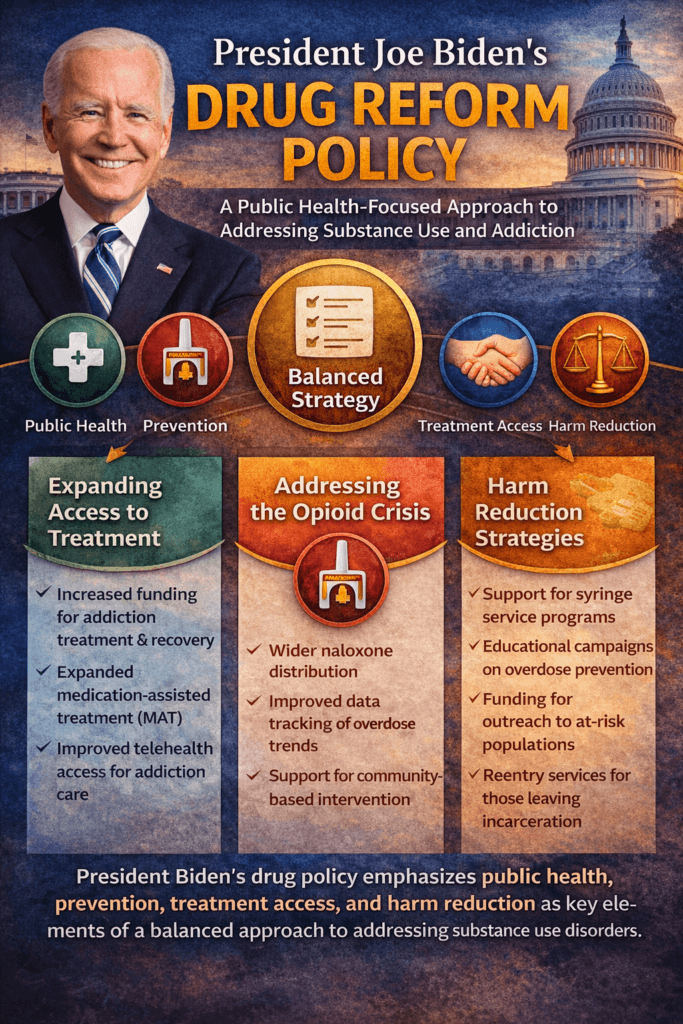
During his presidency, Joe Biden advanced a national drug policy centered on public health, prevention, expanded treatment, and harm-reduction strategies. Rather than relying primarily on punitive enforcement models that dominated earlier eras, his administration emphasized addressing substance use disorder as a medical and social condition influenced by mental health, environment, and access to care. Federal initiatives during his term focused on expanding treatment availability, supporting overdose prevention efforts, strengthening data monitoring systems, and encouraging collaboration among healthcare providers, communities, and justice systems. This framework reflects a broader shift in U.S. drug policy toward balancing enforcement with evidence-based health interventions.
President Joe Biden’s Drug Reform Policy: A Public Health–Focused Approach to Addiction and Substance Use
During his presidency, Joe Biden has emphasized a shift in U.S. drug policy from primarily punitive enforcement toward a more balanced strategy integrating public health, treatment access, harm reduction, and prevention. While law enforcement remains part of federal drug control efforts, his administration has prioritized addressing substance use disorder as a medical condition rather than solely a criminal issue. This approach reflects broader changes in addiction science, policy research, and public attitudes toward substance use.
1. Expanding Access to Treatment
One of the central pillars of Biden’s drug policy has been increasing the availability of evidence-based treatment. Federal initiatives have supported:
- Expansion of medication-assisted treatment (MAT)
- Increased funding for community health clinics
- Integration of addiction care into primary healthcare
- Telehealth access for substance use treatment
These measures aim to reduce barriers such as cost, provider shortages, and geographic limitations—factors that historically prevented many individuals from receiving timely care.
2. Addressing the Opioid Crisis
The administration has focused heavily on opioid overdose prevention. Policies and funding priorities have included:
- Wider distribution of overdose-reversal medications like naloxone
- Surveillance systems to track overdose trends
- Targeted interventions for high-risk communities
- Collaboration with state and local health departments
This strategy reflects recognition that overdose deaths are driven by multiple factors, including synthetic opioids, polysubstance use, and gaps in treatment access.
3. Harm Reduction Strategies
Unlike earlier eras of drug policy that emphasized abstinence-only approaches, Biden’s framework has incorporated harm reduction principles. These include:
- Education on safer use practices
- Support for syringe service programs in certain jurisdictions
- Public health campaigns to reduce stigma
- Funding for outreach to vulnerable populations
Harm reduction policies aim to decrease immediate health risks—such as infectious disease transmission and fatal overdose—while connecting individuals to treatment and social services.
4. Criminal Justice Reform Elements
While not eliminating enforcement, the administration has supported reforms intended to reduce incarceration for nonviolent drug offenses and encourage diversion to treatment programs. Efforts have included:
- Encouraging drug courts and treatment alternatives
- Reviewing sentencing disparities
- Supporting reentry services for individuals leaving incarceration
These initiatives attempt to balance public safety with rehabilitation and long-term recovery outcomes.
5. Prevention and Youth Education
Another component of Biden’s drug policy focuses on prevention, particularly among adolescents and young adults. Federal programs have supported:
- School-based prevention education
- Community mentorship initiatives
- Mental health resources for youth
- Early screening programs
Prevention efforts are designed to reduce first exposure and delay the onset of substance use, both of which are associated with lower lifetime addiction risk.
Policy Philosophy
The defining characteristic of Biden’s drug policy approach is its public health orientation. Rather than treating substance use primarily as a criminal issue, the strategy frames it as a complex condition influenced by biology, psychology, and social environment. This perspective aligns with modern addiction medicine, which emphasizes treatment, prevention, and recovery support alongside enforcement.
Conclusion
President Biden’s drug reform policies represent an evolution in federal strategy—one that attempts to integrate healthcare, community support, prevention, and justice reform into a unified response to substance use. While debate continues about effectiveness, scope, and implementation, the administration’s approach reflects a broader national shift toward viewing addiction as a treatable medical condition rather than solely a legal problem. The long-term impact of these policies will likely depend on sustained funding, state-federal collaboration, and continued adaptation to emerging drug trends.
The Impact of President Joe Biden’s Drug Reform Policy During His Term
During his presidency, Joe Biden has overseen a period of notable transition in U.S. drug policy, marked by a shift toward integrating public health principles with traditional enforcement strategies. Rather than redefining federal drug policy through a single sweeping reform, his administration’s impact has largely come from incremental changes, funding priorities, and regulatory adjustments that collectively influence prevention, treatment, and harm-reduction efforts nationwide.
Public Health Emphasis
One of the most significant impacts of Biden’s approach has been the normalization of treating substance use disorder as a medical condition. Federal agencies expanded support for treatment programs, mental health integration, and recovery services, reinforcing a healthcare-centered model. This reframing has influenced state systems, healthcare providers, and insurers, encouraging broader acceptance of addiction treatment as essential care rather than optional support.
Opioid Crisis Response
A defining focus of his term has been addressing opioid-related overdoses, particularly those involving synthetic opioids. Federal funding has supported naloxone distribution, overdose surveillance systems, and community-based intervention programs. These initiatives have strengthened early detection of overdose spikes and improved emergency response capacity, helping communities react more quickly to emerging drug threats.
Expansion of Treatment Access
Policy adjustments during Biden’s term helped expand access to medication-assisted treatment and telehealth addiction services. Regulatory flexibility introduced during the COVID-19 pandemic was extended or adapted in some areas, allowing more patients to receive care remotely. This change has been especially impactful in rural or underserved regions where addiction specialists are scarce.
Harm Reduction Integration
Another measurable impact has been the increased federal recognition of harm reduction strategies. Funding streams have supported outreach programs, public education, and services aimed at reducing overdose deaths and infectious disease transmission. This represents a broader policy shift compared with earlier decades when harm reduction received limited federal endorsement.
Criminal Justice and Reentry Influence
While enforcement remains part of national drug policy, Biden-era initiatives have emphasized alternatives to incarceration for certain nonviolent drug offenses. Support for diversion programs, reentry services, and treatment-focused interventions has influenced how some jurisdictions handle substance-related cases. These changes aim to reduce recidivism and improve long-term recovery outcomes.
Long-Term Systemic Effects
The broader impact of Biden’s drug policy may ultimately be measured less by immediate statistics and more by structural change. By directing federal funding toward treatment infrastructure, prevention programs, and community health systems, the administration has contributed to a policy environment that prioritizes sustainability and early intervention. Such systemic investments often produce results gradually rather than immediately.
Conclusion
The impact of President Biden’s drug reform efforts lies in their cumulative influence across healthcare, public health, and justice systems. His administration’s approach reflects an evolving national perspective that views substance use disorders through a multidisciplinary lens—combining medical treatment, prevention, harm reduction, and social support. While debates continue about effectiveness and scope, the policy direction during his term has helped shape a modernized framework for addressing addiction in the United States.
President Biden’s drug policy efforts have been linked with improvements in addiction-related outcomes
1. Expanded Access to Treatment and Harm Reduction
Under Biden’s National Drug Control Strategy, federal agencies have prioritized expanding access to evidence-based addiction treatment and harm reduction services such as naloxone distribution, drug testing strips, and outreach programs. This approach aims to reach people where they are, reduce overdose risk, and connect more individuals to care.
- For example, policies under the administration helped extend easy access to medications for opioid use disorder (like buprenorphine and methadone)—including broader availability via telehealth and less restrictive prescribing requirements—which can increase treatment uptake and retention.
2. Shift Toward Public Health Framing
Biden’s strategy reframes substance-use problems as public health issues rather than purely criminal matters. Federal funding through the American Rescue Plan included billions for expanding substance use disorder services, helping providers reach more people with treatment and support.
This public health emphasis, paired with harm-reduction outreach, aims to reduce barriers to care and mitigate stigma, which can lead to more people entering treatment earlier—a key factor shown to reduce risk of long-term addiction and overdose.
3. Association With Declines in Overdose Deaths
Independent of specific policies, recent national trends show promising declines in overdose deaths in 2024, particularly from synthetic opioids like fentanyl—the deadliest contributor to the U.S. overdose epidemic. Experts attribute part of the decline to expanded public health and harm-reduction efforts at the state and community levels, including naloxone distribution and outreach programs.
Although causation is hard to establish precisely at the national policy level, these trends suggest that increased access to treatment and preventive services correlates with reductions in fatal overdoses, an important positive shift in addiction outcomes.
4. Data Limits and Continued Challenges
It’s important to note that:
- Comprehensive federal data on addiction prevalence and treatment outcomes are still imperfect, making precise measurements difficult.
- Reducing overdose deaths and improving addiction outcomes is a multifaceted process involving state, local, and community-level actions as well as federal strategies.
Still, policies that expand treatment access, support harm reduction, emphasize public health, and connect people to care earlier are consistent with evidence-based approaches that do improve addiction outcomes when implemented widely.
Bottom Line
President Biden’s drug reform policies haven’t been linked to a single dramatic change in addiction rates alone—but they have contributed to expanding treatment access, normalizing harm reduction strategies, and supporting public health interventions that align with observed reductions in overdose deaths, especially in 2024. These policy directions are consistent with evidence showing that greater access to treatment and prevention services helps improve addiction-related outcomes.
Frequently Asked Questions
Here are some common questions:
1. What is President Joe Biden’s overall approach to drug policy?
Joe Biden has promoted a drug policy framework that combines public health strategies with traditional law enforcement. His administration emphasizes treatment access, prevention, harm reduction, and recovery support alongside efforts to reduce illegal drug trafficking.
2. How is his policy different from earlier drug strategies?
Earlier federal approaches often focused heavily on criminal penalties and enforcement. Biden’s strategy places greater emphasis on healthcare-based responses, recognizing substance use disorder as a medical condition influenced by mental health, social environment, and access to care.
3. What role does treatment play in his policy?
Treatment access is a central priority. Federal initiatives have supported expanding medication-assisted treatment, integrating addiction care into primary healthcare, and increasing telehealth options so more people can receive services regardless of location.
4. What is meant by “harm reduction” in this context?
Harm reduction refers to strategies designed to reduce the immediate dangers of substance use, such as overdose or infectious disease. Examples include distributing naloxone, supporting education campaigns, and funding outreach programs that connect individuals to treatment and social services.
5. How does the policy address the opioid crisis?
The administration has focused on improving overdose surveillance, expanding access to reversal medications, strengthening public health infrastructure, and coordinating responses among federal, state, and local agencies to address opioid-related harms.
6. Does the policy change criminal justice enforcement?
It does not eliminate enforcement but encourages alternatives for certain nonviolent drug offenses, such as diversion programs and treatment-focused interventions. The goal is to balance accountability with rehabilitation and long-term recovery outcomes.
7. What prevention efforts are included?
Prevention programs target youth and communities through education initiatives, early screening, mental health resources, and mentorship programs. These efforts aim to reduce first exposure to drugs and lower long-term addiction risk.
8. Has the policy shown measurable results?
Assessing the impact of national drug policy is complex because outcomes depend on many factors, including state programs and community initiatives. However, expanded treatment access, increased naloxone availability, and improved surveillance systems are widely recognized as evidence-based steps associated with better public health outcomes.
9. Who benefits most from these reforms?
Individuals with substance use disorders, families, healthcare providers, and communities benefit from improved access to treatment, reduced stigma, and better prevention resources. Rural and underserved populations may particularly benefit from telehealth and expanded service funding.
10. Is this policy considered complete or ongoing?
Federal drug policy is an evolving process. Strategies are updated regularly to respond to emerging drug trends, scientific research, and public health data. Biden’s initiatives are part of a continuing national effort rather than a final solution.
Conclusion
President Biden’s drug reform policies represent an evolution in national strategy that prioritizes treatment access, early intervention, and community support alongside traditional enforcement. While debate continues about the scale and speed of their effects, the overall direction signals a growing recognition that sustainable progress against addiction requires coordinated public health, social, and legal responses. By emphasizing prevention, reducing stigma, and investing in treatment infrastructure, his policy approach contributes to a long-term framework aimed at improving outcomes for individuals, families, and communities affected by substance use disorders.
Video: Biden’s Opioid Plan They Don’t Talk About #DrugPolicy #PublicHealth #Shorts