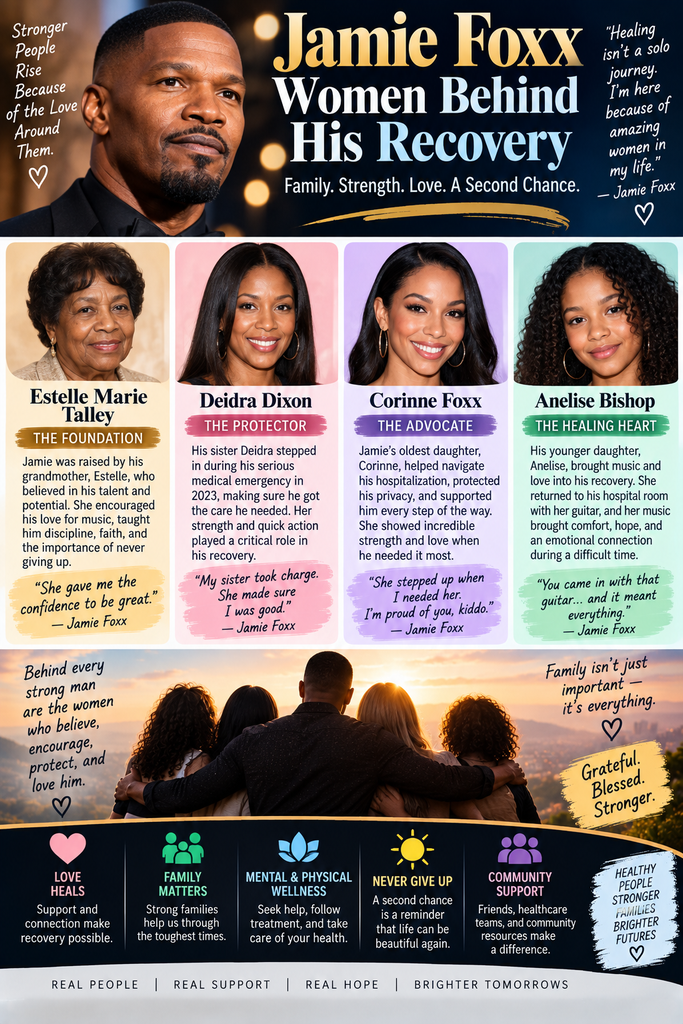
Jamie Foxx’s life has included extraordinary success, family challenges, loss, fatherhood, and a frightening medical crisis. Throughout those experiences, several women have played important roles in providing guidance, love, protection, and motivation.
Four women stand out in his publicly documented story: his grandmother, Estelle Marie Talley; his sister, Deidra Dixon; and his daughters, Corinne Foxx and Anelise Bishop. Their influence illustrates a broader recovery lesson: healing—whether from illness, emotional struggles, trauma, or addiction—often becomes stronger when people do not have to face difficult circumstances alone.
1. Estelle Marie Talley: The Grandmother Who Built His Foundation
Foxx was adopted and raised by his maternal grandparents as an infant. He has repeatedly described his grandmother, Estelle Marie Talley, as one of the greatest influences on his life.
She encouraged his musical abilities and had him begin studying classical piano when he was young. Those early lessons eventually helped him obtain a college music scholarship.
Foxx has also credited his grandmother with teaching him confidence, discipline, faith, and the importance of refusing to limit himself.
Her influence demonstrates how one stable adult can have a lasting impact on a child’s development.
Important lessons from that relationship include:
- Encourage children’s talents early.
- Provide structure along with affection.
- Help children believe that their circumstances do not determine their potential.
- Teach healthy values through consistent behavior.
- Create stability when other family relationships are complicated.
The lessons Foxx learned from his grandmother continued influencing him long after her death.
2. Deidra Dixon: A Sister Who Took Action
Family support became especially important during Foxx’s serious medical emergency in 2023.
Foxx later revealed that a brain bleed led to a stroke. During his recovery, he publicly thanked his sister Deidra for stepping in and helping him when he was critically ill.
At the 2025 BET Awards, Foxx again thanked Deidra, describing how she took control of the situation and made sure her brother received care.
Her role demonstrates an important principle that applies to many health and recovery situations:
Support sometimes means taking action when the person you love cannot advocate for themselves.
Family members can help during difficult periods by:
- Recognizing when something is seriously wrong
- Helping someone obtain professional care
- Communicating important information to healthcare professionals
- Protecting privacy when appropriate
- Remaining involved during treatment
- Providing practical assistance during recovery
- Encouraging the person without trying to control every decision
Support does not mean having all the answers. Sometimes it simply means refusing to disappear when circumstances become frightening.
3. Corinne Foxx: A Daughter Who Stepped Forward
Foxx has frequently expressed pride in his oldest daughter, Corinne.
Their relationship changed dramatically during his medical crisis. Foxx has credited Corinne with helping him survive the emergency and managing circumstances surrounding his hospitalization.
At the 2025 BET Awards, he thanked her publicly, saying that although she had often allowed him to take center stage, she stepped forward when he needed her.
Their relationship demonstrates how family roles can temporarily change during a crisis.
Parents usually expect themselves to protect their children. Illness, addiction, injury, or another major life event can suddenly reverse those roles.
An adult child may become the person who:
- Communicates with healthcare professionals
- Helps coordinate treatment
- Protects a parent’s privacy
- Encourages rehabilitation
- Provides transportation
- Manages practical responsibilities
- Reminds the parent why recovery matters
Accepting that help can sometimes be difficult. Recovery may require allowing loved ones to help when independence is temporarily limited.
4. Anelise Bishop: Music, Love, and Connection
Foxx has shared an especially emotional story about his younger daughter, Anelise.
During his hospitalization, he said Anelise entered his hospital room carrying her guitar after hearing that her father’s condition was serious. Foxx later described her playing as an extraordinarily meaningful moment during his recovery.
Whether someone is recovering from a major illness, addiction, trauma, or another crisis, this story illustrates something medicine alone cannot always provide: emotional connection.
Music, familiar voices, supportive relationships, spirituality, and meaningful activities can complement professional treatment by helping someone remain connected to the life they are fighting to return to.
The Bigger Lesson: Recovery Needs Connection
Foxx’s medical recovery should not be confused with addiction recovery. However, the family dynamics surrounding his experience provide valuable lessons that can also apply to substance-use recovery.
People recovering from addiction often need more than determination.
They may need:
- Professional treatment
- Supportive relationships
- Accountability
- Structure
- Meaningful activities
- Healthy coping strategies
- Medical care
- Hope for a different future
Recovery becomes harder when someone is completely isolated.
Self-Management Strategies
Family support is valuable, but recovery also requires personal participation.
Helpful self-management strategies include:
- Accept help. Independence does not mean refusing support.
- Follow professional recommendations. Medical and behavioral health treatment should guide recovery when appropriate.
- Create healthy routines. Regular sleep, nutrition, physical activity, and structured daily activities can support stability.
- Recognize emotional triggers. Stress, grief, loneliness, anger, and exhaustion can increase vulnerability to unhealthy coping behaviors.
- Protect mental health. Counseling, mindfulness, spirituality, journaling, or other healthy practices may help.
- Stay connected. Isolation can make difficult circumstances harder.
- Set realistic goals. Recovery often happens through small improvements rather than one dramatic transformation.
- Practice gratitude. Recognizing supportive people can strengthen relationships during difficult periods.
Recovery does not require doing everything alone.
Family Support Strategies
Foxx’s experiences demonstrate several forms of family support—from the guidance of his grandmother to the practical and emotional support of his sister and daughters.
Families supporting someone through addiction or another serious health challenge can:
- Listen without judgment.
- Encourage appropriate professional treatment.
- Learn about the person’s condition.
- Help with practical responsibilities when necessary.
- Celebrate progress without demanding perfection.
- Maintain healthy boundaries.
- Avoid enabling destructive behaviors.
- Encourage healthy routines.
- Protect their own emotional health.
- Seek family counseling when needed.
Family members should remember that they can support recovery without becoming the person’s physician, counselor, or entire recovery program.
Community and Professional Support
Not everyone has a large or supportive family. Recovery can still be built through community.
A person’s support network might include:
- Primary care professionals
- Addiction specialists
- Mental health counselors
- Psychologists or psychiatrists
- Peer recovery specialists
- Recovery support groups
- Rehabilitation programs
- Community organizations
- Faith communities when personally meaningful
- Coaches or mentors
- Trusted friends
The important factor is developing healthy connections rather than trying to manage every challenge alone.
When Family Becomes Part of Healing
Families cannot cure addiction, stroke, trauma, depression, or other serious conditions simply through love.
Professional care still matters.
But families can provide something that treatment programs cannot fully replicate: history, belonging, encouragement, and reminders of who someone was before a crisis and who they may still become afterward.
Foxx’s relationship with his grandmother helped establish his foundation. His sister acted during a medical emergency. Corinne stepped forward when her father needed protection and support. Anelise brought music and emotional connection into an extraordinarily difficult moment.
Each woman provided something different.
Together, their stories demonstrate that support does not always look the same.
Conclusion
Jamie Foxx’s documented recovery story is primarily about surviving a serious medical crisis rather than overcoming a publicly confirmed substance addiction. Keeping that distinction clear prevents an inspiring family story from becoming misinformation.
What his experience does demonstrate is the extraordinary importance of human connection during difficult times.
Estelle Marie Talley provided the foundation. Deidra Dixon stepped forward during crisis. Corinne Foxx helped protect and advocate for her father. Anelise Bishop brought music and emotional connection into his recovery.
For people dealing with addiction, illness, or emotional struggles, the broader lesson remains powerful:
Strength does not always mean handling everything yourself. Sometimes strength means accepting treatment, allowing people to help, and recognizing the relationships that give you another reason to keep moving forward.
Frequently Asked Questions
Here are some common questions:
1. What happened to Jamie Foxx in 2023?
Jamie Foxx experienced a serious medical emergency in April 2023. He later revealed that a brain bleed led to a stroke. He required hospitalization and rehabilitation and has described having to relearn skills such as walking during his recovery.
2. Was Jamie Foxx recovering from addiction?
No reliable evidence reviewed for this story establishes that Foxx’s recent recovery was addiction-related. In this context, “recovery” refers to his recovery from the 2023 brain bleed and stroke, not sobriety or substance-use treatment.
3. Who were the influential women in Jamie Foxx’s story?
His grandmother Estelle Marie Talley was a major influence throughout his childhood and career. During his medical crisis and recovery, Foxx has particularly credited his sister, Deidra Dixon, and his daughters, Corinne Foxx and Anelise Bishop/Foxx, for their support.
4. How did his grandmother Estelle Marie Talley influence his life?
Foxx was raised by his grandparents, Mark and Estelle Talley. Estelle encouraged his musical ability, ensured he received piano lessons, and helped instill the discipline that contributed to his later career.
5. What role did his sister Deidra Dixon play during his medical emergency?
Foxx has described Deidra as instrumental in getting him appropriate medical attention after his condition became serious. He later credited her advocacy as an important factor in his survival during the emergency.
6. How did Corinne Foxx support her father?
Foxx publicly thanked Corinne during his 2025 BET Awards speech, saying that when she needed to take charge, she did and helped make sure he was still there. His family also carefully managed public information about his condition while he was hospitalized.
7. What did Anelise do while Jamie Foxx was hospitalized?
Foxx has told the emotional story of Anelise bringing her guitar into his hospital room and playing for him when he was critically ill. He said his vital signs improved while she played and later described her guitar as his “spiritual defibrillator.”
8. Why was music especially meaningful during his recovery?
Music has been part of Foxx’s life since childhood, beginning with the piano lessons encouraged by his grandmother. Decades later, music became part of an important emotional moment between Foxx and Anelise during his hospitalization.
9. What self-management lessons can people take from his recovery?
His experience illustrates the importance of accepting professional treatment, participating in rehabilitation, allowing others to help, maintaining meaningful relationships, and recognizing that recovery may require patience. These are general lessons rather than a specific treatment plan based on Foxx’s experience.
10. How can families support someone recovering from a serious illness?
Families can help communicate with healthcare professionals, provide transportation and practical assistance, encourage rehabilitation, protect appropriate privacy, and offer emotional support. They should also respect medical recommendations and avoid trying to replace trained healthcare professionals.
11. Why is community support important during recovery?
Family members cannot provide every form of care someone needs. Physicians, nurses, rehabilitation professionals, mental health professionals, friends, faith communities (when personally meaningful), and other community resources can each contribute different types of support. Foxx has publicly expressed gratitude for the people who supported him during his health crisis.
12. What did Jamie Foxx say about receiving a second chance?
At the 2025 BET Awards, Foxx reflected emotionally on how close he had come to dying and described his survival as a second chance that he did not intend to take for granted.
13. What is the central message of “Jamie Foxx: Women Behind His Recovery”?
His story demonstrates that serious recovery rarely depends on one person alone. Medical treatment was essential, while the advocacy, presence, music, encouragement, and love from people close to him provided additional support.
14. What broader lesson can this story offer families dealing with addiction or other health challenges?
Although Foxx’s documented medical crisis was not an addiction recovery story, the family-support principles can apply more broadly. People facing addiction, major illness, or rehabilitation may benefit from professional treatment combined with healthy relationships, appropriate boundaries, encouragement, and community resources.
Family cannot replace treatment—but treatment combined with meaningful human connection can create a powerful foundation for recovery.
Video: