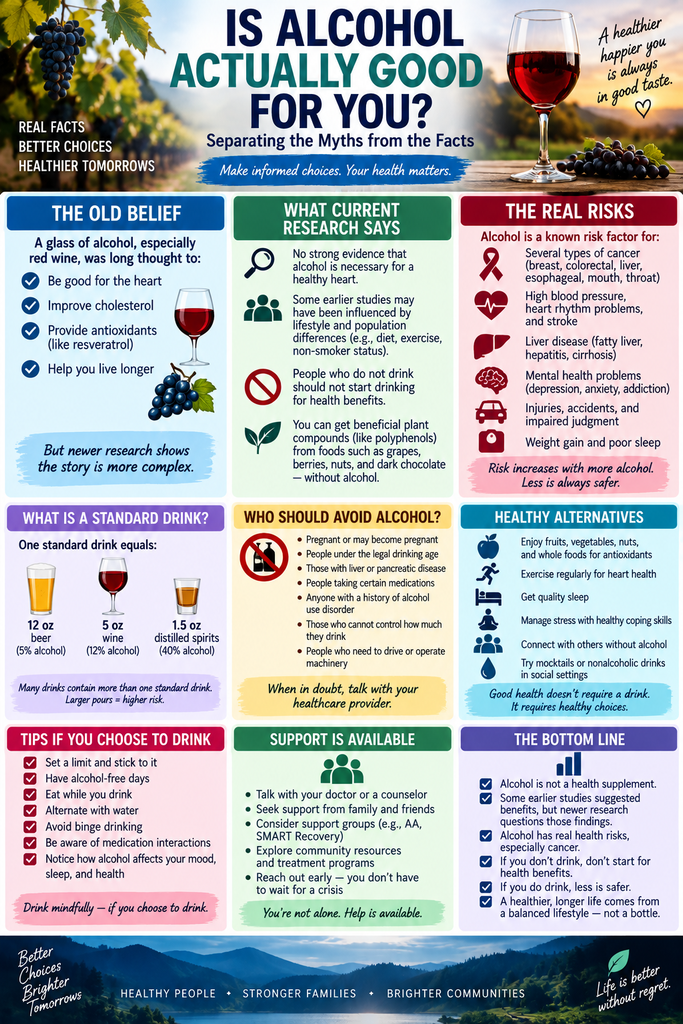
For decades, many people have heard that moderate drinking—particularly a glass of red wine with dinner—might be good for the heart. Some observational studies appeared to show that people who drank small amounts of alcohol had lower rates of cardiovascular disease than people who did not drink.
Today, the picture is much more complicated.
Researchers have discovered that some of the apparent benefits of moderate drinking may have resulted from differences between drinkers and nondrinkers rather than alcohol itself. Diet, exercise, income, healthcare access, smoking, and the inclusion of former drinkers with existing health problems in nondrinking groups can influence study results.
The practical message is increasingly clear: people who do not drink alcohol should not start drinking for health benefits.
Where Did the Idea That Alcohol Is Healthy Come From?
The belief developed partly from observational research showing a “J-shaped” relationship between alcohol consumption and cardiovascular disease. Moderate drinkers sometimes appeared healthier than both heavy drinkers and nondrinkers.
Red wine received particular attention because it contains antioxidants such as polyphenols, including resveratrol.
But there is an important distinction between red wine containing potentially beneficial compounds and alcohol itself being beneficial.
Polyphenols are also available from grapes, berries, peanuts, cocoa, and other foods—without alcohol exposure.
What Does Current Research Say?
Modern research has increasingly questioned whether light or moderate drinking provides the protective health effects once attributed to it.
Alcohol consumption is associated with health risks that generally increase as consumption increases. These include liver disease, several cancers, high blood pressure, injuries, alcohol use disorder, and other medical problems.
This does not mean that every person who occasionally drinks will develop an alcohol-related disease.
It means that alcohol should not be treated as a medication or health supplement.
Alcohol and Cancer
One of the most important reasons the health conversation has changed is stronger evidence regarding alcohol and cancer.
Alcoholic beverages are classified as carcinogenic to humans. Alcohol consumption is associated with increased risk for several cancers, including:
- Breast cancer.
- Colorectal cancer.
- Liver cancer.
- Esophageal cancer.
- Mouth cancer.
- Throat cancer.
- Voice-box cancer.
When the body metabolizes alcohol, it produces acetaldehyde, a toxic compound that can damage DNA and proteins.
Cancer risk can increase even at relatively low levels of alcohol consumption for some cancers.
But What About Red Wine and the Heart?
Red wine contains compounds that have antioxidant properties, but that does not mean drinking wine is necessary for cardiovascular health.
Many of the same beneficial plant compounds can be obtained from foods such as:
- Grapes.
- Blueberries.
- Strawberries.
- Nuts.
- Dark-colored fruits and vegetables.
- Cocoa and other plant foods.
Cardiovascular health is much more strongly supported by established behaviors such as regular physical activity, not smoking, managing blood pressure, maintaining healthy cholesterol levels, eating a nutritious diet, getting adequate sleep, and treating diabetes when present.
A glass of wine should not replace these strategies.
Is There a Completely Safe Amount of Alcohol?
This question requires some nuance.
Risk is not an on/off switch. The health consequences of alcohol depend on the amount consumed, drinking pattern, individual health conditions, medications, age, genetics, and other factors.
In general, less alcohol means less alcohol-related risk.
Someone who drinks one alcoholic beverage occasionally does not face the same overall risk as someone consuming several drinks every day. However, “lower risk” does not mean “health promoting.”
That distinction is important.
What About the U.S. Drinking Guidelines?
U.S. dietary guidance has historically defined moderate alcohol consumption as up to one drink per day for women and up to two drinks per day for men.
These limits should not be interpreted as recommendations to drink that amount.
They are upper limits intended to reduce risk among people who already choose to drink—not health targets someone should try to reach.
A standard drink is approximately:
- 12 ounces of regular beer.
- 5 ounces of wine.
- 1.5 ounces of 80-proof distilled spirits.
Actual serving sizes can contain considerably more than one standard drink.
Who Should Avoid Alcohol?
For some people, avoiding alcohol is particularly important.
Examples may include people who:
- Are pregnant or may become pregnant.
- Are younger than the legal drinking age.
- Have certain liver or pancreatic diseases.
- Take medications that interact with alcohol.
- Cannot reliably control how much they drink.
- Are recovering from alcohol use disorder.
- Need to drive or operate dangerous equipment.
- Have medical conditions for which alcohol could worsen symptoms.
Individual medical advice should come from a healthcare professional familiar with the person’s history.
Self-Management Strategies: Making an Informed Choice
People do not necessarily need to identify as having an alcohol problem to evaluate their drinking.
Useful self-management strategies include:
- Keep track of how many standard drinks you actually consume.
- Notice whether your drinking has gradually increased.
- Schedule alcohol-free days.
- Avoid using alcohol as your primary strategy for managing anxiety, sadness, anger, or insomnia.
- Eat before or while drinking.
- Alternate alcoholic beverages with nonalcoholic drinks.
- Avoid binge-drinking situations.
- Learn what constitutes a standard drink.
- Review alcohol-medication interactions with a healthcare professional or pharmacist.
- Consider how alcohol affects your sleep, blood pressure, mood, weight, and relationships.
- Talk with a healthcare professional if reducing alcohol becomes unexpectedly difficult.
A useful question is not simply, “Do I drink too much?”
Ask, “What role is alcohol playing in my life?”
Pay Attention to Why You Drink
The reason someone drinks can sometimes be as important as the amount.
Having an occasional drink socially is different from repeatedly needing alcohol to:
- Fall asleep.
- Calm anxiety.
- Escape sadness.
- Manage trauma.
- Reduce loneliness.
- Cope with work stress.
- Feel comfortable socially.
- Get through difficult relationships.
When alcohol becomes a primary coping mechanism, it may be worth discussing the pattern with a healthcare or mental health professional.
Family Support Strategies
Families can help promote healthier attitudes toward alcohol without turning every conversation into an accusation.
Helpful strategies include:
- Avoid presenting alcohol as necessary for relaxation or celebration.
- Model responsible decisions about drinking.
- Discuss family histories of alcohol problems when appropriate.
- Keep conversations factual rather than shame-based.
- Encourage someone to seek help when drinking begins interfering with health or relationships.
- Avoid covering up consequences caused by another person’s drinking.
- Establish boundaries when alcohol contributes to unsafe behavior.
- Support alcohol-free family activities.
- Avoid pressuring someone to drink because “one won’t hurt.”
- Respect someone who chooses not to drink.
One particularly useful cultural change is normalizing the simple statement:
“No thanks, I don’t drink.”
Nobody should have to provide a medical diagnosis or recovery history to justify that decision.
Community Support Strategies
People who want to reduce or stop drinking have many options beyond trying to do it alone.
Community resources can include:
- Primary-care professionals.
- Addiction medicine specialists.
- Mental health counselors.
- Alcohol treatment programs.
- Recovery coaches.
- Alcoholics Anonymous.
- SMART Recovery.
- Women for Sobriety.
- Community health centers.
- Family support groups.
- Faith-based recovery programs when personally meaningful.
- Alcohol-free social and recreational groups.
People do not need to wait until alcohol has caused catastrophic consequences before asking for help.
Early intervention can prevent problems from becoming more severe.
What If Someone Wants to Cut Back?
Setting specific goals can be more useful than saying, “I’m going to drink less.”
Someone might decide to track drinks for a month, establish alcohol-free days, stop keeping alcohol at home, avoid known binge-drinking situations, or replace an evening drink with another routine.
However, people who experience withdrawal symptoms when they stop drinking—including shaking, sweating, severe anxiety, hallucinations, seizures, or significant physical illness—should seek medical care.
Alcohol withdrawal can become life-threatening in people with significant physical dependence.
Does Drinking Occasionally Mean You Have an Alcohol Problem?
No.
Drinking alcohol does not automatically mean someone has alcohol use disorder.
Alcohol use disorder involves a problematic pattern of alcohol consumption producing clinically significant impairment or distress. Warning signs can include difficulty controlling drinking, strong cravings, repeatedly drinking more than intended, unsuccessful attempts to cut down, neglecting responsibilities, continuing despite consequences, tolerance, and withdrawal.
What matters is the overall pattern and its consequences.
Alcohol-Free Does Not Mean Fun-Free
One reason people continue drinking is cultural. Alcohol is deeply connected with weddings, holidays, sporting events, vacations, restaurants, dating, and celebrations.
But social connection does not require alcohol.
Mocktails, alcohol-free beverages, exercise groups, hobbies, travel, family activities, and recovery-oriented social events can provide connection without alcohol exposure.
For someone in recovery, building a life that is enjoyable without substances can be one of the most important long-term changes.
The Bottom Line: Should You Drink Alcohol for Your Health?
No one needs to start drinking alcohol to become healthier.
If you do not currently drink, there is no compelling health reason to start.
If you already drink, the relationship between alcohol and health is better understood as a spectrum of risk rather than a choice between “healthy” and “unhealthy.” Generally, drinking less reduces alcohol-related health risks.
And if controlling alcohol has become difficult, that is not a reason for shame. It is a reason to consider additional support.
Conclusion
The old message that moderate alcohol consumption—especially red wine—is “good for you” is far less certain than it once appeared.
Some early observational research suggested cardiovascular benefits, but improved research methods have challenged whether alcohol itself deserves the credit. Meanwhile, evidence linking alcohol with cancer, liver disease, injuries, addiction, and other health consequences has become increasingly important.
That does not mean every drink is catastrophic. It means alcohol should be viewed realistically: it is a psychoactive substance with potential risks, not a health supplement.
If you do not drink, don’t start for supposed health benefits. If you choose to drink, understanding the amount and risks can help you make an informed decision. And if drinking has become difficult to control, effective treatment and support are available.
Better health does not require a glass of alcohol. It requires informed choices that support your body, your mental health, and the life you want to build.
Frequently Asked Questions
Here are some common questions:
1. Is alcohol actually good for your health?
Alcohol is not considered necessary for good health. Although older observational studies suggested that light or moderate drinking might provide cardiovascular benefits, newer research has raised questions about whether those apparent benefits were actually caused by alcohol. People who do not drink should not start drinking for health benefits.
2. Is a glass of red wine every day good for your heart?
The evidence is not strong enough to recommend red wine for heart health. Red wine contains plant compounds such as polyphenols, but these can also be obtained from grapes, berries, nuts, and other foods without alcohol.
3. Why did doctors once say moderate alcohol was healthy?
Earlier studies found that moderate drinkers sometimes had lower rates of cardiovascular disease than nondrinkers. However, observational studies can be influenced by factors such as diet, exercise, smoking, socioeconomic circumstances, and whether former heavy drinkers were included in the nondrinking group.
4. Does drinking alcohol increase cancer risk?
Yes. Alcohol consumption is associated with increased risk of several cancers, including cancers of the breast, liver, colorectum, esophagus, mouth, throat, and larynx. The body converts alcohol into acetaldehyde, which can damage DNA.
5. Can even small amounts of alcohol increase cancer risk?
Yes. For certain cancers, particularly breast cancer, risk can increase even at relatively low levels of alcohol consumption. Generally, cancer risk increases as alcohol exposure increases.
6. Does that mean one alcoholic drink will cause cancer?
No. Risk is not the same as certainty. Having one drink does not mean someone will develop cancer. Alcohol contributes to risk over time, and an individual’s overall risk depends on many biological, behavioral, and environmental factors.
7. Is wine healthier than beer or liquor?
No type of alcoholic beverage eliminates the risks associated with ethanol. Wine may contain beneficial plant compounds, but the alcohol itself is still metabolized into acetaldehyde. The amount of ethanol consumed is more important than whether it comes from wine, beer, or spirits.
8. What is considered one standard alcoholic drink?
In the United States, approximately one standard drink contains 14 grams of pure alcohol. That is roughly 12 ounces of 5% beer, 5 ounces of 12% wine, or 1.5 ounces of 40% distilled spirits. Many cocktails, large wine pours, and high-alcohol beers contain more than one standard drink.
9. Is moderate drinking completely safe?
No amount of alcohol can be described as completely risk-free for every health outcome. Risk generally increases with consumption. Someone who drinks occasionally has a very different risk profile from someone who drinks heavily, but “lower risk” should not be confused with “health benefit.”
10. Can alcohol help you sleep?
Alcohol can make someone feel sleepy initially, but it can disrupt sleep architecture and contribute to poorer-quality and fragmented sleep later in the night. Regularly using alcohol as a sleep aid can also encourage an unhealthy pattern of reliance.
11. Can alcohol reduce stress and anxiety?
Alcohol may temporarily produce relaxation, but regularly using it to manage stress or anxiety can become problematic. As alcohol wears off, some people experience increased anxiety, irritability, or sleep problems, creating a cycle in which they drink again for temporary relief.
12. Can alcohol damage the liver?
Yes. Heavy or prolonged alcohol consumption can contribute to alcohol-associated fatty liver disease, alcohol-associated hepatitis, fibrosis, and eventually cirrhosis. Advanced cirrhosis can lead to liver failure and other serious complications.
13. Who should avoid alcohol completely?
Alcohol should generally be avoided by people who are pregnant or may become pregnant, people below the legal drinking age, people who cannot control their drinking, and people who need to drive or operate dangerous equipment. Certain medical conditions and medications can also make alcohol unsafe, so individualized medical advice may be necessary.
14. Should someone who doesn’t drink start having red wine for their heart?
No. There is no compelling health reason for a nondrinker to start consuming alcohol. Cardiovascular health can be supported through strategies with clearer benefits, including exercise, nutritious food, avoiding tobacco, managing blood pressure and cholesterol, and getting adequate sleep.
15. What are healthier ways to obtain the antioxidants found in red wine?
Grapes, berries, nuts, vegetables, and other plant foods provide polyphenols and other beneficial nutrients without alcohol exposure. A balanced dietary pattern provides a much broader range of nutrients than a glass of wine.
16. How can someone make healthier choices if they currently drink?
Useful self-management strategies include keeping track of standard drinks, having alcohol-free days, avoiding binge drinking, noticing emotional triggers, finding alcohol-free ways to manage stress, and discussing alcohol use with a healthcare professional when concerns arise.
17. How can families encourage healthier drinking habits?
Families can normalize alcohol-free gatherings, avoid pressuring people to drink, discuss alcohol without shame, support someone who decides to reduce or stop drinking, and maintain healthy boundaries when another person’s alcohol use becomes harmful.
18. What community resources are available for someone worried about drinking?
Options include primary-care clinicians, addiction medicine professionals, therapists, community treatment programs, recovery coaches, Alcoholics Anonymous, SMART Recovery, and other peer-support organizations. Someone does not need to reach a crisis before seeking assistance.
19. What if someone wants to stop drinking but experiences withdrawal?
People who have developed significant physical dependence should not assume that abruptly stopping alcohol is safe. Alcohol withdrawal can cause severe symptoms, including seizures and delirium, and may require medical supervision.
20. What is the bottom line—is alcohol healthy or unhealthy?
Alcohol is better viewed as a substance carrying dose-dependent health risks rather than as a health supplement. If you don’t drink, there is no health reason to start. If you choose to drink, generally less alcohol means less alcohol-related risk.
The takeaway: You don’t need alcohol for heart health, antioxidants, relaxation, or a healthy lifestyle. Good nutrition, physical activity, quality sleep, supportive relationships, stress management, and appropriate healthcare offer healthier ways to support long-term well-being.
Video: The Red Wine Myth: Why Your Daily Glass Isn’t Healthy 🍷 #healthtips #alcoholfacts