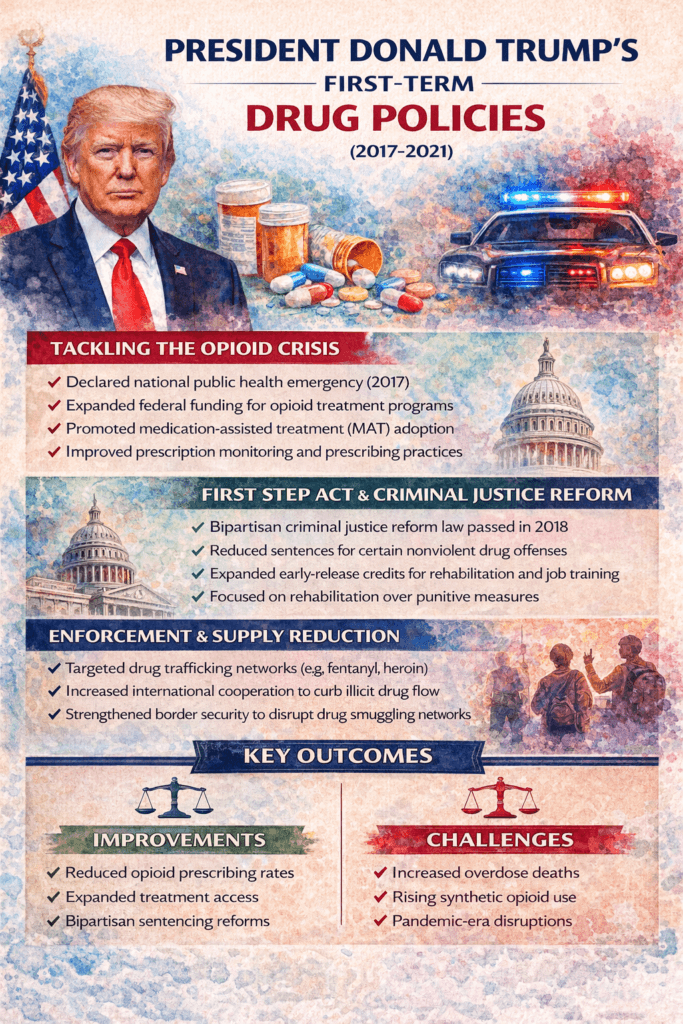
During his first term in office, Donald Trump pursued a multifaceted federal drug policy strategy that combined public health initiatives, criminal justice reform, and law enforcement efforts. His administration addressed the opioid crisis through expanded treatment funding, national awareness campaigns, and prescribing oversight, while also supporting legislative reforms such as the First Step Act aimed at rehabilitation and sentencing adjustments for certain drug-related offenses. These policies reflected a hybrid approach that attempted to balance traditional enforcement priorities with growing recognition of addiction as a medical and social issue.
How President Donald Trump’s First-Term Drug Policies Affected Addiction Rates
Assessing how Donald Trump’s first-term drug policies influenced addiction rates requires separating policy actions from public health outcomes. His administration (2017–2021) implemented several initiatives targeting opioid misuse, treatment access, and criminal justice reform. Some indicators showed improvement, while others worsened due to broader factors such as fentanyl proliferation and pandemic-era disruptions.
Areas Where Indicators Showed Improvement
1. Prescription Opioid Prescribing Declined
Federal monitoring programs, prescribing guidelines, and awareness campaigns contributed to continued reductions in opioid prescribing. This downward trend began before 2017 but continued during his term, suggesting policies supporting monitoring and education reinforced existing progress.
2. Expanded Treatment Access
Federal grants to states increased funding for medication-assisted treatment (MAT), recovery programs, and prevention initiatives. These resources helped expand treatment infrastructure, particularly in rural and underserved areas.
3. Criminal Justice Reform
The First Step Act (2018) reduced some sentences for nonviolent drug offenses and expanded rehabilitation programs for incarcerated individuals. Supporters argue this helped shift some policy focus toward recovery rather than punishment, which is associated with improved long-term outcomes for people with substance use disorders.
Areas Where Outcomes Did Not Improve—or Worsened
1. Overdose Deaths Increased
Despite prevention efforts, national overdose deaths rose significantly between 2017 and 2020. A major driver was the rapid spread of illicit fentanyl and synthetic opioids, which dramatically increased overdose risk regardless of policy changes.
2. Synthetic Drug Supply Expanded
Enforcement efforts targeted trafficking networks, but global drug markets adapted quickly. Increased potency and availability of synthetic drugs offset some gains from prescription control measures.
3. Pandemic Effects
In 2020, social isolation, economic stress, and reduced access to in-person treatment contributed to spikes in substance use and overdose deaths, complicating the evaluation of policy effectiveness.
Why Results Were Mixed
Drug addiction trends are influenced by multiple factors beyond federal policy, including:
- Global drug supply changes
- Socioeconomic stressors
- State-level policies
- Healthcare access
- Public health crises
Because these variables interact, it is difficult to attribute national addiction trends solely to one administration’s policies.
Balanced Policy Assessment
Trump’s first-term approach combined enforcement, treatment funding, and criminal justice reform. Some structural improvements—like expanded treatment resources and sentencing reforms—are considered positive steps by many analysts. However, rising overdose deaths during the same period show that policy changes alone were not sufficient to reverse national addiction trends, especially amid the surge of synthetic opioids.
In summary: Certain policy measures improved treatment access and prescribing practices, but overall addiction-related harm—particularly overdose mortality—did not decline during the period. The evidence suggests a mixed impact rather than a clear improvement or failure.
Frequently Asked Questions
Here are some common questions:
Who oversaw U.S. drug policy during 2017–2021?
Drug policy during this period was directed by the Trump administration through federal agencies such as the Office of National Drug Control Policy, the Department of Justice, and the Department of Health and Human Services.
What were the main goals of his first-term drug strategy?
The administration focused on three broad priorities:
- Reducing opioid misuse and overdose deaths
- Strengthening law enforcement against drug trafficking
- Expanding treatment and recovery resources
This reflected a combined public health and enforcement approach rather than relying on a single strategy.
What was the First Step Act, and why was it important?
Passed in 2018 with bipartisan support, the First Step Act introduced sentencing reforms and prison rehabilitation initiatives. It reduced some penalties for nonviolent drug offenses and expanded early-release incentives for participation in treatment or job training programs. Many analysts viewed it as a shift toward rehabilitation-focused justice policy.
Did overdose deaths decrease during this period?
No. Despite expanded treatment funding and prevention campaigns, national overdose deaths increased overall between 2017 and 2020. Experts attribute this rise largely to the spread of illicit fentanyl and synthetic opioids, which dramatically increased overdose risk.
Did the administration address prescription opioid misuse?
Yes. Policies supported prescription monitoring programs, provider education, and prescribing guidelines. Prescription opioid dispensing continued a downward trend that had begun before 2017 and continued through the administration’s term.
What enforcement actions were emphasized?
Federal agencies prioritized disrupting drug trafficking networks, especially those distributing fentanyl and heroin. The administration also promoted international cooperation to reduce drug supply chains entering the United States.
How did the administration approach addiction treatment?
Federal grants were expanded to states for treatment programs, including medication-assisted treatment, prevention initiatives, and recovery services. The goal was to increase access to care, particularly in rural and underserved communities.
Why do experts describe the results as “mixed”?
Drug trends depend on many factors beyond federal policy, including global trafficking patterns, state-level laws, economic conditions, and public health crises. Because multiple forces were affecting drug use simultaneously, it is difficult to attribute national outcomes solely to one administration’s policies.
Did these policies change long-term drug strategy in the U.S.?
Some elements—such as expanded treatment funding and criminal justice reforms—have influenced ongoing policy discussions across later administrations. The First Step Act, in particular, is often cited as a notable bipartisan reform with lasting effects.
What is the overall takeaway?
Trump’s first-term drug policies combined enforcement, treatment expansion, and sentencing reform. Some structural improvements occurred, especially in treatment access and justice reform, but national overdose trends did not decline overall. Most policy analysts, therefore, characterize the impact as partial progress in a complex and evolving drug landscape.
Conclusion
Evaluating Trump’s first-term drug policies requires recognizing both their structural contributions and the broader context in which they operated. While some initiatives expanded treatment access, strengthened monitoring systems, and introduced reforms in the justice system, national addiction trends were also shaped by powerful external factors such as the rise of synthetic opioids and shifting global drug markets. As a result, the legacy of these policies is best understood as part of a larger, evolving national response to substance use challenges. Their lasting significance lies in how they contributed to ongoing policy conversations about prevention, treatment, enforcement, and the role of government in addressing addiction as a complex public health issue.
Video: https://youtube.com/shorts/bgjWcUqQyik