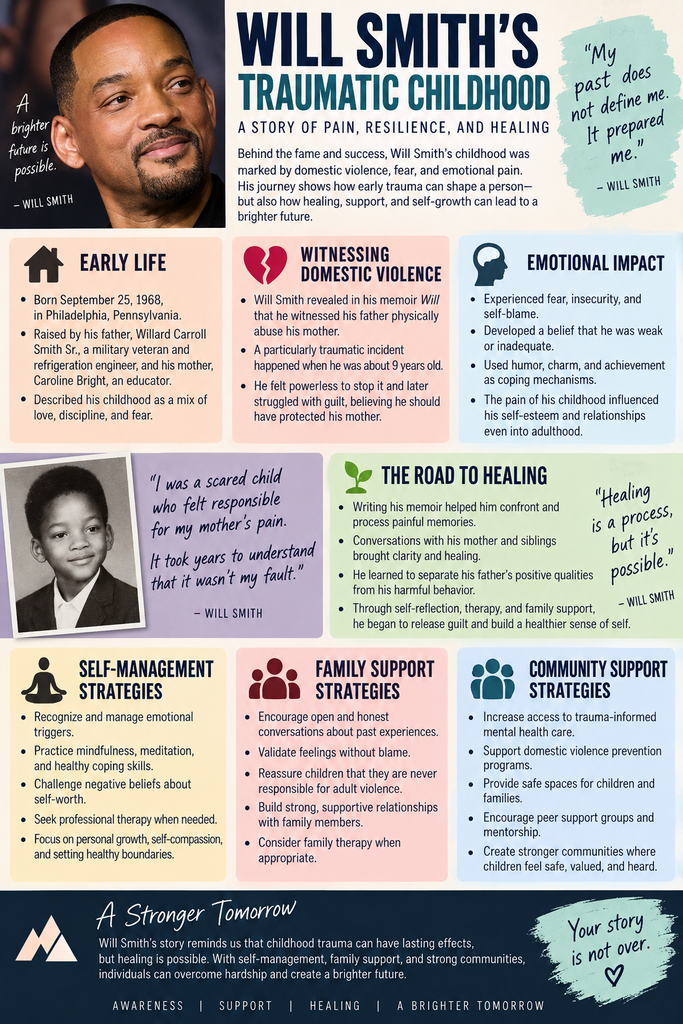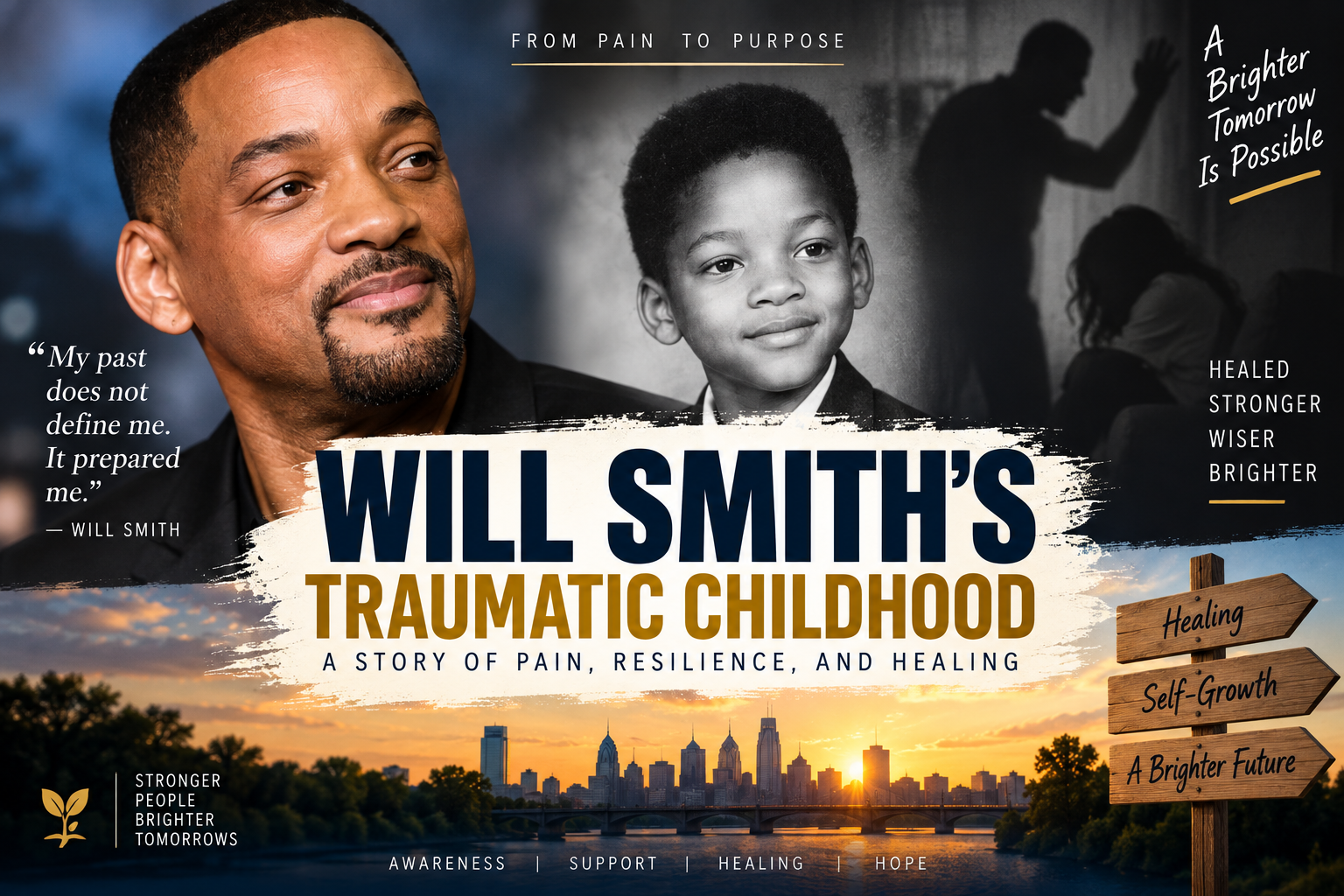
Will Smith is known worldwide for his infectious personality, successful acting career, and memorable performances in The Fresh Prince of Bel-Air, Men in Black, and The Pursuit of Happyness. However, behind his public image lies a childhood marked by domestic violence, fear, and emotional pain.
In his 2021 memoir, Will Smith revealed how witnessing his father physically abuse his mother profoundly affected his self-esteem, relationships, and perception of himself. His experiences illustrate how childhood trauma can influence emotional development, even when someone achieves extraordinary professional success.
Understanding Will Smith’s childhood provides an opportunity to explore the long-term effects of trauma, the importance of emotional healing, and how self-management, family involvement, and community support can help individuals develop healthier coping strategies.
Will Smith’s Childhood: Growing Up With Domestic Violence
Will Smith was born on September 25, 1968, in Philadelphia, Pennsylvania. His father, Willard Carroll Smith Sr., was a military veteran and refrigeration engineer, while his mother, Caroline Bright, worked in education.
Although Smith has described his father as hardworking and dedicated to providing for his family, he also revealed that his father could be physically violent toward his mother.
In his memoir, Smith recalled witnessing a particularly traumatic incident when he was approximately nine years old. He watched his father physically assault his mother and felt powerless to intervene.
The experience left him struggling with guilt and shame because he believed he should have protected her.
During a 2021 NPR interview, Smith explained that he continued to blame himself for his perceived failure to defend his mother, despite being a frightened child at the time.
He also described the emotional conflict of loving and admiring his father while fearing his violent behavior.
How witnessing domestic violence affects children
Children who witness domestic violence may experience psychological consequences even when they are not physically assaulted themselves.
Potential effects include:
- Fear and hypervigilance: Constantly monitoring the environment for signs of danger or conflict.
- Guilt and self-blame: Believing they should have prevented the violence or protected another family member.
- Emotional insecurity: Having difficulty feeling safe in relationships or trusting caregivers.
- Low self-esteem: Developing negative beliefs about their personal worth or abilities.
- Emotional suppression: Hiding sadness, anger, or fear to avoid additional family conflict.
- Relationship difficulties: Struggling with boundaries, emotional expression, or conflict resolution later in life.
Not every child exposed to domestic violence develops these difficulties. Individual temperament, supportive relationships, access to treatment, and environmental stability can influence long-term outcomes.
An important lesson from Smith’s childhood is that children are never responsible for stopping domestic violence between adults.
Children need protection, reassurance, and opportunities to process frightening experiences without being made to feel responsible for their caregivers’ behavior.
How Childhood Trauma Influenced Will Smith’s Self-Esteem
One of the most revealing aspects of Smith’s memoir is his description of how childhood trauma influenced his perception of himself.
Smith explained that witnessing his mother’s abuse contributed to a persistent belief that he was weak or inadequate.
Rather than openly discussing these feelings, he described developing an outgoing, entertaining personality that helped him gain approval and create positive experiences for those around him.
Smith connected his drive for achievement to his desire to overcome painful feelings about himself. He explained that his cheerful public persona sometimes concealed feelings of low self-esteem.
Understanding achievement as a possible response to trauma
Some individuals who experience childhood adversity develop coping strategies centered on achievement, perfectionism, or gaining approval from others.
These behaviors may provide a sense of control and temporarily reduce feelings of insecurity.
However, professional accomplishments and public recognition do not necessarily resolve underlying emotional pain.
Common patterns may include:
- Working excessively to establish a sense of personal worth.
- Seeking approval or reassurance from others.
- Using humor to avoid discussing uncomfortable emotions.
- Setting unrealistic expectations for personal success.
- Experiencing difficulty accepting mistakes or criticism.
- Believing that love and acceptance must be earned through achievement.
These behaviors are not proof that someone has experienced trauma. They may have many different causes.
The goal of trauma recovery is not to eliminate ambition or success, but to develop a sense of self-worth that does not depend entirely on external validation.
The Long-Term Emotional Effects of Childhood Trauma
Childhood trauma can influence how individuals interpret stressful situations, regulate emotions, and develop relationships throughout adulthood.
When children repeatedly experience frightening or unpredictable environments, their stress-response systems may become more sensitive to perceived threats.
As adults, some individuals may react strongly to criticism, rejection, interpersonal conflict, or situations that remind them of earlier experiences.
These reactions can occur even when the present situation is different from the original traumatic event.
Potential long-term effects of childhood trauma
Emotional regulation difficulties
Individuals may experience intense anger, anxiety, sadness, or frustration when confronted with stressful situations.
Difficulty trusting others
Growing up in an unpredictable environment can affect expectations about safety, emotional availability, and reliability in relationships.
Negative self-perception
Childhood experiences may contribute to persistent beliefs involving shame, inadequacy, or personal responsibility for events outside one’s control.
Avoidance behaviors
Some individuals cope with painful emotions by avoiding difficult conversations, overworking, withdrawing socially, or engaging in potentially harmful behaviors.
Increased vulnerability to mental health conditions
Childhood adversity is associated with an increased risk of certain mental health conditions, including depression, anxiety, post-traumatic stress disorder, and substance use disorders.
However, experiencing childhood trauma does not mean that an individual will develop any of these conditions.
It is also important not to assume that Smith has a particular psychiatric diagnosis or substance use disorder based on his childhood experiences.
His publicly described experiences can help illustrate broader psychological concepts without assigning him a diagnosis.
Will Smith’s Journey Toward Understanding His Childhood
For many years, Smith did not openly discuss the domestic violence he witnessed during childhood.
In his 2021 NPR interview, he explained that writing his memoir provided an opportunity to examine experiences he had previously struggled to discuss.
He also described conversations with his mother and siblings about their shared family history.
According to Smith, these discussions allowed family members to explore experiences they had rarely addressed openly.
One particularly meaningful conversation involved his mother reassuring him that she had never viewed him as a coward for failing to intervene during the violence.
These conversations helped him reconsider beliefs about himself that had developed during childhood.
What his experience teaches us about emotional healing
Smith’s account highlights several concepts that may be relevant to individuals recovering from childhood adversity:
- Acknowledging painful experiences can help individuals understand their emotional responses.
- Revisiting childhood beliefs from an adult perspective may reduce inappropriate guilt and self-blame.
- Family conversations can provide opportunities for clarification, validation, and emotional connection when they are safe and voluntary.
- Understanding a parent’s positive qualities does not require minimizing or excusing abusive behavior.
- Emotional healing can involve recognizing that childhood experiences do not determine a person’s entire identity.
Recovery from childhood trauma is not always linear. Some individuals experience meaningful improvement while continuing to encounter emotional challenges.
The objective is to develop healthier ways of responding to difficult memories, relationships, and stressful situations.
Self-Management Strategies for Healing Childhood Trauma
Self-management involves developing practical skills to recognize emotional triggers, regulate responses, and maintain psychological well-being.
For people who identify with aspects of Smith’s childhood experiences, the following strategies may support recovery.
Recognize emotional triggers
Trauma-related triggers are situations, memories, or sensory experiences that produce emotional or physiological responses associated with earlier adversity.
A person who witnessed domestic violence may experience heightened distress during arguments, confrontations, or situations involving raised voices.
Helpful strategies include:
- Identifying situations that produce unusually intense emotional reactions.
- Recognizing physical warning signs such as muscle tension, rapid breathing, or increased heart rate.
- Recording emotional responses in a journal.
- Distinguishing between present circumstances and past traumatic experiences.
- Practicing grounding techniques when distressing memories arise.
Recognizing triggers can help individuals respond more intentionally rather than automatically reacting to perceived threats.
Develop healthier emotional regulation skills
Emotional regulation involves recognizing, understanding, and managing emotional responses.
Practical techniques include:
- Practicing slow, controlled breathing during periods of heightened stress.
- Taking a brief break from an argument before responding.
- Engaging in regular physical activity.
- Maintaining consistent sleep and daily routines.
- Using mindfulness exercises to increase awareness of thoughts and emotions.
- Expressing difficult feelings through writing, creative activities, or supportive conversations.
These strategies can reduce everyday stress, although they do not replace professional treatment when trauma symptoms significantly interfere with functioning.
Challenge negative childhood beliefs
Children exposed to violence may develop inaccurate beliefs about their responsibility for what happened.
For example, a child who witnesses domestic violence may believe that failing to intervene means they are weak or responsible for the victim’s suffering.
As an adult, that person may continue to experience shame even though they understand the situation was beyond their control.
Cognitive restructuring can help individuals identify and reconsider these beliefs.
A healthier perspective may involve recognizing that:
- Children are not responsible for controlling adult behavior.
- Fear during a dangerous situation is a normal protective response.
- Personal worth does not depend on preventing another person’s harmful actions.
- Childhood experiences can influence identity without permanently defining it.
Seek professional trauma-focused treatment
Individuals experiencing persistent trauma-related symptoms may benefit from professional mental health treatment.
Depending on their symptoms and clinical needs, treatment options may include trauma-focused cognitive behavioral therapy, cognitive processing therapy, prolonged exposure therapy, or eye movement desensitization and reprocessing (EMDR).
A qualified mental health professional can help determine which approach is appropriate.
Self-management is an important part of recovery, but individuals do not have to process significant childhood trauma alone.
Family Support Strategies: Creating Safety and Understanding
Family relationships can play an important role in recovery from childhood trauma.
However, family involvement should prioritize emotional and physical safety rather than pressure individuals to reconcile with people who have harmed them.
Smith’s account of discussing his childhood with his mother and siblings illustrates how supportive conversations can sometimes help family members develop a deeper understanding of shared experiences.
Encourage open communication
Families can create opportunities for individuals to discuss painful experiences without fear of criticism or dismissal.
Helpful approaches include:
- Listening without interrupting or immediately offering solutions.
- Validating the person’s emotional experience.
- Avoiding statements that minimize childhood abuse.
- Allowing individuals to discuss difficult memories at their own pace.
- Respecting privacy and personal boundaries.
Family members do not need to agree on every interpretation of the past to acknowledge that someone experienced genuine emotional pain.
Avoid blaming children for adult behavior
Children who witness domestic violence may mistakenly believe they caused the violence or should have prevented it.
Parents and caregivers should clearly communicate that responsibility belongs to the adult who engaged in the abusive behavior.
Helpful messages include:
- You were not responsible for what happened.
- Protecting adults was never your responsibility.
- Your feelings about the experience are important.
- You deserve to feel safe and supported.
- You can ask for help without being blamed or punished.
These messages can help address feelings of guilt and shame that may persist into adulthood.
Establish healthy family boundaries
Families recovering from histories of abuse may need to establish boundaries that protect individual well-being.
Examples include:
- Refusing to tolerate threatening or physically aggressive behavior.
- Avoiding conversations that involve intimidation or verbal abuse.
- Respecting an individual’s decision to limit contact with certain relatives.
- Establishing clear expectations for respectful communication.
- Seeking professional guidance when family conflicts become difficult to manage.
Forgiveness and reconciliation are personal choices, not requirements for trauma recovery.
Consider family therapy when appropriate
Family therapy may help relatives improve communication, understand the effects of childhood adversity, and develop healthier relationship patterns.
However, joint therapy with an abusive family member may be inappropriate when violence, coercion, or intimidation is ongoing.
In these circumstances, individual support and safety planning should take priority.
Community Support Strategies: Building a Stronger Recovery Environment
Community resources can help individuals and families address childhood trauma by providing education, professional treatment, practical assistance, and opportunities for meaningful social connection.
These resources are especially important for individuals who lack supportive family relationships.
Expand access to trauma-informed mental healthcare
Trauma-informed care recognizes that past experiences may influence a person’s emotional responses, relationships, and interactions with healthcare professionals.
Community healthcare organizations can support trauma recovery by:
- Providing access to affordable mental health services.
- Offering screening for trauma-related symptoms when clinically appropriate.
- Training healthcare professionals to recognize the effects of childhood adversity.
- Connecting individuals with qualified trauma therapists.
- Providing culturally responsive and confidential treatment.
Trauma-informed care emphasizes safety, trust, collaboration, and respect for individual choice.
Strengthen domestic violence prevention and intervention programs
Communities can reduce exposure to domestic violence by supporting services that protect survivors and their children.
Important resources include:
- Domestic violence shelters and emergency housing.
- Confidential crisis hotlines.
- Legal advocacy and assistance with protective orders.
- Safety planning and counseling services.
- Financial assistance and housing support.
- Educational programs addressing healthy relationships and violence prevention.
Children exposed to domestic violence may also benefit from age-appropriate counseling and supportive school environments.
Encourage peer support and social connection
Supportive relationships can help individuals reduce isolation and develop healthier perspectives on their experiences.
Community support may include:
- Trauma survivor support groups.
- Peer-led mental health programs.
- Community wellness activities.
- Mentorship opportunities.
- Educational workshops about childhood adversity.
- Faith-based or spiritual support when aligned with the individual’s preferences.
Peer support can complement professional treatment by providing opportunities for connection and shared understanding.
Promote early intervention for children experiencing trauma
Early identification of childhood adversity can help families access appropriate services before emotional difficulties become more severe.
Schools, pediatric healthcare providers, and community organizations can work together to identify children who may benefit from additional support.
Effective approaches may include:
- School-based counseling and mental health services.
- Parenting education and caregiver support.
- Child-focused trauma therapy.
- Programs that strengthen safe and supportive relationships.
- Assistance for families experiencing housing instability or financial hardship.
- Referral pathways for children exposed to abuse or domestic violence.
Early intervention cannot guarantee that a child will avoid future mental health difficulties, but it can provide protective support during important developmental periods.
The Connection Between Childhood Trauma and Addiction
Although Will Smith’s childhood experiences provide an opportunity to discuss the relationship between trauma and addiction, his traumatic childhood should not be interpreted as evidence that he has a substance use disorder.
Childhood adversity is one of several factors associated with an increased risk of substance misuse later in life.
Some individuals may use alcohol or drugs to temporarily manage distressing memories, anxiety, emotional numbness, or sleep disturbances.
This pattern is sometimes described as self-medication.
However, substance use can worsen emotional regulation, interfere with sleep, and increase the risk of developing a substance use disorder.
How trauma-informed addiction treatment can help
For individuals experiencing both trauma-related symptoms and substance use problems, comprehensive treatment may include:
- Assessment of trauma-related symptoms and substance use patterns.
- Evidence-based treatment for substance use disorders.
- Trauma-focused psychotherapy when clinically appropriate.
- Medications for addiction treatment when indicated.
- Development of healthier coping and emotional regulation skills.
- Family education and supportive relationship building.
- Peer recovery services and ongoing relapse prevention planning.
Treatment should address both substance use and the psychological factors that may contribute to it.
An individual does not necessarily need to complete addiction treatment before beginning appropriate trauma-focused care. Integrated treatment can address both conditions while considering safety, readiness, and individual preferences.
What Can We Learn From Will Smith’s Childhood Experiences?
Will Smith’s public reflections demonstrate that professional success and emotional well-being are not necessarily the same.
His experiences also illustrate how a child may develop lasting feelings of guilt after witnessing domestic violence, even though the child was never responsible for stopping it.
Several important lessons emerge from his account:
- Childhood trauma can influence self-esteem and emotional development long after the original events.
- Children may develop negative beliefs about themselves when they witness violence between caregivers.
- Humor, achievement, and a positive public image do not necessarily reveal someone’s private emotional experiences.
- Open communication can help family members better understand the effects of shared childhood adversity.
- Healthy boundaries and personal safety are essential components of trauma recovery.
- Professional mental health treatment can help individuals address persistent trauma-related symptoms.
- Family and community support can strengthen recovery by reducing isolation and improving access to resources.
Smith’s story also highlights the importance of separating a person’s childhood experiences from their adult choices.
Understanding how trauma may influence emotional responses does not mean that every subsequent behavior can be attributed to trauma or that harmful actions are excused.
Personal accountability and emotional healing can coexist.
Conclusion: Healing Childhood Trauma Is Possible
Will Smith’s traumatic childhood reveals a side of his life that many people may not associate with his successful entertainment career.
His account of witnessing domestic violence, struggling with childhood guilt, and eventually discussing those experiences with his family illustrates how early adversity can continue to influence emotional well-being into adulthood.
His story also offers an important reminder: children are not responsible for protecting adults from domestic violence, and painful childhood experiences do not have to determine a person’s future.
Through self-awareness, healthy coping strategies, professional treatment, supportive relationships, and community resources, individuals affected by childhood trauma can work toward greater emotional stability and healthier relationships.
Healing does not require forgetting the past. It involves understanding what happened, recognizing that childhood abuse was never the child’s responsibility, and developing the skills and support needed to move forward.
Resources for Individuals Experiencing Childhood Trauma or Domestic Violence
If you or someone you know is experiencing domestic violence, confidential assistance is available through the National Domestic Violence Hotline at 1-800-799-SAFE (7233).
For individuals experiencing a mental health crisis or thoughts of suicide, call or text 988 to connect with the Suicide & Crisis Lifeline.
If someone is in immediate danger, call 911.
These services can provide crisis support and help connect individuals with appropriate local resources.
Frequently Asked Questions
Here are some common questions:
1. What childhood trauma did Will Smith experience?
Will Smith revealed in his 2021 memoir, Will, that he witnessed domestic violence between his parents during childhood. He described seeing his father physically abuse his mother when he was approximately nine years old. The experience left him struggling with fear, guilt, and feelings of inadequacy. Smith has discussed how these childhood memories influenced his self-esteem and emotional development well into adulthood.
2. How did Will Smith’s father influence his childhood?
Will Smith has described his father, Willard Carroll Smith Sr., as a hardworking provider who emphasized discipline and responsibility. However, Smith also revealed that his father was physically abusive toward his mother. Growing up with these conflicting experiences created complicated emotions involving love, admiration, fear, and resentment. Smith later reflected on how his relationship with his father influenced his understanding of family, masculinity, and personal identity.
3. Why did Will Smith blame himself for his mother’s abuse?
Smith explained that witnessing his father physically assault his mother left him feeling powerless. As a child, he believed he should have intervened to protect her. These feelings of guilt continued into adulthood.
Children who witness domestic violence sometimes mistakenly believe they are responsible for preventing the abuse. However, children are never responsible for controlling an adult’s violent behavior.
4. How did childhood trauma affect Will Smith’s self-esteem?
In his memoir, Smith described struggling with feelings of inadequacy and shame related to his childhood experiences. He connected his desire to entertain others and achieve professional success with his efforts to overcome negative feelings about himself.
His experiences illustrate how childhood trauma can influence self-worth, even when an individual achieves significant personal and professional accomplishments.
5. Did Will Smith use humor to cope with childhood trauma?
Yes. Smith has described developing an entertaining personality partly to manage difficult emotions and gain approval from others.
Humor can be a healthy coping strategy that helps individuals manage stress and build social connections. However, some people also use humor to avoid discussing painful experiences.
Recognizing the emotions behind humor can help individuals develop a more balanced approach to emotional expression.
6. Did Will Smith develop PTSD because of his traumatic childhood?
Will Smith has publicly discussed the emotional effects of witnessing domestic violence, but these experiences alone do not establish a diagnosis of post-traumatic stress disorder (PTSD).
Childhood exposure to domestic violence can increase the risk of PTSD, anxiety, depression, and other mental health difficulties.
A PTSD diagnosis requires a clinical evaluation of symptoms, their duration, and their effects on daily functioning.
Not everyone who experiences childhood trauma develops PTSD.
7. How did Will Smith’s childhood trauma affect his adult relationships?
Smith has discussed how childhood experiences influenced his self-esteem, emotional responses, and desire to gain approval from others.
Childhood trauma can affect adult relationships by influencing trust, communication, emotional regulation, and responses to conflict.
However, it would be inappropriate to attribute specific events in Smith’s adult relationships solely to his childhood trauma without sufficient evidence.
Understanding past experiences can provide context for emotional patterns, but it does not eliminate personal responsibility for adult behavior.
8. Did Will Smith forgive his father for the abuse?
Smith has publicly discussed his complicated relationship with his father, including feelings of love, admiration, anger, and resentment.
His memoir describes how he reflected on his father’s positive qualities while acknowledging the harm caused by his violent behavior.
His experiences demonstrate that individuals can recognize the complexity of family relationships without minimizing or excusing abuse.
Forgiveness is a personal choice and is not required for emotional healing.
9. How did writing his memoir help Will Smith understand his childhood?
Smith has explained that writing gave him an opportunity to examine painful childhood memories and reconsider beliefs he had developed about himself.
The process also encouraged conversations with family members about their shared experiences.
Writing about difficult experiences can help some individuals organize their thoughts, identify emotional patterns, and develop a clearer understanding of their personal history.
However, trauma-focused writing can sometimes intensify distress, and individuals with significant trauma symptoms may benefit from professional guidance.
10. What role did Will Smith’s mother play in his emotional healing?
Smith has described discussing his childhood experiences with his mother, Caroline Bright, as he reflects on his family history.
He explained that his mother reassured him that she had never considered him a coward for failing to intervene during his father’s violent behavior.
This reassurance helped him reconsider feelings of guilt that had persisted since childhood.
Supportive family conversations can help individuals challenge inaccurate beliefs about their responsibility for traumatic events.
Self-Management and Emotional Healing
11. What self-management strategies can help someone recover from childhood trauma?
Self-management strategies can help individuals recognize emotional triggers, regulate stress responses, and develop healthier coping mechanisms.
Helpful approaches include:
- Practicing mindfulness and grounding exercises.
- Identifying situations that trigger distressing memories.
- Maintaining consistent sleep and exercise routines.
- Challenging negative beliefs about personal worth.
- Establishing healthy boundaries in relationships.
- Seeking professional trauma-focused treatment when needed.
Self-management can support emotional recovery, but it should not replace professional care when trauma symptoms significantly interfere with daily functioning.
12. Can childhood trauma affect someone even after they become successful?
Yes. Professional achievements, financial stability, and public recognition do not automatically resolve the psychological effects of childhood trauma.
Some individuals continue experiencing shame, anxiety, emotional insecurity, or relationship difficulties despite achieving significant success.
Smith’s account illustrates how childhood experiences can influence self-perception long after the original events.
Emotional recovery involves addressing underlying experiences rather than relying exclusively on external accomplishments for validation.
13. Can childhood trauma cause someone to become a perfectionist?
Childhood trauma may contribute to perfectionistic tendencies in some individuals, particularly when they develop beliefs that personal worth depends on achievement or approval.
Perfectionism may involve setting unrealistic expectations, fearing mistakes, or becoming excessively concerned about criticism.
However, perfectionism has multiple possible causes and is not necessarily evidence of childhood trauma.
Treatment may help individuals develop healthier expectations and a sense of self-worth that does not depend entirely on performance.
14. What types of therapy can help adults recover from childhood trauma?
Several evidence-based treatments can help individuals experiencing persistent trauma-related symptoms.
Depending on the person’s symptoms and clinical needs, options may include trauma-focused cognitive behavioral therapy, cognitive processing therapy, prolonged exposure therapy, and eye movement desensitization and reprocessing (EMDR).
A qualified mental health professional can assess symptoms and recommend an appropriate treatment approach.
Treatment may focus on reducing distress, improving emotional regulation, challenging negative beliefs, and strengthening interpersonal relationships.
15. How can someone stop blaming themselves for childhood abuse?
Overcoming childhood self-blame often involves recognizing that children are not responsible for an adult’s abusive behavior.
Helpful strategies include identifying negative beliefs, examining them from an adult perspective, practicing self-compassion, and discussing difficult memories with a qualified therapist.
Supportive family members may also provide reassurance and validation when it is safe to involve them.
The responsibility for domestic violence belongs to the person who commits the abuse, never to the child who witnesses it.
Family and Community Support
16. How can families support someone recovering from childhood trauma?
Families can support trauma recovery by creating an emotionally safe environment where individuals feel comfortable discussing their experiences.
Helpful approaches include:
- Listening without judgment or criticism.
- Acknowledging the person’s feelings.
- Avoiding statements that minimize childhood abuse.
- Respecting personal boundaries.
- Encouraging professional treatment when appropriate.
- Allowing individuals to discuss painful memories at their own pace.
Family members should avoid pressuring someone to forgive or reconcile with an abusive relative.
17. Should someone confront an abusive parent to heal from childhood trauma?
Confronting an abusive parent is not necessary for emotional healing.
Some individuals find that carefully planned conversations help them express their feelings or establish boundaries. Others may decide that maintaining distance is healthier.
The decision should depend on personal safety, emotional readiness, and the individual’s circumstances.
When abuse or intimidation is ongoing, professional guidance and safety planning should take priority over confrontation.
18. How can communities help children who witness domestic violence?
Communities can help by providing safe environments, early mental health intervention, and practical support for children and their caregivers.
Important resources include school-based counseling, domestic violence shelters, child-focused trauma therapy, family support programs, and access to affordable healthcare.
Teachers, healthcare professionals, and community organizations can also help identify children who may need additional support.
Early intervention may reduce the long-term effects of childhood adversity and strengthen protective relationships.
19. Can childhood trauma increase the risk of addiction later in life?
Yes. Research has identified an association between adverse childhood experiences and an increased risk of substance use disorders in adulthood.
Some individuals may use alcohol or drugs to manage anxiety, painful memories, emotional distress, or sleep difficulties.
However, childhood trauma does not inevitably lead to addiction.
Protective factors such as supportive relationships, access to mental healthcare, healthy coping strategies, and stable living environments can help reduce risk.
Will Smith’s traumatic childhood should not be interpreted as evidence that he has a substance use disorder.
20. What is the most important lesson from Will Smith’s traumatic childhood?
Will Smith’s story illustrates that childhood trauma can influence emotional well-being long after the original experiences.
His reflections on witnessing domestic violence, struggling with guilt, and discussing painful memories with family members highlight the importance of understanding how early experiences shape personal beliefs.
His account also reinforces an essential message: Children are never responsible for preventing domestic violence between adults.
With appropriate support, professional treatment when needed, and opportunities to develop healthier coping strategies, individuals affected by childhood trauma can work toward emotional healing and stronger relationships.
Where Can Someone Find Help for Childhood Trauma or Domestic Violence?
Individuals experiencing domestic violence or struggling with the emotional effects of childhood abuse can seek confidential assistance.
The National Domestic Violence Hotline is available at 1-800-799-SAFE (7233) and provides crisis support, safety planning, and information about local resources.
Individuals experiencing a mental health crisis can call or text 988 to reach the Suicide & Crisis Lifeline.
For ongoing trauma-related symptoms, a licensed mental health professional can provide an evaluation and recommend appropriate treatment.
Remember: Your childhood experiences may influence your life, but they do not have to define your future.
Video: