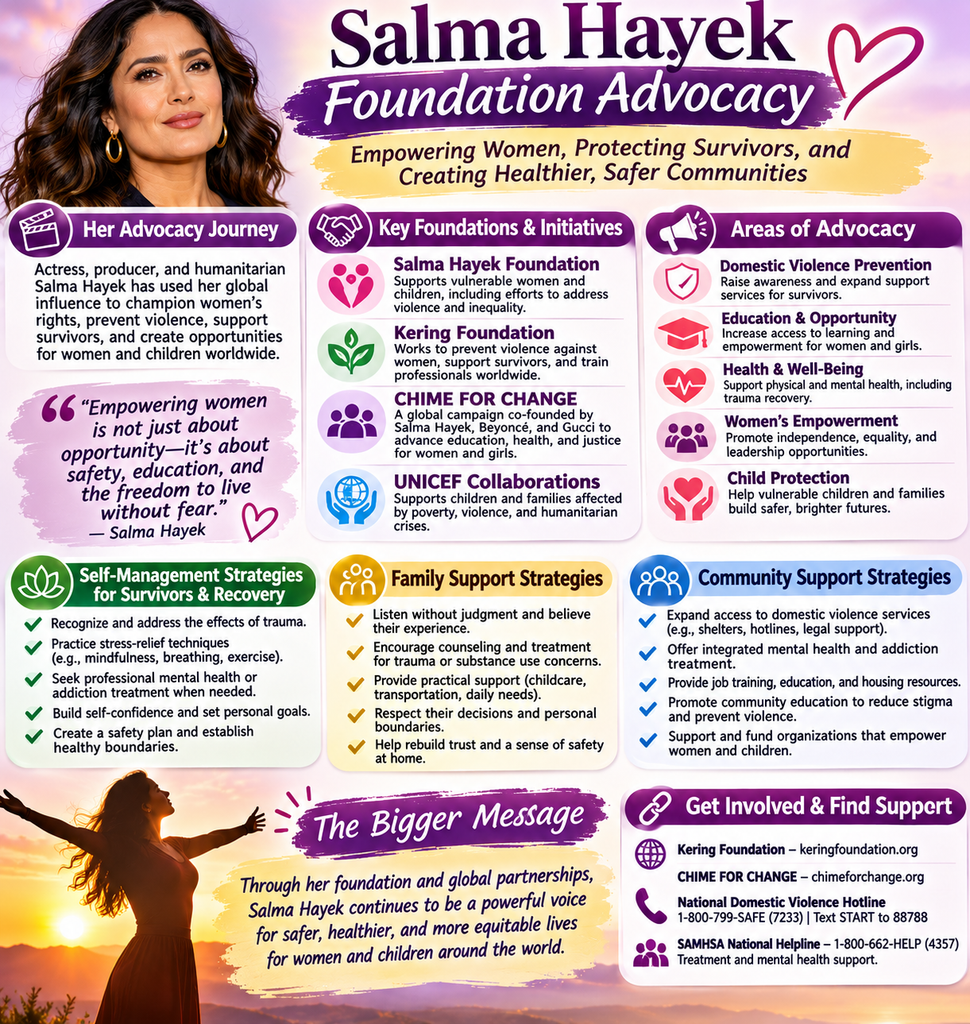
Actress, producer, and humanitarian Salma Hayek has used her international influence to advocate for women’s rights, prevent domestic violence, promote education, and advance social equality. Beyond her successful entertainment career, Hayek has dedicated decades to supporting vulnerable women and children through charitable initiatives, nonprofit partnerships, and public awareness campaigns.
Her philanthropic journey includes establishing the Salma Hayek Foundation, helping launch CHIME FOR CHANGE, and supporting the Kering Foundation’s efforts to prevent violence against women. Her advocacy emphasizes the importance of addressing emotional trauma, promoting independence, and creating safer environments where survivors can rebuild their lives.
Although Hayek’s advocacy is not specifically an addiction recovery initiative, her work offers important lessons for individuals and families affected by trauma, domestic violence, and substance use disorders. These challenges may overlap, making comprehensive mental health services and supportive communities especially important.
This article explores Salma Hayek’s humanitarian journey and practical self-management, family support, and community-based strategies inspired by her commitment to empowerment, healing, and social change.
Salma Hayek’s Advocacy Journey: From Hollywood to Humanitarian Leadership
Salma Hayek began advocating for women’s rights long before her humanitarian efforts received widespread recognition. She has consistently emphasized the importance of helping people affected by violence, discrimination, and limited access to opportunities.
In 2006, she established the Salma Hayek Foundation, which has supported efforts to address violence against women and disadvantaged children. She subsequently expanded her advocacy through partnerships with international organizations and foundations. Salma Hayek
Her major initiatives include:
- Salma Hayek Foundation: Philanthropic efforts focused on vulnerable women and children.
- Kering Foundation: Supporting organizations working to prevent gender-based violence and assist survivors.
- CHIME FOR CHANGE: Promoting education, health, and justice for women and girls.
- UNICEF collaborations: Supporting children and families affected by poverty, displacement, and humanitarian crises.
- Public advocacy: Raising awareness about domestic violence, women’s rights, and gender inequality.
Hayek’s involvement with these organizations reflects her belief that meaningful change requires collaboration, education, and sustained commitment.
Understanding the Salma Hayek Foundation’s Mission
The Salma Hayek Foundation is part of Hayek’s broader philanthropic commitment to helping disadvantaged women and children.
Her advocacy focuses on addressing conditions that contribute to vulnerability, including violence, inequality, and limited access to support services.
Key Areas of Advocacy
- Domestic violence prevention: Increasing awareness and encouraging access to safety resources.
- Women’s empowerment: Promoting independence, education, and equal opportunities.
- Child protection: Supporting vulnerable children and families.
- Mental health awareness: Recognizing the emotional consequences of trauma and abuse.
- Community collaboration: Encouraging organizations to work together to address social problems.
Public information about the Salma Hayek Foundation’s current independent programs is limited. Much of Hayek’s more extensively documented recent work has been conducted through the Kering Foundation and CHIME FOR CHANGE.
The Kering Foundation: Combating Violence Against Women
One of Hayek’s most visible advocacy commitments involves the Kering Foundation.
Established in 2008, the foundation supports nonprofit organizations that prevent violence against women and provide services to survivors.
Hayek has served on its board and has worked alongside her husband, François-Henri Pinault, to expand awareness and financial support for these efforts.
According to a 2024 CBS News report, the Kering Foundation had helped approximately one million survivors over 16 years and trained thousands of professionals to recognize and respond to violence. CBS News
Major Areas of Support
- Funding nonprofit organizations that assist survivors.
- Promoting domestic violence prevention education.
- Training professionals to recognize signs of abuse.
- Supporting women’s safety and economic independence.
- Encouraging corporate involvement in social responsibility.
- Raising funds for survivor-centered community programs.
In September 2026, the foundation’s fifth annual Caring for Women Dinner raised more than $5 million for organizations working to end violence against women and children. Hayek co-hosted the event, demonstrating her continued involvement in the cause. keringfoundation.org
CHIME FOR CHANGE: Empowering Women Through Education, Health, and Justice
In 2013, Salma Hayek co-founded CHIME FOR CHANGE alongside Beyoncé and Gucci creative director Frida Giannini.
The initiative was established to encourage global action supporting women’s and girls’ rights.
Its three central priorities include:
- Education: Expanding opportunities for girls and women to access learning and professional development.
- Health: Improving access to healthcare and supporting women’s physical and emotional well-being.
- Justice: Addressing discrimination, gender-based violence, and barriers to equality.
Hayek has been especially involved in the initiative’s justice-related advocacy. Kering+1
CHIME FOR CHANGE has also collaborated with the Kering Foundation on campaigns supporting women affected by gender-based violence, including the #StandWithWomen initiative during the COVID-19 pandemic. Gucci Stories
The Connection Between Domestic Violence, Trauma, and Addiction
Domestic violence and substance use disorders can be interconnected, although neither condition inevitably causes the other.
Individuals exposed to abuse may experience depression, anxiety, post-traumatic stress disorder (PTSD), and chronic emotional distress. Some may use alcohol or drugs to cope with these symptoms, increasing their risk of developing a substance use disorder.
Substance use can also complicate safety planning, treatment engagement, financial stability, and recovery.
Important considerations include:
- Trauma can increase vulnerability to unhealthy coping behaviors.
- Alcohol or drug use may temporarily numb distress while worsening long-term problems.
- Survivors may face barriers to accessing confidential treatment.
- Shame and stigma can discourage help-seeking.
- Integrated mental health and addiction treatment may improve outcomes.
Domestic violence is never justified by substance use, and survivors are not responsible for the abusive behavior of others.
Hayek’s advocacy demonstrates the importance of addressing underlying social and emotional challenges rather than focusing exclusively on visible symptoms.
Self-Management Strategies: Empowering Survivors and Supporting Emotional Recovery
Self-management strategies can help individuals rebuild emotional stability, confidence, and independence after trauma or substance-related difficulties.
However, personal coping techniques should complement professional treatment and safety planning rather than replace them.
1. Recognize Emotional and Psychological Distress
Understanding the emotional effects of abuse or trauma is an important part of recovery.
Helpful strategies include:
- Identify persistent anxiety, sadness, fear, or emotional numbness.
- Recognize unhealthy coping patterns.
- Monitor sleep, mood, and stress levels.
- Seek professional evaluation for depression, PTSD, or substance use concerns.
- Develop a personalized emotional wellness plan.
2. Establish Personal Safety and Healthy Boundaries
For individuals experiencing abuse, safety should remain the primary concern.
Practical strategies include:
- Contact a domestic violence advocate for confidential safety planning.
- Identify trusted individuals who can provide assistance.
- Keep important documents accessible when safe.
- Establish boundaries that protect physical and emotional well-being.
- Seek legal or protective services when appropriate.
Leaving an abusive relationship can increase danger in some circumstances. Safety decisions should be individualized with assistance from trained professionals.
3. Seek Trauma-Informed Mental Health Treatment
Trauma-informed treatment recognizes how traumatic experiences affect emotional functioning and behavior.
Evidence-based approaches may include:
- Cognitive Behavioral Therapy (CBT): Addresses unhelpful thinking patterns and coping behaviors.
- Trauma-focused psychotherapy: Helps individuals process traumatic experiences when clinically appropriate.
- Dialectical Behavior Therapy (DBT) skills: Supports emotional regulation and distress tolerance.
- Addiction treatment: Provides specialized support when substance use disorders coexist.
- Medication management: May help treat depression, anxiety, PTSD, or substance use disorders when indicated.
4. Rebuild Confidence and Independence
Trauma and prolonged emotional distress can diminish self-esteem and independence.
Individuals can strengthen recovery by:
- Setting achievable personal goals.
- Developing financial literacy and employment skills.
- Reconnecting with supportive relationships.
- Participating in education or vocational programs.
- Practicing self-compassion.
- Recognizing personal strengths and accomplishments.
Family Support Strategies: Creating Safe and Compassionate Environments
Families can play an important role in helping survivors rebuild trust, emotional security, and confidence.
Hayek’s advocacy emphasizes the importance of protecting vulnerable individuals and addressing violence within families and communities.
1. Listen Without Judgment
Survivors may hesitate to disclose abuse or emotional distress because they fear criticism, disbelief, or retaliation.
Families can help by:
- Listening patiently and respectfully.
- Believing disclosures without demanding proof.
- Avoiding blame or criticism.
- Respecting confidentiality.
- Allowing survivors to make informed decisions about their safety.
2. Encourage Professional Support
Family members can help survivors connect with appropriate services.
Supportive actions include:
- Helping identify qualified counselors.
- Providing transportation when safe.
- Assisting with childcare.
- Sharing information about legal and housing resources.
- Supporting treatment for co-occurring mental health or addiction concerns.
3. Support Recovery Without Creating Additional Pressure
Recovery from trauma does not follow a predictable timeline.
Families should avoid pressuring survivors to forgive an abusive partner, return to an unsafe relationship, or disclose experiences before they are ready.
Instead, they can:
- Respect personal decisions and boundaries.
- Offer consistent emotional support.
- Encourage healthy independence.
- Recognize gradual progress.
- Maintain a safe and supportive environment.
4. Protect Children Affected by Family Violence
Children exposed to domestic violence may experience anxiety, behavioral changes, sleep disturbances, and difficulties with emotional regulation.
Families can support children by:
- Providing predictable daily routines.
- Encouraging age-appropriate emotional expression.
- Seeking pediatric or child mental health evaluation when needed.
- Avoiding placing children in adult conflicts.
- Connecting with trauma-informed family services.
Community Support Strategies: Turning Advocacy Into Action
Salma Hayek’s philanthropic work demonstrates how coordinated community action can create meaningful opportunities for survivors.
1. Expand Access to Domestic Violence Services
Communities can improve safety by supporting:
- Emergency shelters and transitional housing.
- Confidential crisis hotlines.
- Legal advocacy and protective services.
- Trauma-informed mental health treatment.
- Employment assistance and financial education.
- Childcare and transportation programs.
2. Integrate Addiction and Mental Health Treatment
Survivors experiencing substance use disorders may benefit from coordinated care that addresses both addiction and trauma.
Healthcare organizations can:
- Screen sensitively for intimate partner violence.
- Offer confidential substance use assessments.
- Provide medications for opioid or alcohol use disorders when indicated.
- Coordinate mental health and addiction services.
- Avoid punitive or stigmatizing approaches.
- Develop individualized treatment and safety plans.
3. Promote Education and Prevention
Community education can help people recognize abuse and respond appropriately.
Programs may include:
- Healthy relationship education for adolescents.
- Domestic violence awareness workshops.
- Training for healthcare professionals.
- Workplace policies supporting survivors.
- Public campaigns challenging harmful stereotypes.
- Community discussions about trauma and addiction.
4. Support Survivor-Centered Organizations
Individuals can contribute to advocacy through volunteering, fundraising, donating, and participating in educational campaigns.
Organizations should prioritize survivor autonomy, confidentiality, cultural responsiveness, and long-term safety.
Community Resources for Survivors and Families
The following organizations provide information, support, or referrals.
| Organization | Services |
|---|---|
| National Domestic Violence Hotline | Confidential safety planning and support. Call 1-800-799-SAFE (7233) or text START to 88788. |
| Kering Foundation | Advocacy, partnerships, and funding to address gender-based violence. |
| UN Women | International gender equality and violence prevention initiatives. |
| SAMHSA | Substance use and mental health treatment information. National Helpline: 1-800-662-4357. |
| FindTreatment.gov | Searchable directory of mental health and substance use treatment services. |
| 988 Suicide & Crisis Lifeline | Immediate emotional crisis support by calling or texting 988 in the United States. |
Lessons From Salma Hayek’s Advocacy Journey
Salma Hayek’s humanitarian work offers important lessons for individuals, families, healthcare professionals, and community leaders.
1. Advocacy begins with recognizing injustice. Individuals do not need to experience a particular hardship personally to support those affected.
2. Empowerment requires more than awareness. Education, financial independence, healthcare access, and legal protection are essential to long-term safety.
3. Collaboration strengthens community impact. Partnerships among foundations, healthcare organizations, businesses, and nonprofits can expand access to resources.
4. Trauma recovery requires comprehensive support. Emotional healing, physical safety, stable housing, and mental health treatment may all be necessary.
5. Families can influence recovery outcomes. Compassionate communication and practical assistance can reduce isolation and encourage help-seeking.
6. Long-term change requires sustained commitment. Hayek’s decades of advocacy demonstrate the value of continued involvement rather than temporary public attention.
Conclusion: Empowerment, Healing, and the Power of Advocacy
Salma Hayek’s foundation advocacy reflects her longstanding commitment to protecting women, supporting vulnerable children, and addressing the social conditions that contribute to inequality and violence.
Through her philanthropic initiatives, involvement with the Kering Foundation, and leadership in CHIME FOR CHANGE, she has helped promote greater awareness of domestic violence, women’s rights, and the importance of community responsibility.
Her work also provides valuable lessons for addiction recovery and trauma-informed care. Individuals affected by violence or substance use disorders often need more than personal determination. They may require professional treatment, emotional understanding, financial stability, safe housing, and accessible community resources.
By combining self-management strategies, family involvement, and community-based support, survivors can rebuild confidence, restore independence, and move toward healthier futures.
True empowerment begins when people are given the safety, resources, and opportunities they need to heal. Salma Hayek’s advocacy reminds us that compassion becomes most powerful when it leads to meaningful action.
Frequently Asked Questions and Answers
Understanding Salma Hayek’s Foundation and Advocacy
1. Who is Salma Hayek, and why is she involved in humanitarian advocacy?
Salma Hayek is a Mexican-American actress, producer, and humanitarian who has used her public influence to advocate for women’s rights, social equality, and protection from violence.
Her philanthropic efforts emphasize education, healthcare, economic independence, and community support for vulnerable populations.
2. What is the Salma Hayek Foundation?
The Salma Hayek Foundation is a philanthropic initiative established by Hayek in 2006 to support disadvantaged women and children, including efforts addressing domestic violence.
Its historical work reflects her commitment to helping vulnerable populations access safety, education, and opportunities.
Public information about the foundation’s current independent operations is limited. Her more visible advocacy has included partnerships with established nonprofit organizations.
3. What are the main goals of Salma Hayek’s advocacy?
Her humanitarian efforts focus on several important priorities:
- Preventing violence against women and children.
- Supporting survivors of domestic abuse.
- Promoting women’s education and economic independence.
- Improving access to health and social services.
- Encouraging gender equality.
- Raising awareness about discrimination and injustice.
- Strengthening community organizations that protect vulnerable populations.
4. What inspired Salma Hayek to advocate for women’s rights?
Hayek has spoken publicly about gender inequality, discrimination, and violence against women.
Her advocacy reflects a belief that public awareness should lead to meaningful changes in how societies protect and support vulnerable individuals.
Through partnerships and public campaigns, she has encouraged individuals, businesses, and communities to take action.
5. What is the relationship between Salma Hayek and the Kering Foundation?
Hayek is the Honorary President of the Kering Foundation. The foundation was established in 2008 by François-Henri Pinault, her husband.
The organization supports specialized nonprofits, prevention programs, workplace education, and initiatives protecting women and children from violence. Governance+1
6. What is CHIME FOR CHANGE, and how is Salma Hayek involved?
CHIME FOR CHANGE is a global initiative co-founded in 2013 by Salma Hayek, Beyoncé, and Frida Giannini through Gucci.
Its mission centers on three priorities:
- Education: Expanding educational opportunities for women and girls.
- Health: Improving access to healthcare and promoting well-being.
- Justice: Addressing gender-based violence, discrimination, and inequality.
Hayek has helped promote its campaigns, including #StandWithWomen, which supported organizations responding to increased domestic violence during the COVID-19 pandemic. Gucci Stories
7. How has Salma Hayek helped raise money for survivors of domestic violence?
Hayek has co-hosted the Kering Foundation’s Caring for Women Dinner, bringing together leaders from entertainment, fashion, business, and philanthropy.
In September 2026, the fifth annual event raised more than $5 million for organizations addressing gender-based violence. keringfoundation.org
These fundraising efforts help nonprofit organizations provide services and advocate for survivors.
8. Does the Salma Hayek Foundation provide direct financial assistance to individuals?
Publicly available information does not establish a current application process for individuals seeking financial assistance directly from the Salma Hayek Foundation.
The Kering Foundation primarily funds specialized partner organizations rather than individuals. keringfoundation.keringapps.com
People seeking immediate assistance should contact local domestic violence organizations, shelters, or social service agencies.
Domestic Violence, Trauma, and Addiction
9. How is domestic violence connected to substance use disorders?
Domestic violence and substance use disorders may occur together, although one does not automatically cause the other.
Survivors sometimes use alcohol or drugs to cope with trauma-related symptoms such as anxiety, depression, or emotional distress.
Substance use can also complicate safety planning and treatment. However, substance use never excuses abusive behavior.
10. Can domestic violence increase the risk of addiction?
Yes. Exposure to traumatic experiences can increase vulnerability to substance misuse.
Potential contributing factors include:
- Persistent emotional distress.
- PTSD symptoms.
- Depression and anxiety.
- Sleep disturbances.
- Social isolation.
- Limited access to mental health services.
Trauma-informed treatment can address both psychological symptoms and substance use concerns.
11. Does Salma Hayek’s advocacy specifically focus on addiction treatment?
Her documented advocacy primarily focuses on gender-based violence, women’s empowerment, and child protection rather than operating a dedicated addiction treatment program.
Nevertheless, her work supports broader principles relevant to addiction recovery, including trauma-informed care, emotional safety, access to healthcare, and community empowerment.
12. Why is trauma-informed care important for survivors?
Trauma-informed care recognizes that past traumatic experiences can influence emotional responses, behavior, relationships, and treatment engagement.
Its principles include:
- Physical and emotional safety.
- Trust and transparency.
- Respect for personal choices.
- Collaboration with healthcare professionals.
- Empowerment and independence.
- Cultural sensitivity.
This approach helps reduce the risk of retraumatization during treatment.
Self-Management Strategies for Survivors
13. What self-management strategies can help survivors recover emotionally?
Helpful strategies include:
- Recognizing emotional and psychological symptoms.
- Practicing mindfulness and relaxation techniques.
- Maintaining healthy sleep and nutrition habits.
- Seeking professional counseling.
- Establishing safe personal boundaries.
- Reconnecting with trusted relationships.
- Setting realistic goals for independence.
Self-management supports recovery but does not replace professional treatment or domestic violence safety planning.
14. How can survivors rebuild confidence and independence?
Rebuilding confidence often involves regaining a sense of personal control.
Individuals may benefit from educational opportunities, vocational training, financial literacy programs, counseling, and supportive relationships.
Recovery should progress at a pace that respects each survivor’s circumstances and safety.
15. What mental health treatments are available for survivors of abuse?
Evidence-based treatment options may include:
- Cognitive Behavioral Therapy (CBT): Helps address unhelpful thinking patterns.
- Trauma-focused CBT: Addresses trauma-related symptoms when appropriate.
- Cognitive Processing Therapy (CPT): Helps individuals process trauma-related beliefs.
- Eye Movement Desensitization and Reprocessing (EMDR): May help treat PTSD.
- Medication management: Can address depression, anxiety, or other diagnosed conditions.
- Integrated addiction treatment: Supports individuals experiencing co-occurring substance use disorders.
Treatment should be individualized and provided by qualified professionals.
16. How can survivors establish healthy boundaries?
Healthy boundaries protect emotional well-being and personal autonomy.
Examples include:
- Identifying unacceptable behaviors.
- Communicating personal needs when safe.
- Limiting contact with harmful individuals when feasible.
- Seeking assistance from trusted professionals.
- Developing individualized safety plans.
- Recognizing that personal safety takes priority over maintaining relationships.
In abusive relationships, directly confronting an abusive partner may increase danger. Safety planning with a trained advocate is preferable.
Family Support Strategies
17. How can families support survivors of domestic violence?
Families can provide emotional reassurance and practical assistance.
Helpful approaches include:
- Listening without judgment.
- Believing disclosures of abuse.
- Avoiding blame or criticism.
- Respecting confidentiality.
- Offering transportation or childcare when safe.
- Helping identify professional services.
- Supporting survivors’ independent decisions.
18. What should families avoid saying to survivors?
Families should avoid statements that minimize abuse or place responsibility on the survivor.
Examples include:
- “Why didn’t you leave sooner?”
- “You should forgive and forget.”
- “You must have done something to upset them.”
- “Think about what people will say.”
Instead, families can communicate concern, respect, and willingness to help.
19. How can families help survivors who also struggle with addiction?
Families can encourage integrated treatment addressing trauma and substance use.
Support may include:
- Helping locate qualified addiction specialists.
- Encouraging evidence-based treatment.
- Supporting medication treatment when appropriate.
- Maintaining healthy boundaries.
- Avoiding stigmatizing language.
- Recognizing progress in both emotional healing and recovery.
20. How does domestic violence affect children?
Children who witness or experience domestic violence may develop emotional, behavioral, and physical health difficulties.
Possible effects include anxiety, depression, sleep problems, concentration difficulties, and trauma-related symptoms.
The Kering Foundation expanded its work to address violence against children, recognizing the importance of preventing harm across generations. Our Distinctive Approach
Early intervention, stable relationships, and trauma-informed care can improve children’s long-term outcomes.
Community Support and Advocacy
21. How can communities help prevent domestic violence?
Communities can strengthen prevention through:
- Healthy relationship education.
- Accessible shelters and crisis services.
- Public awareness campaigns.
- Professional training.
- Legal assistance.
- Affordable mental health services.
- Employment and housing support.
- Programs addressing violence among younger generations.
22. Why is financial independence important for survivors?
Financial dependence can make it more difficult to leave an abusive relationship or establish long-term safety.
Economic empowerment programs may provide:
- Employment training.
- Educational opportunities.
- Financial literacy.
- Housing assistance.
- Childcare support.
- Career development resources.
These services help survivors gain greater control over their circumstances.
23. How does the Kering Foundation support community organizations?
The Kering Foundation funds specialized organizations, supports prevention initiatives, and promotes collaboration among service providers.
It also works with businesses to improve workplace responses to domestic violence, including training employees to recognize concerns and refer colleagues to appropriate resources. What We Do
24. How can individuals participate in advocacy inspired by Salma Hayek?
Individuals can support similar causes by:
- Volunteering with domestic violence organizations.
- Donating to reputable survivor-support programs.
- Participating in awareness campaigns.
- Supporting educational workshops.
- Encouraging trauma-informed healthcare.
- Promoting policies that improve survivor safety.
- Sharing accurate information about available resources.
25. Where can survivors and families find help?
Several organizations offer confidential assistance and referrals.
| Organization | Support available |
|---|---|
| National Domestic Violence Hotline | Safety planning, crisis support, and referrals. Call 1-800-799-SAFE (7233) or text START to 88788. |
| Kering Foundation | Information about advocacy, prevention, and nonprofit partnerships. |
| UN Women | International gender equality and violence prevention resources. |
| FindTreatment.gov | Mental health and addiction treatment locator. |
| 988 Suicide & Crisis Lifeline | Immediate mental health crisis support by calling or texting 988. |
For immediate physical danger, call emergency services when it is safe to do so.
Lessons From Salma Hayek’s Humanitarian Journey
26. What makes Salma Hayek’s advocacy meaningful?
Her advocacy combines public awareness with fundraising, nonprofit partnerships, and efforts to influence social attitudes.
Rather than focusing exclusively on individual experiences, her work emphasizes structural issues such as violence, inequality, and limited access to resources.
27. What lessons can addiction recovery organizations learn from her advocacy?
Addiction recovery organizations can apply several principles:
- Address trauma and mental health alongside substance use.
- Promote dignity and reduce stigma.
- Provide individualized, survivor-centered care.
- Strengthen family and community support systems.
- Improve access to housing, education, and employment.
- Collaborate with organizations specializing in domestic violence.
28. What is the most important message of Salma Hayek’s foundation advocacy?
The central message is that lasting empowerment requires more than raising awareness.
Individuals affected by violence need safety, emotional understanding, accessible healthcare, financial opportunities, and strong community support.
Hayek’s work demonstrates how advocacy can help create systems that protect vulnerable individuals and expand opportunities for healing.
Video: