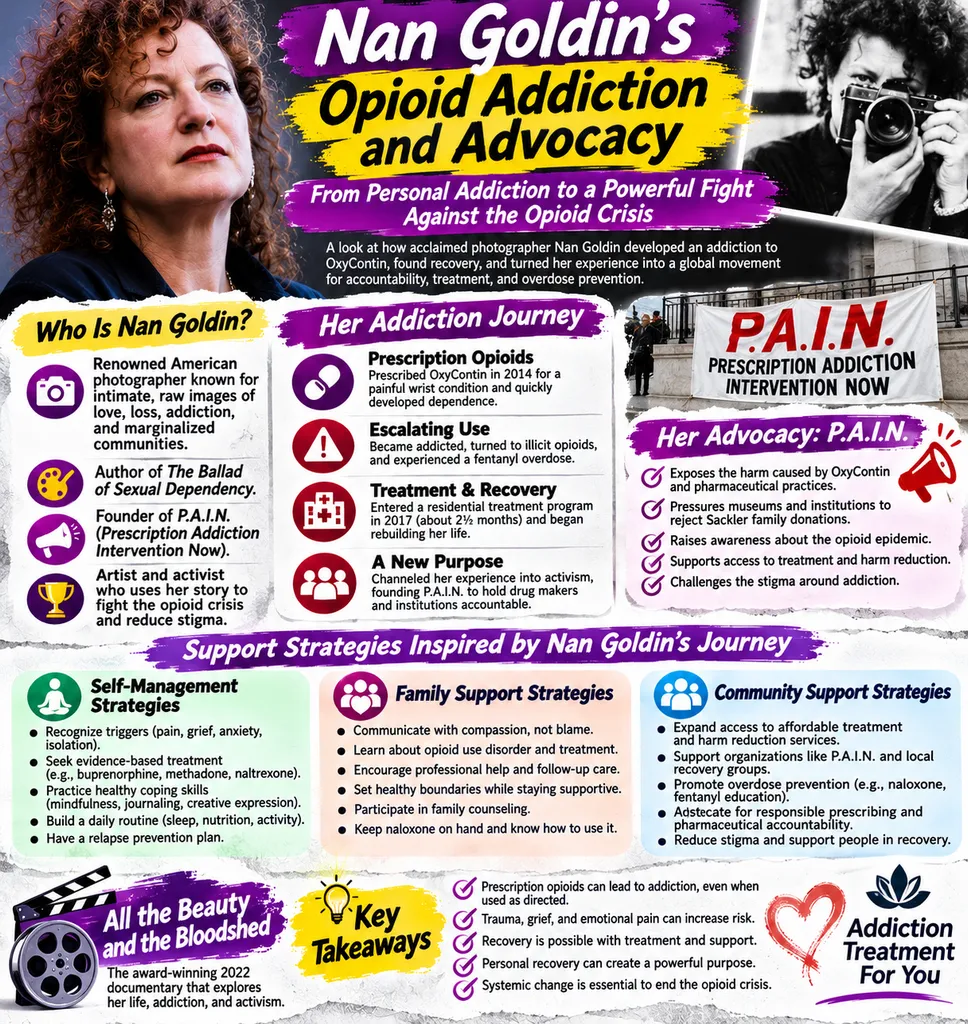
Nan Goldin is an internationally recognized American photographer whose work explores intimate relationships, identity, trauma, addiction, and marginalized communities.
Beyond her artistic achievements, Goldin has become one of the most influential voices in the movement demanding accountability for the opioid epidemic.
After developing an addiction to OxyContin, a prescription opioid pain medication, Goldin experienced firsthand how quickly opioid dependence can disrupt an individual’s physical health, emotional stability, and personal relationships.
Following treatment and recovery, she transformed her experience into public advocacy by founding P.A.I.N. (Prescription Addiction Intervention Now) in 2017.
Her activism brought attention to the role of Purdue Pharma, the Sackler family, pharmaceutical marketing, and the responsibility of cultural institutions that accepted donations associated with opioid-related wealth.
Goldin’s journey demonstrates an important lesson: Recovery is not only about overcoming substance dependence. It can also involve rebuilding personal identity, finding meaningful purpose, and helping prevent others from experiencing similar harm.
Her experiences offer valuable insights into self-management, family involvement, community support, and the importance of systemic accountability in addressing opioid addiction.
Nan Goldin’s Early Life: Trauma, Loss, and the Power of Photography
Born in Washington, D.C., in 1953, Goldin experienced significant emotional challenges during childhood.
One of the most devastating events in her life was the suicide of her older sister, Barbara, when Goldin was 11 years old.
Goldin has described how her family’s response to her sister’s death contributed to feelings of isolation, secrecy, and mistrust.
Photography eventually became a way for her to express emotions, preserve memories, and document relationships that were often overlooked by mainstream society.
Her work, including The Ballad of Sexual Dependency, explored intimate relationships, sexuality, violence, substance use, and the lives of people living on society’s margins. The New Yorker+1
Understanding the Relationship Between Trauma and Addiction
Adverse childhood experiences can increase vulnerability to substance use disorders, although trauma does not inevitably lead to addiction.
Potential contributing factors include:
- Unresolved grief and emotional loss.
- Difficulties developing trust and emotional security.
- Exposure to substance use within social environments.
- Anxiety, depression, or post-traumatic stress symptoms.
- Using substances to temporarily escape painful memories.
- Limited access to supportive mental health services.
Goldin’s experiences demonstrate the importance of trauma-informed care, which recognizes how past experiences may influence present behaviors and treatment needs.
How Nan Goldin Developed an Addiction to OxyContin
In 2014, Goldin was prescribed OxyContin following treatment for a painful wrist condition.
OxyContin contains oxycodone, a powerful opioid analgesic that can cause physical dependence and addiction.
Goldin described developing an intense dependence on the medication and rapidly increasing her consumption.
Her opioid use eventually dominated her daily activities, relationships, and professional life.
In a personal essay published by TIME in 2018, Goldin described how her addiction led to severe isolation and financial difficulties. She also reported turning to illicitly obtained opioids and experiencing a fentanyl overdose. TIME
Why Prescription Opioids Can Become Addictive
Opioids bind to receptors in the brain and nervous system, reducing pain while also affecting reward pathways.
Repeated exposure may produce:
- Tolerance: Needing higher doses to achieve the same effect.
- Physical dependence: Developing withdrawal symptoms when opioid use decreases or stops.
- Cravings: Experiencing strong urges to use opioids.
- Loss of control: Taking larger amounts or using medication longer than intended.
- Functional impairment: Continuing opioid use despite negative consequences.
Physical dependence alone does not establish opioid use disorder. Addiction involves additional behavioral and clinical features, including impaired control and continued use despite harm.
The Dangerous Transition From Prescription Opioids to Fentanyl
As Goldin’s addiction progressed, she began obtaining opioids outside the medical system.
She later described using a substance she believed was heroin that contained fentanyl, a highly potent synthetic opioid.
In 2017, she experienced an overdose.
Goldin survived, but the experience revealed how dangerous opioid use had become. NCPR News
Understanding Fentanyl Overdose Risks
Illicitly manufactured fentanyl is frequently found in the unregulated drug supply, sometimes without the person’s knowledge.
The risk of fatal overdose increases with unpredictable drug potency, combining opioids with other sedating substances, and reduced opioid tolerance following abstinence.
Essential overdose prevention strategies include:
- Keeping naloxone readily available.
- Learning to recognize slowed breathing, unresponsiveness, and other overdose symptoms.
- Avoiding combinations of opioids with alcohol or benzodiazepines.
- Using fentanyl test strips where available, while understanding their limitations.
- Avoiding substance use alone.
- Seeking evidence-based treatment for opioid use disorder.
If an overdose is suspected, immediately call 911, administer naloxone, provide rescue breathing or CPR as instructed, and remain with the individual until emergency responders arrive.
Seeking Rehabilitation and Beginning Recovery
Following her overdose and escalating addiction, Goldin entered a residential treatment program in 2017.
She spent approximately two and a half months receiving treatment.
Goldin later acknowledged that the care she received was expensive and inaccessible to many individuals experiencing opioid addiction.
Her experience helped shape her commitment to advocating for affordable, accessible treatment and harm reduction services. TIME+1
Why Professional Treatment Matters
Opioid use disorder is a chronic but treatable medical condition.
Evidence-based treatment may include:
- Buprenorphine: Reduces opioid cravings and withdrawal symptoms and lowers overdose risk.
- Methadone: A highly effective medication for opioid use disorder, typically provided through regulated opioid treatment programs.
- Extended-release naltrexone: An option for selected patients who have completed opioid withdrawal.
- Behavioral therapy: Helps individuals address emotional triggers and behavioral patterns.
- Psychiatric treatment: Addresses co-occurring mental health conditions.
- Recovery support: Provides ongoing encouragement and assistance with housing, employment, and social needs.
Buprenorphine and methadone are particularly important because they substantially reduce mortality risk in opioid use disorder.
Detoxification alone is not considered adequate treatment and can increase overdose vulnerability if opioid use resumes after tolerance decreases.
Self-Management Strategies: Lessons From Nan Goldin’s Recovery
Goldin’s experiences demonstrate that recovery requires attention to physical health, psychological well-being, relationships, and meaningful activities.
Her transition from addiction to activism also illustrates how personal purpose can become a powerful source of motivation.
Recognize Triggers and Emotional Vulnerabilities
Individuals recovering from opioid addiction should learn to recognize situations that increase cravings or emotional distress.
Common triggers include:
- Chronic pain.
- Emotional trauma or unresolved grief.
- Anxiety and depression.
- Social isolation.
- Relationship conflict.
- Exposure to environments associated with previous substance use.
A written relapse prevention plan can help individuals identify warning signs and develop healthier responses.
Participate in Evidence-Based Treatment
Medication treatment should be considered a central component of opioid use disorder care when clinically appropriate.
Individuals should work with qualified healthcare professionals to determine which medications and additional services best meet their needs.
Develop Healthy Emotional Coping Skills
Helpful strategies include:
- Cognitive behavioral therapy.
- Trauma-informed counseling.
- Mindfulness and grounding exercises.
- Journaling and creative expression.
- Regular physical activity.
- Consistent sleep and nutrition.
- Maintaining contact with supportive individuals.
Find Meaningful Activities
Goldin’s photography and activism demonstrate how creative expression and meaningful work can support personal identity.
For others, purpose may come from volunteering, education, parenting, employment, spirituality, or community participation.
Meaningful activities can complement treatment by reducing isolation and creating opportunities for positive reinforcement.
Family Support Strategies: Understanding Trauma, Addiction, and Recovery
Goldin’s personal history illustrates how family relationships, emotional loss, and communication patterns can influence psychological well-being.
Although her public advocacy has emphasized community organizing more than traditional family-based recovery, her experiences offer valuable lessons for families supporting someone with opioid use disorder.
How Families Can Provide Effective Support
Communicate without judgment.
Families should express concerns using respectful, compassionate language.
Encourage evidence-based treatment.
Loved ones can help identify clinicians who prescribe buprenorphine or provide other appropriate opioid use disorder treatment.
Learn overdose prevention.
Family members should understand how to recognize an overdose and administer naloxone.
Establish healthy boundaries.
Boundaries protect family members while maintaining opportunities for supportive relationships.
Participate in counseling.
Family therapy can improve communication, address conflict, and support emotional healing.
Recognize trauma and grief.
Unresolved family experiences may contribute to emotional distress and deserve compassionate attention.
Protect caregivers’ well-being.
Families should seek support for their own mental health and avoid assuming complete responsibility for another person’s recovery.
Why Family Education Matters
Families sometimes misunderstand addiction as a lack of willpower or personal responsibility.
Education can help relatives recognize that opioid use disorder involves changes in brain function, behavioral patterns, and physiological dependence.
Understanding addiction as a treatable medical condition can reduce blame and encourage earlier intervention.
Founding P.A.I.N.: Turning Personal Recovery Into Advocacy
Opioid protest at Harvard art museum – The Boston Globe
In 2017, Goldin founded P.A.I.N. — Prescription Addiction Intervention Now.
The organization emerged from her personal experiences with OxyContin and her anger over the devastating effects of the opioid epidemic.
Inspired by the AIDS activist organization ACT UP, P.A.I.N. used public demonstrations, educational campaigns, and direct action to demand accountability from powerful institutions.
Its central goals included:
- Holding pharmaceutical companies accountable for harmful opioid marketing practices.
- Challenging the Sackler family’s philanthropic influence.
- Encouraging museums to reject Sackler-associated donations.
- Supporting addiction treatment and harm reduction.
- Reducing stigma toward individuals with substance use disorders.
- Amplifying the voices of overdose survivors and bereaved families.
Goldin’s activism helped transform a deeply personal experience into an international movement. MoMA+1
Challenging Purdue Pharma and the Sackler Family
Purdue Pharma manufactured and marketed OxyContin, a prescription opioid that became closely associated with the opioid epidemic.
Members of the Sackler family owned Purdue Pharma, and family philanthropy supported major museums, universities, and cultural institutions.
Goldin argued that institutions accepting these donations should examine the relationship between philanthropic recognition and the financial consequences of opioid marketing.
P.A.I.N. organized demonstrations at prominent museums, including:
- The Metropolitan Museum of Art in New York.
- The Solomon R. Guggenheim Museum.
- The Louver in Paris.
- Other cultural institutions associated with Sackler philanthropy.
Activists staged symbolic demonstrations representing overdose deaths and the human consequences of opioid addiction.
Their efforts helped pressure several institutions to remove Sackler naming recognition or reconsider financial relationships with the family. Georgia Public Broadcasting+1
Why Institutional Accountability Matters
Goldin’s activism raised broader questions about corporate responsibility, public health, and the ethical obligations of cultural institutions.
Her work emphasized that addiction prevention requires more than individual behavioral changes.
It also requires:
- Responsible pharmaceutical marketing.
- Evidence-based prescribing practices.
- Transparency about medication risks.
- Access to affordable addiction treatment.
- Stronger overdose prevention programs.
- Public health policies informed by scientific evidence.
The opioid epidemic is a complex public health crisis involving prescription opioids, illicit drug markets, economic conditions, mental health, and treatment access.
Community Support Strategies: Building a Stronger Response to the Opioid Crisis
Goldin’s advocacy demonstrates how organized communities can influence public awareness and institutional decisions.
Community support is essential because individuals cannot overcome systemic barriers through personal determination alone.
Expand Access to Medication Treatment
Communities should support low-barrier access to buprenorphine, methadone, and other evidence-based services.
Treatment programs should minimize unnecessary administrative barriers and support continuity of care.
Increase Naloxone Availability
Naloxone distribution programs can help prevent fatal opioid overdoses.
Community organizations can provide training to families, schools, workplaces, and people who use drugs.
Promote Harm Reduction
Harm reduction services help reduce overdose deaths and infectious disease transmission while maintaining opportunities for treatment engagement.
Examples include naloxone distribution, syringe services where legally available, fentanyl test strips, and education about safer practices.
Support Peer Recovery Programs
Peer recovery specialists with lived experience can help individuals navigate treatment, build trust, and remain connected to supportive services.
Address Social Determinants of Health
Stable housing, transportation, employment, food security, and access to healthcare can significantly influence recovery outcomes.
Challenge Addiction Stigma
Communities should avoid language that dehumanizes individuals experiencing substance use disorders.
Respectful communication can encourage treatment participation and reduce discrimination.
All the Beauty and the Bloodshed: Bringing Addiction Advocacy to a Global Audience
All the Beauty and the Bloodshed (2022)
Goldin’s life and activism are documented in All the Beauty and the Bloodshed, directed by Laura Poitras.
Released in 2022, the film combines Goldin’s personal history, photography, addiction experiences, and activism against the Sackler family’s influence.
It won the Golden Lion at the Venice International Film Festival and received an Academy Award nomination for Best Documentary Feature. praxisfilms.org
The documentary illustrates how Goldin’s experiences with trauma, relationships, artistic expression, and addiction shaped her commitment to social justice.
It also gives visibility to families affected by overdose deaths and individuals advocating for systemic change.
The Role of Advocacy in Sustaining Recovery
Goldin has described how founding P.A.I.N. gave her a renewed sense of purpose.
In a 2023 NPR interview, she reflected on how her activism helped support her sobriety for years. Fresh Air Archive
This illustrates an important principle in recovery: meaningful engagement can strengthen motivation and social connection.
However, advocacy is not a substitute for professional treatment, and individuals should not feel obligated to publicly disclose their addiction histories.
Benefits of Meaningful Community Involvement
- Strengthening personal identity beyond addiction.
- Developing supportive social relationships.
- Reducing feelings of isolation.
- Increasing self-confidence.
- Creating opportunities to help others.
- Encouraging accountability and long-term goals.
Individuals should choose activities that support their emotional health without creating excessive stress or compromising treatment needs.
A Practical Recovery and Advocacy Plan
| Recovery area | Recommended strategy |
|---|---|
| Medical treatment | Seek evaluation for buprenorphine, methadone, or other appropriate treatment |
| Overdose prevention | Keep naloxone available and educate family members |
| Emotional health | Address trauma, grief, anxiety, and depression |
| Pain management | Develop an individualized pain treatment plan |
| Self-management | Identify triggers and establish healthy routines |
| Family support | Encourage communication, counseling, and boundaries |
| Peer recovery | Connect with recovery specialists and support groups |
| Community involvement | Participate in meaningful activities or advocacy |
| Long-term recovery | Maintain treatment and update relapse prevention plans |
Lessons From Nan Goldin’s Journey
Goldin’s experiences provide several important lessons for individuals, families, healthcare professionals, and policymakers.
- Prescription medications can carry addiction risks. Patients deserve clear information about potential benefits, harms, and alternatives.
- Addiction is not a moral failure. Opioid use disorder is a treatable medical condition.
- Overdose survivors need continuing care. Emergency treatment should be followed by access to medication treatment and recovery support.
- Trauma-informed care matters. Emotional distress and past experiences may influence treatment needs.
- Families need education. Compassionate support and overdose prevention training can improve safety.
- Communities can influence change. Collective action can challenge stigma and institutional practices.
- Recovery can create new purpose. Personal experiences may inspire meaningful activities and advocacy.
- Systemic accountability is essential. Effective responses to addiction require responsible policies and accessible healthcare.
Conclusion: From Surviving Addiction to Creating Change
Nan Goldin’s journey demonstrates how opioid addiction can affect individuals regardless of their professional accomplishments, creativity, or social influence.
Her experiences with prescription OxyContin, isolation, fentanyl overdose, and rehabilitation revealed the devastating consequences of opioid use disorder.
Rather than remaining silent, Goldin transformed her recovery experience into a movement demanding accountability and greater public awareness.
Through P.A.I.N., she challenged powerful institutions, supported harm reduction, and amplified the experiences of people affected by the opioid epidemic.
Her story reminds us that addiction recovery requires both individual support and broader social change.
Recovery can begin with personal healing, but its impact can extend far beyond one person’s life.
Goldin’s legacy demonstrates that compassion, evidence-based treatment, family support, and community advocacy can work together to create a more effective response to addiction.
Addiction Treatment and Overdose Prevention Resources
- SAMHSA National Helpline: 1-800-662-HELP (4357), for confidential addiction treatment referrals.
- FindTreatment.gov: Find substance use and mental health treatment
- CDC Overdose Prevention: Learn about opioid overdose prevention and naloxone
- SAMHSA: Access substance use treatment and recovery resources
- 988 Suicide & Crisis Lifeline: Call or text 988 for emotional or mental health crisis support in the United States.
For a suspected opioid overdose, call 911 immediately and administer naloxone if available.
Frequently Asked Questions and Answers
Understanding Nan Goldin’s Opioid Addiction
1. Who is Nan Goldin?
Nan Goldin is an American photographer and activist born in 1953. She is internationally recognized for documenting intimate relationships, identity, grief, marginalized communities, and social injustice.
Her best-known photographic works include The Ballad of Sexual Dependency. She has also advocated for people affected by HIV/AIDS and the opioid epidemic.
Her photography and activism often emphasize the importance of recognizing people whose experiences have been overlooked or stigmatized. MoMA
2. How did Nan Goldin develop an addiction to OxyContin?
In 2014, Goldin was prescribed OxyContin, a long-acting formulation of oxycodone, for a painful wrist condition.
She has described developing a strong compulsion to use the medication and eventually taking substantially more than prescribed.
Her opioid use increasingly affected her relationships, finances, emotional health, and professional activities. TIME
3. Did Nan Goldin have a history of addiction before OxyContin?
Yes. Goldin has publicly discussed an earlier period of heroin addiction during the 1970s and 1980s.
She entered recovery from that addiction before later developing problems with prescription OxyContin.
Her experiences demonstrate that individuals with previous substance use disorders may remain vulnerable to future addiction, particularly when exposed to medications with addictive potential.
4. Can someone become addicted to opioids even when taking them as prescribed?
Yes. Prescription opioids carry risks of physical dependence, overdose, and opioid use disorder, even when initially taken according to medical instructions.
However, physical dependence and addiction are not identical.
Physical dependence involves physiological adaptation and withdrawal symptoms when medication is stopped. Opioid use disorder additionally involves symptoms such as impaired control, cravings, and continued use despite harmful consequences.
Not everyone prescribed an opioid develops addiction.
5. How did Nan Goldin’s opioid addiction affect her daily life?
Goldin described becoming increasingly isolated while spending much of her time obtaining and using OxyContin.
Her addiction affected her finances, relationships, physical health, and ability to maintain her previous lifestyle.
She also described how fear of withdrawal contributed to continued opioid use.
Her experiences illustrate how addiction can progressively interfere with daily functioning, even among professionally successful individuals. TIME
6. Did Nan Goldin experience a fentanyl overdose?
Yes. Goldin has publicly described experiencing a fentanyl overdose during her period of opioid addiction.
She survived the overdose and later discussed how the experience contributed to her understanding of the opioid crisis.
Fentanyl is a highly potent synthetic opioid. Illicitly manufactured fentanyl may be present in unregulated drugs without a person’s knowledge, substantially increasing overdose risk. The Guardian
7. When did Nan Goldin enter rehabilitation?
Goldin entered rehabilitation in 2017 and reported receiving approximately two and a half months of treatment.
She later emphasized that the care she received was expensive and inaccessible to many people experiencing opioid addiction.
Her experience strengthened her commitment to advocating for affordable addiction treatment and overdose prevention services. House Docs
Treatment, Recovery, and Self-Management
8. What treatments are most effective for opioid use disorder?
Evidence-based treatment for opioid use disorder commonly includes medications and supportive services.
The three FDA-approved medications are:
- Buprenorphine: Reduces withdrawal symptoms, cravings, and overdose risk.
- Methadone: A long-acting opioid agonist that reduces illicit opioid use and overdose mortality.
- Naltrexone: An opioid antagonist that blocks opioid effects and may be appropriate for selected patients after opioid withdrawal.
Behavioral therapies, psychiatric care, peer support, and assistance with housing or other social needs can strengthen treatment.
Buprenorphine and methadone have particularly strong evidence for reducing overdose mortality.
9. Has Nan Goldin discussed using medication during recovery?
Yes. The documentary All the Beauty and the Bloodshed includes Goldin’s discussion of buprenorphine as part of her recovery.
Her experience highlights an important principle: taking prescribed medication for opioid use disorder is a legitimate form of recovery.
Medication treatment should not be considered a failure of sobriety or a substitute addiction. The Nation
10. What self-management strategies can help individuals recovering from opioid addiction?
Self-management involves developing practical skills to support treatment and reduce the risk of returning to harmful opioid use.
Recommended strategies include:
- Recognizing emotional and environmental triggers.
- Following prescribed medication treatment.
- Participating in counseling when appropriate.
- Developing healthy sleep, nutrition, and exercise routines.
- Practicing mindfulness and emotional regulation.
- Maintaining contact with supportive individuals.
- Creating a written relapse prevention plan.
- Keeping naloxone accessible.
Self-management is most effective when combined with professional treatment and ongoing support.
11. Can creative expression help individuals recover from addiction?
Creative activities can support recovery by providing opportunities for emotional expression, stress reduction, and personal meaning.
Goldin’s photography has long served as a way to document painful experiences, relationships, and social realities.
Helpful creative activities may include photography, painting, writing, music, and journaling.
Although creative expression can complement addiction treatment, it should not replace medication or other clinically indicated care.
12. Why is relapse prevention important after opioid rehabilitation?
Following a period without opioids, an individual’s tolerance may decrease significantly.
If opioid use resumes, previously tolerated amounts may cause a fatal overdose.
Relapse prevention should therefore include:
- Continued access to medication treatment.
- Naloxone availability.
- Identification of personal triggers.
- Rapid reengagement with treatment if opioid use resumes.
- Supportive relationships and peer recovery services.
- A safety plan for high-risk situations.
A return to opioid use should prompt additional support and treatment reassessment rather than punishment or shame.
Nan Goldin’s Addiction Advocacy
13. What is P.A.I.N., and why did Nan Goldin establish it?
P.A.I.N. stands for Prescription Addiction Intervention Now.
Goldin founded the organization in 2017 after surviving opioid addiction and receiving treatment.
The organization challenges pharmaceutical industry practices, promotes accountability, supports harm reduction, and raises awareness about the opioid epidemic.
P.A.I.N. became particularly known for its demonstrations at major art museums associated with Sackler family philanthropy. MoMA
14. What is the connection between Purdue Pharma, OxyContin, and the Sackler family?
Purdue Pharma manufactured and marketed OxyContin, a prescription opioid pain medication.
The company was owned by members of the Sackler family, whose philanthropic donations supported prominent museums, universities, and cultural institutions.
Purdue’s opioid marketing practices became the subject of major investigations, litigation, and public controversy.
Goldin’s advocacy challenged the use of philanthropic donations to enhance reputations while opioid-related harms were being addressed through legal and public health processes.
15. Why did Nan Goldin protest museums?
Goldin believed that museums accepting Sackler family donations should examine the ethical implications of those financial relationships.
P.A.I.N. organized demonstrations to pressure institutions to reconsider donations and naming agreements associated with the family.
The protests included symbolic pill bottles, public statements, and coordinated actions designed to draw attention to overdose deaths and pharmaceutical accountability. The New Yorker
16. Did Nan Goldin’s advocacy influence major museums?
Yes. P.A.I.N.’s demonstrations contributed to broader public pressure that encouraged several prominent institutions to reconsider Sackler-associated donations and naming arrangements.
Her campaign helped bring questions of philanthropic accountability into mainstream discussions about art institutions.
The outcomes reflected collective activism, investigative journalism, litigation, and changing institutional policies rather than the actions of one individual alone.
17. What is All the Beauty and the Bloodshed about?
All the Beauty and the Bloodshed (2022)
All the Beauty and the Bloodshed is a documentary directed by Laura Poitras.
The film explores Goldin’s photography, family history, relationships, addiction, recovery, and activism against the Sackler family’s influence.
It won the Golden Lion at the 2022 Venice International Film Festival and received an Academy Award nomination for Best Documentary Feature. praxisfilms.org
18. How has Nan Goldin helped reduce stigma surrounding opioid addiction?
Goldin has openly discussed her experiences with prescription opioid addiction, overdose, treatment, and recovery.
Her advocacy challenges the misconception that addiction reflects moral weakness or a lack of character.
She has also emphasized the importance of listening to individuals directly affected by the opioid epidemic.
Public discussions of lived experience can help encourage treatment engagement, reduce discrimination, and increase understanding.
Family Support Strategies
19. How can families support someone experiencing opioid addiction?
Families can provide important emotional and practical support while encouraging professional treatment.
Helpful strategies include:
- Communicating with compassion rather than blame.
- Learning about opioid use disorder and medication treatment.
- Helping loved ones locate qualified treatment providers.
- Keeping naloxone available.
- Establishing healthy boundaries.
- Participating in family counseling when appropriate.
- Supporting continued treatment after rehabilitation.
- Protecting their own emotional well-being.
Families cannot guarantee another person’s recovery, but they can help create a safer and more supportive environment.
20. How can families recognize an opioid overdose?
Common signs of opioid overdose include:
- Unresponsiveness or inability to awaken the person.
- Slow, irregular, or absent breathing.
- Gurgling or unusual snoring sounds.
- Blue, gray, or discolored lips and fingernails.
- Pinpoint pupils, although this sign is not always present.
If an opioid overdose is suspected:
- Call 911 immediately.
- Administer naloxone if available.
- Provide rescue breathing or CPR according to dispatcher instructions and training.
- Give additional naloxone doses if needed, following product instructions.
- Remain with the person until emergency responders arrive.
Naloxone can reverse opioid-induced respiratory depression, but emergency medical evaluation remains essential.
21. How can families establish boundaries without abandoning a loved one?
Healthy boundaries protect family members while maintaining opportunities for treatment and supportive relationships.
Examples include declining to provide money that would knowingly support harmful drug use, refusing to tolerate violence or threats, and establishing expectations for respectful communication.
Families can continue offering practical help with treatment, transportation, food, or healthcare while protecting their own safety.
Boundaries should be consistent, compassionate, and realistic.
Community Support and Public Health Advocacy
22. What is harm reduction, and why did Nan Goldin advocate for it?
Harm reduction refers to evidence-based strategies designed to reduce the negative health consequences associated with substance use.
Examples include naloxone distribution, syringe services, drug-checking education, and access to low-barrier treatment.
Goldin and P.A.I.N. have promoted harm reduction as an essential component of responding to the opioid epidemic.
Harm reduction does not require individuals to achieve abstinence before receiving healthcare or overdose prevention services. Pressroom
23. How can communities prevent opioid overdose deaths?
Communities can reduce overdose risk by expanding access to effective treatment and prevention services.
Important strategies include:
- Increasing availability of buprenorphine and methadone.
- Distributing naloxone.
- Providing overdose recognition training.
- Supporting peer recovery specialists.
- Expanding mental health and trauma-informed services.
- Providing accessible harm reduction programs.
- Addressing barriers related to housing, transportation, and healthcare.
- Reducing stigma within healthcare and community settings.
Community programs are especially effective when people with lived experience participate in planning and implementation.
24. How can individuals become advocates for opioid addiction awareness?
Individuals can participate in advocacy without publicly disclosing personal addiction experiences.
Opportunities include volunteering with recovery organizations, supporting naloxone distribution, educating families, attending community meetings, and advocating for access to evidence-based treatment.
People can also challenge stigmatizing language and support policies that improve access to healthcare.
Goldin’s experiences demonstrate how personal knowledge, professional skills, and community organizing can contribute to broader social change.
25. What is the most important lesson from Nan Goldin’s opioid addiction and advocacy?
Goldin’s journey illustrates that recovery can involve both personal healing and a renewed commitment to helping others.
Her experiences also show that opioid addiction is not solely an individual problem. Effective prevention requires attention to pharmaceutical practices, healthcare access, social conditions, and public health policy.
The most important lesson is that recovery becomes more achievable when compassionate treatment, family support, community resources, and systemic accountability work together.
Video: