Can growing up around addiction influence a person’s emotional well-being, relationships, and approach to life?
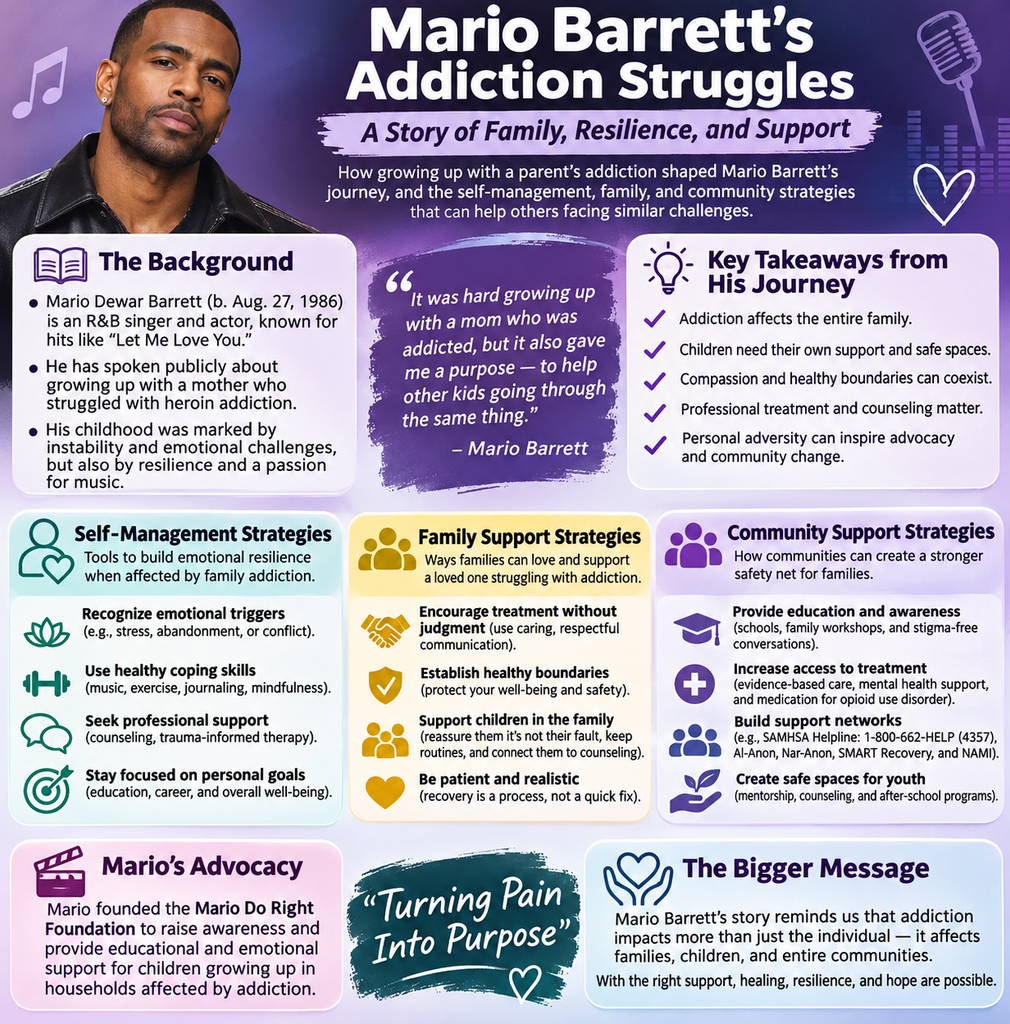
For R&B singer and actor Mario Barrett, widely recognized for his hit songs “Let Me Love You” and “Just a Friend 2002,” addiction has been a significant part of his family story.
Mario has publicly discussed the challenges of growing up with a mother who struggled with heroin addiction. His experiences illustrate how substance use disorders can affect not only individuals living with addiction but also their children, families, and communities.
An important distinction: Mario’s publicly documented story primarily concerns his mother’s addiction and its effects on his childhood. It should not be presented as his own confirmed substance use disorder or personal rehabilitation journey without reliable evidence.
His story offers an opportunity to explore childhood adversity, emotional resilience, family relationships, and the support systems that help people heal from addiction-related trauma.
Mario Barrett’s Childhood and Family Addiction Challenges
Mario Dewar Barrett was born on August 27, 1986, in Baltimore, Maryland. Growing up, he experienced family instability associated with his mother’s substance use disorder.
His mother, Shawntia Hardaway, struggled with heroin addiction, which affected their relationship and his childhood experiences.
Despite these challenges, Mario developed a passion for music that eventually helped him establish a successful career in entertainment.
His family experiences brought attention to several important issues:
- Childhood instability: Parental substance use disorders can disrupt routines, emotional security, and caregiving.
- Emotional distress: Children may experience fear, sadness, anger, confusion, or guilt when a parent struggles with addiction.
- Family separation: Substance use disorders may contribute to changes in living arrangements and family relationships.
- Resilience: Supportive relationships, creative activities, and positive role models can help children navigate adversity.
- Intergenerational effects: Childhood exposure to addiction may increase vulnerability to later mental health and substance use problems, although these outcomes are not inevitable.
Mario’s experiences demonstrate why addiction treatment should consider the needs of the entire family rather than focusing exclusively on the person using substances.
Bringing Addiction Into Public Awareness
Mario’s willingness to discuss his mother’s addiction helped bring attention to the emotional challenges experienced by children whose parents have substance use disorders.
In the 2007 MTV documentary I Won’t Love You to Death: The Story of Mario and His Mom, audiences were introduced to his efforts to support his mother while confronting the difficult realities of her addiction.
The documentary highlighted the emotional complexity of loving someone who struggles with substance use.
Family members may want desperately to help, yet discover that love alone cannot eliminate addiction.
Several lessons emerge from this experience:
- Addiction is a chronic, treatable medical condition involving changes in brain function, behavior, and motivation.
- Family members cannot force another person to achieve lasting recovery.
- Professional treatment, ongoing support, and personal willingness to engage in care are important.
- Setting healthy boundaries does not mean abandoning a loved one.
- Family members deserve emotional support and counseling for their own well-being.
Mario’s story illustrates how families can experience both deep compassion and profound frustration while navigating addiction.
Self-Management Strategies: Building Emotional Resilience
Growing up around addiction can leave lasting emotional effects. Self-management strategies help individuals recognize these experiences, develop healthy coping mechanisms, and strengthen emotional well-being.
Although these approaches should not be interpreted as Mario’s personal treatment plan, they provide practical guidance for anyone affected by family addiction.
Recognizing Emotional Triggers
People exposed to addiction during childhood may experience emotional reactions connected to uncertainty, abandonment, conflict, or loss of trust.
Helpful strategies include:
- Identifying situations that trigger anxiety, sadness, or anger.
- Keeping a journal to recognize recurring emotional patterns.
- Practicing mindfulness and grounding techniques.
- Developing healthy responses to stressful family interactions.
- Seeking professional counseling when emotional distress interferes with daily functioning.
Recognizing emotional triggers can help individuals respond thoughtfully rather than react automatically.
Developing Healthy Coping Skills
Creative expression, physical activity, and structured routines may improve emotional regulation.
Practical approaches include:
- Participating in music, art, writing, or other creative activities.
- Maintaining regular sleep and exercise routines.
- Practicing breathing exercises and relaxation techniques.
- Establishing realistic personal and professional goals.
- Building friendships that encourage healthy choices.
For Mario, music became central to his identity and professional life. His career illustrates how creative interests can provide purpose and opportunities for personal development.
However, creativity should complement—not replace—professional mental health treatment when needed.
Seeking Professional Support
People affected by family addiction may benefit from counseling even if they have never personally developed a substance use disorder.
Evidence-based approaches may include cognitive behavioral therapy, trauma-focused psychotherapy, and family therapy.
Professional support can help individuals process childhood experiences, address relationship difficulties, and develop healthier coping strategies.
Family Support Strategies: Loving Someone With Addiction
One of the most important lessons from Mario Barrett’s family experiences is that addiction affects relationships throughout the household.
Families often struggle to balance compassion, personal boundaries, and the desire to help someone enter treatment.
Encouraging Treatment Without Judgment
Family members can encourage recovery through respectful communication and practical assistance.
Helpful strategies include:
- Discussing concerns when the person is not intoxicated.
- Using supportive language rather than blame or criticism.
- Encouraging evaluation by qualified addiction professionals.
- Helping locate appropriate treatment programs.
- Offering transportation or assistance with appointments when feasible.
- Recognizing positive changes without expecting immediate perfection.
For opioid use disorder, medications such as buprenorphine and methadone are evidence-based treatments that reduce illicit opioid use and the risk of fatal overdose.
Establishing Healthy Boundaries
Supporting a loved one does not require accepting unsafe or harmful behavior.
Healthy boundaries may involve:
- Refusing to provide money that could support substance use.
- Protecting children from unsafe situations.
- Establishing clear expectations regarding behavior in the home.
- Avoiding repeated attempts to control another person’s recovery.
- Seeking outside assistance when family safety is threatened.
Boundaries help preserve emotional well-being while allowing family members to remain compassionate.
Supporting Children Affected by Addiction
Children living with parental addiction require special attention because they may blame themselves or feel responsible for the parent’s behavior.
Families and caregivers can help by:
- Reassuring children that addiction is not their fault.
- Explaining substance use disorders using age-appropriate language.
- Maintaining consistent routines and dependable caregiving.
- Encouraging children to express their feelings.
- Connecting children with school counselors or mental health professionals.
- Identifying trusted adults who can provide ongoing emotional support.
Early intervention may reduce the long-term effects of childhood adversity and strengthen resilience.
Community Support Strategies: Turning Personal Pain Into Advocacy
Mario Barrett transformed his family’s experiences into an opportunity to help other children affected by addiction.
He established the Mario Do Right Foundation to raise awareness and provide educational support for young people growing up in households affected by substance use disorders.
In an interview with ESSENCE, Mario emphasized the importance of obtaining separate support for children and parents, recognizing that children often need safe environments outside the home to discuss their experiences. Essence+1
Expanding Community Education
Communities can strengthen addiction prevention and family recovery through accessible educational programs.
Effective strategies include:
- Providing school-based education about addiction and mental health.
- Training teachers to recognize signs of childhood distress.
- Establishing confidential counseling services for affected children.
- Organizing family education workshops.
- Promoting stigma-free discussions about substance use disorders.
- Encouraging partnerships between schools, healthcare organizations, and community agencies.
Increasing Access to Addiction Treatment
Communities should prioritize evidence-based addiction treatment that addresses both substance use and co-occurring mental health conditions.
Important services include:
- Outpatient and residential addiction treatment when clinically appropriate.
- Medication treatment for opioid use disorder.
- Mental health counseling and trauma-informed care.
- Peer recovery support and recovery coaching.
- Naloxone distribution and overdose prevention education.
- Affordable transportation and assistance navigating healthcare services.
Building Support Networks for Families
Families may benefit from connecting with others who have experienced similar challenges.
Helpful resources include:
- SAMHSA’s National Helpline: 1-800-662-HELP (4357), providing confidential treatment referrals and information.
- Al-Anon Family Groups: Peer support for people affected by someone else’s drinking.
- Nar-Anon Family Groups: Support for relatives and friends affected by another person’s drug use.
- SMART Recovery Family & Friends: Skills-based support focused on communication, boundaries, and coping.
- NAMI: Mental health education and support for individuals and families.
These services can reduce isolation and help families develop healthier approaches to addiction-related challenges.
Grief, Forgiveness, and Emotional Healing
Mario’s mother, Shawntia Hardaway, died in 2017. Her cause of death was not publicly established, so it would be inappropriate to attribute her death to an overdose.
Mario publicly expressed his love for his mother following her death. In earlier interviews, he had also discussed forgiveness, personal growth, and the emotional challenges associated with their relationship. [site:name]+1
His experiences illustrate how grief can be especially complicated when a loved one has struggled with addiction.
Individuals may experience sadness, anger, regret, relief, guilt, or unresolved questions.
Strategies for Coping With Addiction-Related Grief
- Acknowledge that conflicting emotions can exist at the same time.
- Recognize that another person’s addiction is not your responsibility.
- Consider grief counseling or trauma-informed therapy.
- Maintain supportive relationships with trusted individuals.
- Use journaling, music, or other meaningful activities to express emotions.
- Allow forgiveness to develop naturally without feeling pressured to reconcile or excuse harmful behavior.
Emotional healing does not require forgetting painful experiences. It involves learning to live with those experiences while protecting one’s mental health.
Important Lessons From Mario Barrett’s Journey
Mario’s experiences provide valuable lessons for families, healthcare professionals, and communities affected by substance use disorders.
Addiction affects the entire family. Children and partners may experience significant emotional consequences even when they do not personally use substances.
Compassion and boundaries can coexist. Supporting a loved one should not require sacrificing personal safety or emotional well-being.
Children need independent support. Counseling, mentorship, and reliable caregiving can help protect children from the effects of parental addiction.
Professional treatment matters. Family encouragement is valuable, but evidence-based medical and psychological care is often essential for sustained recovery.
Personal adversity can inspire advocacy. Mario’s foundation work demonstrates how lived family experiences can motivate efforts to support vulnerable children.
Conclusion: Turning Family Struggles Into Hope
Mario Barrett’s story is not primarily one of personal addiction recovery. It is a story of a son growing up with a mother’s heroin addiction, struggling with its emotional consequences, and eventually using his public platform to advocate for children facing similar circumstances.
His journey reminds us that substance use disorders affect far more than the individual experiencing addiction. They can influence childhood development, family stability, emotional health, and relationships across generations.
Through self-management, healthy family boundaries, professional treatment, and community resources, families can develop stronger support systems and create opportunities for healing.
The most important message from Mario Barrett’s experiences is that children affected by addiction deserve understanding, protection, and support—and that families do not have to face addiction alone.
Frequently Asked Questions and Answers
Mario Barrett’s Personal and Family Experiences
1. Did Mario Barrett struggle with drug addiction?
There is no well-established public evidence that R&B singer Mario Barrett personally experienced a substance use disorder or underwent addiction rehabilitation.
His publicly documented experiences primarily involve growing up with a mother who struggled with heroin addiction. His story highlights the emotional challenges children face when a parent experiences substance dependence.
2. Who is Mario Barrett, and why is his story connected to addiction awareness?
Mario Barrett is an American R&B singer, songwriter, and actor known for songs such as “Let Me Love You” and “Just a Friend 2002.”
Beyond his music career, Mario has discussed his childhood experiences with his mother’s heroin addiction. His willingness to share these challenges has helped raise awareness about parental addiction, childhood adversity, and the importance of family support.
3. What type of addiction did Mario Barrett’s mother experience?
Mario’s mother, Shawntia Hardaway, publicly struggled with heroin addiction.
Heroin is a highly addictive opioid that affects the brain’s reward pathways and can cause physical dependence, withdrawal symptoms, and life-threatening respiratory depression.
Opioid use disorder is a treatable medical condition. Evidence-based medications, including methadone and buprenorphine, can reduce illicit opioid use and overdose risk.
4. How did his mother’s addiction affect Mario Barrett’s childhood?
Growing up with parental addiction exposed Mario to family instability and emotional challenges.
Children in similar circumstances may experience:
- Anxiety, fear, and uncertainty.
- Difficulty trusting others.
- Feelings of abandonment or rejection.
- Increased responsibility at a young age.
- Emotional distress related to family conflict.
- Difficulty establishing healthy relationships.
These outcomes are possible consequences of childhood adversity, not diagnoses that should automatically be attributed to Mario.
5. Did Mario Barrett publicly discuss his mother’s addiction?
Yes. Mario and his mother appeared in the 2007 MTV documentary I Won’t Love You to Death: The Story of Mario and His Mom.
The documentary explored his mother’s addiction and Mario’s efforts to support her while dealing with the emotional consequences of her substance use.
It demonstrated the difficult balance between loving someone with addiction and recognizing that professional treatment and personal engagement in recovery are necessary.
6. What happened to Mario Barrett’s mother?
Mario’s mother, Shawntia Hardaway, died in 2017.
Mario publicly expressed his grief and love for his mother following her death.
Her death should not be described as an overdose without reliable confirmation of the cause.
7. Did Mario Barrett forgive his mother for her addiction?
Mario has publicly discussed his complicated relationship with his mother and the importance of love, understanding, and forgiveness.
Forgiveness can be an important part of emotional healing for some families, but it is not required for recovery.
Individuals affected by parental addiction can develop emotional well-being while maintaining boundaries or limiting contact when necessary.
8. How did music influence Mario Barrett’s resilience?
Music became an important part of Mario’s personal development and professional identity.
Creative expression can help individuals process emotions, develop confidence, and establish meaningful goals.
Music and other creative activities may support emotional regulation, although they should not replace professional treatment for significant mental health conditions.
Self-Management and Emotional Healing
9. What self-management strategies can help people affected by parental addiction?
Individuals who grow up around addiction may benefit from developing coping skills that strengthen emotional stability.
Recommended strategies include:
- Recognizing emotional triggers associated with childhood experiences.
- Practicing mindfulness, relaxation, and stress management.
- Maintaining healthy sleep and exercise routines.
- Using journaling or creative expression to process feelings.
- Establishing achievable personal goals.
- Seeking counseling when emotional distress becomes difficult to manage.
These strategies can support emotional well-being but do not replace professional treatment when needed.
10. Can growing up with an addicted parent increase the risk of developing addiction?
Yes. Childhood exposure to parental substance use disorders is associated with an increased risk of substance use problems later in life.
Contributing factors may include genetic vulnerability, chronic stress, adverse childhood experiences, and exposure to substance use.
However, having a parent with addiction does not mean a child will inevitably develop addiction.
Protective factors include supportive caregivers, stable environments, positive relationships, and access to mental health services.
11. How can someone overcome guilt associated with a parent’s addiction?
Children and adult family members sometimes believe they could have prevented their loved one’s addiction.
Healing involves recognizing that addiction is a complex medical condition and that family members are not responsible for controlling another person’s substance use.
Helpful approaches include self-compassion, counseling, support groups, and learning to separate personal responsibility from another person’s decisions.
12. What role does therapy play in recovering from childhood addiction-related trauma?
Therapy can help individuals understand how early experiences influence their emotions, relationships, and behavior.
Treatment approaches may include:
- Cognitive behavioral therapy (CBT).
- Trauma-focused cognitive behavioral therapy.
- Eye movement desensitization and reprocessing (EMDR), when clinically indicated.
- Family therapy.
- Grief counseling.
The most appropriate treatment depends on the individual’s symptoms, experiences, and clinical assessment.
Family Support and Healthy Relationships
13. How can families support someone struggling with heroin addiction?
Families can provide emotional encouragement while helping their loved one access evidence-based treatment.
Helpful strategies include:
- Communicating without blame or humiliation.
- Encouraging professional addiction assessment.
- Supporting medication treatment when appropriate.
- Keeping naloxone available to reverse opioid overdose.
- Establishing healthy boundaries.
- Participating in family counseling.
- Recognizing that recovery may involve setbacks.
Families should understand that supporting treatment does not require tolerating unsafe behavior.
14. What are healthy boundaries when a parent has an addiction?
Healthy boundaries protect emotional, physical, and financial well-being.
Examples include refusing to provide money for substances, avoiding arguments when someone is intoxicated, protecting children from unsafe environments, and maintaining realistic expectations.
Boundaries are most effective when communicated clearly and consistently.
15. Can someone love a family member with addiction without enabling harmful behavior?
Yes. Compassion and accountability can coexist.
Families can express love, offer transportation to treatment, and encourage healthier decisions without providing resources that directly support dangerous substance use.
Mario’s public discussions about his mother illustrate the difficulty of balancing emotional attachment with personal well-being. Essence+1
16. How can parents explain addiction to children?
Parents and caregivers should use simple, age-appropriate explanations.
Children should understand that:
- Addiction is a health condition.
- They did not cause their parent’s addiction.
- They cannot cure the condition through love or good behavior.
- Trusted adults can help keep them safe.
- Their feelings deserve attention and support.
Consistent reassurance and access to counseling can help children feel less isolated.
Community Advocacy and Addiction Awareness
17. What is the Mario Do Right Foundation?
The Mario Do Right Foundation is an organization Mario Barrett established in 2007 to support children affected by substance use disorders in their families and communities.
Its documented initiatives included education, mentorship, prevention programs, and opportunities for young people to discuss their experiences in supportive environments. CBS Baltimore+1
18. Why did Mario Barrett establish his foundation?
Mario was motivated by his experiences growing up with parental addiction and witnessing the effects of substance use on his family.
He described his mother’s overdose and the resulting family crisis as important motivations for helping other children.
His advocacy focused on providing young people with the emotional support and educational resources that he felt were missing during his childhood. Essence+1
19. How can communities help children living with parental addiction?
Communities can create safer environments by expanding access to:
- School-based mental health counseling.
- Youth mentorship and after-school programs.
- Family education workshops.
- Addiction prevention programs.
- Trauma-informed healthcare.
- Peer support groups.
- Affordable addiction treatment services.
Schools, healthcare organizations, and community agencies can collaborate to identify vulnerable children and connect families with appropriate resources.
20. What addiction recovery resources are available for families?
Several organizations provide education, referrals, and peer support.
- SAMHSA National Helpline: 1-800-662-HELP (4357) for confidential treatment referrals.
- Al-Anon: Support for families affected by another person’s alcohol use.
- Nar-Anon: Support for families affected by another person’s drug use.
- SMART Recovery Family & Friends: Practical tools for coping and communication.
- NAMI: Mental health education, advocacy, and family support.
Families can also consult addiction medicine specialists, licensed therapists, and community mental health clinics.
Lessons From Mario Barrett’s Journey
21. What is the most important lesson from Mario Barrett’s family experiences?
Mario’s story demonstrates that addiction affects entire families, especially children who may struggle with emotional distress, uncertainty, and disrupted relationships.
His experiences emphasize the importance of recognizing childhood trauma, encouraging professional treatment, and providing families with supportive community resources.
22. Can people who experience childhood trauma build successful and fulfilling lives?
Yes. Childhood adversity can increase the risk of later difficulties, but it does not determine a person’s future.
Supportive relationships, counseling, education, healthy coping strategies, and opportunities for personal growth can strengthen resilience.
Mario’s music career and advocacy efforts demonstrate how someone can pursue meaningful goals despite difficult family circumstances.
23. How can Mario Barrett’s story help reduce addiction stigma?
Mario’s willingness to discuss his mother’s heroin addiction encourages people to recognize addiction as a health condition rather than a moral failure.
His advocacy also highlights an often-overlooked population: children who experience the consequences of parental addiction.
Greater public understanding can encourage families to seek help earlier and support more compassionate treatment approaches.
24. What message does Mario Barrett’s journey offer to families affected by addiction?
Mario’s story offers a message of resilience, compassion, and hope.
Families affected by addiction may experience fear, disappointment, grief, and emotional exhaustion. However, professional treatment, healthy boundaries, and supportive relationships can create opportunities for healing.
A parent’s addiction does not define a child’s future, and seeking help is a sign of strength.
Video: