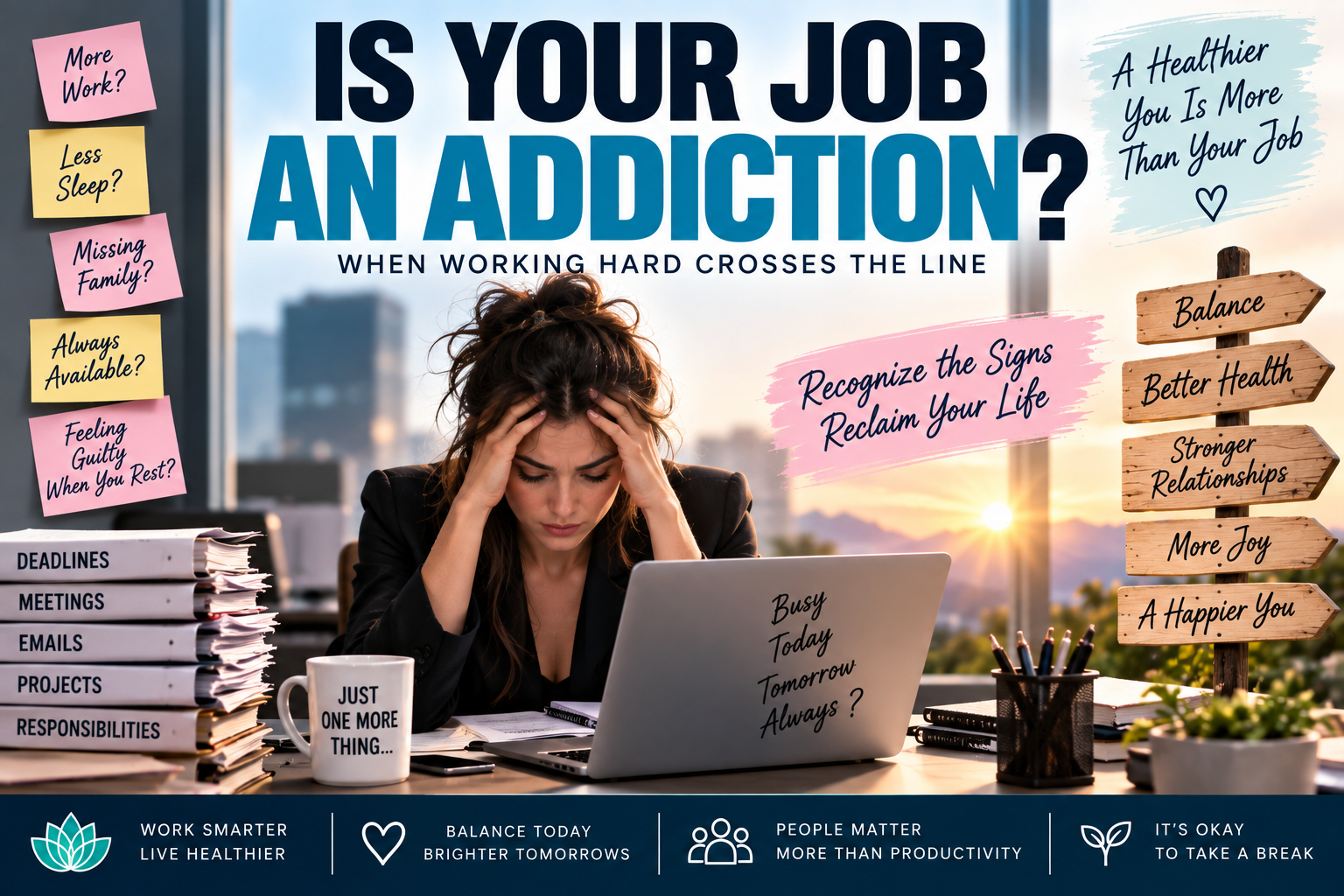
Working hard is often praised. Staying late, answering emails after hours, skipping vacations, and always being available can even be viewed as signs of dedication. But what happens when working stops feeling like a choice?
For some people, work can develop into a compulsive pattern sometimes described as work addiction or workaholism. The person may feel driven to work excessively, even when it harms sleep, relationships, physical health, or emotional well-being.
Not everyone who works long hours has a work addiction. Someone may temporarily work more because of financial pressures, deadlines, staffing shortages, career goals, or family responsibilities. The more important question is whether the person feels unable to disengage from work despite negative consequences.
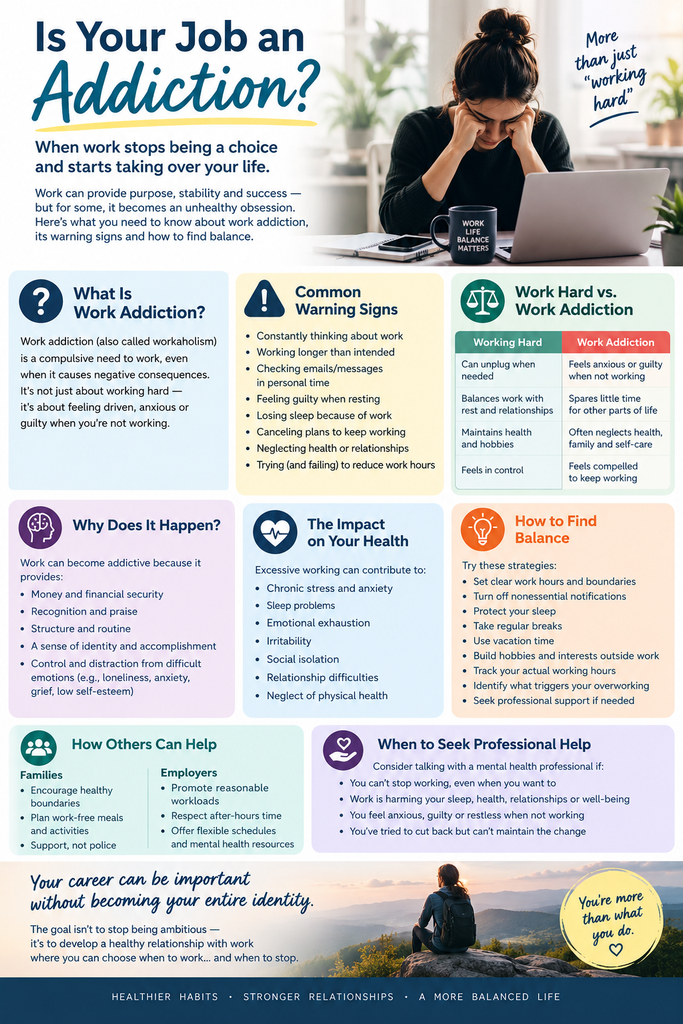
What Is Work Addiction?
Work addiction is generally used to describe an excessive and compulsive need to work. It is not simply enjoying your career or wanting to succeed.
A person experiencing workaholic patterns may constantly think about work, feel uncomfortable when not working, and repeatedly sacrifice important parts of life to remain productive.
Unlike substance use disorders, “work addiction” is not a standalone diagnosis in the DSM-5-TR. However, researchers study workaholism as a potentially harmful behavioral pattern associated with psychological distress and impaired well-being.
The distinction matters because working hard and compulsively needing to work are not the same thing.
Signs Your Relationship With Work May Be Unhealthy
Long hours alone cannot determine whether someone has a problem. Look instead at the relationship between work, control, and consequences.
Possible warning signs include:
- Thinking about work almost constantly
- Regularly working longer than originally intended
- Feeling guilty, anxious, restless, or irritable when not working
- Checking emails or work messages during family time
- Skipping meals, exercise, sleep, or medical appointments to continue working
- Consistently canceling social activities because of work
- Working during vacations or scheduled days off
- Using work to avoid uncomfortable emotions
- Feeling that personal worth depends primarily on productivity
- Continuing excessive work despite relationship conflicts
- Being physically exhausted but feeling unable to stop
- Promising to reduce working hours but repeatedly failing to do so
One isolated behavior does not establish work addiction. Repeated patterns and consequences are more important.
When Productivity Becomes Emotional Escape
Why would someone become compulsively attached to work?
Sometimes work provides more than income.
It can provide:
Control.
Recognition.
Identity.
Structure.
Distraction.
Self-esteem.
Escape.
Someone experiencing grief, loneliness, anxiety, relationship difficulties, low self-esteem, or other emotional problems may discover that staying constantly busy prevents them from thinking about uncomfortable feelings.
The person may say:
“I’m just ambitious.”
But underneath the ambition may be another thought:
“If I stop working, I have to deal with everything else.”
That distinction can be important.
The Productivity Trap
Work can become particularly difficult to recognize as harmful because society frequently rewards excessive productivity.
A person who drinks excessively may eventually receive criticism.
A person who works excessively may receive a promotion.
That external reinforcement can make unhealthy patterns harder to recognize.
Praise such as “You’re always working!” or “I don’t know how you do it!” can sound positive even when the person is chronically exhausted.
Success does not necessarily mean the behavior producing it is sustainable.
Work Addiction vs. Healthy Ambition
Healthy ambition generally allows flexibility.
A hardworking person may put in extra hours when necessary but can eventually disconnect and enjoy relationships, recreation, and rest without overwhelming guilt.
Compulsive working is different.
The person may intellectually understand that rest is necessary while emotionally feeling unable to allow it.
Healthy ambition says:
“I want to work.”
Workaholism may feel more like:
“I have to work.”
That sense of internal pressure is worth examining.
How Excessive Work Can Affect Mental Health
Chronically excessive work may contribute to stress and emotional exhaustion.
Over time, a person may experience:
- Irritability
- Anxiety
- Difficulty sleeping
- Emotional exhaustion
- Reduced concentration
- Relationship conflict
- Social isolation
- Loss of enjoyment outside work
- Chronic stress
- Burnout
Work addiction and burnout are related concepts, but they are not identical.
Workaholism describes a compulsive relationship with working. Burnout describes a state of exhaustion and reduced functioning associated with chronic occupational stress.
A person can experience either condition without necessarily experiencing the other, although they may overlap.
Self-Management Strategies: Learning to Stop Working
For someone who has spent years measuring success through productivity, simply being told to “work less” may not be enough.
Self-management involves changing both behaviors and beliefs about work.
Helpful strategies include:
- Establish specific start and end times for the workday.
- Turn off unnecessary work notifications after hours.
- Avoid checking email immediately after waking.
- Schedule meals, exercise, hobbies, and social activities just as you schedule meetings.
- Take regular breaks during the workday.
- Use vacation time without routinely working through it.
- Track how many hours you actually work each week.
- Identify emotions that drive excessive work.
- Practice saying no to unnecessary responsibilities.
- Create technology-free periods at home.
- Develop interests that have nothing to do with your career.
- Consider counseling when reducing work feels extremely difficult.
One particularly useful question is:
“If nobody praised me for working this hard, would I still feel compelled to do it?”
The answer may reveal whether productivity has become connected to identity or emotional validation.
Learn to Tolerate Rest
Rest can initially feel uncomfortable for someone accustomed to constant productivity.
A quiet evening may create guilt.
A vacation may create anxiety.
Sitting without completing a task may feel wasteful.
Instead of immediately escaping those feelings by returning to work, practice tolerating them.
Start small.
Spend 30 minutes doing something that has no productivity goal—walking, reading, listening to music, gardening, cooking, or simply talking with someone you care about.
Rest is not a reward you earn after destroying your energy.
Rest is part of maintaining your ability to function.
Family Support: When Work Becomes the Third Person in a Relationship
Families often recognize excessive working before the individual does.
A spouse may feel ignored.
Children may stop asking the parent to participate because they expect the answer to be, “I have to work.”
Family members may become frustrated when someone is physically present but mentally engaged in answering emails, planning projects, or checking their phone.
Over time, work can begin to occupy the emotional space that previously belonged to relationships.
How Families Can Help
Families can provide support without turning every conversation into an argument about working.
Helpful approaches include:
- Describe specific behaviors rather than labeling the person a “workaholic.”
- Explain how excessive working affects the family.
- Establish work-free meals or family activities.
- Encourage vacations and recreational activities.
- Avoid praising unhealthy overworking.
- Discuss household responsibilities openly.
- Encourage professional counseling when necessary.
- Protect important family traditions and routines.
- Create shared expectations for phone use and work communication.
- Consider couples or family therapy when work has significantly damaged relationships.
Instead of saying:
“You care more about your job than your family.”
Try:
“I’ve noticed you’re answering work messages throughout dinner, and we’re missing time together. Can we make dinner work-free?”
Specific requests are often easier to address than accusations.
Family Support Should Not Become Policing
Constantly monitoring someone’s laptop, phone, or work hours can create additional conflict.
The goal is not to become the person’s supervisor.
Healthy support involves communicating concerns, establishing boundaries, and encouraging responsibility.
Ultimately, the individual must participate in changing the behavior.
Community and Workplace Support
Work addiction cannot always be addressed at the individual level.
Workplace culture matters.
Organizations that reward employees for answering messages at midnight, discourage vacations, chronically understaff departments, or celebrate exhaustion may unintentionally reinforce unhealthy working patterns.
Helpful community and workplace strategies include:
- Employee assistance programs
- Mental health counseling
- Occupational health services
- Reasonable workload expectations
- Protected vacation time
- Flexible scheduling when appropriate
- Clear after-hours communication policies
- Peer-support programs
- Stress-management education
- Leadership that models healthy boundaries
Managers also influence workplace culture. When supervisors take vacations, disconnect after work, and respect employee boundaries, they communicate that recovery time is compatible with professional success.
When Professional Help May Be Needed
Consider talking with a mental health professional if attempts to reduce working repeatedly fail or if excessive work is significantly affecting relationships, sleep, emotional health, or daily functioning.
Therapy may help someone explore questions such as:
Why does stopping make me uncomfortable?
Do I believe my worth depends on achievement?
Am I using work to avoid another problem?
What emotions appear when I am not busy?
What would my identity look like without my job title?
These questions can uncover patterns that simply reducing working hours may not address.
You Are More Than Your Productivity
One of the most difficult parts of changing an unhealthy relationship with work is separating identity from achievement.
Ask yourself:
Who am I when I am not working?
You may be a parent, spouse, friend, sibling, neighbor, volunteer, artist, gardener, traveler, musician, reader, mentor—or simply a person who deserves time to exist without constantly producing something.
Your career can be meaningful without becoming your entire identity.
Conclusion
Being hardworking does not automatically mean someone is addicted to work. The concern begins when work becomes compulsive and repeatedly interferes with sleep, health, relationships, emotional well-being, or the ability to enjoy life outside of one’s career.
Self-management can involve setting working-hour boundaries, identifying emotional triggers, protecting sleep, developing interests outside work, and learning to tolerate rest. Family support can provide honest communication and healthy boundaries without becoming controlling. Community and workplace support can create environments where employees are valued for sustainable performance rather than chronic exhaustion.
The goal is not to stop caring about your career.
It is to reach a point where you can care about your career without sacrificing everything else that makes your life meaningful.
Sometimes the most productive decision you can make is knowing when to stop working.
Frequently Asked Questions
Here are some common questions:
1. Can someone really become addicted to work?
People can develop an excessive, compulsive relationship with work, commonly called workaholism or work addiction. However, work addiction is not currently a standalone diagnosis in the DSM-5-TR. The concern is not simply working hard but feeling driven to work despite negative consequences.
2. What is the difference between working hard and work addiction?
A hardworking person can usually disengage from work when necessary and make room for sleep, relationships, recreation, and other responsibilities. Someone with workaholic patterns may feel guilty, anxious, restless, or uncomfortable when not working and have difficulty stopping even when work is causing problems.
3. What are common warning signs of work addiction?
Possible warning signs include:
- Constantly thinking about work
- Regularly working longer than intended
- Checking work messages during personal time
- Feeling guilty when resting
- Losing sleep because of work
- Canceling family or social activities to continue working
- Working throughout vacations
- Neglecting health or relationships
- Using work to avoid uncomfortable emotions
- Repeatedly trying—and failing—to reduce work hours
The overall pattern matters more than any single behavior.
4. Is working long hours automatically unhealthy?
No. Long hours may be temporarily necessary due to deadlines, financial needs, staffing shortages, emergencies, or career responsibilities. The concern increases when excessive work becomes persistent, difficult to control, and harmful to other areas of life.
5. Why can work become so difficult to stop?
Work can provide money, recognition, structure, identity, a sense of accomplishment, and a sense of control. For some people, it can also become a way of avoiding loneliness, anxiety, grief, relationship difficulties, low self-esteem, or other uncomfortable emotions.
6. Can work addiction affect mental health?
Excessive and compulsive working can be associated with chronic stress, anxiety, irritability, sleep difficulties, emotional exhaustion, social isolation, and relationship problems. Mental health concerns may also contribute to someone’s tendency to overwork.
7. Are work addiction and burnout the same thing?
No. Workaholism describes a compulsive relationship with working, while burnout refers to exhaustion and other difficulties associated with chronic workplace stress. The two can overlap, but they are not interchangeable.
8. Why is workaholism sometimes difficult to recognize?
Unlike many harmful behaviors, excessive working can receive social rewards. Promotions, praise, higher income, and recognition may reinforce overworking even when the person’s health or relationships are deteriorating.
9. Can perfectionism contribute to excessive working?
It can. Someone who believes every task must be flawless may spend excessive amounts of time working, struggle to delegate, repeatedly check completed work, or feel that nothing they accomplish is good enough.
10. What self-management strategies can help?
Helpful strategies may include establishing work hours, turning off unnecessary notifications, protecting sleep, taking regular breaks, using vacation time, developing hobbies outside work, tracking actual working hours, and identifying emotions that trigger excessive working.
11. Why might someone feel guilty when resting?
If self-worth has become closely connected with productivity, rest may feel like laziness or failure. Learning that recovery time is a normal part of physical and psychological functioning can be an important part of developing healthier work habits.
12. How can families help someone who works excessively?
Families can describe specific behaviors and their effects rather than simply calling someone a “workaholic.” They can establish work-free meals, encourage shared activities, set reasonable technology boundaries, and encourage counseling when work significantly interferes with family life.
13. What should families avoid doing?
Constantly checking someone’s phone, monitoring every work hour, or repeatedly arguing about work can create additional conflict. Support should focus on communication and boundaries rather than policing another adult’s behavior.
14. Can employers contribute to unhealthy working patterns?
Yes. Workplace cultures that reward constant availability, discourage vacations, normalize excessive workloads, or expect employees to answer messages at all hours can reinforce unhealthy behavior.
15. How can workplaces encourage healthier habits?
Organizations can promote reasonable workloads, encourage employees to use vacation time, establish after-hours communication expectations, provide employee assistance programs, support flexible scheduling when appropriate, and have leaders model healthy boundaries.
16. When should someone consider professional help?
Consider talking with a mental health professional when attempts to reduce working repeatedly fail or when work is significantly interfering with sleep, physical health, relationships, emotional well-being, or everyday functioning.
17. What questions can help someone evaluate their relationship with work?
Ask yourself:
Can I stop working without feeling intense guilt or anxiety?
Am I sacrificing sleep or relationships to work?
Do I use work to avoid difficult emotions?
Does my self-worth depend on productivity?
Have people close to me repeatedly expressed concern?
Have I tried to work less but found myself unable to maintain the change?
Several “yes” answers do not automatically establish an addiction, but they may indicate that your relationship with work deserves closer attention.
18. What is the biggest lesson about work addiction?
Your career can be important without becoming your entire identity. Healthy achievement allows room for sleep, relationships, recreation, physical health, and emotional well-being.
Video: Why you can’t stop working even when you’re exhausted 🧠 #Workaholism #MentalHealthAwareness