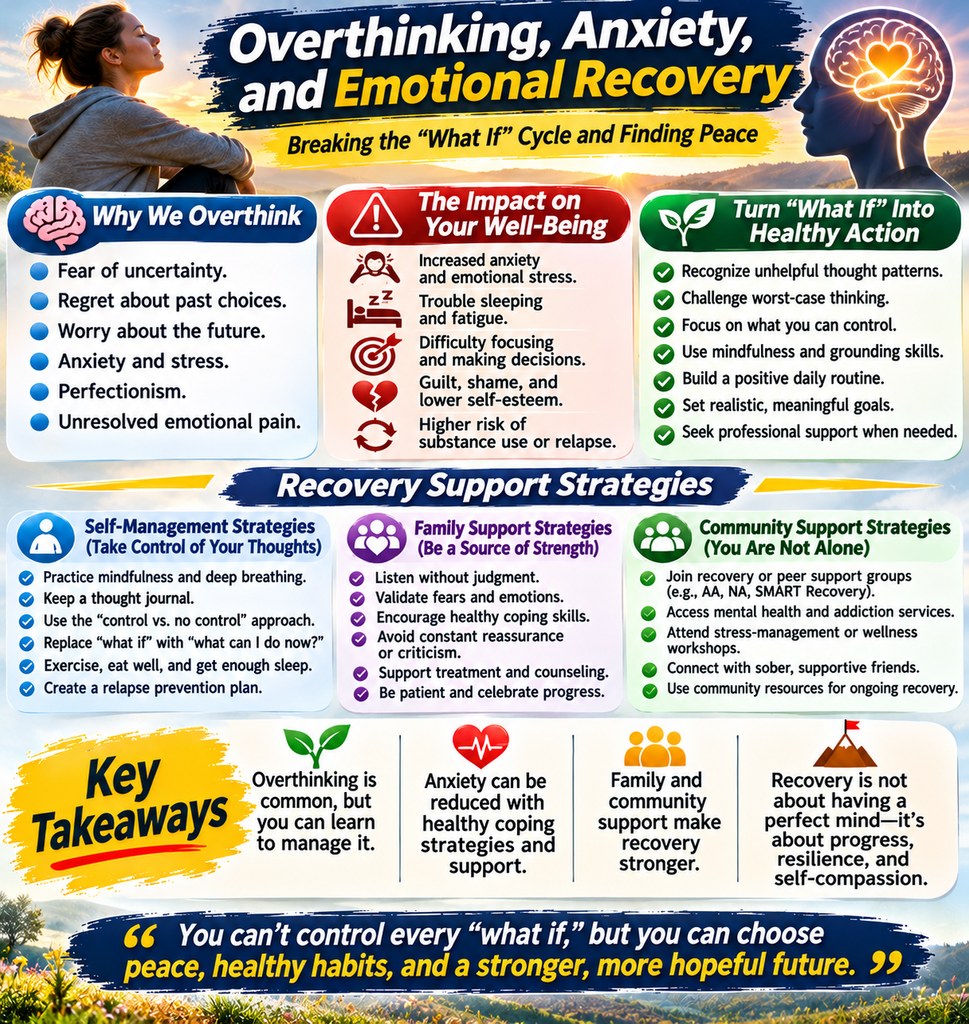
Do you often find yourself questioning past decisions, imagining alternative outcomes, or worrying about an uncertain future? Persistent thoughts such as “What if I had done things differently?” or “What if I relapse?” can create a cycle of overthinking, anxiety, and emotional exhaustion. While self-reflection can encourage personal growth, excessive rumination may increase stress, intensify regret, and interfere with daily functioning. For individuals recovering from addiction, fears of relapse, damaged relationships, and missed opportunities can make it difficult to move forward with confidence. Learning to recognize and manage these thought patterns is essential for developing healthier coping mechanisms and emotional resilience. This article explores the psychology behind “what if” thinking and offers practical self-management, family support, and community strategies to overcome overthinking, restore emotional balance, and promote long-term recovery.
Understanding the Psychology Behind ‘What If’ Thinking
The human brain naturally evaluates past experiences and anticipates future possibilities.
This ability helps people make decisions, recognize potential dangers, and prepare for challenges.
However, when hypothetical thinking becomes repetitive and emotionally distressing, it may develop into an unhealthy pattern.
Psychologists commonly distinguish between two related processes.
Rumination involves repeatedly thinking about past experiences, perceived mistakes, losses, or emotional difficulties.
Worry typically focuses on potential future threats or uncertain outcomes.
Both can involve repetitive “what if” questions.
Examples include:
- What if I had never started using drugs?
- What if I had recognized my addiction earlier?
- What if my family never trusts me again?
- What if I relapse after months of sobriety?
- What if I make another mistake?
- What if I cannot rebuild my life?
These questions may reflect genuine concerns. However, repeatedly asking them without identifying practical solutions can intensify anxiety rather than resolve uncertainty.
Why the Brain Gets Stuck in ‘What If’ Thoughts
Several psychological processes contribute to repetitive hypothetical thinking.
Fear of uncertainty
People often prefer predictable outcomes because uncertainty can create discomfort.
When the future feels unclear, the brain may repeatedly imagine different scenarios to regain a sense of control.
Unfortunately, excessive mental rehearsal does not necessarily increase certainty.
Regret and self-blame
Individuals may replay past experiences while imagining how different decisions could have changed their lives.
This process is known as counterfactual thinking.
Although counterfactual thinking can support learning, persistent self-blame may contribute to guilt, shame, and depressive symptoms.
Anxiety and threat anticipation
Anxiety can increase attention toward possible dangers.
The brain may interpret uncertain situations as threats, leading to repeated attempts to predict or prevent negative outcomes.
Perfectionism
Individuals with perfectionistic tendencies may believe they must make the correct decision every time.
This can contribute to excessive analysis, fear of failure, and difficulty accepting mistakes.
Unresolved emotional experiences
Trauma, grief, relationship conflicts, and other distressing experiences may contribute to repetitive thoughts.
For some individuals, professional mental health treatment may be necessary to address underlying difficulties.
The Connection Between ‘What If’ Thinking and Addiction Recovery
Addiction recovery often involves confronting difficult memories, rebuilding relationships, and developing confidence in the future.
During this process, individuals may experience guilt about past behaviors or anxiety about maintaining sobriety.
Common recovery-related thoughts include:
- What if I disappoint my family again?
- What if I encounter an unexpected trigger?
- What if I cannot handle stress without alcohol or drugs?
- What if treatment doesn’t work?
- What if people judge me because of my past?
- What if I never regain the opportunities I lost?
These thoughts can contribute to emotional distress, particularly when they become repetitive and difficult to manage.
How overthinking can affect recovery
Persistent rumination and worry may:
- Increase anxiety and emotional exhaustion.
- Interfere with concentration and decision-making.
- Disrupt sleep patterns.
- Reduce confidence and self-esteem.
- Contribute to avoidance of challenging situations.
- Intensify feelings of guilt and shame.
- Increase vulnerability to substance use when combined with other relapse risk factors.
Importantly, having anxious thoughts does not mean someone will relapse.
Thoughts are mental experiences, not predictions of future behavior.
Learning to respond to uncertainty more effectively can support emotional well-being and recovery.
Self-Management Strategies: Breaking the Cycle of Overthinking
Managing repetitive “what if” thinking involves recognizing unhelpful thought patterns, developing emotional regulation skills, and redirecting attention toward meaningful actions.
1. Recognize the thought pattern
The first step is identifying when reflection becomes repetitive and unproductive.
Ask yourself:
- Am I solving a problem or replaying the same question?
- Is this situation within my control?
- Does this thought lead to useful action?
- Am I treating a possibility as though it is a certainty?
Recognizing the difference between productive reflection and rumination can help interrupt the cycle.
2. Challenge catastrophic thinking
Catastrophizing involves assuming that the worst possible outcome is likely to occur.
Instead of asking, “What if I relapse and lose everything?”, consider:
“What steps can I take today to protect my recovery?”
Cognitive behavioral therapy (CBT) can help individuals examine exaggerated predictions and develop more balanced interpretations.
3. Practice mindfulness
Mindfulness encourages awareness of present experiences without excessive judgment.
Helpful techniques include:
- Slow, controlled breathing.
- Guided meditation.
- Progressive muscle relaxation.
- Mindful walking.
- Grounding exercises.
- Observing thoughts without immediately reacting to them.
Mindfulness does not require eliminating thoughts. Instead, it involves learning to notice them without becoming overwhelmed.
4. Use the control-versus-uncertainty approach
Separate concerns into two categories.
Within your control:
- Attending treatment appointments.
- Practicing coping skills.
- Communicating honestly.
- Establishing healthy boundaries.
- Avoiding known substance use triggers.
Outside your control:
- Other people’s reactions.
- Past decisions.
- Every possible future outcome.
- Whether others forgive you.
- Unexpected life events.
Focusing on controllable actions can reduce feelings of helplessness.
5. Establish a designated worry period
Some individuals benefit from setting aside approximately 10–20 minutes each day to write down concerns and identify possible solutions.
When worries arise outside that period, gently postpone them until the scheduled time.
This strategy can help reduce the tendency to engage with every anxious thought immediately.
6. Practice self-compassion
Individuals experiencing guilt or regret may engage in harsh self-criticism.
Self-compassion involves acknowledging mistakes while recognizing the possibility of learning and change.
Instead of thinking, “I ruined everything,” consider:
“I cannot change the past, but I can take responsibility for my next decision.”
7. Seek professional support when needed
Persistent rumination, anxiety, intrusive thoughts, or compulsive reassurance-seeking may require professional evaluation.
CBT, acceptance and commitment therapy (ACT), and other evidence-based approaches can help address repetitive thinking.
When thoughts involve obsessions or compulsions, treatment such as exposure and response prevention may be appropriate following assessment.
Family Support Strategies: Helping Loved Ones Manage ‘What If’ Thinking
Family members may unintentionally reinforce overthinking by repeatedly offering reassurance, criticizing past decisions, or emphasizing worst-case scenarios.
Supportive communication can help individuals feel understood while encouraging healthier coping strategies.
Practical family support strategies
- Listen without judgment: Allow loved ones to express concerns without immediately criticizing or dismissing them.
- Validate emotions: Acknowledge that uncertainty and fear can be difficult.
- Avoid excessive reassurance: Repeatedly guaranteeing that nothing bad will happen may reinforce reassurance-seeking patterns.
- Encourage problem-solving: Help identify realistic actions rather than repeatedly discussing hypothetical outcomes.
- Promote healthy routines: Support regular sleep, exercise, meals, and meaningful activities.
- Respect boundaries: Avoid pressuring someone to discuss experiences before they feel ready.
- Encourage professional treatment: Support counseling when anxiety or rumination interferes with daily functioning.
- Practice patience: Recognize that changing long-standing thinking patterns takes time.
Helpful communication examples
Instead of saying:
“Stop worrying. Nothing bad is going to happen.”
Try:
“I understand why you’re concerned. What is one thing you can do right now that might help?”
Instead of:
“You always think about the worst possible outcome.”
Try:
“It sounds like uncertainty is making this difficult. Would it help to talk through what is within your control?”
These responses validate emotional experiences without reinforcing catastrophic thinking.
Community Support Strategies: Creating Environments That Reduce Anxiety
Community resources can help individuals manage emotional distress, develop social connections, and access professional mental health services.
For people recovering from addiction, supportive environments may also strengthen recovery stability.
Community-based strategies
- Expand mental health services: Increase access to affordable counseling and psychiatric care.
- Support peer recovery groups: Encourage participation in recovery meetings and community organizations.
- Provide psychoeducation: Teach individuals about anxiety, rumination, emotional regulation, and healthy coping skills.
- Develop stress-management workshops: Offer mindfulness classes, relaxation training, and resilience-building programs.
- Promote supportive workplaces: Encourage reasonable accommodations and access to employee assistance programs.
- Reduce mental health stigma: Normalize seeking help for persistent anxiety and emotional distress.
- Create social connection opportunities: Organize volunteer activities, recreational programs, and community events.
- Integrate mental health and addiction treatment: Address co-occurring substance use and mental health conditions together.
The role of peer support
Peer support groups provide opportunities to discuss uncertainty, fear, regret, and recovery challenges with people who understand similar experiences.
These groups may reduce isolation and provide encouragement.
However, peer support should complement professional treatment when anxiety or other mental health symptoms become severe.
How to Turn ‘What If’ Thoughts Into Productive Actions
One way to reduce overthinking is to transform hypothetical questions into specific, manageable goals.
| Unhelpful thought | Healthier response |
|---|---|
| What if I relapse? | I can review my relapse prevention plan and contact my support network. |
| What if my family never forgives me? | I can demonstrate accountability and respect their healing process. |
| What if I make another mistake? | I can learn from mistakes and make adjustments. |
| What if I cannot handle stress? | I can practice coping skills and seek additional support. |
| What if people judge my past? | I can focus on my values and the progress I am making. |
| What if recovery takes longer than expected? | I can measure progress through consistent actions rather than a fixed timeline. |
The goal is not to guarantee a positive outcome.
Instead, it is to build confidence in your ability to respond constructively to uncertainty.
When ‘What If’ Thinking May Signal a Mental Health Concern
Occasional worry and regret are normal psychological experiences.
However, persistent repetitive thinking may be associated with anxiety disorders, depression, obsessive-compulsive disorder, trauma-related conditions, or other mental health concerns.
Consider professional evaluation when thoughts:
- Occupy several hours of the day.
- Interfere with work, relationships, or daily responsibilities.
- Cause persistent sleep disturbances.
- Lead to avoidance of important activities.
- Trigger panic symptoms or severe emotional distress.
- Contribute to increased alcohol or drug use.
- Involve repeated checking, reassurance-seeking, or compulsive behaviors.
Treatment should address the underlying condition rather than focusing exclusively on eliminating unwanted thoughts.
Building Emotional Resilience During Addiction Recovery
Emotional resilience involves developing the ability to respond to difficulties, adapt to uncertainty, and recover from stressful experiences.
For individuals overcoming addiction, resilience may involve learning to tolerate uncomfortable emotions without relying on substances.
Important resilience-building practices include:
- Maintaining realistic recovery expectations.
- Developing a supportive social network.
- Practicing emotional awareness.
- Setting achievable personal goals.
- Strengthening problem-solving skills.
- Recognizing progress without demanding perfection.
- Seeking help when coping strategies are insufficient.
- Developing meaning and purpose beyond addiction.
Recovery does not require eliminating fear or uncertainty.
It involves learning how to make healthier decisions even when uncomfortable thoughts arise.
Resources for Managing Anxiety, Overthinking, and Addiction Recovery
Individuals experiencing persistent anxiety or addiction-related distress can access several support resources.
- National Institute of Mental Health (NIMH): Educational information about anxiety disorders and evidence-based treatments.
- SAMHSA National Helpline: 1-800-662-HELP (4357), providing confidential addiction treatment referrals.
- FindTreatment.gov: Directory of mental health and substance use treatment providers.
- SMART Recovery: Peer support emphasizing coping skills and behavioral change.
- Alcoholics Anonymous and Narcotics Anonymous: Peer recovery communities.
- 988 Suicide & Crisis Lifeline: Call or text 988 for immediate emotional crisis support in the United States.
Conclusion: Stop Living in the ‘What If’ and Start Focusing on What You Can Do
Repeatedly thinking about what could have happened or what might happen next can create anxiety, regret, and emotional exhaustion.
For individuals recovering from addiction, these thoughts may become particularly intense when reflecting on past decisions, rebuilding relationships, or worrying about relapse.
However, uncertainty is a natural part of life, and every possible outcome cannot be predicted or controlled.
By recognizing unhelpful thinking patterns, practicing mindfulness, developing healthier coping strategies, and seeking appropriate support, individuals can reduce the impact of repetitive worry.
Families can help through compassionate communication, healthy boundaries, and encouragement.
Communities can strengthen emotional well-being by providing accessible mental health services, recovery resources, and supportive environments.
You cannot rewrite every moment of your past or predict every event in your future. But you can choose meaningful actions today that support your health, recovery, and personal growth.
The goal is not to eliminate every “what if” thought. It is to stop letting those thoughts control your decisions and keep you from moving forward.
Frequently Asked Questions and Answers
Understanding Overthinking and Anxiety
1. What is overthinking?
Overthinking refers to excessive or repetitive thinking about situations, decisions, experiences, or potential outcomes.
It commonly involves two psychological processes:
- Rumination: Repeatedly focusing on past events, mistakes, regrets, or emotional difficulties.
- Worry: Repeatedly anticipating potential future problems or negative outcomes.
Occasional reflection is normal, but persistent overthinking can increase anxiety and interfere with daily functioning.
2. Why can’t I stop thinking about “what if” situations?
The brain naturally attempts to predict threats and reduce uncertainty.
When someone experiences anxiety, the mind may repeatedly generate hypothetical scenarios to prepare for possible problems.
However, excessive mental rehearsal rarely provides complete certainty and may reinforce anxiety.
The goal is not to eliminate uncertainty but to develop confidence in managing it.
3. What causes chronic overthinking?
Several factors can contribute to repetitive thinking:
- Anxiety and fear of uncertainty.
- Perfectionism and fear of failure.
- Past trauma or distressing experiences.
- Low self-confidence.
- Unresolved grief or regret.
- Chronic stress.
- Depression or other mental health conditions.
- Difficulties regulating emotions.
Overthinking is not itself a formal psychiatric diagnosis, although it can occur alongside several mental health conditions.
4. What is the difference between overthinking and anxiety?
Overthinking describes a pattern of excessive mental activity, while anxiety involves emotional, cognitive, and physiological responses to perceived threats.
Overthinking may contribute to anxiety, and anxiety may increase repetitive thinking.
Someone can overthink without having an anxiety disorder.
5. Why does overthinking become worse at night?
At night, fewer distractions can make unresolved concerns feel more prominent.
Fatigue, stress, and irregular sleep schedules can also make emotional regulation more difficult.
Helpful strategies include establishing a consistent bedtime routine, limiting stimulating activities before bed, and writing down concerns earlier in the evening.
6. Can overthinking affect physical health?
Yes. Persistent worry and anxiety can contribute to physical symptoms such as:
- Muscle tension.
- Headaches.
- Sleep disturbances.
- Fatigue.
- Gastrointestinal discomfort.
- Difficulty concentrating.
- Increased heart rate during anxious episodes.
These symptoms are not specific to anxiety. New, persistent, or concerning physical symptoms should be evaluated by a doctor.
7. Is overthinking a sign of weakness?
No. Overthinking is a common cognitive pattern that can develop in response to stress, uncertainty, and emotional experiences.
It does not indicate a lack of intelligence, discipline, or personal strength.
Recognizing repetitive thought patterns and learning effective coping skills can improve emotional well-being.
Overthinking and Addiction Recovery
8. Why is overthinking common during addiction recovery?
Recovery often involves confronting past decisions, rebuilding relationships, and managing uncertainty.
Individuals may worry about relapse, financial difficulties, family trust, or future opportunities.
These concerns can increase rumination and anxiety, especially during early recovery.
9. Can anxiety and overthinking increase the risk of addiction relapse?
Persistent anxiety and rumination may contribute to emotional distress and increase vulnerability to substance use in some individuals.
However, anxious thoughts do not automatically cause relapse.
Risk depends on multiple factors, including treatment engagement, coping skills, substance availability, social support, and co-occurring mental health conditions.
10. Why do people in recovery repeatedly think about past mistakes?
Individuals recovering from addiction may experience guilt, regret, or shame about previous behaviors.
Replaying these experiences can represent an attempt to understand what happened or prevent similar mistakes.
However, excessive self-blame may interfere with emotional healing.
Therapy can help individuals process past experiences while developing healthier self-perceptions.
11. How can someone stop worrying about addiction relapse?
Rather than attempting to eliminate every fear, individuals can focus on practical prevention strategies.
Helpful approaches include:
- Developing a personalized relapse prevention plan.
- Recognizing high-risk situations.
- Attending treatment appointments.
- Practicing stress-management skills.
- Maintaining supportive relationships.
- Addressing cravings early.
- Seeking professional help when symptoms intensify.
The goal is to respond constructively to risk rather than continuously imagining worst-case outcomes.
12. Can guilt and shame interfere with emotional recovery?
Yes. Persistent shame may contribute to isolation, hopelessness, and reduced willingness to seek support.
Guilt can sometimes motivate constructive changes, but excessive self-criticism may become harmful.
Self-compassion, accountability, and counseling can help individuals acknowledge past actions without defining themselves entirely by those experiences.
Self-Management Strategies for Overthinking
13. What is the best way to stop overthinking?
There is no single strategy that works for everyone.
A useful starting point is recognizing when thinking becomes repetitive rather than productive.
Individuals can then practice redirecting attention toward present circumstances, identifying actionable problems, and accepting uncertainty.
Cognitive behavioral therapy is particularly useful when overthinking is associated with anxiety or depression.
14. How can mindfulness reduce overthinking?
Mindfulness encourages individuals to observe thoughts and emotions without immediately reacting.
Common techniques include:
- Mindful breathing.
- Guided meditation.
- Body scanning.
- Mindful walking.
- Grounding exercises.
- Nonjudgmental observation of thoughts.
Mindfulness does not require stopping thoughts. Instead, it helps change how individuals respond to them.
15. What is the 5-4-3-2-1 grounding technique?
The 5-4-3-2-1 technique helps redirect attention toward the present environment.
Try this grounding exercise
5
things you can see
4
things you can feel
3
things you can hear
2
things you can smell
1
thing you can taste
This exercise may help interrupt escalating worry or anxiety by focusing attention on immediate sensory experiences.
16. Can journaling help reduce anxious thoughts?
Yes. Journaling can help individuals identify recurring concerns, recognize triggers, and organize their thoughts.
Useful prompts include:
- What am I worried about?
- What evidence supports this concern?
- What evidence challenges it?
- Is this situation within my control?
- What is one helpful action I can take?
Journaling is most useful when it encourages reflection and problem-solving rather than prolonged rumination.
17. What is cognitive behavioral therapy, and how does it help?
Cognitive behavioral therapy (CBT) is an evidence-based psychological treatment that addresses unhelpful thinking and behavioral patterns.
CBT can help individuals:
- Recognize catastrophic thinking.
- Examine exaggerated predictions.
- Reduce avoidance behaviors.
- Develop practical problem-solving skills.
- Improve emotional regulation.
- Build tolerance for uncertainty.
18. How can someone replace negative “what if” thoughts?
One strategy is to transform hypothetical worries into practical questions.
| Anxious thought | Healthier response |
|---|---|
| What if I fail? | What can I learn from trying? |
| What if I relapse? | What steps can protect my recovery? |
| What if someone judges me? | How can I act according to my values? |
| What if I make another mistake? | How can I respond constructively? |
| What if the future is uncertain? | What can I do today? |
This approach emphasizes realistic action rather than attempting to guarantee a particular outcome.
19. Can exercise help manage overthinking?
Yes. Regular physical activity may improve mood, sleep quality, and stress regulation.
Walking, swimming, cycling, yoga, and other enjoyable activities can support emotional well-being.
Exercise should complement, not replace, professional treatment when anxiety symptoms are clinically significant.
20. How long does it take to overcome chronic overthinking?
Improvement varies depending on symptom severity, underlying conditions, treatment approach, and individual circumstances.
Some people notice improvements after practicing coping strategies consistently, while others benefit from structured psychotherapy over several weeks or months.
Emotional recovery is a gradual process rather than a fixed timeline.
Family Support and Emotional Recovery
21. How can family members help someone who overthinks?
Families can provide support by listening without judgment, validating emotions, and encouraging healthy coping strategies.
Practical approaches include:
- Maintaining calm communication.
- Avoiding criticism or dismissive statements.
- Encouraging realistic problem-solving.
- Supporting consistent routines.
- Respecting emotional boundaries.
- Encouraging professional counseling when needed.
22. What should families avoid saying to someone with anxiety?
Statements such as “Just stop worrying,” “You’re overreacting,” or “There’s nothing to be anxious about” may make individuals feel misunderstood.
More supportive responses include:
- “I understand that this feels overwhelming.”
- “Would you like to talk about what’s worrying you?”
- “What would help you feel supported right now?”
- “Can we identify one thing you can control?”
23. Can excessive reassurance make overthinking worse?
Sometimes. Repeatedly seeking reassurance may temporarily reduce anxiety but can reinforce the belief that uncertainty is intolerable.
Families can provide emotional validation while helping individuals practice independent coping skills.
For persistent reassurance-seeking associated with obsessive-compulsive symptoms, specialized therapy may be beneficial.
24. How can families support someone experiencing anxiety during addiction recovery?
Families can encourage participation in treatment, maintain healthy boundaries, and avoid using past mistakes as a source of shame.
They can also support alcohol-free or drug-free activities, promote open communication, and learn about relapse prevention.
Family counseling may help address relationship difficulties and improve mutual understanding.
25. Why are healthy boundaries important during emotional recovery?
Boundaries help individuals maintain emotional safety, independence, and respectful relationships.
They can reduce conflict and prevent family members from assuming responsibility for another person’s emotions or behaviors.
Healthy boundaries support both the individual experiencing anxiety and the people providing care.
Community Support and Professional Treatment
26. How can community support reduce anxiety and overthinking?
Community programs can reduce isolation, improve access to mental health services, and create opportunities for supportive relationships.
Helpful resources include peer support groups, counseling centers, stress-management workshops, recreational programs, and recovery organizations.
27. Can support groups help people who struggle with overthinking?
Yes. Support groups may help individuals feel understood and learn practical coping strategies from others.
For people recovering from addiction, groups such as SMART Recovery, Alcoholics Anonymous, and Narcotics Anonymous may provide additional support.
However, support groups do not replace professional mental health treatment when clinically indicated.
28. When should someone seek professional help for overthinking?
Professional evaluation is recommended when repetitive thoughts:
- Interfere with work, school, or relationships.
- Cause persistent sleep disturbances.
- Lead to significant emotional distress.
- Result in avoidance of important activities.
- Involve compulsive checking or reassurance-seeking.
- Contribute to increased alcohol or drug use.
- Become difficult to manage independently.
Persistent intrusive thoughts may occur in anxiety disorders, depression, obsessive-compulsive disorder, or trauma-related conditions.
29. What therapies are effective for chronic anxiety and rumination?
Evidence-based approaches may include:
- Cognitive behavioral therapy (CBT): Addresses unhelpful thinking and behavioral patterns.
- Acceptance and commitment therapy (ACT): Encourages psychological flexibility and values-based action.
- Exposure-based therapy: Helps reduce fear and avoidance of anxiety-provoking situations.
- Exposure and response prevention (ERP): A first-line psychological treatment for obsessive-compulsive disorder.
- Mindfulness-based interventions: May improve emotional awareness and stress management.
Treatment selection should depend on the underlying diagnosis and individual needs.
30. Can medication help people experiencing severe anxiety?
Yes. For some anxiety disorders, medications such as selective serotonin reuptake inhibitors (SSRIs) or serotonin-norepinephrine reuptake inhibitors (SNRIs) may be appropriate.
Medication decisions should involve a qualified healthcare professional.
For individuals with substance use disorders, prescribing decisions should carefully consider dependence potential, medication interactions, and overdose risks.
Emotional Resilience and Long-Term Recovery
31. What does emotional recovery mean?
Emotional recovery involves developing healthier ways to understand, experience, and respond to emotions.
It may include improving self-awareness, addressing unresolved distress, strengthening relationships, and developing effective coping skills.
Emotional recovery does not mean eliminating sadness, fear, or uncertainty.
32. How can someone become more emotionally resilient?
Emotional resilience can be strengthened through:
- Practicing self-compassion.
- Developing realistic expectations.
- Building supportive relationships.
- Learning emotional regulation skills.
- Maintaining healthy routines.
- Setting achievable goals.
- Seeking professional support when needed.
- Accepting uncertainty as part of life.
33. Why is self-compassion important for overcoming overthinking?
Self-compassion helps individuals respond to mistakes and emotional difficulties without excessive self-criticism.
It encourages accountability while reducing shame and hopelessness.
For individuals recovering from addiction, self-compassion may support treatment engagement and healthier responses to setbacks.
34. Can someone completely eliminate overthinking?
It is neither realistic nor necessary to eliminate all repetitive thoughts.
The goal is to reduce unproductive rumination, improve emotional regulation, and develop healthier responses to uncertainty.
With appropriate coping strategies and treatment when needed, many individuals can significantly reduce the impact of overthinking.
35. What is the most important lesson about overthinking, anxiety, and emotional recovery?
The most important lesson is that thoughts are not always accurate predictions of reality.
Individuals can learn to recognize anxious thinking, tolerate uncertainty, and focus on meaningful actions.
You cannot control every thought that enters your mind, but you can develop healthier ways to respond to those thoughts.
Mental Health and Addiction Recovery Resources
Individuals experiencing persistent anxiety, emotional distress, or substance use problems can access support through several organizations.
- National Institute of Mental Health (NIMH): Mental health information and research
- SAMHSA National Helpline: 1-800-662-HELP (4357), offering confidential treatment referrals.
- FindTreatment.gov: Find mental health and addiction treatment
- SMART Recovery: Recovery support and coping skills
- Anxiety & Depression Association of America (ADAA): Anxiety education and support resources
- 988 Suicide & Crisis Lifeline: Call or text 988 for immediate crisis support in the United States.
Video: