Adolescent substance use continues to present serious challenges for families, schools, and communities across the United States. Alcohol, marijuana, prescription medications, and illicit drugs can affect developing brains, emotional health, academic performance, and relationships. For many families, recognizing the early warning signs of substance use can be difficult, especially when teenagers hide their struggles out of fear, embarrassment, or shame.
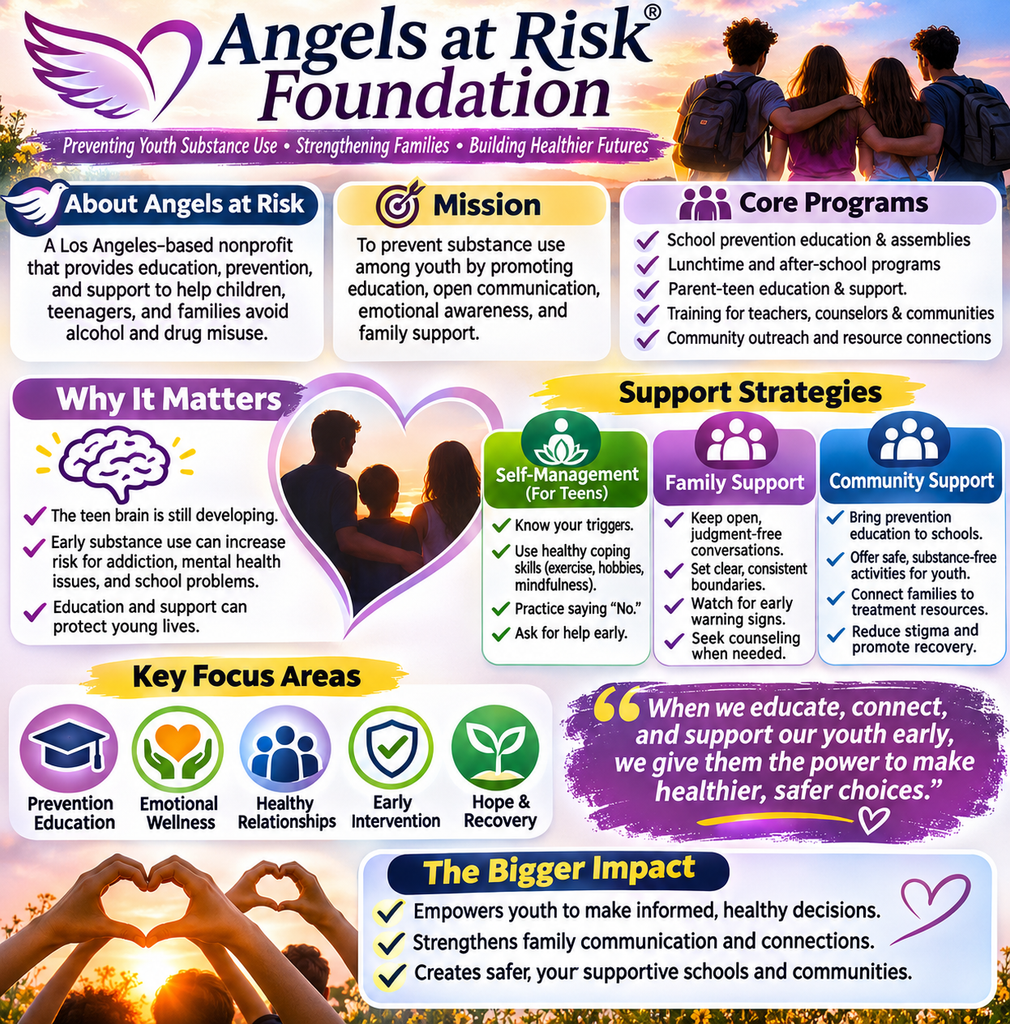
Angels at Risk is a Los Angeles-based nonprofit organization dedicated to helping children, teenagers, and families understand and prevent alcohol and drug misuse. Through prevention education, emotional learning, storytelling, school partnerships, and family engagement, the organization encourages open communication before substance use develops into a more serious problem.
Established as an educational initiative in 1997 and incorporated as an independent nonprofit in 2007, Angels at Risk has worked to bring addiction prevention into schools and communities. Its approach emphasizes early intervention, emotional awareness, and supportive relationships. Wikipedia+1
The foundation’s philosophy offers an important message: Addiction prevention begins with education, but lasting protection also requires trust, emotional connection, and accessible support.
Understanding the organization’s history and programs provides valuable lessons for young people, parents, educators, healthcare professionals, and community leaders.
The History and Mission of Angels at Risk
Angels at Risk grew from the belief that substance use prevention should begin early and involve entire families rather than focusing exclusively on young people.
The organization was developed by addiction prevention advocate Susie Spain, alongside supporters including actors Ted Danson and Mary Steenburgen, as well as other community leaders.
Spain’s personal experience with addiction and recovery helped shape the organization’s compassionate, family-centered approach. In a published account, she described wanting to help young people and families avoid the isolation she experienced during her own struggles. SMDP+1
Rather than relying solely on warnings about the dangers of drugs and alcohol, Angels at Risk emphasizes emotional learning and meaningful conversations.
Its mission includes:
- Preventing alcohol and drug misuse among children and teenagers.
- Encouraging communication between parents and adolescents.
- Increasing awareness of emotional and mental health challenges.
- Helping schools recognize early signs of substance use.
- Reducing the stigma associated with addiction and treatment.
- Connecting families with counseling and community resources.
The organization recognizes that substance use problems often affect the entire family system, making prevention a shared responsibility.
Understanding the Importance of Early Addiction Prevention
Adolescence is a critical period of neurological, emotional, and social development.
During these years, the brain continues developing systems responsible for judgment, impulse control, emotional regulation, and long-term decision-making.
Young people may experiment with substances because of curiosity, peer pressure, emotional distress, family circumstances, or a desire to belong.
Early substance exposure is associated with an increased risk of later substance use disorders, although not every teenager who experiments with alcohol or drugs develops addiction.
Common risk factors for adolescent substance use
- Family history of substance use disorders.
- Untreated anxiety, depression, or other mental health conditions.
- Exposure to alcohol or drugs within social environments.
- Bullying, social isolation, or chronic stress.
- Adverse childhood experiences.
- Limited parental supervision or inconsistent boundaries.
- Poor access to mental health services.
- Peer groups where substance use is normalized.
Protective factors include supportive family relationships, school connectedness, positive peer influences, emotional coping skills, and access to appropriate healthcare.
Angels at Risk attempts to strengthen these protective factors through education and communication.
Angels at Risk’s Prevention Education Programs
The organization describes several educational approaches designed to reach students, parents, teachers, counselors, and community members.
Its reported activities include classroom speakers, school assemblies, lunchtime and after-school programs, parent-teen education, and professional training. Programs & Services
School-based prevention education
Educational sessions help students explore the emotional, social, and health consequences of substance use.
Topics may include:
- Alcohol and drug-related risks.
- Peer pressure and decision-making.
- Mental health and emotional well-being.
- Healthy coping strategies.
- Communication with trusted adults.
- Recognizing when professional help is needed.
Lunchtime and after-school programs
These programs create opportunities for students to discuss challenges in less formal settings.
Supportive environments can encourage adolescents to share concerns they might otherwise keep hidden.
Parent-teen education
Family-focused activities emphasize listening, communication, and mutual understanding.
Parents learn ways to discuss difficult subjects without immediately resorting to punishment or criticism.
Professional and community training
Teachers, counselors, and community members receive prevention education intended to improve awareness and strengthen connections between schools and families.
These initiatives reflect the organization’s belief that substance use prevention is most effective when young people are surrounded by informed and supportive adults.
Self-Management Strategies: Helping Teenagers Make Healthy Choices
Self-management involves recognizing emotions, understanding personal risk factors, and developing healthier responses to stress and peer pressure.
Although young people benefit from adult guidance, teaching age-appropriate self-management skills can strengthen resilience and decision-making.
A. Develop emotional awareness
Teenagers should learn to identify emotions such as sadness, anxiety, frustration, anger, and loneliness.
Helpful strategies include:
- Keeping a daily mood journal.
- Identifying situations that cause emotional distress.
- Practicing mindfulness and breathing exercises.
- Talking with a trusted adult about difficult experiences.
- Recognizing when emotions require professional support.
Emotional awareness can reduce reliance on unhealthy coping mechanisms.
B. Build healthy coping strategies
Teenagers need practical alternatives to alcohol and drug use.
Examples include:
- Participating in sports or physical activities.
- Exploring music, art, writing, or creative hobbies.
- Practicing relaxation techniques.
- Maintaining healthy sleep routines.
- Developing supportive friendships.
- Seeking counseling when stress becomes overwhelming.
These strategies are protective supports, not substitutes for treatment when a substance use disorder is present.
C. Practice refusal and decision-making skills
Young people may face pressure to experiment with substances.
Role-playing can help them develop confidence in declining offers.
For example:
“No thanks. I’m not interested. Let’s do something else.”
Students should understand that setting boundaries is an important part of protecting their health.
D. Recognize when to ask for help
Teenagers should know that seeking help does not mean they have failed.
Warning signs requiring additional support include persistent emotional distress, escalating substance use, declining academic performance, and withdrawal from family or friends.
Early professional evaluation can help identify problems before they become more severe.
Family Support Strategies: Building Trust and Preventing Addiction
Families play an important role in reducing the risk of substance use.
Angels at Risk places particular emphasis on improving communication between parents and children.
Strong family relationships do not eliminate every risk, but they can provide emotional security and make it easier for adolescents to discuss problems.
A. Encourage open communication
Parents should create opportunities for conversations about emotions, friendships, school experiences, and substance use.
Helpful approaches include:
- Asking open-ended questions.
- Listening without interrupting.
- Avoiding immediate accusations.
- Acknowledging emotional experiences.
- Discussing risks using age-appropriate information.
A teenager who feels heard may be more willing to disclose concerns.
B. Recognize early warning signs
Parents should pay attention to meaningful changes in behavior, including:
- Sudden academic difficulties.
- Unexplained changes in friendships.
- Increased secrecy.
- Unusual sleep patterns.
- Frequent intoxication or signs of substance exposure.
- Unexplained financial problems.
- Loss of interest in previously enjoyable activities.
These signs are not specific to addiction and may reflect other medical, emotional, or developmental concerns.
A professional assessment can help determine the underlying cause.
C. Establish clear boundaries
Consistent expectations can help adolescents understand family values and safety requirements.
Parents can:
- Communicate clear rules about alcohol and drug use.
- Monitor medication storage.
- Maintain appropriate supervision.
- Discuss consequences calmly and consistently.
- Model responsible attitudes toward substances.
- Encourage honesty rather than secrecy.
D. Participate in family counseling
When substance use or significant family conflict occurs, professional family therapy may improve communication and strengthen relationships.
Evidence-based approaches such as multidimensional family therapy and functional family therapy can be useful for selected adolescents and families.
E. Avoid shame and blame
Punishment and humiliation may discourage teenagers from asking for help.
Families should focus on safety, accountability, understanding, and access to treatment.
Community Support: Schools, Healthcare Professionals, and Local Organizations
Angels at Risk demonstrates how community partnerships can expand addiction prevention efforts.
Its reported work has included partnerships with public and private schools in the Los Angeles area, including Green Dot Public Schools, Beverly Hills Unified School District, and Crossroads School for Arts and Sciences. Programs & Services
Strategies for schools
Schools can strengthen prevention by:
- Integrating evidence-informed substance use education.
- Providing confidential access to counselors.
- Teaching social and emotional learning skills.
- Establishing clear referral procedures.
- Addressing bullying and school-related stress.
- Encouraging positive peer relationships.
Strategies for healthcare professionals
Healthcare professionals can support prevention through routine screening, brief interventions, and appropriate referrals.
For adolescents, validated screening tools such as CRAFFT may help identify risky substance use.
Healthcare providers should also assess co-occurring mental health conditions and explain confidentiality protections and their limits.
Strategies for community organizations
Community organizations can:
- Sponsor prevention workshops.
- Offer substance-free recreational activities.
- Train adults to recognize overdose symptoms.
- Support youth mentorship programs.
- Provide accessible family education.
- Partner with addiction treatment facilities.
- Promote stigma-free recovery resources.
These activities can reinforce prevention messages outside school and home environments.
The Role of Social and Emotional Learning in Addiction Prevention
A distinctive feature of Angels at Risk is its emphasis on social and emotional learning, often called SEL.
SEL focuses on skills such as self-awareness, emotional regulation, relationship building, empathy, and responsible decision-making.
The organization uses storytelling and shared experiences to make prevention education relatable to young people.
Five important emotional skills
Self-awareness: Recognizing emotions, strengths, vulnerabilities, and personal triggers.
Self-management: Managing stress, impulses, and emotional reactions.
Social awareness: Understanding others’ feelings and perspectives.
Relationship skills: Communicating effectively, resolving conflicts, and seeking support.
Responsible decision-making: Considering consequences and making safer choices.
Research supports the value of well-designed social and emotional learning programs for improving various developmental outcomes. However, SEL alone should not be presented as a guaranteed method of preventing addiction.
The strongest prevention approaches combine evidence-based education, family involvement, supportive school environments, and access to appropriate services.
Recognizing the Connection Between Mental Health and Teen Substance Use
Some adolescents use alcohol or drugs to cope with anxiety, depression, trauma-related symptoms, or social discomfort.
This pattern is sometimes described as self-medication.
Although substances may temporarily reduce emotional discomfort, repeated use can worsen mental health symptoms and increase the risk of dependence.
Recommended interventions
- Screen for depression, anxiety, trauma exposure, and substance use.
- Provide access to adolescent-focused behavioral healthcare.
- Use evidence-based interventions such as cognitive behavioral therapy when indicated.
- Encourage family participation when clinically appropriate.
- Monitor safety concerns, including self-harm and overdose risk.
- Coordinate care among families, schools, and healthcare professionals while respecting confidentiality.
Adolescents with significant substance use problems should receive individualized treatment rather than relying exclusively on school prevention activities.
How Angels at Risk Helps Reduce Addiction Stigma
Stigma remains a major barrier to early intervention and treatment.
Young people may fear being labeled as irresponsible, weak, or troubled if they admit to using substances.
Parents may also hesitate to seek help because they worry about embarrassment or judgment.
Angels at Risk attempts to reduce these barriers by encouraging conversations that normalize asking for support.
Ways to reduce stigma
- Use respectful, person-first language.
- Avoid labeling young people as addicts or failures.
- Recognize addiction as a treatable health condition.
- Encourage recovery stories that offer realistic hope.
- Protect confidentiality.
- Educate families about treatment options.
- Emphasize that seeking help demonstrates courage and self-awareness.
Reducing stigma can make prevention and treatment services more approachable.
Creating a Family and Community Addiction Prevention Action Plan
A practical prevention plan can help families and communities move from awareness to action.
| Area | Recommended action |
|---|---|
| Individual | Learn healthy coping skills and identify trusted adults |
| Family | Schedule regular, judgment-free conversations |
| School | Provide evidence-informed prevention education and counseling referrals |
| Healthcare | Screen for substance use and mental health concerns |
| Community | Support youth programs and accessible treatment |
| Emergency preparedness | Provide overdose recognition education and naloxone access where appropriate |
Additional steps for families
- Discuss alcohol and drug risks before adolescence whenever developmentally appropriate.
- Keep prescription medications secured.
- Monitor changes in emotional well-being and behavior.
- Encourage positive friendships and extracurricular involvement.
- Identify local mental health and addiction resources.
- Seek professional guidance promptly when concerning patterns emerge.
Prevention is an ongoing process, not a single conversation.
Challenges Facing Youth Addiction Prevention Organizations
Organizations such as Angels at Risk may encounter several barriers when delivering prevention services.
These include limited funding, competing school priorities, differences in community resources, and persistent stigma.
Evaluating prevention outcomes can also be challenging because changes in substance use behavior may take years to observe.
Opportunities for improvement
- Expand culturally responsive education.
- Increase access to rural and underserved communities.
- Integrate prevention into routine school health programs.
- Strengthen partnerships with pediatric and adolescent healthcare providers.
- Use validated measures to evaluate program effectiveness.
- Provide accessible resources in multiple languages.
- Develop sustainable funding for long-term prevention efforts.
These recommendations are broader public health strategies and are not necessarily existing Angels at Risk programs.
The Bigger Message: Prevention Begins With Connection
The work of Angels at Risk highlights a central principle of adolescent substance use prevention: young people benefit when they feel connected, supported, and understood.
Education about drugs and alcohol is important, but information alone may not be enough.
Young people also need safe environments, emotional coping skills, positive relationships, and opportunities to seek help without fear of humiliation.
Families need education and guidance.
Schools need appropriate resources.
Communities need accessible prevention and treatment services.
When these systems work together, they can reduce risk factors and strengthen protective influences throughout adolescence.
Conclusion: Angels at Risk and the Power of Early Intervention
Angels at Risk represents a community-centered approach to youth addiction prevention.
Through school-based education, family communication, storytelling, and social and emotional learning, the organization helps young people make healthier decisions and connects families with support.
Its history demonstrates how personal experiences with addiction and recovery can inspire broader prevention efforts.
The organization’s work also reinforces that addiction prevention should not focus exclusively on warning teenagers about the dangers of substances. It should help them build emotional resilience, meaningful relationships, and the confidence to ask for help.
For individuals, prevention begins with self-awareness and healthy coping strategies.
For families, it begins with communication, compassion, and consistent boundaries.
For communities, it requires accessible services, supportive schools, and collaborative prevention programs.
The most powerful message of Angels at Risk is that early education, meaningful connections, and timely support can help change the course of a young person’s life.
Addiction Prevention and Family Support Resources
For families seeking prevention education or treatment resources:
- Angels at Risk — Official Website
- Substance Abuse and Mental Health Services Administration
- FindTreatment.gov — Treatment Locator
- Partnership to End Addiction — Family Resources
SAMHSA’s National Helpline is available at 1-800-662-HELP (4357). For immediate mental health crises, call or text 988. For suspected overdose or another medical emergency, call 911.
Frequently Asked Questions and Answers
1. What is Angels at Risk Foundation?
Angels at Risk is a Los Angeles-based nonprofit organization focused on youth substance use prevention and education.
The organization works to help children, teenagers, parents, educators, and communities understand the risks associated with alcohol and drug misuse.
Its approach emphasizes emotional awareness, family communication, early intervention, and access to appropriate support services.
2. What is the mission of Angels at Risk?
The organization’s mission is to help prevent alcohol and drug misuse among young people through education, awareness, and meaningful relationships.
Its primary objectives include:
- Educating teenagers about substance use risks.
- Encouraging communication between parents and children.
- Supporting emotional and mental health awareness.
- Promoting healthy decision-making.
- Helping families recognize early warning signs.
- Reducing stigma surrounding addiction.
- Encouraging timely intervention and treatment.
3. Who founded Angels at Risk?
Angels at Risk was developed by addiction prevention advocate Susie Spain, whose personal experiences with addiction and recovery helped inspire its mission.
Actors Ted Danson and Mary Steenburgen have also supported the organization and its prevention efforts.
The organization’s history demonstrates how lived experiences with addiction can inspire initiatives that help families and communities.
4. When was Angels at Risk established?
Angels at Risk traces its educational work to 1997 and became an independent nonprofit organization in 2007.
Over time, its work expanded to include school-based prevention education, parent-teen communication, and community outreach.
5. Why is Angels at Risk important?
Adolescence is a critical period for emotional, social, and neurological development.
Early exposure to alcohol and drugs can increase the likelihood of later substance use problems, especially when combined with other risk factors.
Angels at Risk promotes early education and supportive relationships to help young people make informed decisions and seek help when needed.
Angels at Risk Programs and Prevention Education
6. What educational programs does Angels at Risk provide?
Angels at Risk reports several prevention education activities, including:
- Classroom presentations and school assemblies.
- Lunchtime and after-school prevention programs.
- Parent-teen education initiatives.
- Training workshops for teachers, counselors, and community members.
- Public awareness campaigns.
- Partnerships with schools and other organizations.
Its educational approach uses storytelling and social-emotional learning to encourage discussion and strengthen awareness. Program offerings may vary by school and year. Programs & Services
7. How does Angels at Risk help teenagers avoid substance use?
The organization encourages young people to recognize the consequences of substance use, develop emotional awareness, and communicate with trusted adults.
Its prevention approach emphasizes understanding personal challenges rather than relying exclusively on fear-based messages.
Teenagers are encouraged to develop healthy coping skills, supportive friendships, and confidence in asking for help.
8. What is social-emotional learning, and how does it relate to addiction prevention?
Social-emotional learning (SEL) teaches skills that help individuals understand emotions, build relationships, and make responsible decisions.
Important skills include:
- Self-awareness.
- Emotional regulation.
- Empathy.
- Healthy communication.
- Problem-solving.
- Responsible decision-making.
These skills can strengthen protective factors associated with lower substance use risk. However, SEL alone does not guarantee addiction prevention.
9. Does Angels at Risk work directly with schools?
Yes. The organization has reported partnerships with public and private schools, including Green Dot Public Schools, Beverly Hills Unified School District, and Crossroads School for Arts and Sciences.
Its school-based programs include classroom speakers, assemblies, and small-group prevention activities. Programs & Services
10. Does Angels at Risk provide addiction treatment?
Angels at Risk primarily focuses on prevention education, awareness, and connections to supportive resources.
Its educational programs should not be confused with comprehensive medical addiction treatment.
Teenagers experiencing substance use disorders may need professional assessment, behavioral therapy, family-based interventions, and other individualized treatment services.
Self-Management Strategies for Teenagers
11. What self-management skills can help teenagers avoid alcohol and drugs?
Healthy self-management skills help teenagers respond to stress without relying on substances.
Recommended strategies include:
- Identifying emotional triggers.
- Practicing mindfulness and relaxation.
- Maintaining healthy sleep and exercise routines.
- Developing hobbies and interests.
- Choosing supportive friendships.
- Practicing refusal skills.
- Seeking help when emotional problems become overwhelming.
12. Why do some teenagers experiment with alcohol or drugs?
Teenagers may experiment with substances because of curiosity, peer pressure, emotional distress, social influences, or a desire for acceptance.
Other contributing factors may include family history, trauma exposure, untreated mental health conditions, and easy access to substances.
Experimentation does not automatically mean addiction, but early and repeated use can increase the risk of developing a substance use disorder.
13. How can teenagers handle peer pressure involving drugs or alcohol?
Teenagers can practice simple refusal statements and prepare strategies for leaving uncomfortable situations.
For example:
“No thanks. I’m not interested.”
They can also arrange transportation, contact a trusted adult, or spend time with peers who respect their decisions.
14. How can teenagers recognize when they need help?
Warning signs may include increasing substance use, difficulty stopping, changes in school performance, emotional distress, withdrawal from friends, or continuing substance use despite negative consequences.
Teenagers should speak with a trusted adult, school counselor, or healthcare professional when these concerns arise.
Seeking help early can prevent additional harm.
Family Support and Addiction Prevention
15. How can parents help prevent substance use in their children?
Parents can reduce substance use risks by maintaining open communication, providing appropriate supervision, and establishing clear expectations.
Helpful actions include:
- Discussing substance use before problems develop.
- Listening without judgment.
- Modeling healthy coping behaviors.
- Monitoring medication storage.
- Knowing their children’s friends and activities.
- Encouraging participation in positive extracurricular activities.
- Seeking professional support when necessary.
16. What are the early warning signs of teenage substance use?
Potential warning signs include:
- Sudden changes in behavior or mood.
- Declining academic performance.
- Increased secrecy.
- Changes in friendships.
- Unexplained financial problems.
- Loss of interest in usual activities.
- Evidence of intoxication or substance-related items.
These symptoms can also reflect other medical or mental health concerns. Parents should avoid assuming that behavioral changes automatically indicate addiction.
17. How should parents respond if they discover their teenager is using drugs?
Parents should prioritize safety and begin a calm, supportive conversation.
Rather than immediately using punishment or accusations, they should ask questions, listen, and assess the seriousness of the situation.
A healthcare professional can evaluate substance use patterns, mental health symptoms, and the need for treatment.
18. Can family communication reduce the risk of addiction?
Supportive family communication is an important protective factor.
Teenagers who feel comfortable discussing difficult situations may be more likely to seek help before problems escalate.
Communication is most effective when combined with consistent boundaries, appropriate supervision, and access to professional services.
19. What should parents avoid when discussing addiction?
Parents should avoid shaming, humiliating, threatening, or labeling their children.
These approaches may increase secrecy and discourage honest communication.
Instead, parents should focus on safety, understanding, accountability, and problem-solving.
20. Can family counseling help teenagers with substance use problems?
Yes. Family-based interventions can be effective components of adolescent substance use treatment.
Approaches such as multidimensional family therapy and functional family therapy may improve communication, address family conflict, and support healthier behaviors.
Treatment should be selected according to the teenager’s needs and family circumstances.
Community Support and Mental Health
21. How can communities support the mission of Angels at Risk?
Communities can strengthen prevention by supporting schools, families, and youth-focused organizations.
Important actions include:
- Providing evidence-based substance use education.
- Expanding access to adolescent mental health services.
- Supporting mentorship programs.
- Offering substance-free recreational activities.
- Training adults to recognize warning signs.
- Reducing stigma surrounding addiction.
- Connecting families with appropriate treatment resources.
22. Why is mental health education important in addiction prevention?
Mental health difficulties can increase vulnerability to substance misuse, particularly when young people use alcohol or drugs to manage anxiety, depression, or emotional distress.
Mental health education can help teenagers recognize symptoms, develop coping strategies, and seek assistance.
Early identification and appropriate treatment of co-occurring mental health conditions are important components of comprehensive prevention.
23. How can schools recognize students who may be at risk?
Schools can identify potential concerns through behavioral observations, supportive conversations, and established referral procedures.
Teachers and counselors should watch for persistent academic difficulties, emotional distress, social withdrawal, or signs of substance use.
Students should be approached respectfully, with attention to confidentiality and appropriate parental involvement.
24. How does Angels at Risk help reduce addiction stigma?
The organization encourages open conversations about substance use, emotional challenges, and the importance of seeking support.
Its storytelling approach is intended to help young people and families recognize that they are not alone.
Reducing stigma can make it easier for individuals to discuss concerns and access assistance.
25. Can prevention education eliminate teenage addiction?
No prevention program can guarantee that every teenager will avoid substance use or addiction.
However, comprehensive prevention efforts can reduce risk factors and strengthen protective influences.
Effective prevention combines education, family engagement, supportive school environments, mental health services, and community resources.
Supporting Angels at Risk and Finding Help
26. How can someone support Angels at Risk?
Individuals interested in supporting the organization can explore volunteering, fundraising, donations, and potential educational partnerships.
Schools and community organizations may also contact Angels at Risk to inquire about prevention presentations or collaboration opportunities.
Visit the Angels at Risk official website for information about current opportunities.
27. Is Angels at Risk a registered nonprofit organization?
Yes. Angels at Risk is listed as a 501(c)(3) nonprofit organization headquartered in Los Angeles, California, with EIN 26-1100549.
Its public nonprofit records identify substance use prevention and youth education as primary activities. Rating for Angels at Risk+1
28. Where can parents find additional addiction prevention resources?
Families can access educational materials, treatment information, and support through several national organizations.
- SAMHSA — Substance use prevention and treatment information.
- Partnership to End Addiction — Family education and guidance.
- FindTreatment.gov — Substance use and mental health treatment locator.
- 988 Suicide & Crisis Lifeline — Emotional and mental health crisis support.
For suspected overdose or another immediate medical emergency, call 911.
Video: