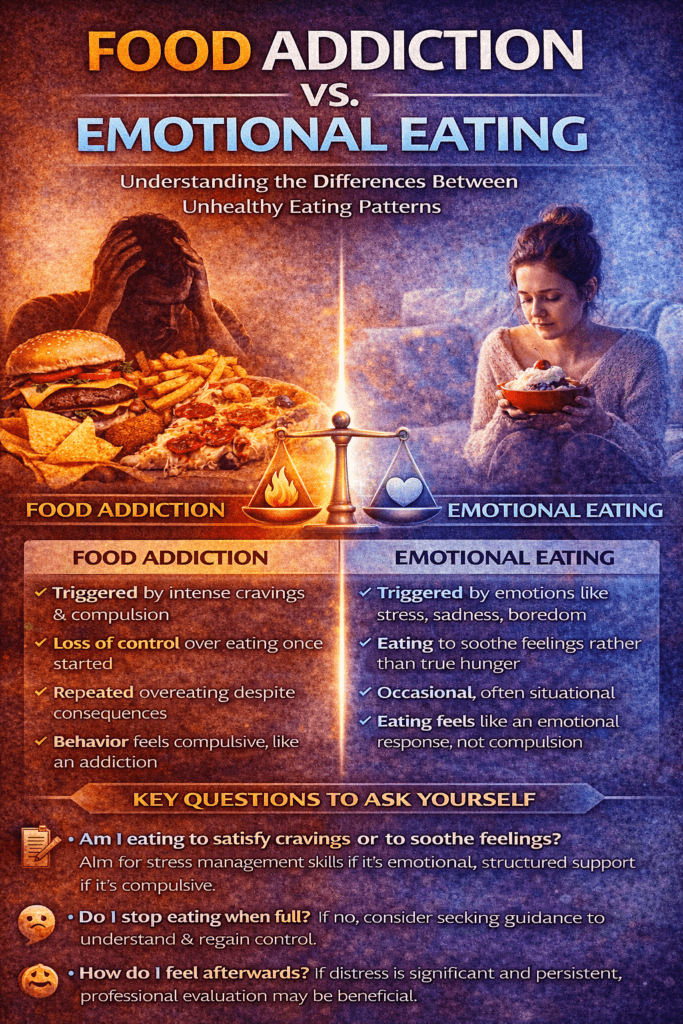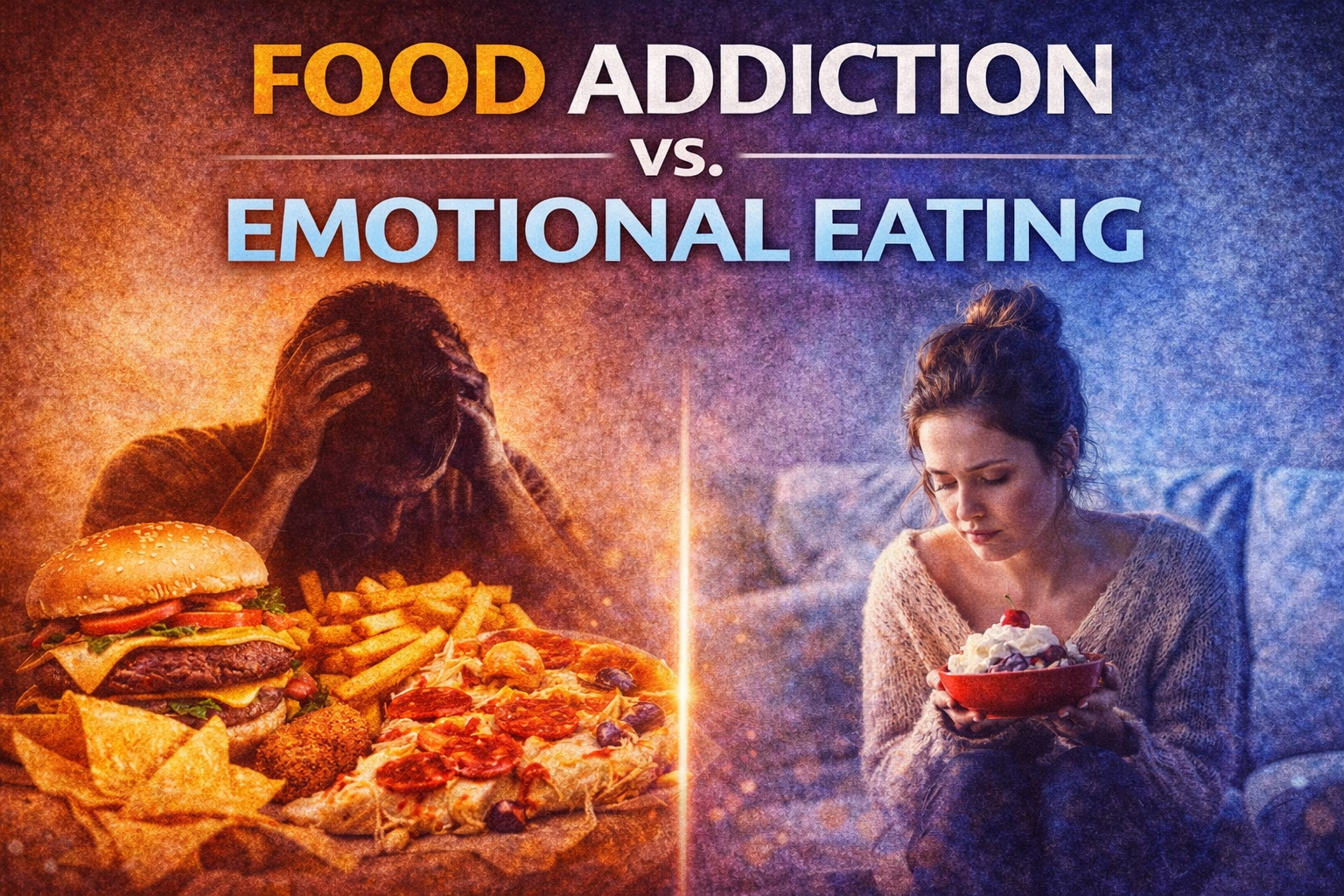
The distinction between food addiction and emotional eating is an important but often misunderstood topic in nutrition and behavioral health. Both involve eating that is not driven by physical hunger, yet they differ in intensity, frequency, and underlying mechanisms. Emotional eating is typically a response to feelings such as stress, boredom, or sadness, and is a common human coping behavior. Food addiction–like patterns, in contrast, involve stronger cravings, diminished control, and repeated overeating despite negative consequences. Understanding where these behaviors overlap—and where they diverge—helps individuals, families, and professionals recognize patterns accurately and respond with the most appropriate strategies and support.
Food Addiction vs. Emotional Eating: Where’s the Fine Line?
In conversations about nutrition and mental health, the terms food addiction and emotional eating are often used interchangeably—but they are not the same. While both involve complex relationships with food, they differ in underlying mechanisms, severity, and treatment needs. Understanding the distinction is essential for recognizing warning signs, reducing stigma, and choosing effective strategies for change.
What Is Emotional Eating?
Emotional eating refers to using food—often comfort foods high in sugar, fat, or salt—to cope with feelings rather than hunger. People may eat when stressed, bored, lonely, or anxious. This pattern is common and does not automatically indicate a disorder.
Key features:
- Triggered by emotions rather than physical hunger
- Often situational or occasional
- Usually involves specific comfort foods
- Awareness and control are generally intact
Emotional eating becomes concerning when it is the primary coping mechanism for distress or begins interfering with health, mood, or daily functioning.
What Is Food Addiction?
Food addiction is a more severe pattern characterized by compulsive eating behaviors, loss of control, and continued overeating despite negative consequences. Research suggests that highly processed foods can stimulate brain reward pathways in ways similar to addictive substances, especially in vulnerable individuals.
Key features:
- Cravings that feel intense or intrusive
- Loss of control over the amount consumed
- Repeated unsuccessful attempts to cut down
- Continued overeating despite health or emotional consequences
- Possible withdrawal-like symptoms (irritability, restlessness when restricting certain foods)
Unlike emotional eating, food addiction often involves neurological reward changes and behavioral compulsion.
The Overlap: Why the Line Can Be Blurry
The distinction is not always clear because emotional eating can evolve into compulsive patterns over time. For example:
- Someone may start eating for comfort during stress.
- The behavior becomes habitual.
- Brain reward pathways reinforce the pattern.
- Cravings intensify, and control weakens.
At this stage, the behavior may resemble addiction more than occasional emotional coping.
Key Differences at a Glance
| Feature | Emotional Eating | Food Addiction |
|---|---|---|
| Trigger | Emotional state | Cravings/compulsion |
| Control | Usually intact | Often impaired |
| Frequency | Occasional | Persistent |
| Awareness | Recognizes pattern | May feel unable to stop |
| Impact | Mild–moderate | Often significant |
Why Understanding the Difference Matters
Mislabeling emotional eating as addiction can create unnecessary shame, while dismissing addiction as “just emotional eating” can delay needed support. Each requires different approaches:
- Emotional eating often responds well to stress management, therapy, and coping skills.
- Food addiction–like patterns may require structured treatment, behavioral therapy, nutritional guidance, and sometimes clinical support.
Accurate understanding leads to targeted, effective intervention.
Signs It May Be Time to Seek Help
Consider professional guidance if eating behaviors:
- Feel out of control
- Cause distress or guilt
- Affects physical health
- Interfere with work, relationships, or mood
- Continue despite efforts to change
Early support can prevent patterns from becoming more entrenched.
Conclusion
The fine line between emotional eating and food addiction lies in control, intensity, and impact. Emotional eating is a common human response to stress, while food addiction involves compulsive patterns that resemble other behavioral addictions. Recognizing where someone falls on this spectrum is not about labeling—it’s about understanding. With insight, compassion, and the right support, individuals can develop healthier relationships with food and address the emotional needs beneath their eating behaviors.
Self-Management Strategies to Differentiate Between Food Addiction vs. Emotional Eating
Understanding whether your eating patterns reflect emotional eating or a more compulsive, addiction-like relationship with food can be challenging. Both involve urges to eat that are not driven by physical hunger, but they differ in intensity, frequency, and degree of control. Self-management strategies can help you observe your behavior objectively, recognize patterns, and determine whether your relationship with food is primarily emotional, habitual, or compulsive. This awareness is the first step toward choosing the right support and intervention.
1. Track Triggers and Patterns
Keeping a food-and-mood journal is one of the most effective self-assessment tools. Record:
- What you ate
- When you ate
- Your emotional state beforehand
- Hunger level (1–10 scale)
- Feelings afterward
What to look for:
- Emotional eating tends to follow specific emotional triggers (stress, sadness, boredom).
- Addiction-like eating often occurs regardless of mood and may feel automatic or urgent.
2. Test Your Sense of Control
A simple self-check is to set a gentle limit, such as delaying a craving for 15–20 minutes or reducing portion size.
- If the urge fades or becomes manageable → more consistent with emotional eating.
- If the urge intensifies and feels impossible to resist → may indicate compulsive patterns.
This is sometimes called a behavioral pause test, and it helps assess impulse strength.
3. Identify Hunger vs. Urge Signals
Physical hunger develops gradually and can be satisfied with a variety of foods. Emotional or compulsive urges tend to:
- Appear suddenly
- Focus on specific foods (often highly processed)
- Feel urgent or intrusive
Learning to distinguish these sensations helps clarify whether eating is driven by physiology or emotion.
4. Monitor Frequency and Consistency
Ask yourself:
- How often does this happen?
- Does it occur daily or occasionally?
- Does it happen even when I’m not stressed?
Occasional emotional eating is common and typically manageable. Persistent, repetitive episodes—especially when they feel automatic—may suggest deeper behavioral conditioning.
5. Observe Emotional Aftereffects
After eating, reflect on how you feel:
- Emotional eating often brings temporary relief followed by mild regret.
- Addiction-like eating may lead to stronger guilt, shame, or a sense of loss of control.
The intensity of emotional aftermath can provide clues about the underlying pattern.
6. Evaluate Attempts to Change
Consider past efforts:
- Were you able to modify habits when motivated?
- Or did attempts repeatedly fail despite strong intentions?
Repeated unsuccessful attempts to change behavior are a hallmark sign of compulsive patterns rather than situational emotional eating.
7. Use Structured Self-Reflection Questions
Regularly ask yourself:
- Am I eating to solve a feeling or to satisfy hunger?
- Do I feel in control of when I stop eating?
- Do cravings feel like suggestions or commands?
Your answers can reveal whether the behavior is flexible (emotional eating) or rigid (a compulsive pattern).
Why Self-Differentiation Matters
Understanding the difference is not about labeling yourself—it’s about choosing the right strategy. Emotional eating often improves with stress management, coping skills, and emotional awareness. Compulsive eating patterns may require more structured approaches, such as therapy, behavioral interventions, or professional guidance. Misidentifying the pattern can lead to frustration or ineffective solutions.
Conclusion
The distinction between food addiction and emotional eating lies in control, intensity, and repetition. Self-management strategies—such as tracking triggers, testing control, monitoring frequency, and reflecting on emotional responses—can help clarify where your eating patterns fall on the spectrum. This awareness empowers you to respond with the appropriate tools, whether that means strengthening coping skills or seeking structured support. Ultimately, understanding your relationship with food is an act of self-knowledge, not self-judgment—and it opens the door to healthier, more balanced habits.
Family Support Strategies to Differentiate Between Food Addiction vs. Emotional Eating
Families often notice eating patterns long before individuals recognize them themselves. When concerns arise, loved ones may wonder whether the behavior reflects emotional eating—a common response to stress—or a more persistent, compulsive pattern resembling food addiction. Understanding the difference is important because each requires different types of support. Emotional eating is usually situational and tied to feelings, while addiction-like eating involves stronger cravings, reduced control, and repeated behavior despite consequences. Families can play a key role in helping distinguish between the two through observation, communication, and structured support.
1. Observe Patterns, Not Isolated Moments
Families should look for consistent trends rather than single episodes. Occasional stress-related snacking is common and usually temporary. However, warning signs that suggest a deeper pattern include:
- Eating large amounts rapidly or secretly
- Repeated episodes despite negative consequences
- Frequent intense cravings
- Difficulty stopping once eating begins
Consistency and repetition often indicate something more than situational emotional eating.
2. Notice Triggers and Context
Emotional eating usually follows identifiable feelings—stress, sadness, boredom, or anxiety. Families can gently observe whether eating episodes consistently occur after emotional events. If eating seems unrelated to mood or occurs even when the person feels calm or content, it may suggest habit-driven or compulsive patterns rather than emotion-based behavior.
3. Watch for Signs of Control or Loss of Control
A key difference between emotional eating and addiction-like behavior is the ability to regulate intake. Families may notice:
- Emotional eating → a person can stop when full or distracted
- Compulsive eating → person struggles to stop despite intention
Loss of control is one of the strongest indicators that professional assessment may be helpful.
4. Encourage Open, Nonjudgmental Conversations
Supportive dialogue helps clarify what the individual is experiencing internally. Families can ask gentle, curiosity-based questions such as:
- “Do you feel hungry or stressed when this happens?”
- “Do cravings feel manageable or overwhelming?”
- “How do you feel after eating?”
Avoiding blame or criticism encourages honesty, which helps clarify whether the behavior is emotional coping or a compulsive habit.
5. Monitor Emotional Aftereffects
How someone feels after eating can provide clues:
- Emotional eating → brief comfort followed by mild regret
- Addiction-like eating → stronger guilt, shame, or distress
Families who notice intense emotional reactions can use that information to guide supportive discussions.
6. Support Healthy Coping Alternatives
Families can help test whether eating is emotionally driven by encouraging alternative coping strategies—such as walking, talking, creative activities, or relaxation exercises. If urges decrease when emotional needs are met, the behavior is likely emotional eating. If urges persist despite emotional relief, a deeper behavioral pattern may be involved.
7. Encourage Professional Guidance When Needed
Families are not responsible for diagnosing eating patterns, but they can encourage evaluation when behaviors appear persistent, distressing, or out of control. Dietitians, therapists, and healthcare professionals can assess whether patterns reflect emotional coping, disordered eating, or addiction-like tendencies.
Why Family Insight Is So Valuable
Individuals may struggle to see their own patterns clearly, especially when habits develop gradually. Families provide an external perspective that can identify changes in frequency, intensity, and control. Their observations help differentiate between occasional emotional responses and more ingrained behavioral patterns.
Conclusion
Distinguishing between food addiction and emotional eating requires careful attention to triggers, consistency, and control. Family support strategies—such as observing patterns, fostering open communication, encouraging healthy coping tools, and recognizing warning signs—can help clarify where someone falls on this spectrum. When families approach the issue with compassion rather than judgment, they create a safe environment for awareness, understanding, and positive change. Ultimately, supportive families don’t just notice patterns—they help guide loved ones toward healthier relationships with food and themselves.
Community Resource Strategies to Differentiate Between Food Addiction vs. Emotional Eating
Understanding the difference between food addiction and emotional eating can be difficult without guidance, especially because both involve urges to eat that are not driven by physical hunger. Emotional eating is typically situational and linked to feelings such as stress or sadness, while food addiction–like patterns involve stronger cravings, loss of control, and repeated behavior despite consequences. Community resources play a vital role in helping individuals distinguish between these patterns by providing education, screening tools, professional assessments, and supportive environments. When communities offer accessible, stigma-free services, they empower individuals to gain clarity and take appropriate steps toward healthier relationships with food.
1. Public Screening and Assessment Programs
Community health clinics, wellness fairs, and behavioral health centers often provide validated screening tools for eating behaviors. These assessments can help identify whether eating patterns are primarily emotion-driven or exhibit compulsive tendencies. Structured questionnaires administered by trained professionals offer objective insight that is difficult to achieve through self-reflection alone.
2. Nutrition Education Initiatives
Local organizations, schools, and public health departments frequently host workshops on nutrition and eating psychology. These programs teach participants how to recognize:
- Physical hunger vs. emotional hunger
- Cravings vs. nutritional needs
- Habitual eating patterns
- Warning signs of disordered eating
Education increases awareness, which is one of the strongest predictors of behavior change.
3. Access to Multidisciplinary Professionals
Communities that provide access to dietitians, therapists, physicians, and behavioral specialists allow individuals to receive comprehensive evaluations. Different professionals assess different aspects:
- Dietitians → nutritional patterns
- Therapists → emotional triggers
- Physicians → medical factors
- Behavioral specialists → habit loops
This collaborative approach improves accuracy when distinguishing emotional coping behaviors from addiction-like patterns.
4. Peer Support Groups
Support groups offer a real-life perspective from individuals experiencing similar struggles. Hearing others describe their eating patterns can help participants recognize similarities or differences in their own behavior. Peer discussions often clarify whether urges are situational and emotional or persistent and compulsive.
5. Mental Health and Stress-Management Programs
Since emotional eating is often tied to stress and mood, community-based mental health programs can help determine whether eating decreases when emotional coping skills improve. If stress reduction leads to improved eating habits, emotional eating is likely the primary issue. If urges persist despite emotional support, deeper behavioral conditioning may be at play.
6. Early Intervention and Prevention Services
Many communities now offer early intervention programs for individuals who notice concerning eating habits but do not yet meet the criteria for a disorder. These services may include brief counseling, coaching, or structured workshops that help identify patterns before they become severe. Early intervention helps differentiate temporary coping behaviors from developing compulsive cycles.
7. Awareness Campaigns and Public Health Messaging
Community awareness efforts reduce stigma and encourage individuals to seek help sooner. Educational campaigns explaining the spectrum between emotional eating and addictive patterns normalize the conversation and emphasize that both experiences are understandable and treatable.
Why Community Resources Matter
Distinguishing between food addiction and emotional eating is not always straightforward, especially when habits develop gradually. Community systems provide objective tools, expert insight, and supportive environments that help individuals move from uncertainty to understanding. These resources ensure that people do not have to navigate complex behavioral questions on their own.
Conclusion
The difference between emotional eating and food addiction lies in patterns of control, intensity, and persistence. Community resource strategies—such as screening programs, educational workshops, professional evaluations, peer support groups, and mental health services—help individuals identify where their behaviors fall on this spectrum. When communities invest in accessible, compassionate resources, they empower individuals to understand their eating habits accurately and choose the most effective path toward balanced health and well-being.
Frequently Asked Questions
Here are some common questions:
1. What is the main difference between food addiction and emotional eating?
Food addiction involves compulsive eating patterns, intense cravings, and difficulty controlling intake despite negative consequences. Emotional eating, on the other hand, is typically a response to feelings—such as stress or sadness—and is usually situational rather than constant.
2. Is emotional eating considered a disorder?
Not usually. Emotional eating is a common human behavior and does not automatically indicate a disorder. It becomes concerning when it happens frequently, feels uncontrollable, or negatively affects physical or emotional health.
3. Can emotional eating turn into food addiction?
In some cases, yes. Repeatedly using food as a coping mechanism can reinforce brain reward pathways, making cravings stronger and habits more automatic. Over time, this can develop into compulsive patterns if left unaddressed.
4. What triggers emotional eating most often?
Common triggers include stress, boredom, loneliness, anxiety, fatigue, or sadness. Emotional eating is usually linked to a specific feeling or situation rather than physical hunger.
5. What are the signs of food addiction–like behavior?
Possible indicators include:
- Intense cravings for specific foods
- Loss of control once eating starts
- Repeated unsuccessful attempts to cut back
- Eating despite negative consequences
- Feeling preoccupied with food
These patterns suggest a stronger behavioral drive than occasional emotional eating.
6. How can I tell if I’m physically hungry or emotionally hungry?
Physical hunger develops gradually, can be satisfied with many foods, and stops when full. Emotional hunger tends to appear suddenly, focuses on specific comfort foods, and may persist even after eating.
7. Do both conditions involve cravings?
Yes, but the intensity differs. Emotional eating cravings are often tied to mood and may pass with distraction. Food addiction cravings can feel urgent, intrusive, and difficult to ignore.
8. Does labeling something “food addiction” help or harm?
It depends on context. For some people, the term validates their experience and encourages them to seek treatment. For others, it may increase shame if misunderstood. The most helpful approach is focusing on patterns and support needs rather than labels.
9. How are they treated differently?
Emotional eating often improves with stress-management skills, emotional awareness, and lifestyle adjustments. Compulsive or addiction-like eating patterns may require structured interventions such as therapy, nutritional counseling, or behavioral treatment plans.
10. When should someone seek professional help?
Consider professional support if eating patterns:
- Feel out of control
- Cause distress or guilt
- Affect health or daily functioning
- Persist despite attempts to change
Early guidance can prevent behaviors from becoming more severe.
Conclusion
Recognizing the difference between emotional eating and food addiction is not about labeling or judging behavior; it is about gaining clarity and direction. Emotional eating often improves with stress management, emotional awareness, and healthier coping skills, while addiction-like eating patterns may require more structured intervention and professional guidance. When people understand the fine line between these experiences, they can choose solutions that match their needs rather than relying on trial and error. Ultimately, awareness fosters empowerment, reduces stigma, and supports the development of a balanced, sustainable relationship with food and overall well-being.
Video: Addictive vs Emotional Eating