Why do some teenagers turn to alcohol, vaping, marijuana, or other substances when facing emotional difficulties, while others develop healthier coping strategies?
One important factor is emotional understanding—the ability to recognize, interpret, express, and manage emotions effectively.
Adolescence is a period of significant physical, emotional, and neurological development. Teenagers experience increasing academic pressure, changing friendships, identity development, family expectations, and exposure to social media. These challenges can create intense emotions that may be difficult to understand or manage.
When teenagers lack effective coping skills, some may experiment with substances to escape anxiety, sadness, loneliness, rejection, or stress. Although substance use may temporarily change how they feel, it can lead to additional emotional, behavioral, and health problems.
Emotional understanding does not guarantee that a teenager will avoid substance use. Genetics, peer influences, substance availability, trauma, and other factors also contribute to addiction risk.
However, teaching teenagers emotional awareness, healthy coping skills, and effective communication can strengthen protective factors and support substance use prevention.
Parents, schools, healthcare professionals, and communities all play important roles in helping teenagers develop these skills.
Understanding Emotional Development During Adolescence
Adolescence is a developmental stage characterized by changes in emotional processing, decision-making, social relationships, and personal identity.
Brain regions involved in emotional responses and reward processing develop alongside systems responsible for planning, impulse control, and evaluating consequences.
These developmental differences may contribute to increased sensation-seeking and sensitivity to social rewards, particularly during emotionally intense situations.
However, teenagers are not inherently incapable of making responsible decisions. Their behavior is influenced by individual maturity, experience, environment, and available support.
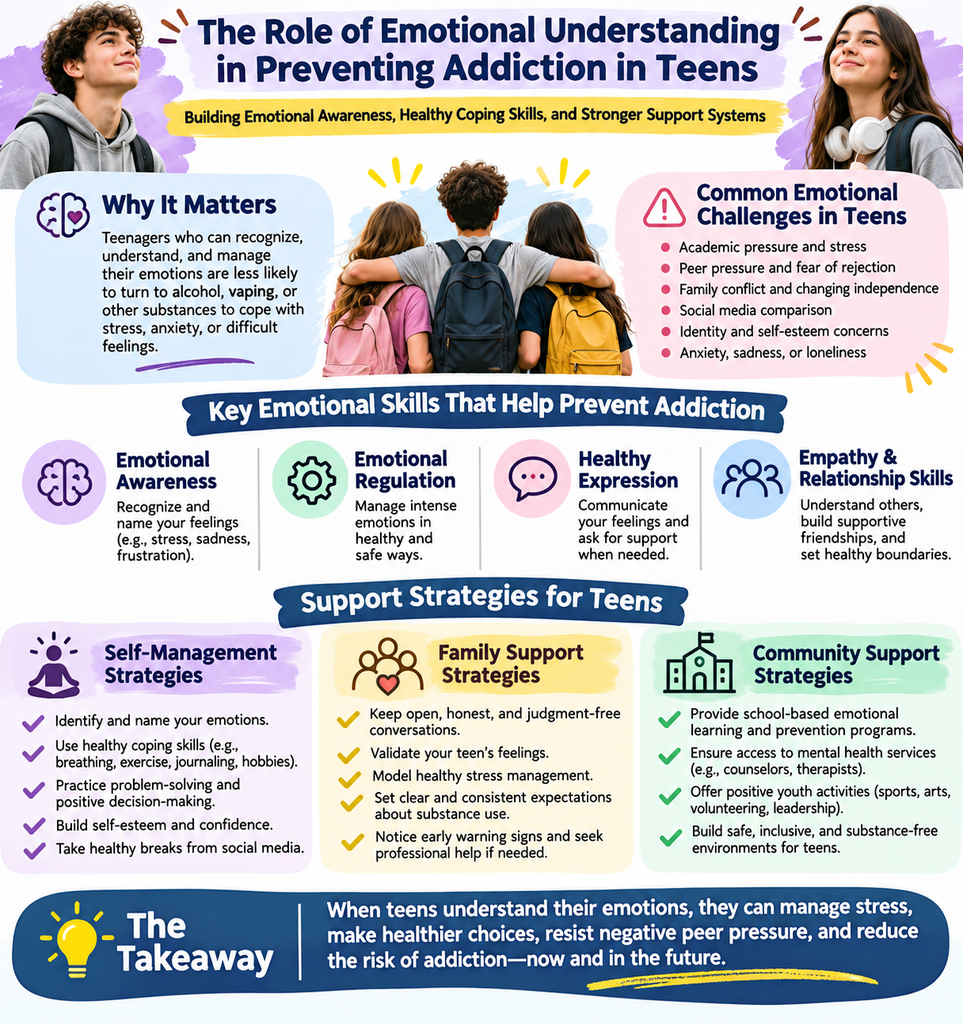
Common emotional challenges teenagers experience
- Academic pressure: Fear of failure, examinations, and expectations about future success.
- Peer acceptance: Desire to belong and concerns about social rejection.
- Family conflict: Disagreements involving independence, rules, and responsibilities.
- Social media comparison: Exposure to unrealistic lifestyles, appearance standards, and online criticism.
- Identity development: Questions about personal values, relationships, and future goals.
- Emotional distress: Anxiety, sadness, frustration, anger, and loneliness.
- Traumatic experiences: Bullying, abuse, significant losses, or exposure to violence.
Teenagers who understand their emotional responses may be better equipped to communicate their needs and seek support before difficulties escalate.
The Connection Between Emotional Distress and Teen Substance Use
Some adolescents use substances as a way to cope with uncomfortable emotions.
This behavior is sometimes described as self-medication, although not every teenager who uses substances is attempting to manage emotional distress.
For example, a teenager experiencing social anxiety may drink alcohol to feel more comfortable at a party. Another teenager may use cannabis in an attempt to relax after stressful school experiences.
Although substances can temporarily alter mood, repeated use may worsen emotional regulation and increase the risk of dependence.
Emotional factors that may increase vulnerability
- Persistent anxiety or depressive symptoms.
- Difficulty tolerating frustration.
- Poor emotional regulation.
- Low self-esteem.
- Unresolved trauma or grief.
- Chronic family conflict.
- Social isolation.
- Limited access to supportive adults.
Mental health conditions and substance use disorders can also influence one another. Substance use may worsen psychiatric symptoms, while untreated emotional difficulties may contribute to substance-related risk.
Early recognition and appropriate treatment can help address these interconnected concerns.
Why Emotional Intelligence Matters in Addiction Prevention
Emotional intelligence refers broadly to skills involved in recognizing, understanding, expressing, and managing emotions.
These abilities can help teenagers respond more effectively to stress, relationships, and difficult decisions.
Four important emotional skills
1. Emotional awareness
Recognizing feelings such as sadness, jealousy, embarrassment, frustration, or fear instead of experiencing them as unexplained distress.
2. Emotional regulation
Learning to manage intense emotions without impulsive or harmful behaviors.
3. Healthy emotional expression
Communicating feelings appropriately and asking for help when necessary.
4. Empathy and relationship skills
Understanding other people’s perspectives while developing healthy boundaries and supportive friendships.
These skills may reduce vulnerability to unhealthy coping behaviors. School-based social-emotional learning programs can improve emotional and social competencies, although their effects on substance use vary across programs and populations.
Self-Management Strategies: Teaching Teens to Understand Their Emotions
Teenagers benefit from practical skills they can use independently when experiencing emotional distress.
Self-management does not mean handling every problem alone. It means developing the ability to recognize emotions, make safer decisions, and seek help when needed.
Identify and name emotions
Teenagers sometimes describe their feelings using general statements such as “I’m stressed” or “I’m upset.”
Encouraging more specific emotional language can improve self-awareness.
For example:
- “I feel embarrassed because my friends excluded me.”
- “I feel anxious about tomorrow’s examination.”
- “I feel frustrated because my parents do not understand my concerns.”
- “I feel lonely even when I am surrounded by people.”
Identifying emotions can help teenagers understand what support or coping strategy they need.
Practice healthy coping mechanisms
Teenagers should have several coping strategies available rather than depending on one activity.
Helpful options include:
- Deep breathing and relaxation exercises.
- Physical activity and outdoor recreation.
- Journaling or creative writing.
- Music, drawing, and other artistic activities.
- Talking with trusted adults or friends.
- Mindfulness and grounding exercises.
- Participating in hobbies and organized activities.
- Taking healthy breaks from social media.
Develop problem-solving skills
Teenagers can learn to respond to difficult situations through a structured approach.
Encourage them to identify the problem, consider possible solutions, evaluate consequences, and choose a safe response.
For example, a teenager who feels pressured to vape at a gathering can practice declining the offer, leaving the situation, or contacting a trusted adult.
Build confidence and self-esteem
Teenagers who feel capable of managing challenges may be more willing to resist unhealthy peer pressure.
Parents and educators can encourage confidence by recognizing effort, supporting age-appropriate independence, and helping teenagers develop realistic goals.
Family Support Strategies: Creating Emotional Safety at Home
Families play an important role in adolescent emotional development.
A supportive home environment can help teenagers feel comfortable discussing difficult experiences without fearing immediate criticism or punishment.
Encourage open communication
Parents should create regular opportunities for conversations about school, friendships, stress, and emotional well-being.
Helpful strategies include:
- Asking open-ended questions.
- Listening without interrupting.
- Acknowledging feelings before offering advice.
- Avoiding dismissive statements such as “You’re overreacting.”
- Discussing difficult situations calmly.
- Respecting age-appropriate privacy.
- Encouraging teenagers to seek help when needed.
Validate emotions without approving harmful behavior
Emotional validation means acknowledging that a person’s feelings are real and understandable.
For example, a parent might say:
“I understand that you’re angry about what happened. It’s okay to feel angry, but we still need to find a safe way to handle it.”
This approach teaches teenagers that emotions are acceptable even when certain behaviors are not.
Model healthy emotional regulation
Teenagers learn by observing adults.
Parents who manage disagreements respectfully, acknowledge mistakes, and demonstrate healthy stress-management strategies provide valuable examples.
Establish clear expectations about substance use
Supportive parenting should include consistent rules and developmentally appropriate discussions about alcohol, nicotine, cannabis, and other drugs.
Families can explain health risks, discuss peer pressure, and create safety plans for situations involving substance exposure.
Recognize early warning signs
Parents should watch for persistent changes in behavior, especially when several concerns occur together.
Possible warning signs include:
- Sudden withdrawal from family or friends.
- Significant changes in sleep or appetite.
- Declining school performance.
- Increased secrecy or unexplained absences.
- Persistent irritability or sadness.
- Loss of interest in previously enjoyed activities.
- Evidence of vaping, drinking, or other substance use.
These signs are not proof of addiction. They may reflect depression, anxiety, bullying, medical problems, or other difficulties that warrant compassionate assessment.
Community Support Strategies: Building Emotionally Healthy Environments
Teen addiction prevention should extend beyond individual families.
Schools, healthcare systems, youth organizations, and community leaders can create environments that support emotional development and reduce substance-related risks.
School-based emotional education
Schools can incorporate social-emotional learning into educational programs.
Important topics include:
- Recognizing and expressing emotions.
- Managing stress and frustration.
- Developing healthy friendships.
- Responding to bullying and peer pressure.
- Resolving conflicts.
- Understanding substance use risks.
- Seeking help for mental health concerns.
Evidence-informed prevention programs should also address substance-specific risks rather than relying solely on emotional education.
Accessible mental health services
Communities can strengthen prevention by improving access to school counselors, psychologists, pediatric healthcare professionals, and adolescent behavioral health services.
Early assessment can help identify anxiety, depression, trauma-related symptoms, or emerging substance use problems.
Positive youth activities
Structured extracurricular activities can provide opportunities for healthy relationships, mentorship, and personal achievement.
Examples include:
- Sports and recreational programs.
- Music and performing arts.
- Community volunteering.
- Youth leadership organizations.
- Mentoring programs.
- Educational clubs and after-school activities.
Participation is most helpful when activities are safe, inclusive, and supported by caring adults.
Community prevention partnerships
Schools, parents, healthcare professionals, and local organizations can collaborate to reduce substance availability and improve prevention education.
Effective community approaches may include youth education, parent workshops, screening programs, and policies that limit underage access to alcohol, nicotine, and other substances.
The Role of Social Media in Teen Emotional Health and Addiction Risk
Social media is an important part of many teenagers’ social lives.
It can provide friendship, education, creativity, and emotional support. However, certain online experiences may contribute to emotional distress or normalize substance use.
Potential concerns include:
- Cyberbullying and online harassment.
- Unrealistic social comparisons.
- Exposure to substance-related promotional content.
- Pressure to participate in risky trends.
- Sleep disruption from excessive nighttime use.
- Repeated exposure to emotionally distressing content.
Parents can encourage healthy digital habits through open communication, appropriate privacy settings, and consistent expectations.
Rather than focusing exclusively on screen time, families should also consider the quality of online experiences and whether digital activity interferes with sleep, relationships, school, or emotional well-being.
Recognizing When a Teen Needs Professional Mental Health Support
Normal adolescent emotions can be intense, but persistent distress may indicate a need for professional evaluation.
Parents and caregivers should consider seeking help when a teenager experiences:
- Persistent sadness or anxiety.
- Significant behavioral changes.
- Frequent emotional outbursts affecting daily functioning.
- Social withdrawal.
- Declining academic performance.
- Substance use or repeated intoxication.
- Self-harm behaviors.
- Expressions of hopelessness or suicidal thoughts.
Healthcare professionals may use validated screening tools such as CRAFFT to assess adolescent substance use risk.
Treatment may involve individual therapy, family-based interventions, psychiatric assessment, or specialized substance use services.
If a teenager expresses suicidal intent, has an overdose, or is in immediate danger, emergency intervention is necessary. In the United States, call 911 for immediate danger or call or text 988 for suicide and crisis support.
Practical Emotional Understanding Exercises for Teenagers
Parents, counselors, and educators can use simple exercises to help teenagers develop emotional awareness.
Daily Teen Emotional Check-In
An interactive reflection activity for recognizing feelings and choosing healthy responses.
1. How am I feeling right now? Happy or excited; Anxious or worried; Sad or lonely; Angry or frustrated; Overwhelmed or confused.
2. What might be contributing to this feeling?
3. What healthy action can I take? Talk to someone I trust; practice breathing or grounding; go for a walk or exercise; write or draw my feelings; ask a counselor or adult for help
Copy my reflection. For education and self-reflection; not a diagnostic screening tool. Teens may keep their answers private or share them with a trusted adult.
Integrating Emotional Understanding Into Teen Addiction Prevention Programs
An effective prevention program should combine emotional education with substance-specific prevention strategies.
Programs may include classroom instruction, family workshops, peer mentoring, and access to mental health professionals.
Important components include:
- Teaching emotional awareness and regulation.
- Developing refusal and decision-making skills.
- Providing accurate education about nicotine, alcohol, cannabis, and other substances.
- Encouraging healthy peer relationships.
- Supporting parents with communication and boundary-setting skills.
- Screening for mental health and substance use concerns when appropriate.
- Connecting at-risk teenagers with early intervention services.
Prevention programs should be culturally responsive, developmentally appropriate, and evaluated for effectiveness.
Resources for Teen Mental Health and Addiction Prevention
| Organization | Available support |
|---|---|
| SAMHSA | Substance use prevention and treatment resources |
| National Institute on Drug Abuse | Research and education about adolescent substance use |
| CDC Mental Health | Mental health information and prevention resources |
| American Academy of Pediatrics | Adolescent health guidance |
| NAMI | Youth mental health and family education |
| 988 Suicide & Crisis Lifeline | Confidential crisis support |
Conclusion: Emotional Understanding as a Foundation for Teen Addiction Prevention
Preventing addiction in teenagers requires more than warning them about the dangers of drugs and alcohol.
Young people also need the emotional skills, supportive relationships, and safe environments that help them manage everyday challenges without relying on substances.
Emotional understanding allows teenagers to recognize their feelings, communicate their needs, manage stress, and make more informed decisions.
Self-management strategies strengthen emotional regulation and healthy coping. Family involvement provides guidance, encouragement, and consistent boundaries. Community programs create opportunities for connection, education, and early intervention.
Although emotional intelligence alone cannot eliminate addiction risk, it can contribute to a comprehensive prevention approach that addresses both emotional well-being and substance-related behaviors.
When teenagers learn to understand their emotions, they gain valuable tools to navigate challenges, resist unhealthy influences, and build healthier futures.
Frequently Asked Questions and Answers
Understanding Emotional Intelligence and Teen Addiction
1. What is emotional understanding, and why is it important for teenagers?
Emotional understanding is the ability to recognize, identify, interpret, and communicate emotions.
For teenagers, this skill helps them understand why they feel anxious, angry, sad, embarrassed, or overwhelmed.
Developing emotional awareness can improve communication, strengthen relationships, and encourage healthier responses to stress.
2. How does emotional understanding help prevent addiction in teenagers?
Emotional understanding can reduce certain risk factors associated with substance use by helping teenagers recognize emotional triggers and develop healthier coping strategies.
For example, a teenager who understands that loneliness contributes to distress may seek social support rather than experiment with substances for temporary relief.
However, emotional intelligence alone cannot prevent addiction. Comprehensive prevention also addresses peer influence, family history, substance availability, and environmental factors.
3. Why are teenagers more vulnerable to substance use and addiction?
Adolescence involves ongoing brain development, including changes in reward processing, emotional responses, and decision-making.
Teenagers may be particularly sensitive to peer approval, novelty, and immediate rewards.
Additional risk factors include:
- Family history of substance use disorders.
- Early exposure to alcohol, nicotine, or drugs.
- Peer pressure and substance availability.
- Untreated mental health conditions.
- Chronic stress or traumatic experiences.
- Limited parental supervision or social support.
These factors increase vulnerability but do not determine whether addiction will develop.
4. Can emotional distress lead teenagers to experiment with drugs or alcohol?
Yes. Some teenagers experiment with substances to temporarily manage anxiety, sadness, loneliness, or social discomfort.
This pattern is sometimes described as self-medication.
However, teenagers may also experiment because of curiosity, peer influence, sensation-seeking, or perceived social benefits.
Repeated substance use can worsen emotional difficulties and increase the risk of dependence.
5. What emotions commonly contribute to unhealthy coping behaviors in teenagers?
Common emotional challenges include:
- Anxiety about school or social situations.
- Sadness or loneliness.
- Anger and frustration.
- Fear of rejection.
- Embarrassment or shame.
- Low self-esteem.
- Grief or unresolved emotional distress.
These emotions are normal human experiences. The concern arises when teenagers lack effective ways to manage them or experience persistent symptoms that interfere with daily functioning.
Emotional Awareness and Self-Management Strategies
6. How can teenagers learn to recognize and understand their emotions?
Teenagers can improve emotional awareness by practicing daily emotional check-ins.
They may ask themselves:
- What am I feeling right now?
- What happened before this feeling started?
- How is this emotion affecting my behavior?
- What would help me respond safely?
- Do I need support from someone I trust?
Journaling, mindfulness, and counseling can also help teenagers identify emotional patterns.
7. What healthy coping strategies can teenagers use instead of substances?
Healthy coping strategies include:
- Physical activity and outdoor recreation.
- Deep breathing and relaxation exercises.
- Journaling or creative writing.
- Listening to music.
- Drawing, painting, or other creative activities.
- Talking with trusted adults.
- Spending time with supportive friends.
- Practicing mindfulness.
- Participating in hobbies and extracurricular activities.
Teenagers should be encouraged to develop several coping strategies because different situations may require different responses.
8. How can emotional regulation reduce impulsive decisions?
Emotional regulation helps teenagers recognize intense feelings and respond thoughtfully rather than acting on them immediately.
For example, a teenager experiencing anger after an argument may learn to take a short break, practice breathing exercises, and discuss the situation after calming down.
These skills may also help teenagers resist substance-related peer pressure.
9. Can mindfulness help teenagers avoid substance use?
Mindfulness practices can help teenagers become more aware of thoughts, emotions, and physical sensations without immediately reacting.
Techniques such as focused breathing and grounding exercises may improve stress management.
However, evidence that mindfulness alone prevents adolescent addiction is limited. It is best used as one component of a broader prevention approach.
10. How does building self-esteem help prevent addiction?
Healthy self-esteem may help teenagers make decisions based on personal values rather than relying entirely on peer approval.
Parents and educators can strengthen confidence by encouraging age-appropriate independence, recognizing effort, and helping teenagers develop realistic goals.
Self-esteem is one protective factor, but it does not eliminate substance use risk.
Family Support and Parental Involvement
11. How can parents help teenagers develop emotional understanding?
Parents can help by creating a supportive environment where teenagers feel comfortable discussing difficult emotions.
Effective approaches include:
- Listening without immediately criticizing.
- Asking open-ended questions.
- Validating feelings.
- Demonstrating healthy stress management.
- Encouraging problem-solving.
- Respecting age-appropriate privacy.
- Discussing substance use risks openly.
Consistent communication can help teenagers seek guidance before problems escalate.
12. Why is emotional validation important in preventing teen substance use?
Emotional validation means acknowledging that a teenager’s feelings are real and meaningful, even when parents disagree with the teenager’s behavior.
For example, a parent might say:
“I understand that you feel rejected by your friends. That sounds painful. Let’s talk about what might help.”
Validation can strengthen trust and encourage teenagers to communicate emotional difficulties rather than hide them.
It does not mean approving unsafe or harmful behavior.
13. How can parents discuss alcohol, vaping, and drugs without creating conflict?
Parents should use calm, factual, age-appropriate conversations rather than relying exclusively on fear or punishment.
Helpful strategies include:
- Asking what teenagers already know about substances.
- Correcting misinformation.
- Explaining health and addiction risks.
- Discussing peer pressure.
- Establishing clear expectations.
- Practicing refusal skills.
- Encouraging teenagers to ask questions without embarrassment.
These discussions should occur regularly rather than only after a problem develops.
14. What are early warning signs that a teenager may be struggling emotionally or using substances?
Possible warning signs include:
- Sudden changes in friendships or behavior.
- Declining school performance.
- Persistent sadness or irritability.
- Increased secrecy.
- Significant changes in sleep or appetite.
- Withdrawal from family activities.
- Loss of interest in hobbies.
- Unexplained absences.
- Evidence of vaping, drinking, or drug use.
These signs do not automatically indicate addiction. They may reflect other mental health, developmental, or social concerns.
A compassionate conversation and professional evaluation may be appropriate.
15. How can families establish healthy boundaries while supporting teenagers?
Healthy boundaries involve clear expectations, consistent consequences, and respectful communication.
Parents may establish rules regarding substance use, curfews, transportation, social activities, and digital behavior.
Boundaries should emphasize safety and accountability rather than humiliation or excessive punishment.
Teenagers should also have opportunities to express concerns and participate in age-appropriate decision-making.
School and Community Support Strategies
16. What role do schools play in developing emotional intelligence?
Schools can support emotional development through social-emotional learning, counseling, peer support, and evidence-based prevention programs.
Important skills include:
- Emotional awareness.
- Stress management.
- Conflict resolution.
- Decision-making.
- Empathy.
- Healthy communication.
- Resistance to peer pressure.
Programs should also include accurate education about alcohol, nicotine, cannabis, and other substances.
17. Can social-emotional learning programs reduce teenage substance use?
Some school-based social-emotional learning and prevention programs have demonstrated benefits for emotional skills, behavior, and certain substance use outcomes.
However, results vary by program, implementation quality, age group, and outcome measured.
Programs are most effective when they are evidence-informed, developmentally appropriate, and supported by families and communities.
18. How can community organizations help prevent addiction in teenagers?
Community organizations can provide safe environments, supportive adult relationships, and opportunities for positive development.
Helpful initiatives include:
- After-school programs.
- Sports and recreation.
- Mentoring programs.
- Youth leadership activities.
- Community volunteering.
- Mental health education.
- Substance use prevention workshops.
- Accessible counseling services.
These activities can strengthen protective factors and reduce social isolation.
19. Why is peer support important for teen emotional development?
Supportive friendships help teenagers develop a sense of belonging, confidence, and interpersonal skills.
Positive peers can encourage healthy choices and provide emotional support during difficult experiences.
However, peer relationships can also increase substance use risk when drinking, vaping, or drug use becomes normalized.
Helping teenagers recognize healthy friendships and resist negative pressure is an important prevention strategy.
20. How does social media influence teenagers’ emotions and substance use risk?
Social media can provide connection, education, and creative expression.
However, negative online experiences may contribute to emotional distress through cyberbullying, social comparison, and exposure to substance-related content.
Parents should encourage healthy digital habits, open conversations, and attention to whether online activity interferes with sleep, school, relationships, or emotional well-being.
Mental Health Treatment and Long-Term Prevention
21. When should parents seek professional mental health support for their teenager?
Professional evaluation may be appropriate when emotional or behavioral changes persist, worsen, or interfere with daily functioning.
Examples include:
- Persistent depression or anxiety.
- Significant social withdrawal.
- Repeated substance use.
- Severe behavioral changes.
- Self-harm.
- Expressions of hopelessness.
- Suicidal thoughts.
Early assessment can help identify treatable conditions and connect teenagers with appropriate support.
22. What types of therapy help teenagers develop emotional regulation skills?
Several approaches may be helpful.
Cognitive Behavioral Therapy (CBT) helps teenagers recognize unhelpful thinking patterns and develop healthier behaviors.
Dialectical Behavior Therapy (DBT) teaches emotional regulation, distress tolerance, mindfulness, and interpersonal effectiveness.
Family-based therapies can improve communication and address relationship difficulties.
Motivational Interviewing may help adolescents explore concerns about substance use and strengthen motivation for change.
Treatment should be individualized according to the teenager’s symptoms and needs.
23. Can untreated anxiety or depression increase the risk of teen addiction?
Yes. Anxiety and depressive disorders are associated with increased risk of substance-related problems in some adolescents.
Some teenagers may use substances in an attempt to manage distress, while substance use can also worsen psychiatric symptoms.
Not all teenagers with anxiety or depression develop addiction.
Early mental health assessment and appropriate treatment can reduce distress and support healthier development.
24. What should parents do if their teenager has already started using alcohol, nicotine, or drugs?
Parents should respond calmly while taking the behavior seriously.
Recommended steps include:
- Discussing the situation without humiliation or threats.
- Assessing immediate safety concerns.
- Seeking evaluation from a pediatrician or adolescent healthcare professional.
- Using validated screening tools when appropriate.
- Exploring mental health and environmental risk factors.
- Considering evidence-based counseling or addiction treatment.
- Establishing clear safety expectations.
- Maintaining supportive communication.
Early intervention may prevent occasional use from progressing into more serious substance-related problems.
25. What is the most important lesson about emotional understanding and teen addiction prevention?
The most important lesson is that teenagers need more than information about the dangers of drugs and alcohol.
They also need emotional skills, healthy relationships, consistent guidance, and access to supportive resources.
Understanding emotions can help teenagers recognize distress, seek help, manage peer pressure, and make safer decisions.
Emotional understanding is not a guarantee against addiction, but it is a valuable part of comprehensive teen substance use prevention.
Video: