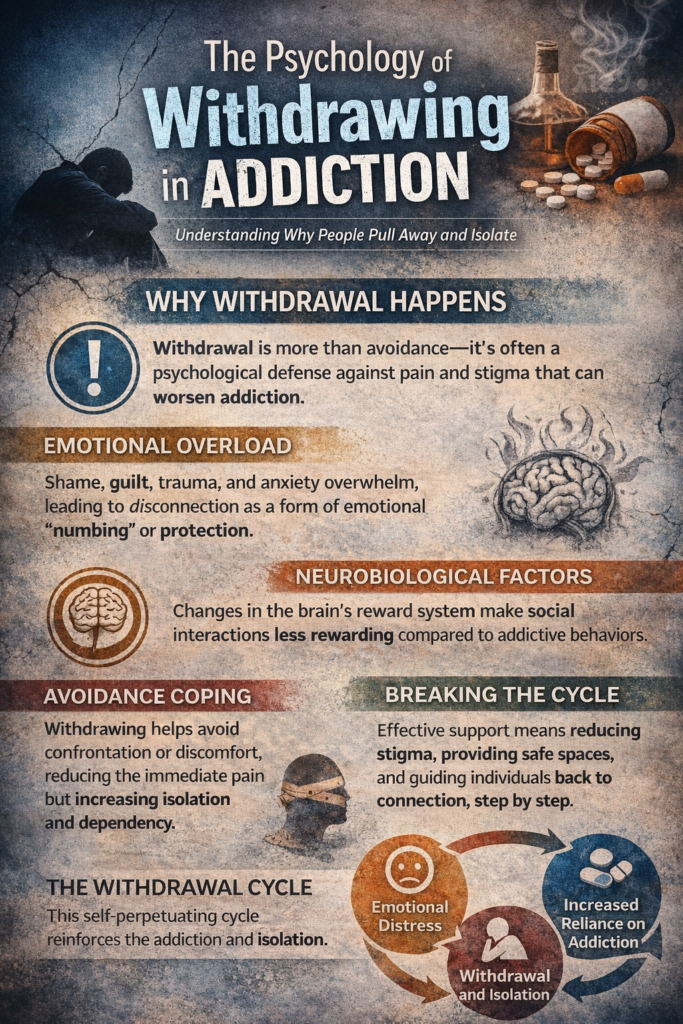
Addiction is often viewed through the lens of substances or behaviors, but its psychological dimensions are equally significant. One of the most overlooked aspects is the tendency for individuals to withdraw—emotionally, socially, and sometimes physically—from the world around them. This withdrawal is not simply avoidance or indifference; rather, it is a complex psychological response shaped by shame, fear, emotional overwhelm, and changes in brain functioning. As individuals struggle with internal conflict and external judgment, distancing themselves can feel like a form of protection. Understanding the psychology behind this withdrawal is essential, as it reveals not only why individuals pull away but also how this pattern reinforces the cycle of addiction and complicates the path to recovery.
The Psychology of Withdrawing in Addiction: Why People Pull Away When They Need Help Most
Addiction is often misunderstood as a problem of substances or behaviors alone—but at its core, it is deeply psychological. One of the most overlooked aspects of addiction is withdrawal not just from a substance, but from people, responsibilities, and reality itself. Many individuals struggling with addiction begin to isolate, becoming distant from loved ones and disengaged from life. This withdrawal is not random—it serves a psychological purpose.
Withdrawal as Emotional Protection
For many, addiction develops alongside overwhelming emotions: shame, guilt, anxiety, or unresolved trauma. Withdrawing from others can act as a defense mechanism. By pulling away, individuals avoid judgment, confrontation, or the discomfort of being seen in a vulnerable state.
This aligns with psychological concepts like avoidance coping, where a person manages distress by avoiding situations that trigger it. While this may provide short-term relief, it ultimately reinforces the addiction cycle by preventing accountability and support.
The Role of Shame and Stigma
Shame plays a central role in withdrawal. Unlike guilt, which focuses on behavior (“I did something bad”), shame targets identity (“I am bad”). This distinction is critical. When individuals internalize shame, they may feel unworthy of help or connection.
Societal stigma around addiction amplifies this. When people fear being labeled or judged, they are more likely to retreat into silence. This isolation can deepen dependency, as substances or behaviors become substitutes for human connection.
Neurobiology and Social Disconnection
Addiction also affects the brain’s reward system, particularly dopamine pathways. Over time, natural rewards—like relationships or achievements—become less satisfying compared to the addictive substance or behavior.
As a result, social interaction may feel less rewarding or even exhausting, contributing to withdrawal. What looks like indifference is often a neurobiological shift: the brain has been rewired to prioritize the addiction over connection.
Control and Avoidance of Confrontation
Withdrawing can also be a way to maintain control. Addiction often involves denial, and distancing oneself from others reduces the likelihood of being confronted about harmful behaviors.
This is especially common when individuals sense that others are noticing changes. Rather than face difficult conversations, they may choose silence, avoidance, or even cutting ties altogether.
The Paradox of Isolation
Here lies the paradox:
The very thing people need most—connection—is what addiction pushes them away from.
Isolation increases emotional distress, which in turn strengthens the urge to use or engage in addictive behaviors. This creates a self-perpetuating cycle:
- Emotional pain → withdrawal
- Withdrawal → isolation
- Isolation → increased reliance on addiction
Breaking this cycle requires understanding that withdrawal is not simply a choice—it is often a symptom.
Moving Toward Reconnection
Addressing withdrawal in addiction involves more than telling someone to “reach out.” It requires creating environments where individuals feel safe enough to reconnect.
This can include:
- Reducing stigma through education and empathy
- Encouraging non-judgmental communication
- Therapeutic support that addresses underlying emotions
- Gradual reintegration into social and support systems
Recovery is not just about stopping a behavior—it is about rebuilding connection, both with others and with oneself.
Final Thought
Withdrawal in addiction is not simply avoidance or indifference—it is often a protective response to pain, shame, and neurological changes. Understanding this shifts the perspective from frustration (“Why are they pushing people away?”) to compassion (“What are they protecting themselves from?”).
And that shift can make all the difference.
Reconnecting from Within: Self-Management Strategies for Overcoming Withdrawal in Addiction
Withdrawal in addiction is often misunderstood as simply “pulling away,” but it is much more than that. It is a psychological response shaped by shame, fear, emotional overload, and even changes in brain chemistry. When individuals withdraw, they are often trying to protect themselves. However, this protective mechanism can deepen isolation and reinforce the cycle of addiction.
Understanding withdrawal is the first step—learning how to manage it is what creates change.
Recognizing Withdrawal as a Pattern, Not a Personality
One of the most important self-management strategies is reframing withdrawal. It is not who you are—it is a pattern of behavior that developed for a reason.
Start by asking:
- When do I tend to pull away?
- What emotions am I avoiding in those moments?
- What am I afraid might happen if I stay present?
This kind of self-awareness interrupts automatic behavior. In psychology, this is known as metacognition—thinking about your thinking. The more you notice the pattern, the less control it has over you.
Building Emotional Tolerance Instead of Avoidance
Withdrawal is often driven by an inability—or lack of practice—in tolerating distressing emotions. Instead of immediately escaping discomfort, a key strategy is to increase emotional tolerance.
This doesn’t mean forcing yourself to feel everything at once. It means practicing small moments of staying present:
- Sitting with discomfort for a few extra minutes
- Naming the emotion (“This is anxiety,” “This is shame”)
- Reminding yourself that emotions are temporary
Over time, this reduces the urge to escape through isolation or addictive behaviors.
Creating Structured Connection
Reconnection can feel overwhelming, especially after periods of withdrawal. Instead of waiting to “feel ready,” it helps to create a structured, low-pressure connection.
Examples include:
- Sending a simple text instead of having a full conversation
- Scheduling short, predictable interactions
- Attending support groups where shared experiences reduce judgment
Structure reduces uncertainty, making connections feel safer and more manageable.
Challenging Shame-Based Thinking
Shame often fuels withdrawal by convincing individuals they are unworthy of support. A powerful self-management tool is cognitive restructuring—challenging these distorted thoughts.
For example:
- Thought: “I’ve messed up too much; people won’t understand.”
- Reframe: “I’m struggling, but that doesn’t make me unworthy of support.”
This isn’t about forced positivity—it’s about developing balanced, realistic thinking that weakens shame’s influence.
Replacing Avoidance with Intentional Action
Withdrawal is passive; recovery requires intentional action. This doesn’t mean drastic change—it means small, consistent steps that move against the pattern of isolation.
Try:
- Setting one daily goal related to connection or self-care
- Practicing routines that anchor you (sleep, meals, movement)
- Engaging in activities that provide even slight meaning or enjoyment
Behavioral psychology shows that action often precedes motivation—not the other way around.
Understanding Your Triggers
Withdrawal doesn’t happen randomly. It is often triggered by specific situations, emotions, or thoughts.
Common triggers include:
- Conflict or perceived criticism
- Feelings of failure or inadequacy
- Stress or emotional overwhelm
By identifying these triggers, you can plan responses in advance. For example:
“When I feel overwhelmed, instead of isolating, I will step outside or text someone.”
Balancing Independence and Support
Self-management does not mean doing everything alone. In fact, one of the most important skills is knowing when to reach out.
Healthy self-management includes:
- Recognizing limits
- Seeking therapy or support groups when needed
- Allowing others to be part of the recovery process
Independence in recovery is not isolation—it is intentional engagement with support.
The Path Back to Connection
Withdrawal in addiction is often a learned response to pain. It once served a purpose, but it no longer serves growth. Through self-awareness, emotional regulation, and intentional action, it is possible to unlearn this pattern.
Recovery is not just about stopping a substance or behavior—it is about rebuilding the ability to stay present, connected, and engaged with life.
Final Thought
If withdrawal has been your way of coping, it doesn’t mean you’re broken—it means you adapted. And what is learned can be unlearned.
Change doesn’t begin with a dramatic transformation.
It begins with one small moment of staying instead of leaving.
Staying Connected: Family Support Strategies for Understanding Withdrawal in Addiction
One of the most painful aspects of addiction for families is not just the behavior—it’s the distance. Conversations become shorter, trust weakens, and the person you care about may begin to withdraw emotionally or physically. It can feel personal, confusing, and even hurtful.
But withdrawal in addiction is rarely about rejecting loved ones. More often, it is a psychological response to shame, fear, and emotional overwhelm. Understanding this can shift how families respond—from frustration to informed, effective support.
Understanding Withdrawal as Protection, Not Rejection
When someone withdraws, it can look like they don’t care. In reality, many individuals pull away because they feel too much, not too little.
They may be trying to avoid:
- Judgment or confrontation
- Disappointing others
- Facing their own guilt or shame
Recognizing withdrawal as a protective mechanism helps families avoid reacting in ways that unintentionally reinforce it, such as anger or criticism.
Creating a Safe Emotional Environment
If withdrawal is driven by fear and shame, then safety becomes essential. Families can support recovery by creating an environment where the individual feels accepted, even when struggling.
This includes:
- Speaking calmly rather than reactively
- Avoiding labels or moral judgments
- Expressing concern without accusation
For example, shifting from “Why are you doing this?” to “I’m worried about you, and I’m here if you want to talk” can make a significant difference.
Practicing Consistent, Low-Pressure Communication
When someone is withdrawing, intense or frequent attempts to “fix” the situation can feel overwhelming. Instead, consistent but low-pressure communication is more effective.
Try:
- Sending short, supportive messages
- Checking in without demanding a response
- Letting them know you’re available, without forcing conversation
This keeps the connection open without increasing emotional pressure.
Setting Boundaries Without Cutting Off Support
Support does not mean enabling. Families often struggle to balance compassion with boundaries, but both are necessary.
Healthy boundaries might include:
- Not providing financial support that enables substance use
- Refusing to participate in harmful behaviors
- Being clear about what is and isn’t acceptable
At the same time, it’s important to communicate:
“I care about you, and I’m here for you—but I can’t support behaviors that harm you.”
This approach maintains connection while protecting both the individual and the family.
Avoiding the Trap of Personalization
It’s natural to take withdrawal personally. However, doing so can lead to reactions—such as anger, guilt, or withdrawal—that escalate the situation.
Remind yourself:
- Withdrawal is a symptom, not a statement about your worth
- Addiction changes behavior and perception
- Your loved one’s distance is often about their internal struggle
This mindset helps families respond more calmly and effectively.
Encouraging Professional Support
Family support is powerful, but it is not a substitute for professional care. Encouraging therapy, counseling, or support groups can help address the deeper psychological factors driving withdrawal.
This can be done gently:
- Offering to help find resources
- Suggesting options without pressure
- Supporting their decision when they’re ready
Sometimes, simply normalizing help-seeking can reduce resistance.
Taking Care of Yourself as a Family Member
Supporting someone through addiction can be emotionally exhausting. Families often neglect their own needs, which can lead to burnout or resentment.
Self-care is not selfish—it is necessary. This might include:
- Seeking your own support (therapy, support groups like Al-Anon)
- Setting emotional limits
- Maintaining your own routines and well-being
You cannot effectively support someone else if you are depleted.
The Power of Staying Present
Withdrawal creates distance, but a consistent, compassionate presence can slowly bridge that gap. Recovery is rarely immediate, and connection may come in small moments rather than big breakthroughs.
A message, a calm conversation, or simply not giving up—these can all matter more than they seem.
Final Thought
When someone you love withdraws into addiction, it can feel like they are slipping away. But often, they are not trying to leave—they are trying to cope.
Family support cannot force change, but it can create the conditions where change feels possible.
And sometimes, the most powerful thing you can do is this:
Stay present, stay steady, and remind them—without pressure—that they are not alone.
Rebuilding Connection: Community Resource Strategies for Addressing Withdrawal in Addiction
Withdrawal in addiction is not just an individual struggle—it is a social one. As individuals pull away from family, friends, and responsibilities, they often become increasingly isolated. This isolation reinforces addiction, creating a cycle that is difficult to break alone.
While personal insight and family support are critical, community resources play a unique and powerful role in addressing withdrawal. They provide structure, a sense of belonging, and access to care—elements that help individuals move from isolation back into connection.
Understanding Withdrawal as a Barrier to Access
One of the biggest challenges in addiction recovery is that the people who need help the most are often the least likely to seek it. Psychological withdrawal—driven by shame, fear, and avoidance—can act as a barrier to accessing community resources.
This means communities must do more than simply offer services. They must:
- Reduce stigma
- Lower entry barriers
- Create welcoming, non-judgmental environments
Understanding withdrawal shifts the focus from “Why aren’t they getting help?” to “How can we make help feel safe to access?”
Creating Low-Barrier Access Points
For someone experiencing withdrawal, even small obstacles—paperwork, cost, transportation, or fear of judgment—can feel overwhelming. Effective community strategies focus on low-barrier access.
Examples include:
- Walk-in clinics and same-day services
- Sliding-scale or free treatment programs
- Mobile outreach units that meet individuals where they are
- Anonymous or confidential support options
The easier it is to access help, the more likely individuals are to take that first step.
Peer Support and Lived Experience
One of the most effective ways to counter withdrawal is through peer support. Individuals who have experienced addiction themselves can offer understanding that feels authentic and non-judgmental.
Peer-led programs:
- Reduce feelings of isolation
- Normalize struggles and setbacks
- Provide relatable role models for recovery
For someone who fears judgment, connecting with someone who “gets it” can be the turning point.
Community Spaces That Foster Belonging
Withdrawal often strips away a sense of belonging. Community resources can help rebuild this through safe, inclusive spaces.
These might include:
- Support groups
- Recovery community centers
- Faith-based or culturally specific programs
- Recreational or skill-building activities
The goal is not just treatment, but reconnection—helping individuals feel part of something again.
Integrated Care Approaches
Addiction rarely exists in isolation. It is often connected to mental health challenges, trauma, housing instability, or unemployment. Community strategies are most effective when they use integrated care models.
This means providing:
- Mental health services alongside addiction treatment
- Case management for housing, employment, and healthcare
- Coordination between providers
By addressing the full context of a person’s life, communities reduce the need for individuals to navigate complex systems while already overwhelmed.
Outreach and Proactive Engagement
Because withdrawal discourages help-seeking, communities must often take the first step. Outreach programs play a critical role in engaging individuals who may not otherwise seek support.
Effective outreach includes:
- Street outreach teams
- School and workplace programs
- Partnerships with emergency services
- Follow-up after hospital visits or crises
These efforts communicate an important message: You don’t have to come to us—we will meet you where you are.
Reducing Stigma Through Education
Stigma is one of the strongest drivers of withdrawal. Community-wide education can shift perceptions of addiction from moral failure to a treatable condition.
Strategies include:
- Public awareness campaigns
- Training for healthcare providers and first responders
- School-based education programs
When communities become more informed, they also become more compassionate—and more effective in supporting recovery.
The Power of Collective Support
Recovery is often framed as an individual journey, but it is deeply influenced by the environment. Communities that prioritize accessibility, empathy, and integration create conditions where individuals feel safe enough to reconnect.
Withdrawal may begin in isolation, but it is often healed through connection.
Final Thought
Understanding the psychology of withdrawal changes how communities respond to addiction. It calls for systems that are not just available, but approachable—systems that recognize fear, reduce barriers, and actively foster belonging.
Because sometimes, the first step toward recovery isn’t asking for help—
It’s finding a place where help feels possible.
Frequently Asked Questions
Here are some common questions:
1. Why do people withdraw from others during addiction?
People often withdraw as a psychological defense mechanism. Feelings like shame, guilt, fear of judgment, and emotional overwhelm can make social interaction feel threatening. Isolation becomes a way to avoid discomfort, even though it ultimately worsens the problem.
2. Is withdrawal in addiction a conscious choice?
Not entirely. While it may look intentional, withdrawal is often partly unconscious and influenced by both psychological coping patterns and neurobiological changes in the brain. It’s less about choosing to disconnect and more about feeling unable to stay engaged.
3. How does shame contribute to withdrawal?
Shame leads individuals to believe they are unworthy of support or connection. This creates a cycle where they avoid others to hide their struggles, which then increases isolation and reinforces addictive behaviors.
4. What is avoidance coping, and how is it related?
Avoidance coping is a strategy where individuals deal with stress by avoiding the source of distress rather than confronting it. Withdrawal in addiction is a form of this, where people avoid difficult emotions, conversations, or accountability.
5. Does addiction change how people experience relationships?
Yes. Addiction affects the brain’s reward system, particularly dopamine pathways, making substances or behaviors feel more rewarding than social interaction. This can reduce motivation to engage with others.
6. Why do people push away those who are trying to help them?
Help can feel threatening because it may involve confrontation, vulnerability, or change. For someone struggling, pushing others away can feel like a way to maintain control or avoid facing painful realities.
7. Is withdrawal the same as depression or social anxiety?
Not exactly, but they can overlap. Withdrawal in addiction may be influenced by depression, anxiety, or trauma, but it is specifically tied to the cycle of addiction and coping mechanisms related to it.
8. How does withdrawal reinforce addiction?
Withdrawal increases isolation, which often leads to greater emotional distress. This distress can drive individuals back to substances or behaviors for relief, creating a self-perpetuating cycle.
9. Can someone recover while still withdrawing from others?
Sustained recovery is difficult without some level of reconnection. While early recovery may involve limited interaction, long-term recovery typically requires rebuilding relationships and support systems.
10. What are the early signs of withdrawal in addiction?
Common signs include:
- Avoiding calls or messages
- Canceling plans frequently
- Emotional distance or irritability
- Loss of interest in relationships
- Increased secrecy
11. How can individuals begin to break the pattern of withdrawal?
Small steps are key:
- Reaching out in low-pressure ways (e.g., texting)
- Practicing emotional awareness
- Seeking therapy or support groups
- Challenging negative self-beliefs
12. How can family or friends respond to withdrawal?
Effective responses include:
- Staying calm and non-judgmental
- Avoid taking it personally
- Offering consistent but low-pressure support
- Encouraging professional help
13. Why is connection so important in recovery?
Connection helps regulate emotions, reduce shame, and provide accountability. It also replaces the role addiction plays as a coping mechanism, making recovery more sustainable.
14. Is withdrawal always harmful?
Not entirely. In the short term, it can serve as a protective response to overwhelming emotions. However, long-term withdrawal becomes harmful because it prevents healing and reinforces addiction.
15. What is the biggest misconception about withdrawal in addiction?
The biggest misconception is that it means the person doesn’t care. In reality, withdrawal often reflects the opposite—they may care deeply but feel overwhelmed, ashamed, or unable to cope.
Conclusion
Withdrawal in addiction is more than a behavioral symptom—it is a reflection of deeper psychological processes that influence how individuals cope with pain, stigma, and vulnerability. While it may serve as a short-term defense, prolonged isolation often intensifies emotional distress and strengthens dependence on addictive behaviors. Recognizing withdrawal as a meaningful, albeit maladaptive, response allows for a more compassionate and effective approach to recovery. By addressing the underlying emotions, reducing stigma, and fostering supportive connections, it becomes possible to break the cycle of isolation. Ultimately, recovery is not only about overcoming addiction but also about rebuilding the capacity for connection, engagement, and self-understanding.
Video: