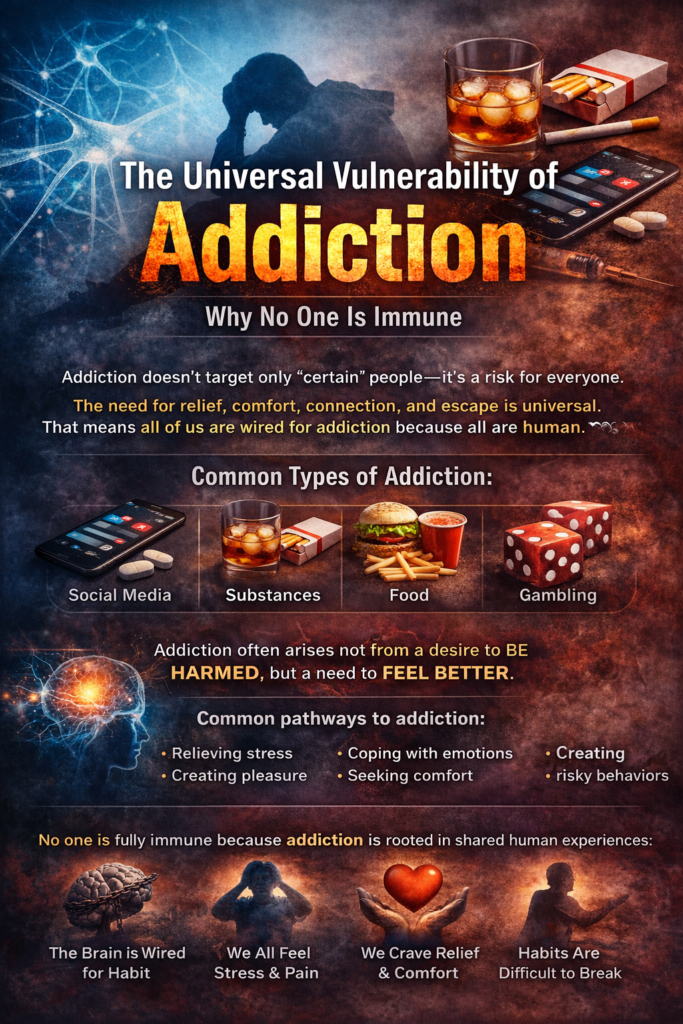
Addiction is often viewed through a narrow lens—something that affects only certain individuals under specific circumstances. However, a deeper understanding reveals a more complex truth: addiction is rooted in universal human experiences. The need for relief, comfort, connection, and escape is something everyone shares. These natural drives, combined with the brain’s tendency to reinforce behaviors that reduce discomfort or create pleasure, make all individuals vulnerable to forming unhealthy attachments. Recognizing addiction as a universal vulnerability shifts the conversation from blame and judgment to awareness and understanding, opening the door for more compassionate and effective approaches to prevention and recovery.
The Universal Vulnerability of Addiction: Why No One Is Immune
Addiction is often misunderstood as something that happens to “other people”—those who lack discipline, willpower, or control. But this view oversimplifies a much deeper reality. Addiction is not a personal failure; it is a human vulnerability.
At its core, addiction is about attachment, relief, and repetition. And those are experiences every person is wired for.
Addiction Is Not Just About Substances
When people hear the word addiction, they often think of drugs or alcohol. But addiction extends far beyond substances.
It can involve:
- Social media
- Food
- Work
- Relationships
- Gambling
- Even certain thought patterns
What these have in common is not the object, but the function. They provide temporary relief, comfort, or escape. And when something reliably changes how we feel, we’re more likely to return to it.
The Brain Is Built for Reinforcement
The human brain is designed to repeat what feels good—or what reduces discomfort.
When an experience:
- Relieves stress
- Eases emotional pain
- Creates pleasure
…the brain takes note. It begins to associate that behavior with relief, encouraging repetition.
Over time, this can shift from:
- “I choose this.”
to - “I need this.”
This isn’t weakness—it’s learning. The brain is doing exactly what it was built to do.
Why No One Is Fully Protected
Some people may be more vulnerable than others due to genetics, environment, or life experiences—but no one is completely immune.
Because everyone:
- Experiences stress
- Seeks comfort
- Wants relief from emotional pain
- Forms habits through repetition
Addiction often begins not with a desire for harm, but with a desire to feel better.
The Role of Emotional Coping
Many addictive behaviors are attempts to cope.
They can help people:
- Avoid difficult emotions
- Feel a sense of control
- Escape from overwhelming situations
The problem is not that these needs exist—it’s that certain behaviors meet those needs in ways that are temporary and ultimately harmful.
From Habit to Compulsion
Addiction doesn’t happen all at once. It develops gradually.
What starts as:
- Occasional use
- A coping strategy
- A source of comfort
…can become:
- A habit
- A reliance
- A compulsion
The shift is often subtle, which is why it can be hard to recognize until the pattern is established.
Reducing Stigma Through Understanding
When addiction is seen as a universal vulnerability rather than a personal flaw, it changes how we respond to it.
It becomes:
- Less about blame
- More about understanding
- Focused on support rather than judgment
This perspective opens the door to more effective conversations, interventions, and recovery.
Final Thought
Addiction is not a sign that something is wrong with you—it’s a sign that you’re human.
The same brain that allows us to form connections, seek comfort, and build habits can also lead us into patterns that are hard to break.
But that also means something important:
The capacity for change, growth, and recovery is just as human as the vulnerability itself.
Taking Control: Self-Management Strategies for Addiction Vulnerability
If addiction is a universal vulnerability, then self-management becomes essential—not just for recovery, but for prevention.
Understanding that anyone can develop unhealthy attachments shifts the focus from “What’s wrong with me?” to “How can I manage what I’m vulnerable to?” This perspective is empowering. It means you’re not defined by the risk—you can respond to it.
Self-management isn’t about perfection. It’s about awareness, intention, and consistent small choices.
1. Build Awareness of Your Patterns
The first step is recognizing your personal tendencies.
Ask yourself:
- What do I turn to when I’m stressed or overwhelmed?
- What behaviors do I repeat even when they don’t help long-term?
Patterns often operate automatically. Bringing them into awareness gives you a chance to interrupt them.
2. Identify Emotional Triggers
Addictive behaviors are often linked to emotional states, such as:
- Stress
- Loneliness
- Boredom
- Anxiety
Instead of focusing only on the behavior, focus on what comes before it.
When you can name the trigger, you gain more control over the response.
3. Create a Pause Between Urge and Action
Urges can feel immediate and powerful—but they are temporary.
Practice:
- Pausing for a few moments
- Taking a breath
- Asking: “What do I actually need right now?”
This small gap can weaken automatic reactions and allow for more intentional choices.
4. Replace, Don’t Just Remove
Simply trying to stop a behavior often leaves a gap.
Instead:
- Identify what the behavior provides (comfort, distraction, relief)
- Find healthier ways to meet that same need
For example:
- Stress → exercise or movement
- Loneliness → reaching out to someone
- Overthinking → journaling or structured reflection
Replacement makes change sustainable.
5. Build Healthy Routines
Consistency reduces vulnerability.
Simple routines—like regular sleep, movement, and structured daily activities—help stabilize mood and reduce the need for external coping mechanisms.
When your baseline is more balanced, urges often feel less intense.
6. Limit Access to Triggers
Environment matters.
You can reduce risk by:
- Removing or limiting access to substances or behaviors
- Creating physical or digital boundaries
- Avoiding environments that reinforce harmful patterns
Self-management is not just internal—it’s also about shaping your surroundings.
7. Practice Self-Compassion, Not Self-Criticism
Setbacks happen. When they do, harsh self-judgment can actually reinforce the cycle.
Instead of:
- “I failed again.”
Try:
- “What can I learn from this?”
Self-compassion keeps you engaged in the process instead of giving up on it.
8. Seek Support When Needed
Self-management doesn’t mean doing everything alone.
Support can include:
- Friends or family
- Support groups
- Counseling or therapy
Reaching out is not a loss of control—it’s a form of it.
Final Thought
Understanding the universal vulnerability of addiction changes the goal.
It’s no longer about proving you’re immune—it’s about learning how to respond when you’re affected.
Because the same brain that forms habits can also reshape them.
And self-management isn’t about eliminating vulnerability—
…it’s about building the skills to navigate it.
Stronger Together: Family Support Strategies for Understanding the Universal Vulnerability of Addiction
Addiction is often misunderstood—not just by individuals, but by families. It can be seen as a failure of discipline, a lack of responsibility, or something that “shouldn’t happen” within a certain household. But when addiction is understood as a universal human vulnerability, the conversation shifts.
It becomes less about blame—and more about support.
Families play a powerful role in shaping how addiction is experienced, addressed, and managed. The goal isn’t to control or fix a loved one, but to create an environment where understanding, accountability, and healing can coexist.
1. Shift from Judgment to Understanding
One of the most important changes a family can make is how they interpret behavior.
Instead of:
- “Why are they doing this?”
Consider:
- “What might they be coping with?”
This doesn’t excuse harmful behavior—but it helps families respond with empathy rather than frustration. Understanding reduces shame, and shame often fuels addictive patterns.
2. Recognize That Vulnerability Is Universal
Addiction isn’t limited to one type of person—it’s rooted in shared human experiences like stress, pain, and the need for relief.
When families recognize this, it:
- Reduces stigma within the household
- Encourages open conversations
- Prevents “us vs. them” thinking
This perspective creates a safer space for honesty.
3. Encourage Open, Ongoing Communication
Silence can increase isolation, while open dialogue builds connection.
Helpful approaches include:
- Asking questions without interrogation
- Listening without interrupting or correcting
- Allowing space for honesty, even when it’s uncomfortable
Consistency matters more than perfection. Regular, calm conversations are more effective than occasional intense ones.
4. Set Boundaries with Care and Clarity
Support does not mean accepting harmful behavior.
Families can:
- Clearly define what is and isn’t acceptable
- Communicate consequences calmly and consistently
- Avoid enabling behaviors while still offering emotional support
Healthy boundaries protect both the individual and the family system.
5. Avoid Enabling While Still Being Supportive
It’s a delicate balance.
Enabling might look like:
- Covering up consequences
- Providing resources that sustain the behavior
- Avoiding difficult conversations
Support, on the other hand, looks like:
- Encouraging accountability
- Offering help that promotes growth
- Staying present without reinforcing the cycle
The difference lies in whether the behavior is being sustained or challenged.
6. Model Healthy Coping Strategies
Family environments influence behavior more than words alone.
Modeling can include:
- Managing stress in constructive ways
- Expressing emotions openly and appropriately
- Demonstrating balance and self-regulation
These behaviors create a living example of alternatives to unhealthy coping.
7. Take Care of the Family System as a Whole
Addiction affects everyone—not just the individual.
Families should also:
- Acknowledge their own emotional responses
- Seek support when needed (e.g., counseling, support groups)
- Maintain routines and stability within the household
A stable environment supports recovery more than a reactive one.
8. Encourage Professional Support Without Stigma
Sometimes, family support alone isn’t enough.
Encouraging outside help can include:
- Therapy or counseling
- Support groups
- Medical or mental health services
Framing this as a resource—not a punishment—makes it more approachable.
Final Thought
Understanding addiction as a universal vulnerability changes how families respond.
It shifts the focus from:
- “How do we stop this?”
to
- “How do we support change while staying grounded ourselves?”
Families don’t have to have all the answers. What matters most is creating an environment where honesty is possible, support is consistent, and growth is encouraged.
Because in the end, the opposite of addiction isn’t just control—
…it’s connection.
Community Matters: Addressing Addiction as a Shared Human Vulnerability
Addiction is often framed as an individual struggle—but in reality, it is deeply influenced by the environments people live in. When we understand addiction as a universal human vulnerability, the responsibility for addressing it expands beyond the individual to the community.
Communities shape norms, provide resources, and influence whether people feel supported or isolated. This means they are not just part of the problem—they are a critical part of the solution.
Addressing addiction at the community level is not about eliminating risk entirely. It’s about creating conditions where healthier choices are easier, support is accessible, and vulnerability is met with understanding rather than stigma.
1. Normalize Conversations Around Addiction
Silence and stigma often prevent people from seeking help.
Communities can:
- Promote open discussions about addiction and mental health
- Share educational resources that frame addiction as a human experience
- Encourage storytelling that reduces shame and isolation
When addiction is openly acknowledged, it becomes easier to address.
2. Increase Access to Support Services
Not everyone has equal access to help—and this gap increases vulnerability.
Communities can strengthen support by offering:
- Affordable or sliding-scale counseling services
- Support groups and peer recovery programs
- Crisis hotlines and walk-in centers
Accessibility turns awareness into action.
3. Create Safe and Supportive Environments
The environment plays a major role in behavior.
Communities can:
- Provide safe spaces for connection (community centers, youth programs)
- Offer structured activities that reduce isolation
- Foster inclusive environments where people feel valued
A supportive environment reduces the need to rely on harmful coping mechanisms.
4. Promote Prevention Through Education
Understanding reduces risk.
Educational efforts can focus on:
- How addiction develops
- The role of stress, trauma, and coping
- Healthy alternatives for managing emotions
When people understand their vulnerability, they are better equipped to manage it.
5. Strengthen Peer Support Networks
Peers often influence behavior more than formal systems.
Communities can encourage:
- Peer-led recovery groups
- Mentorship programs
- Youth leadership initiatives
Positive peer influence can shift norms and create accountability.
6. Partner with Local Organizations
Collaboration increases impact.
Community efforts can include partnerships with:
- Schools
- Healthcare providers
- Nonprofit organizations
- Faith-based groups
Working together creates a more consistent and far-reaching support system.
7. Address Underlying Social Factors
Addiction doesn’t exist in a vacuum.
Communities can work to reduce contributing factors such as:
- Chronic stress
- Social isolation
- Lack of opportunity or resources
Addressing these root issues lowers overall vulnerability.
8. Support Families as Part of the System
Families are often the first line of support—but they need support too.
Communities can provide:
- Family education programs
- Counseling and support groups for caregivers
- Resources on communication and boundary-setting
Strengthening families strengthens the broader community response.
Final Thought
Understanding addiction as a universal vulnerability changes how communities respond.
It shifts the focus from:
- “Who is at fault?”
to
- “How can we support healthier outcomes together?”
Communities have the power to create environments where people feel seen, supported, and capable of change.
Because in the end, addiction may be a shared vulnerability—
…but so is the capacity for connection, resilience, and recovery.
Frequently Asked Questions
Here are some common questions:
1. What does “universal vulnerability of addiction” mean?
It means that anyone—regardless of background, personality, or lifestyle—has the potential to develop addictive patterns. Addiction is rooted in common human experiences like stress, pleasure, and the need for relief.
2. Does this mean everyone will become addicted?
No. Being vulnerable does not mean addiction is inevitable. It means everyone has the capacity for it under certain conditions, but many factors—like environment, coping skills, and support—affect whether it develops.
3. Why are humans naturally vulnerable to addiction?
The brain is designed to:
- Seek pleasure
- Avoid pain
- Repeat behaviors that provide relief
This reinforcement system is essential for survival, but it can also lead to repeated behaviors that become difficult to control.
4. Is addiction only about drugs and alcohol?
No. Addiction can involve many behaviors, including:
- Social media use
- Gambling
- Food
- Work
- Relationships
What defines addiction is not the activity itself, but the compulsive reliance on it.
5. What makes some people more vulnerable than others?
While everyone is vulnerable, certain factors can increase risk:
- Genetics
- Trauma or stress
- Mental health conditions
- Environmental influences
- Lack of support systems
These factors can make addictive patterns more likely to develop.
6. How does addiction usually start?
Addiction often begins with a behavior that provides relief or pleasure. Over time, the brain learns to associate that behavior with feeling better, leading to repetition and, eventually, dependence.
7. Why do people continue addictive behaviors even when they know the risks?
Because addiction involves both the brain’s reward system and emotional coping. The immediate relief or reward can outweigh awareness of long-term consequences, making it difficult to stop.
8. Is addiction a choice or a disease?
It involves both elements. Initial behaviors may involve choice, but over time, changes in the brain can reduce control and increase compulsion. This is why addiction is often understood as a chronic, complex condition rather than a simple choice.
9. How can understanding universal vulnerability reduce stigma?
It shifts the perspective from:
- “What’s wrong with that person?”
to
- “This is something any human could struggle with.”
This promotes empathy, support, and more effective responses to addiction.
10. What are the signs that a behavior is becoming addictive?
Common signs include:
- Loss of control
- Increased frequency or intensity
- Neglecting responsibilities
- Continuing despite negative consequences
- Craving or strong urges
11. How can people protect themselves from developing addiction?
Helpful strategies include:
- Building healthy coping skills
- Managing stress effectively
- Setting boundaries with risky behaviors
- Maintaining supportive relationships
- Staying aware of personal patterns
12. Can people recover from addiction?
Yes. Recovery is possible, and many people successfully manage or overcome addiction. It often involves a combination of self-awareness, support, and sometimes professional help.
Conclusion
Understanding the universal vulnerability of addiction reframes it from a personal failing to a shared human challenge. This perspective encourages empathy, reduces stigma, and emphasizes the importance of support systems—both personal and collective. While no one is entirely immune to developing unhealthy patterns, everyone has the capacity to build awareness, make intentional choices, and seek help when needed. Ultimately, acknowledging this vulnerability is not about accepting defeat, but about empowering individuals and communities to respond with compassion, resilience, and a commitment to growth.
Video: Everyone Has An Addiction—Here’s Why #Psychology #HumanBehavior