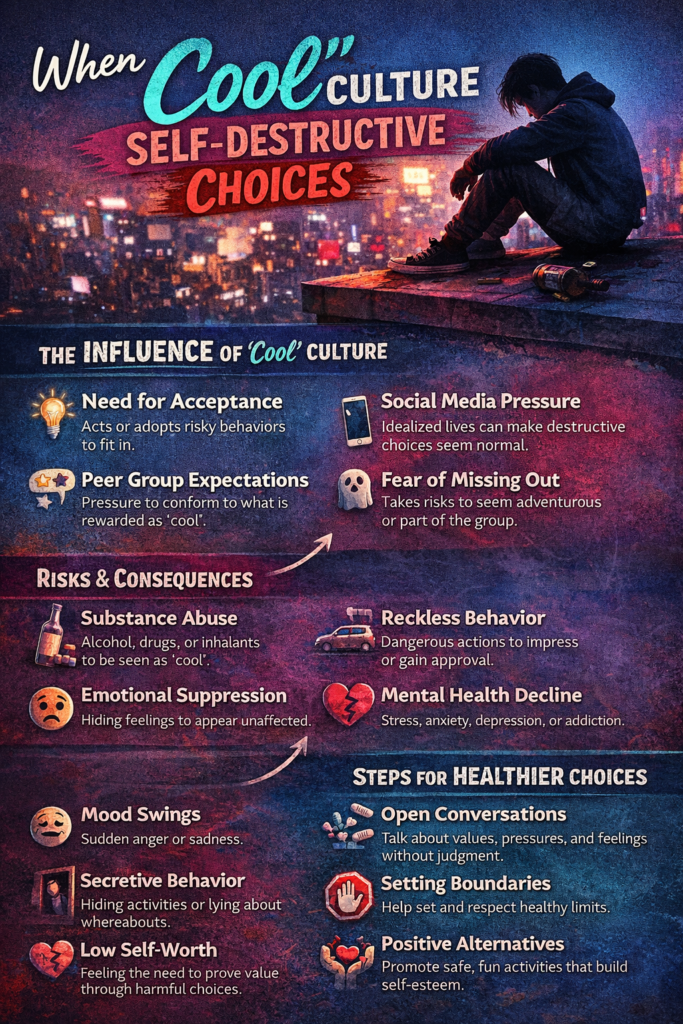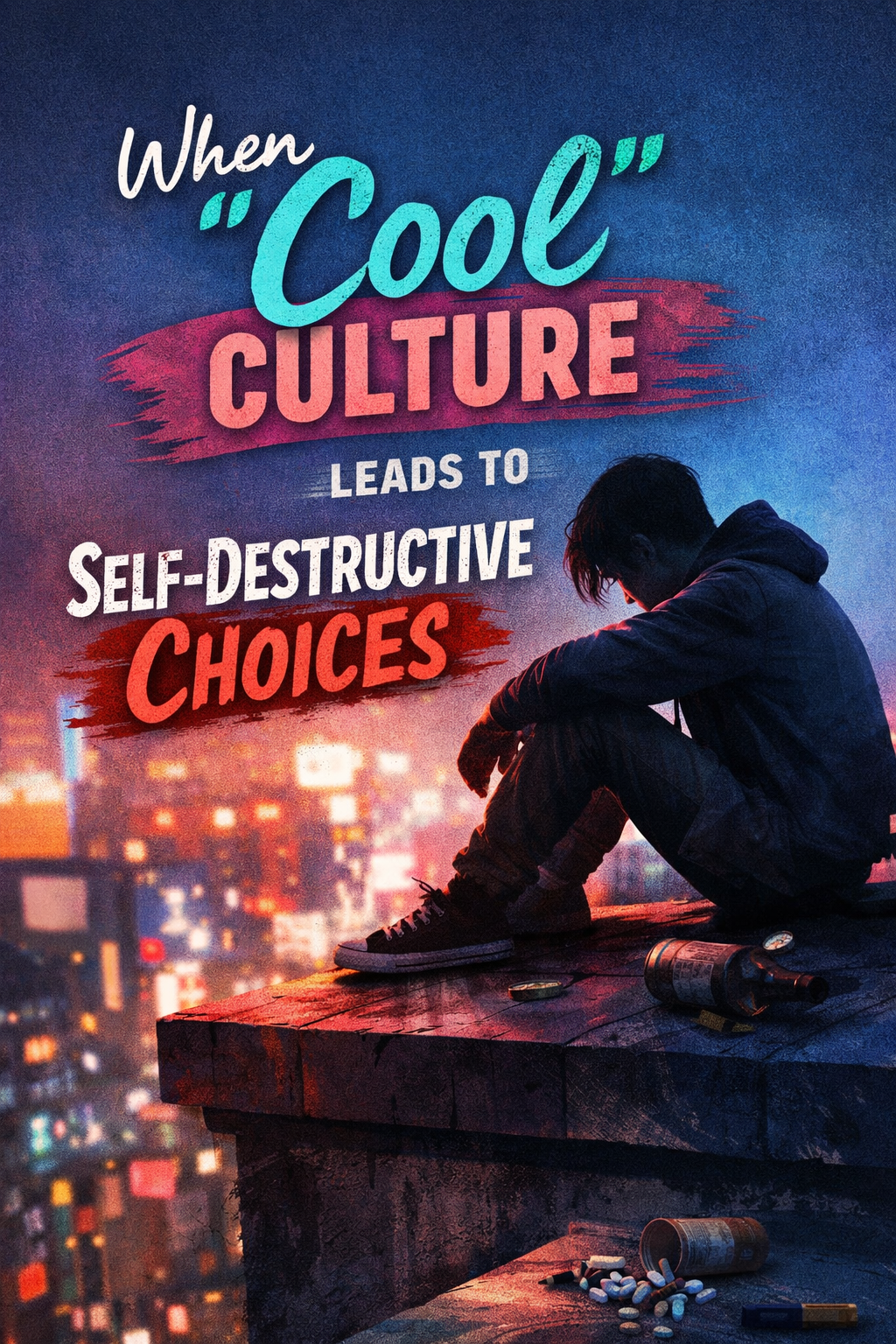
“Cool” culture is often presented as harmless—an ever-changing set of trends, styles, and attitudes that define what is socially desirable. But beneath the surface, it carries a powerful influence over behavior, particularly when acceptance and identity become tied to meeting those expectations. In many cases, the pressure to appear confident, effortless, or admired can push individuals toward choices that don’t align with their well-being. What begins as a desire to fit in can gradually shift into risk-taking, emotional suppression, or other self-destructive patterns. Understanding how “cool” culture operates is essential to recognizing when social influence stops being expressive—and starts becoming harmful.
The Illusion of Cool: How Culture Shapes Who We Try to Be
“Cool” is one of those words everyone understands—but no one can fully define.
It shifts with time, trends, and social groups. What’s considered cool today might feel outdated tomorrow. Yet despite its instability, the pressure to be cool remains constant. It quietly shapes how people dress, speak, behave, and even what risks they’re willing to take.
But what exactly is “cool”—and why does it hold so much power?
What “Cool” Really Represents
At its core, “cool” isn’t about style or confidence—it’s about social approval.
Being seen as cool often signals:
- Belonging to a desired group
- Having status or influence
- Appearing effortless or unaffected
- Being admired (or envied) by others
It’s less about authenticity and more about perception. “Cool” is a performance—one that people learn, mimic, and refine based on what gets rewarded socially.
Where the Pressure Comes From
The pressure to be cool doesn’t come out of nowhere—it’s reinforced constantly by:
- Social media (highlighting curated, idealized lives)
- Peer groups (rewarding conformity and punishing difference)
- Cultural trends (defining what is “in” or “out”)
Over time, people internalize these signals. They don’t just see what’s cool—they start to measure themselves against it.
And that’s where the shift happens—from expression to comparison.
When “Cool” Becomes Costly
Trying to maintain a “cool” image can come with hidden consequences.
People may:
- Hide parts of themselves to fit expectations
- Engage in behaviors they wouldn’t normally choose
- Suppress emotions to appear unaffected
- Base their self-worth on external validation
In some cases, this can lead to self-destructive choices—not because someone wants harm, but because they want acceptance.
The need to belong is powerful. Sometimes, it overrides better judgment.
The Myth of Effortlessness
One of the biggest illusions of cool culture is that it looks effortless.
But behind that image is often:
- Careful curation
- Social awareness
- Fear of rejection
- Constant self-monitoring
What appears natural is often practiced. What looks confident may be deeply dependent on how others respond.
Recognizing this helps break the illusion: “cool” isn’t a fixed trait—it’s a shifting social construct.
Redefining What Matters
The problem with chasing “cool” is that it moves the target. No matter how close you get, it changes.
A more stable alternative is authenticity—not in the cliché sense of “just be yourself,” but in making choices that align with your values rather than external pressure.
That might mean:
- Saying no to things that don’t feel right
- Expressing emotions honestly
- Accepting that not everyone will approve
Ironically, the more someone lets go of needing to be seen as cool, the more grounded and confident they tend to become.
Final Thought
Cool culture thrives on the idea that you need to be more to be accepted.
But often, the real shift happens when you realize you don’t.
Because at some point, the question stops being:
“Do they think I’m cool?”
…and becomes:
“Am I living in a way that actually feels right to me?”
Breaking the “Cool” Trap: Self-Management Strategies to Avoid Self-Destructive Choices
“Cool” culture has a quiet influence. It doesn’t always demand attention—but it shapes behavior in subtle, powerful ways. It tells you what’s acceptable, what’s admired, and what gets approval. And sometimes, in trying to keep up, people make choices that don’t actually serve them.
The challenge isn’t just recognizing that pressure—it’s learning how to manage it.
Because the goal isn’t to reject culture entirely. It’s to stay grounded within it.
1. Recognize the Pressure for What It Is
The first step in self-management is awareness.
Ask yourself:
- Am I doing this because I want to—or because it’s expected?
- Would I still choose this if no one else saw it?
“Cool” culture often works by making behaviors feel normal or necessary. Once you recognize that influence, it becomes easier to question it.
Awareness creates space between you and automatic choices.
2. Identify Your Personal Values
When external pressure is strong, internal clarity becomes essential.
Take time to define:
- What actually matters to you
- What kind of person do you want to be
- What behaviors align—or don’t align—with that
Without clear values, it’s easy to default to whatever gets approval. With them, decisions become more intentional.
3. Pause Before You Act
Many self-destructive choices happen quickly—in social situations, under pressure, or in the moment.
Build a simple habit:
- Pause
- Breathe
- Ask: “Is this worth it—for me?”
Even a few seconds of reflection can interrupt impulsive decisions and shift your response.
4. Redefine What “Cool” Means to You
Instead of trying to meet external definitions, create your own.
“Cool” doesn’t have to mean:
- Risk-taking
- Emotional detachment
- Constant approval from others
It can mean:
- Self-respect
- Confidence in your decisions
- The ability to say no
When you redefine “cool,” you take control of it.
5. Limit Exposure to Reinforcing Environments
Some environments intensify pressure—such as certain social groups, online spaces, or situations where harmful behaviors are normalized.
You don’t have to isolate yourself, but you can:
- Spend more time with people who respect your boundaries
- Reduce exposure to content that promotes unhealthy standards
- Choose environments that align with your values
Environment shapes behavior more than we often realize.
6. Practice Saying No (Without Overexplaining)
One of the most powerful self-management skills is the ability to say no.
You don’t need a long justification. Simple responses work:
- “I’m good.”
- “That’s not really my thing.”
Confidence often comes after the action—not before. The more you practice, the easier it becomes.
7. Replace Risky Behaviors with Healthier Alternatives
If a behavior is meeting a need (connection, excitement, belonging), removing it without replacing it can leave a gap.
Instead, ask:
- What need is this fulfilling?
- What’s a healthier way to meet that need?
For example:
- Seeking excitement → Try new activities or challenges
- Wanting connection → Build relationships that don’t rely on harmful behaviors
Replacement makes change sustainable.
8. Accept That Not Everyone Will Approve
One of the hardest parts of resisting “cool” culture is accepting that you might stand out.
But consider this:
- Approval is temporary
- Self-respect is lasting
Not everyone needs to understand your choices. What matters is that they align with you.
Final Thought
“Cool” culture often suggests that fitting in is the goal.
But self-management shifts the focus from fitting in to staying aligned.
Because in the long run, the most powerful kind of confidence isn’t built on being accepted by everyone—
…it’s built on knowing you didn’t lose yourself trying to be.
When “Cool” Becomes Harmful: How Families Can Help
“Cool” culture doesn’t just influence individuals—it shapes entire environments. From social media trends to peer expectations, the pressure to fit in and be accepted can lead people—especially teens and young adults—toward choices that don’t align with their well-being.
For families, this creates a difficult balance: how do you guide someone without pushing them away?
Supporting a loved one in a culture that rewards risky or self-destructive behavior isn’t about control. It’s about connection, awareness, and consistency.
1. Create a Safe Space for Honest Conversation
If someone feels judged, they’re less likely to open up.
Instead of reacting with immediate criticism, aim for curiosity:
- “What do you like about that?”
- “How does that make you feel afterward?”
These kinds of questions invite reflection rather than defensiveness. When people feel safe talking, they’re more open to reconsidering their choices.
2. Focus on Understanding, Not Just Correcting
It’s easy to focus on the behavior, but behavior is usually driven by something deeper.
Ask yourself:
- Are they seeking belonging?
- Trying to cope with stress?
- Responding to peer pressure?
When families understand the why, their support becomes more effective—and less confrontational.
3. Model Healthy Decision-Making
What families do often carries more weight than what they say.
Demonstrate:
- Setting boundaries
- Making choices based on values rather than approval
- Handling social pressure in constructive ways
These examples provide a real-life blueprint for navigating similar situations.
4. Encourage Critical Thinking About “Cool” Culture
Rather than telling someone what not to do, help them think for themselves.
You might ask:
- “Do you think people actually enjoy that—or just feel like they have to?”
- “What do you think makes something ‘cool’?”
This helps shift them from passive acceptance to active evaluation.
5. Set Clear, Consistent Boundaries
Support doesn’t mean permissiveness.
Families can:
- Clearly communicate expectations
- Set limits around harmful behaviors
- Follow through consistently
The key is balancing firmness with care—boundaries should feel protective, not punitive.
6. Reinforce Identity Beyond Social Approval
When someone’s identity is tied to being “cool,” they become more vulnerable to pressure.
Help broaden that identity by:
- Recognizing their strengths and interests
- Encouraging activities that build confidence and skill
- Valuing effort, character, and authenticity
The more secure someone feels in who they are, the less they rely on external validation.
7. Stay Involved Without Overcontrolling
Too much control can lead to secrecy. Too little involvement can lead to disconnection.
Aim for:
- Regular check-ins
- Awareness of their social environment
- Open communication about expectations
Being present—without being intrusive—keeps the relationship strong.
8. Know When to Seek Additional Support
If “cool”-driven behaviors escalate into consistent risk-taking or self-destructive patterns, outside support may be helpful.
This could include:
- School counselors
- Therapists
- Community programs
Framing this as support rather than punishment makes it more approachable.
Final Thought
“Cool” culture can make harmful choices look normal—and even desirable.
But family support has the power to shift that narrative.
When someone knows they’re understood, supported, and valued beyond social approval, they’re less likely to chase acceptance at the cost of their well-being.
Because in the end, the strongest influence isn’t what’s popular—
…it’s what feels safe, steady, and real at home.
Beyond the Pressure: Community Strategies to Counter Harmful “Cool” Culture
“Cool” culture doesn’t exist in isolation—it’s built, reinforced, and sustained by communities. Social norms, peer influence, media, and local environments all shape what is seen as acceptable, desirable, or even expected.
When risky or self-destructive behaviors become associated with being “cool,” the impact can extend far beyond the individuals involved. It becomes a shared pattern—one that communities have the power to challenge and change.
Because while culture influences behavior, communities influence culture.
1. Create Positive Social Norms
One of the most effective ways to counter harmful trends is to redefine what’s considered “normal.”
Communities can:
- Highlight healthy behaviors as desirable and respected
- Promote stories that reflect resilience and authenticity
- Challenge the idea that risk-taking equals status
When the definition of “cool” shifts, behavior often follows.
2. Provide Accessible Youth and Community Programs
Structured environments give people alternatives to high-risk behaviors.
Examples include:
- After-school programs
- Sports leagues or fitness groups
- Arts, music, or creative workshops
- Mentorship programs
These spaces offer:
- A sense of belonging
- Positive peer interaction
- Opportunities for identity-building without harmful pressure
3. Leverage Schools and Educational Spaces
Schools are central in shaping social behavior.
They can:
- Incorporate social-emotional learning (SEL)
- Facilitate discussions about peer pressure and media influence
- Offer counseling and support services
Education isn’t just academic—it’s social and psychological.
4. Promote Media Literacy
“Cool” culture is often amplified through social media and entertainment.
Community initiatives can help individuals:
- Recognize curated and unrealistic portrayals
- Understand how trends are marketed and reinforced
- Question what they see instead of internalizing it
Awareness reduces the power of harmful messaging.
5. Strengthen Peer Support Networks
Peers are one of the strongest influences on behavior.
Communities can encourage:
- Peer-led support groups
- Youth leadership programs
- Safe spaces for open conversation
When positive influence comes from within peer groups, it becomes more impactful and sustainable.
6. Partner with Local Organizations
Community centers, nonprofits, and health organizations can work together to address harmful trends.
Collaborative efforts might include:
- Awareness campaigns
- Workshops on decision-making and self-esteem
- Outreach programs targeting at-risk groups
A unified approach creates stronger, more consistent messaging.
7. Increase Access to Mental Health Resources
Self-destructive choices are often linked to deeper emotional or psychological needs.
Communities can be supported by providing:
- Affordable counseling services
- Crisis support resources
- Educational materials on coping and emotional regulation
Addressing the root causes reduces reliance on harmful coping behaviors.
8. Engage Families as Part of the Solution
Community strategies are most effective when families are included.
This can involve:
- Parenting workshops
- Family engagement events
- Resources on communication and support
When families and communities align, the support system becomes more cohesive.
Final Thought
“Cool” culture can make harmful behaviors seem normal—but communities have the power to redefine what’s valued.
By creating environments that promote connection, awareness, and healthier alternatives, communities don’t just respond to self-destructive trends—they prevent them.
Because real influence doesn’t come from what’s popular—
…it comes from what’s consistently supported, encouraged, and lived out together.
Frequently Asked Questions
Here are some common questions:
1. What is “cool” culture?
“Cool” culture refers to social norms and trends that define what is considered attractive, admirable, or acceptable within a group. It often emphasizes image, status, confidence, and fitting in with popular expectations.
2. How can “cool” culture lead to self-destructive choices?
When being “cool” is tied to risky behaviors—like substance use, emotional suppression, or reckless actions—people may engage in those behaviors to gain acceptance, even if they know it’s harmful.
3. Why do people feel pressured to be “cool”?
Humans naturally seek belonging and approval. Social environments—especially peer groups and social media—reward certain behaviors, making people feel like they need to conform to be accepted or valued.
4. Is this pressure stronger in certain age groups?
Yes. Teens and young adults are especially vulnerable because they are still forming their identity and are more influenced by peer approval and social comparison.
5. What are examples of self-destructive behaviors linked to “cool” culture?
Some examples include:
- Substance use to fit in
- Risky or reckless behavior
- Hiding emotions to appear “unbothered.”
- Engaging in unhealthy relationships
- Prioritizing image over well-being
6. How does social media contribute to this issue?
Social media often presents idealized and curated lifestyles, making harmful behaviors appear normal or even desirable. This can increase comparison, pressure, and the desire to imitate what is seen as “cool.”
7. Why do people continue these behaviors even if they feel negative effects?
Because the reward (acceptance, attention, belonging) can feel immediate, while the consequences are often delayed. This creates a cycle where short-term validation outweighs long-term well-being.
8. How can someone tell if they are being influenced by “cool” culture?
Ask yourself:
- Would I do this if no one else knew about it?
- Does this align with my values?
- Do I feel pressure or fear of being left out?
If the answer points to external pressure, “cool” culture may be influencing the choice.
9. How can individuals resist harmful “cool” culture pressures?
Helpful strategies include:
- Building self-awareness and personal values
- Practicing saying no
- Choosing supportive social environments
- Limiting exposure to harmful influences
- Reframing what “cool” means personally
10. What role do families and communities play?
Families and communities can:
- Provide support and open communication
- Model healthy behaviors
- Create environments where authenticity is valued over image
- Offer alternatives that promote belonging without harm
11. Can “cool” culture ever be positive?
Yes. When “cool” is associated with positive behaviors—like creativity, kindness, or confidence—it can encourage healthy expression and growth. The impact depends on what is being rewarded.
12. What is the long-term impact of chasing “cool”?
Over time, constantly seeking approval can lead to:
- Low self-esteem
- Identity confusion
- Mental health challenges
- Difficulty making independent decisions
Shifting toward self-defined values helps build more stable confidence.
Conclusion
While “cool” culture may seem external, its impact is deeply internal—shaping decisions, self-perception, and behavior in subtle but significant ways. The key to reducing its harmful effects is not complete rejection, but awareness and intentional choice. By recognizing the pressures at play, individuals can begin to separate personal values from social expectations and make decisions that support long-term well-being rather than short-term approval. Ultimately, moving beyond the need to be seen as “cool” creates space for something more stable and meaningful: authenticity, self-respect, and the freedom to choose what truly aligns with who you are.
Video: Cool Culture’s Dirty Secret #mindset #shorts