Mistakes are often seen as setbacks, but from a neuroscience standpoint, they play a vital role in how the brain learns and adapts. Each error delivers important feedback, signaling that a change or adjustment is needed. Through systems involving attention, memory, and reward, the brain uses these moments to strengthen neural pathways and improve future responses. Rather than being signs of failure, mistakes indicate that learning is actively occurring. By understanding how the brain processes errors, we can shift our mindset—moving away from avoiding mistakes and toward using them as valuable opportunities for growth and improvement.
How the Brain Learns from Mistakes: The Science of Growth
Mistakes are often viewed as failures—something to avoid, correct, or even feel ashamed of. But from a neuroscience perspective, mistakes are not just inevitable; they are essential. The brain is designed to learn through error, using mistakes as signals that guide adaptation, improvement, and growth.
Learning doesn’t happen despite mistakes—it happens because of them.
The Brain’s Error-Detection System
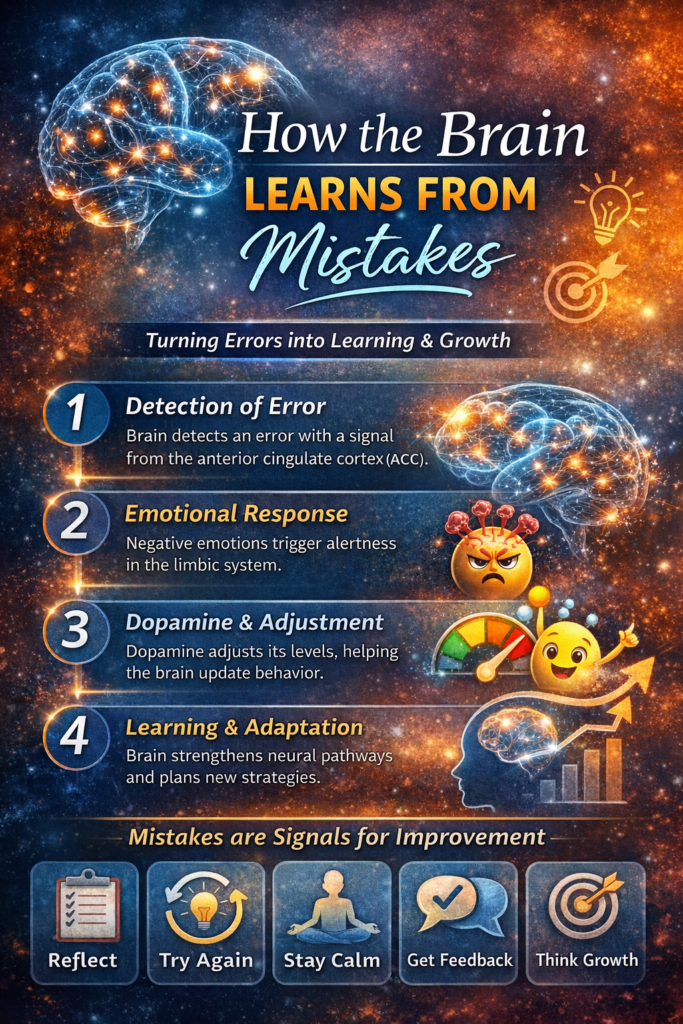
When you make a mistake, your brain immediately recognizes it. This process involves regions such as the anterior cingulate cortex (ACC), which acts as a monitoring system for conflict and errors. Within milliseconds, the brain detects that something didn’t go as expected.
This detection triggers a signal often referred to as the “error-related negativity” (ERN), an electrical response that reflects the brain’s awareness of the mistake—even before you consciously realize it.
Dopamine and Learning from Feedback
Mistakes also engage the brain’s reward system, particularly involving dopamine.
When outcomes don’t match expectations:
- Dopamine levels shift
- The brain updates its predictions
- Learning is reinforced
This process, known as prediction error, helps the brain adjust future behavior. In simple terms, the brain asks: “What went wrong, and how can I do it differently next time?”
Why Mistakes Strengthen Learning
Making a mistake creates a stronger learning signal than getting something right the first time.
This happens because:
- Errors increase attention and focus
- The brain becomes more engaged in correcting the outcome
- New neural pathways are formed or strengthened
As a result, information associated with mistakes is often remembered more clearly.
The Role of the Prefrontal Cortex
The prefrontal cortex, responsible for decision-making and self-control, plays a key role in learning from mistakes.
It helps:
- Evaluate what went wrong
- Plan new strategies
- Inhibit repeating the same error
Over time, repeated learning from mistakes strengthens this area, improving judgment and adaptability.
Emotional Responses to Mistakes
Mistakes often trigger emotional reactions—frustration, embarrassment, or disappointment. These emotions are processed by the brain’s limbic system.
While negative emotions can be uncomfortable, they also:
- Increase attention to the mistake
- Reinforce memory of the experience
- Motivate change
However, excessive fear or shame can interfere with learning, highlighting the importance of a balanced response.
Growth vs. Avoidance
The way we respond to mistakes determines whether learning occurs.
- A growth-oriented mindset views mistakes as opportunities to improve
- An avoidance mindset sees mistakes as threats, leading to disengagement
The brain learns best in environments where mistakes are seen as part of the process, not as failures.
Practical Strategies to Learn from Mistakes
1. Reflect Immediately
Ask what happened and why. Reflection strengthens learning pathways.
2. Focus on Process, Not Just Outcome
Understand the steps that led to the mistake, not just the result.
3. Stay Emotionally Regulated
Manage frustration to keep the brain in a learning state.
4. Try Again Quickly
Repetition after a mistake reinforces new, correct patterns.
5. Reframe Mistakes as Feedback
Shift your perspective from failure to information.
Final Thoughts
The brain is not built to be perfect—it is built to adapt. Mistakes are one of the most powerful tools the brain uses to learn, refine, and grow. When we understand this process, we can shift how we respond to errors, using them not as setbacks, but as stepping stones.
In the end, every mistake carries a message. And when the brain listens, learning follows.
Self-Management Strategies to Understand How the Brain Learns from Mistakes
Understanding how the brain learns from mistakes is only the first step—applying that knowledge in daily life is where real growth happens. The brain is constantly adapting through feedback, and mistakes serve as powerful signals that guide learning. However, whether those signals lead to improvement or frustration depends largely on how we manage our thoughts, emotions, and behaviors in response.
Self-management transforms mistakes from setbacks into tools for progress.
1. Develop Awareness of Your Reactions
The brain responds to mistakes automatically, often triggering frustration, embarrassment, or avoidance. The first step in self-management is noticing these reactions.
Ask yourself:
- What am I feeling right now?
- Am I reacting emotionally or thinking clearly?
Awareness helps shift the brain from a reactive state to a reflective one.
2. Pause Before Responding
Mistakes activate the brain’s emotional centers, which can override rational thinking.
Using a simple pause:
- Take a breath
- Step back from the situation
- Allow the initial emotional response to settle
This pause engages the prefrontal cortex, improving decision-making and learning.
3. Reframe Mistakes as Feedback
The brain learns best when mistakes are interpreted as information rather than failure.
Instead of thinking:
- “I failed” → shift to “What is this teaching me?”
This cognitive shift reduces stress and increases the brain’s ability to process and retain new information.
4. Analyze the Process, Not Just the Outcome
Effective learning comes from understanding why a mistake happened.
Break it down:
- What steps led to the error?
- Where did things go off track?
- What could be done differently next time?
This strengthens neural pathways associated with problem-solving and planning.
5. Practice Immediate Correction
The brain benefits from quick feedback loops.
After identifying a mistake:
- Try the task again
- Apply the corrected approach
- Reinforce the new behavior
Repetition strengthens learning and reduces the likelihood of repeating the same error.
6. Regulate Emotional Responses
Strong negative emotions can interfere with learning by increasing stress hormones like cortisol.
Strategies include:
- Deep breathing or grounding techniques
- Positive self-talk
- Taking short breaks when overwhelmed
A calm brain is more receptive to learning.
7. Track Patterns Over Time
Keeping track of mistakes and progress helps identify patterns.
You can:
- Journal recurring errors
- Note improvements
- Reflect on what strategies are working
Pattern recognition enhances long-term learning and self-awareness.
8. Set Realistic Learning Goals
Expecting perfection can limit growth.
Instead:
- Focus on progress, not perfection
- Break goals into manageable steps
- Celebrate small improvements
This approach keeps the brain engaged and motivated.
9. Seek Feedback from Others
External feedback provides perspectives that the brain may miss.
- Ask for constructive input
- Compare your understanding with others
- Use feedback to refine your approach
This expands learning beyond individual perception.
10. Reinforce a Growth-Oriented Mindset
The brain adapts best in environments that support learning rather than in environments that foster fear of failure.
Remind yourself:
- Mistakes are part of the learning process
- Improvement comes with practice
- Effort strengthens ability
This mindset enhances resilience and long-term development.
Final Thoughts
The brain is wired to learn from mistakes—but how effectively it does so depends on self-management. By becoming aware of reactions, regulating emotions, and intentionally analyzing errors, you can align your behavior with the brain’s natural learning processes.
Over time, these strategies don’t just reduce mistakes—they transform them into one of the most powerful tools for growth. And when managed well, every mistake becomes a step forward rather than a setback.
Family Support Strategies to Understand How the Brain Learns from Mistakes
Mistakes are a natural and essential part of learning, yet within families, they are often met with frustration, correction, or even criticism. Neuroscience shows that the brain learns best through error, using mistakes as signals to adjust behavior and strengthen understanding. Families play a critical role in shaping how individuals respond to these moments.
When families shift from reacting to mistakes as failures to viewing them as opportunities, they create an environment where the brain can truly learn and grow.
1. Normalize Mistakes as Part of Learning
The way families talk about mistakes influences how they are experienced.
Supportive approaches include:
- Reinforcing that mistakes are expected and normal
- Sharing personal examples of learning from errors
- Avoiding language that labels mistakes as failure
When mistakes are normalized, the brain remains open to learning rather than shutting down.
2. Respond with Curiosity, Not Criticism
Immediate criticism can trigger stress responses, limiting the brain’s ability to process information.
Instead, families can ask:
- “What do you think happened?”
- “What could you try differently next time?”
Curiosity encourages reflection and engages the brain’s problem-solving systems.
3. Create a Safe Emotional Environment
The brain learns best when it feels safe.
Families can:
- Avoid harsh reactions or punishment for honest mistakes
- Provide reassurance during moments of frustration
- Allow space for emotional expression
Emotional safety reduces anxiety and supports cognitive processing.
4. Focus on Effort and Process
Praising only outcomes can discourage risk-taking and learning.
Instead, emphasize:
- Effort and persistence
- Strategies used, even if imperfect
- Progress over time
This reinforces a growth-oriented mindset and strengthens learning pathways.
5. Encourage Reflection After Mistakes
Reflection helps the brain consolidate learning.
Families can guide reflection by:
- Discussing what went well and what didn’t
- Identifying specific steps for improvement
- Encouraging self-evaluation
This process strengthens memory and future decision-making.
6. Model Healthy Responses to Mistakes
Family members serve as powerful role models.
Demonstrate:
- Calm responses to your own mistakes
- Willingness to admit errors
- Problem-solving and resilience
Modeling shows that mistakes are manageable and instructive.
7. Avoid Overcorrecting or Taking Over
While it may be tempting to fix mistakes quickly, doing so can limit learning.
Instead:
- Allow time for independent problem-solving
- Offer guidance rather than solutions
- Encourage trying again
This supports the brain’s natural learning processes.
8. Reinforce Emotional Regulation Skills
Mistakes can trigger strong emotions, especially in children or adolescents.
Families can help by:
- Teaching calming techniques (deep breathing, pausing)
- Validating feelings without reinforcing avoidance
- Encouraging persistence after setbacks
Emotional regulation keeps the brain in a state conducive to learning.
9. Celebrate Learning, Not Perfection
Recognizing growth builds motivation and confidence.
Celebrate:
- Improvements after a mistake
- Efforts to try again
- Lessons learned
This shifts the focus from perfection to progress.
10. Maintain Consistency and Patience
Learning from mistakes is a gradual process.
Families should:
- Be patient with repeated errors
- Provide consistent support and feedback
- Understand that growth takes time
Consistency reinforces neural changes and long-term learning.
Final Thoughts
Families have a powerful influence on how individuals interpret and respond to mistakes. By creating a supportive, curious, and emotionally safe environment, they help align everyday experiences with how the brain naturally learns.
When mistakes are treated as opportunities rather than failures, families not only support learning—they help build resilience, confidence, and lifelong growth.
Community Resource Strategies to Understand How the Brain Learns from Mistakes
Learning from mistakes is a fundamental process of brain development, yet individuals rarely develop this skill in isolation. Communities—through schools, workplaces, organizations, and public resources—play a powerful role in shaping how mistakes are understood and used for growth. When communities create environments that support learning rather than punishment, they align with the brain’s natural adaptation and improvement.
Understanding mistakes is not just an individual skill—it is a shared, community-supported process.
1. Promote Brain-Based Education Programs
Community education programs can help individuals understand the science behind learning.
Examples include:
- Workshops on neuroscience and learning
- School-based programs teaching a growth mindset
- Public seminars on behavior and brain function
When people understand that the brain learns through error, they are more likely to embrace mistakes as part of growth.
2. Integrate Growth-Oriented Practices in Schools
Schools are key environments where attitudes toward mistakes are formed.
Effective strategies include:
- Encouraging revision and second attempts
- Providing feedback focused on improvement
- Reducing fear of failure in learning environments
These practices help students associate mistakes with learning rather than judgment.
3. Provide Access to Mentorship Programs
Mentors can guide individuals in constructively interpreting mistakes.
Mentorship offers:
- Real-world examples of learning through failure
- Support in problem-solving and reflection
- Encouragement during setbacks
Learning from others strengthens the brain’s ability to adapt and grow.
4. Offer Skill-Building and Training Opportunities
Community programs that focus on skill development reinforce learning through practice.
These may include:
- Job training programs
- Workshops on decision-making and critical thinking
- Personal development courses
Practice combined with feedback strengthens neural pathways and improves performance.
5. Create Safe Spaces for Learning and Reflection
Psychological safety is essential for brain-based learning.
Communities can:
- Establish environments where mistakes are not punished harshly
- Encourage open discussion about challenges
- Support peer learning and collaboration
Safe spaces reduce fear and allow the brain to remain engaged in learning.
6. Encourage Constructive Feedback Systems
Feedback is essential for learning from mistakes.
Community systems can:
- Train leaders and educators to give specific, actionable feedback
- Focus on improvement rather than blame
- Encourage two-way communication
Effective feedback helps the brain adjust behavior and refine skills.
7. Normalize Failure in Public Narratives
Community messaging influences how mistakes are perceived.
Strategies include:
- Sharing stories of growth through failure
- Highlighting resilience in media and community events
- Challenging perfection-focused narratives
Normalization reduces stigma and supports a growth mindset.
8. Provide Mental Health and Emotional Support Resources
Emotional responses to mistakes can interfere with learning.
Community resources can include:
- Counseling services
- Stress management programs
- Workshops on emotional regulation
Supporting emotional well-being keeps the brain in a state conducive to learning.
9. Foster Collaborative Learning Environments
Learning with others enhances understanding and adaptation.
Communities can:
- Promote group problem-solving activities
- Encourage peer support networks
- Create collaborative learning spaces
Collaboration exposes individuals to different perspectives and strategies.
10. Sustain Long-Term Engagement and Support
Learning from mistakes is an ongoing process.
Communities should:
- Provide continuous access to learning resources
- Encourage lifelong learning
- Support individuals through different stages of development
Long-term engagement reinforces lasting behavioral and neural change.
Final Thoughts
Communities have the power to shape how individuals experience and respond to mistakes. By providing education, support, and safe environments, they can align everyday learning with the brain’s natural processes.
When communities move from punishing mistakes to supporting growth, they do more than improve learning—they build resilience, confidence, and adaptability. And in that shift, mistakes become not something to fear, but something to use.
Frequently Asked Questions
Here are some common questions:
1. Why does the brain learn from mistakes?
The brain learns from mistakes because errors signal that something didn’t go as expected. This activates learning systems that adjust behavior, strengthen memory, and improve future performance. Mistakes provide feedback the brain uses to adapt.
2. What happens in the brain when you make a mistake?
When a mistake occurs:
- The brain quickly detects the error (via areas like the anterior cingulate cortex)
- Attention increases
- The brain updates its expectations and strategies
This process helps refine future decisions and actions.
3. What is “prediction error” in learning?
Prediction error is the difference between what the brain expects and what actually happens. When there’s a mismatch, the brain adjusts its understanding. This is a key mechanism behind learning from mistakes.
4. Does dopamine play a role in learning from mistakes?
Yes. Dopamine helps signal whether an outcome is better or worse than expected. When a mistake happens, dopamine activity shifts, helping the brain update behavior and reinforce learning.
5. Why do mistakes sometimes feel uncomfortable or frustrating?
Mistakes activate emotional centers in the brain, leading to feelings like frustration or embarrassment. These emotions increase attention to the error, but if too intense, they can interfere with learning.
6. Do we learn more from mistakes than from success?
Often, yes. Mistakes create stronger learning signals because they highlight what needs to change. Success reinforces behavior, but mistakes drive deeper adjustment and understanding.
7. Can fear of mistakes interfere with learning?
Yes. Excessive fear or anxiety can activate stress responses that impair memory, attention, and problem-solving. A moderate level of challenge supports learning, but high stress can block it.
8. How can I help my brain learn better from mistakes?
You can:
- Reflect on what went wrong
- Stay calm and regulate emotions
- Try again quickly with adjustments
- Focus on learning rather than perfection
These strategies align with how the brain processes feedback.
9. Why do I repeat the same mistakes sometimes?
Repetition can occur when:
- The underlying pattern isn’t fully understood
- Habits are strong
- Feedback isn’t applied effectively
Learning requires both awareness and intentional change.
10. Does age affect the ability to learn from mistakes?
While learning speed may change with age, the brain remains capable of learning throughout life due to neuroplasticity. People can continue to improve and adapt at any stage.
11. How does feedback help the brain learn from mistakes?
Feedback provides information about what was incorrect and how to improve. Clear, timely feedback strengthens learning by guiding the brain’s adjustments.
12. What is the best mindset for learning from mistakes?
A growth mindset—the belief that abilities can improve with effort—supports learning. It encourages persistence, reduces fear of failure, and keeps the brain engaged in adapting.
Conclusion
Learning from mistakes is not a flaw in the human experience—it is a fundamental feature of how the brain develops and improves over time. By recognizing mistakes as opportunities for feedback rather than failure, individuals can engage more effectively in the learning process. With reflection, emotional regulation, and repeated practice, the brain strengthens its ability to adapt and make better decisions. Ultimately, embracing mistakes allows for deeper learning, greater resilience, and continuous growth, turning everyday challenges into meaningful steps forward.
Video: The Brain Hack Hidden in Every Mistake #learning #psychology