Early recovery is often viewed as a hopeful new chapter, full of potential for positive change, but it is also one of the most emotionally and psychologically demanding stages of recovery. As individuals break free from substances or addictive behaviors, they are confronted with a range of mental health challenges that were once masked or managed through their addictive behaviors. These challenges can include overwhelming emotions, intense cravings, anxiety, shame, and confusion around identity. For many, this phase is marked by feelings of vulnerability, as they navigate unfamiliar territory without the coping mechanisms they once relied on.
Understanding these struggles is essential, as it provides a deeper insight into the emotional and psychological hurdles individuals face during recovery. This awareness emphasizes the need for a strong support system, as well as patience and effective coping strategies to manage the ups and downs of this critical period. Recognizing the complexity of early recovery helps both individuals and those around them approach this stage with compassion and offer the tools and guidance necessary for long-term healing.
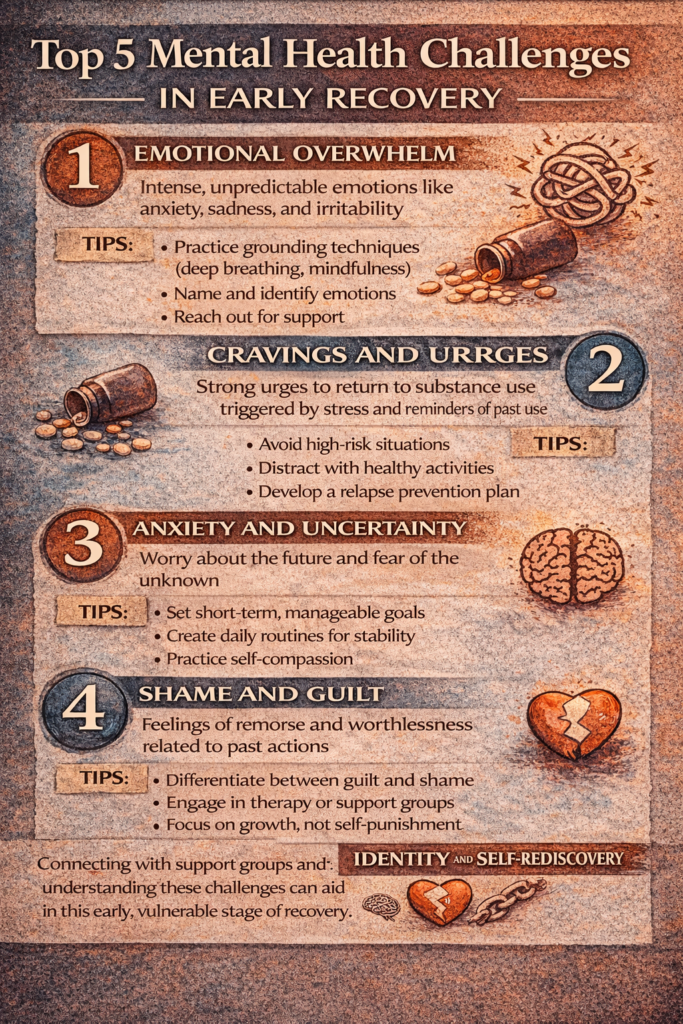
Top 5 Mental Health Challenges in Early Recovery—and How to Navigate Them
Early recovery is often portrayed as a fresh start—a hopeful turning point toward a healthier life. While this is true, it is also one of the most emotionally and psychologically challenging phases of the recovery journey. Without substances or addictive behaviors to cope, individuals are suddenly faced with raw emotions, unresolved issues, and new responsibilities.
Understanding the most common mental health challenges in early recovery can help individuals—and those supporting them—approach this phase with greater awareness, patience, and resilience.
1. Emotional Overwhelm
In early recovery, emotions can feel intense and unpredictable. Without the numbing effect of substances or behaviors, individuals may experience:
- Anxiety
- Sadness
- Irritability
- Mood swings
This emotional surge can feel overwhelming, especially if coping skills are still developing.
How to navigate it:
- Practice grounding techniques (deep breathing, mindfulness)
- Identify and name emotions
- Seek support rather than isolating
2. Cravings and Urges
Cravings are a natural part of recovery and can be both physical and psychological. Triggers such as stress, environment, or memories can intensify the urge to return to old behaviors.
How to navigate it:
- Avoid high-risk situations when possible
- Use distraction techniques (exercise, hobbies)
- Develop a relapse prevention plan
3. Anxiety and Uncertainty
Recovery often brings uncertainty about the future—relationships, work, identity, and stability. This can lead to heightened anxiety and fear.
How to navigate it:
- Focus on short-term goals rather than long-term pressure
- Establish daily routines for stability
- Practice self-compassion during periods of uncertainty
4. Shame and Guilt
Many individuals in early recovery struggle with feelings of shame about past actions or guilt about how addiction affected others.
- Shame: “I am a bad person.”
- Guilt: “I made mistakes.”
These emotions can be heavy and, if unaddressed, may increase the risk of relapse.
How to navigate it:
- Differentiate between guilt and shame
- Engage in therapy or support groups
- Focus on growth and accountability, not self-punishment
5. Identity and Self-Rediscovery
Without addiction, individuals may feel unsure of who they are. Recovery involves rebuilding identity, values, and purpose.
Common thoughts include:
- “Who am I without this?”
- “What do I enjoy or care about?”
How to navigate it:
- Explore new interests and activities
- Set personal goals
- Reflect on values and strengths
The Importance of Support in Early Recovery
These challenges are not signs of failure—they are part of the healing process. Early recovery requires time, patience, and consistent support, whether through therapy, peer groups, or trusted relationships.
Final Thought
Early recovery is not just about stopping a behavior—it is about learning how to live without it. That process can be uncomfortable, emotional, and uncertain, but it is also where growth begins.
The challenges faced during this stage are not obstacles to recovery—
They are part of the path.
And with the right tools and support,
What feels overwhelming today can become manageable tomorrow.
Taking Control: Self-Management Strategies for Early Recovery Challenges
Early recovery is a period of profound transition. Without the presence of substances or addictive behaviors, individuals are often faced with intense emotions, uncertainty, and the task of rebuilding their lives. While these challenges are a natural part of the recovery process, they can feel overwhelming without the right tools.
Self-management plays a crucial role during this stage. It empowers individuals to understand their experiences, regulate their emotions, and build stability, even when external support systems may still be developing.
Managing Emotional Overwhelm Through Awareness
One of the first challenges in early recovery is the sudden intensity of emotions. Self-management begins with recognizing and naming these feelings.
Strategies include:
- Practicing mindfulness to stay present
- Journaling to process emotions
- Using grounding techniques during emotional spikes
Awareness reduces the intensity of emotions and helps prevent reactive behaviors.
Handling Cravings with Structured Responses
Cravings can feel urgent and difficult to control, but they are temporary. Self-management involves preparing for these moments in advance.
Helpful approaches:
- Identifying triggers (people, places, emotions)
- Creating a “go-to” plan for cravings (e.g., calling someone, engaging in an activity)
- Using the “delay and distract” technique
Planning ahead transforms cravings from overwhelming experiences into manageable challenges.
Reducing Anxiety Through Routine and Stability
Uncertainty in early recovery can lead to increased anxiety. Establishing structure helps create a sense of control.
Key strategies:
- Maintaining consistent sleep and meal schedules
- Planning daily activities
- Setting small, achievable goals
Routine provides predictability, which reduces anxiety and supports emotional balance.
Reframing Shame and Guilt
Shame and guilt can be powerful obstacles in recovery. Self-management involves changing how these emotions are understood.
Try:
- Differentiating between guilt (behavior-focused) and shame (identity-focused)
- Practicing self-compassion
- Focusing on growth rather than past mistakes
Reframing these emotions allows individuals to move forward without being stuck in self-judgment.
Rebuilding Identity with Intentional Choices
Early recovery often brings questions about identity. Self-management encourages active exploration rather than passive uncertainty.
This can include:
- Trying new hobbies or interests
- Setting personal values and goals
- Reflecting on strengths and progress
Identity is not something to “find” but something to build through consistent choices.
Developing Healthy Coping Mechanisms
Since addiction often serves as a coping tool, replacing it with healthier alternatives is essential.
Examples include:
- Physical activity for stress relief
- Creative outlets like art or writing
- Talking to supportive individuals
Healthy coping strategies provide sustainable ways to manage emotions and stress.
Tracking Progress and Celebrating Small Wins
Recovery can feel slow, especially in the early stages. Tracking progress helps maintain motivation.
Consider:
- Keeping a daily or weekly reflection log
- Noticing improvements in mood or behavior
- Celebrating small achievements
Recognizing progress reinforces positive change and builds confidence.
Knowing When to Seek Support
Self-management does not mean doing everything alone. It also includes recognizing when additional help is needed.
This might involve:
- Therapy or counseling
- Support groups
- Trusted friends or family
Seeking support is a strength, not a weakness.
The Shift Toward Personal Responsibility and Growth
Self-management in early recovery is about moving from reactive patterns to intentional living. It involves taking responsibility for choices while also practicing patience and compassion.
Final Thought
The mental health challenges of early recovery are real—but they are also manageable. With the right self-management strategies, individuals can navigate this phase with greater confidence and resilience.
Recovery is not about having perfect control—it’s about learning how to respond differently, one moment at a time.
And in those moments,
self-awareness becomes strength,
and small steps become lasting change.
Supporting the Journey: Family Strategies for Early Recovery Mental Health Challenges
Early recovery is a time of significant emotional and psychological adjustment. Individuals are not only working to break free from addiction but are also learning how to manage intense emotions, cravings, and a shifting sense of identity. During this phase, families often want to help—but may feel unsure how to respond to the challenges their loved one is facing.
Understanding the **top mental health challenges in early recovery—emotional overwhelm, cravings, anxiety, shame, and identity struggles—**can help families provide support that is both effective and compassionate.
Responding to Emotional Overwhelm with Stability
In early recovery, emotions can feel intense and unpredictable. Families can support by becoming a source of calm and stability.
Helpful approaches include:
- Remaining patient during mood swings
- Avoiding overreaction to emotional outbursts
- Offering reassurance without dismissing feelings
A steady presence helps reduce emotional intensity and creates a sense of safety.
Supporting Through Cravings Without Enabling
Cravings can be one of the most difficult challenges. Families may feel the urge to control or prevent relapse, but support is more effective when it encourages accountability and autonomy.
Families can:
- Encourage healthy distractions or activities
- Support the avoidance of high-risk environments
- Reinforce coping strategies rather than trying to “fix” the situation
This approach empowers the individual while still providing support.
Reducing Anxiety Through Structure and Predictability
Uncertainty can increase anxiety in early recovery. Families can help by creating a structured and predictable environment.
This might include:
- Maintaining consistent routines at home
- Encouraging regular sleep and meal schedules
- Supporting small, achievable goals
Structure provides a sense of control and reduces stress.
Addressing Shame and Guilt with Compassion
Shame and guilt are common in early recovery and can be deeply discouraging. Families play a key role in helping to separate the person from the behavior.
Supportive strategies include:
- Avoiding blame or past-focused criticism
- Acknowledging effort and progress
- Encouraging self-compassion and growth
Compassion helps reduce the emotional weight that can lead to relapse.
Supporting Identity and Self-Rediscovery
Recovery often involves rebuilding a sense of identity. Families can support this process by:
- Encouraging exploration of new interests
- Supporting personal goals and independence
- Avoiding defining the individual by their past addiction
This helps individuals develop a new, healthier sense of self.
Practicing Open and Non-Judgmental Communication
Communication is essential during early recovery. Families can create a safe space by:
- Listening without interrupting or correcting
- Using “I” statements instead of blame
- Allowing honest conversations without pressure
Open communication builds trust and reduces emotional isolation.
Setting Healthy Boundaries
Support does not mean removing all limits. Families must balance care with clear boundaries.
This includes:
- Not enabling addictive behaviors
- Communicating expectations respectfully
- Protecting personal well-being
Boundaries create structure while maintaining healthy relationships.
Taking Care of the Family System
Supporting someone in early recovery can be emotionally demanding. Families need their own support to remain effective.
This may involve:
- Attending family support groups
- Seeking counseling
- Practicing self-care
A supported family is better equipped to provide support.
The Importance of Patience and Perspective
Progress in early recovery is not always linear. There may be setbacks, emotional ups and downs, and uncertainty.
Families can help by:
- Focusing on long-term growth rather than short-term perfection
- Recognizing small improvements
- Maintaining hope and consistency
Final Thought
The mental health challenges of early recovery can feel overwhelming—not just for the individual, but for the entire family. But families have a powerful role in shaping the recovery environment.
Through patience, understanding, and balanced support, families can help transform this difficult stage into a foundation for long-term healing.
Because recovery is not just an individual journey—
It’s a shared process.
And when families support with both compassion and clarity,
They become part of what makes recovery possible.
Stronger Together: Community Strategies for Supporting Mental Health in Early Recovery
Early recovery is one of the most vulnerable stages in the journey of overcoming addiction. Individuals often face intense emotional challenges, including anxiety, cravings, shame, identity confusion, and emotional overwhelm. While personal effort and family support are essential, community support is critical to sustaining recovery and promoting mental well-being.
Communities have the unique ability to create environments that reduce isolation, increase access to resources, and normalize the challenges of recovery. By understanding the top mental health challenges in early recovery, communities can develop strategies that provide meaningful, long-term support.
Creating Safe and Supportive Environments
One of the most important community roles is providing safe, non-judgmental spaces where individuals feel accepted.
These can include:
- Recovery community centers
- Peer-led support groups
- Drop-in mental health spaces
Safe environments help individuals manage emotional overwhelm by offering connection without fear of stigma.
Expanding Access to Mental Health Services
Early recovery often requires professional support, but access can be limited. Communities can help by:
- Offering low-cost or free counseling services
- Expanding telehealth options
- Providing crisis support resources
Improved access ensures individuals can address anxiety, shame, and emotional challenges early on.
Supporting Peer Connection and Shared Experience
Isolation is a major risk factor in early recovery. Peer support helps counter this by providing:
- Shared understanding
- Emotional validation
- Real-life coping strategies
Programs such as group meetings or peer mentorship allow individuals to connect with others who truly understand their experiences.
Providing Structured Activities and Programs
Unstructured time can increase anxiety, cravings, and emotional distress. Communities can offer:
- Recreational activities (fitness groups, art programs)
- Educational workshops
- Volunteer opportunities
These activities create routine, purpose, and a sense of belonging.
Reducing Stigma Through Education and Awareness
Stigma can prevent individuals from seeking help. Communities can address this by:
- Promoting mental health education
- Hosting awareness campaigns
- Encouraging open conversations about addiction and recovery
Reducing stigma creates a culture where seeking help is normalized and supported.
Supporting Identity and Purpose Development
In early recovery, individuals often struggle with identity. Communities can help by:
- Offering skill-building programs
- Supporting education and employment opportunities
- Encouraging creative and personal development
These opportunities help individuals rebuild a sense of purpose and direction.
Encouraging Early Intervention and Outreach
Many individuals in early recovery may not actively seek help. Community outreach can:
- Identify individuals at risk
- Provide early support
- Connect people with resources before challenges escalate
Early intervention improves long-term outcomes and reduces relapse risk.
Collaborating Across Community Systems
Effective support requires coordination between:
- Healthcare providers
- Social services
- Educational institutions
- Local organizations
Collaboration ensures individuals receive consistent and comprehensive care.
The Power of Community in Recovery
Recovery is not just an individual process—it is deeply influenced by the environment. Communities that provide connection, understanding, and resources create conditions where recovery can thrive.
Final Thought
The mental health challenges of early recovery are real—but they do not have to be faced alone. Communities have the power to transform recovery from an isolating experience into a shared journey of growth and support.
Because when communities show up with understanding and compassion,
they don’t just support recovery—
They help sustain it.
And in that shared support,
individual healing becomes collective strength.
Frequently Asked Questions
Here are some common questions:
1. What are the most common mental health challenges in early recovery?
The top challenges typically include:
- Emotional overwhelm
- Cravings and urges
- Anxiety and uncertainty
- Shame and guilt
- Identity confusion
These are normal responses during the transition away from addiction.
2. Why is early recovery emotionally difficult?
Without substances or addictive behaviors, individuals must face unprocessed emotions and stressors that were previously avoided or numbed.
3. Are mood swings normal in early recovery?
Yes. Mood swings are common due to:
- Brain chemistry changes
- Emotional adjustment
- Stress from lifestyle changes
They usually stabilize over time with support and coping strategies.
4. How long do these mental health challenges last?
The intensity varies, but early recovery challenges are often most noticeable in the first weeks to months. Improvement typically occurs with time and consistent support.
5. What are cravings, and why do they happen?
Cravings are strong urges to return to substance use or behaviors. They occur due to:
- Brain reward system changes
- Environmental triggers
- Emotional stress
They are temporary but can feel intense.
6. How can someone manage cravings effectively?
Helpful strategies include:
- Avoiding triggers
- Using distraction techniques
- Reaching out for support
- Practicing coping skills
Planning ahead is key.
7. Why do people feel anxiety in early recovery?
Anxiety often comes from:
- Uncertainty about the future
- Life changes and responsibilities
- Lack of familiar coping mechanisms
It reflects adjustment, not failure.
8. What is the difference between shame and guilt in recovery?
- Guilt: Feeling bad about actions (“I did something wrong”)
- Shame: Feeling bad about oneself (“I am wrong”)
Understanding this difference helps reduce self-judgment.
9. Why is identity confusion common in early recovery?
Addiction often becomes part of a person’s identity. Removing it creates a gap, leading to questions like:
- “Who am I now?”
- “What do I value?”
This is a normal part of rebuilding self-identity.
10. Can mental health challenges increase the risk of relapse?
Yes. Without proper coping strategies, challenges like stress, shame, or anxiety can increase relapse risk. This is why support and planning are essential.
11. What role does therapy play in early recovery?
Therapy helps individuals:
- Process emotions
- Develop coping strategies
- Address underlying issues (trauma, anxiety, depression)
It provides structure and guidance.
12. How can family and friends support someone in early recovery?
They can:
- Offer non-judgmental support
- Encourage healthy routines
- Be patient with emotional changes
- Support professional help
13. Is it normal to feel overwhelmed even after stopping addiction?
Yes. Recovery is not just physical—it involves emotional and psychological adjustment, which can feel overwhelming at first.
14. What are the signs that someone may need additional help?
Signs include:
- Persistent depression or anxiety
- Frequent cravings or relapse risk
- Withdrawal from support systems
- Difficulty functioning daily
Seeking help early is important.
15. What is the most important takeaway about early recovery challenges?
The key takeaway is that these challenges are normal and temporary. They are part of the healing process, not signs of failure.
Conclusion
The top mental health challenges in early recovery are not signs of failure, but natural and expected parts of the healing process. Each challenge—whether emotional, psychological, or identity-based—represents an opportunity for growth, self-awareness, and resilience. By recognizing and addressing these difficulties, individuals can begin to build healthier coping mechanisms and a stronger foundation for long-term recovery. With the right support systems and strategies in place, what initially feels overwhelming can become manageable, leading to meaningful progress. Ultimately, early recovery is not just about overcoming addiction, but about learning how to navigate life with clarity, balance, and renewed purpose.
Video: