Self-care is widely recognized as an essential part of maintaining mental, emotional, and physical well-being. It encourages rest, reflection, and intentional attention to personal needs—practices that are especially important in times of stress or overwhelm. However, when self-care becomes the primary or only way of coping, it can shift from a supportive habit into a form of dependency. What is meant to restore balance can begin to create imbalance, particularly when it is used to avoid challenges, responsibilities, or uncomfortable emotions. Understanding self-care addiction requires looking beyond the behavior itself and examining the role it plays in how individuals manage distress and navigate daily life.
Too Much of a Good Thing: When Self-Care Becomes Compulsive
Self-care is often promoted as the solution to stress, burnout, and emotional overwhelm. Take a break. Rest. Set boundaries. Do what makes you feel good.
And in many ways, that advice is necessary.
But like anything that provides relief, self-care can shift from something helpful… to something we begin to rely on too heavily. What starts as a healthy practice can quietly become a pattern of avoidance, control, or even dependency.
This is where the conversation becomes more complicated—when self-care stops being supportive and starts becoming compulsive.
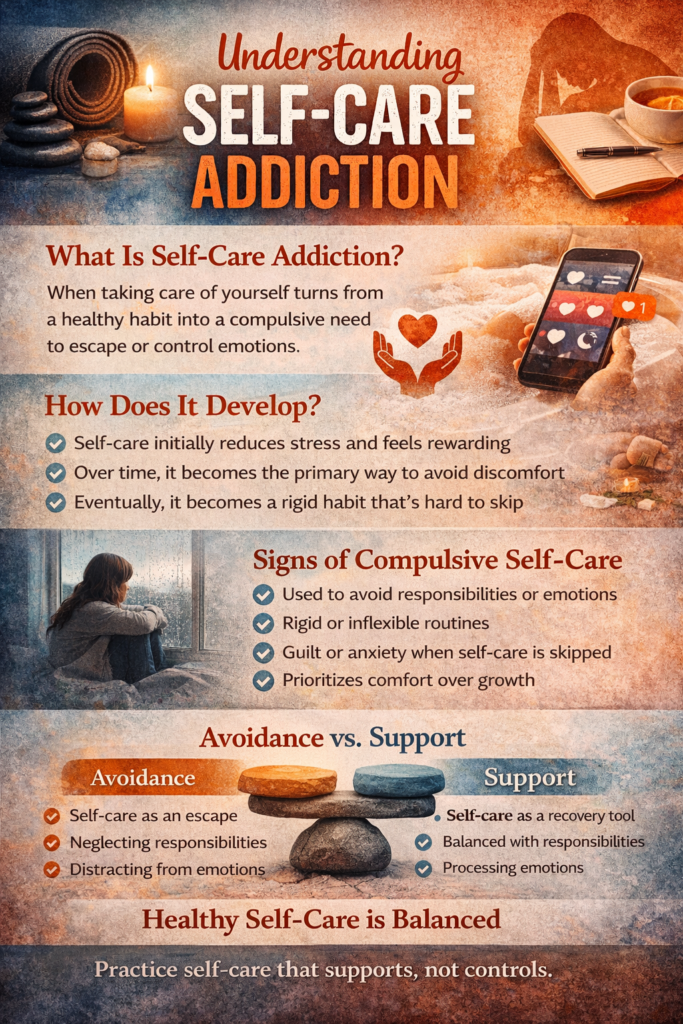
What Is Self-Care Addiction?
Self-care addiction isn’t about taking care of yourself “too much” in a simple sense. It’s about how and why you’re doing it.
It happens when self-care becomes:
- The only way you cope with discomfort
- A way to avoid responsibilities or difficult emotions
- Something you feel you must do to feel okay
- A rigid routine rather than a flexible support
Instead of restoring balance, it begins to control it.
How It Develops
Self-care works because it provides relief—mentally, emotionally, and physically.
Over time, the brain starts to associate certain activities with feeling better:
- Resting reduces stress
- Journaling organizes thoughts
- Disconnecting provides peace
These are all positive—but when they become the only way to regulate emotions, the brain begins to depend on them.
The shift is subtle:
- “This helps me.” → “I need this to function.”
Signs Self-Care Is Becoming Compulsive
Self-care may be crossing into unhealthy territory when it starts to:
- Interfere with responsibilities or relationships
- Become rigid or inflexible (“I can’t function if I don’t do this”)
- Be used to avoid rather than process emotions
- Create guilt or anxiety when skipped
- Replace growth with comfort
Ironically, something meant to support well-being can begin limiting it.
The Role of Avoidance
One of the key issues in self-care addiction is avoidance.
Instead of:
- Facing difficult conversations
- Working through uncomfortable emotions
- Taking necessary action
Self-care can become a way to step away from those challenges.
Rest becomes escape. Reflection becomes rumination. Boundaries become isolation.
The intention may be positive, but the outcome can keep you stuck.
Rebalancing Self-Care
The goal isn’t to stop practicing self-care—it’s to return it to its purpose.
Healthy self-care is:
- Flexible, not rigid
- Supportive, not controlling
- Balanced with responsibility and growth
- Used alongside—not instead of—facing life
It asks not just:
- “What feels good right now?”
…but also:
- “What actually helps me move forward?”
Expanding Your Coping Toolbox
Instead of relying on one form of relief, it helps to build a range of strategies:
- Problem-solving when action is needed
- Emotional processing when feelings arise
- Connection with others for support
- Rest when you’re genuinely depleted
Self-care is one tool—not the entire toolbox.
Final Thought
Self-care is meant to support your life—not replace it.
When it becomes the only way you cope, it can quietly shift from something that heals… to something that holds you back.
The balance isn’t in doing less self-care—it’s in doing it with awareness.
Because real well-being isn’t just about feeling better in the moment—
…it’s about building a life you don’t constantly need to escape from.
Finding Balance: Self-Management Strategies for Self-Care Addiction
Self-care is meant to help us cope, recharge, and maintain well-being. But when it becomes something we rely on excessively—something we need just to function—it can quietly shift into a form of dependency.
Understanding self-care addiction isn’t about criticizing rest or healing. It’s about recognizing when helpful habits start limiting growth. And more importantly, it’s about learning how to manage those patterns in a healthier, more balanced way.
Self-management is the key to turning self-care back into a tool—rather than letting it become a trap.
1. Build Awareness of Your Intentions
Start by asking:
- Why am I doing this right now?
- Am I caring for myself—or avoiding something?
Self-care becomes problematic when it’s used primarily to escape discomfort rather than support recovery. Awareness helps you distinguish between the two.
2. Identify What You Might Be Avoiding
Self-care addiction often masks deeper needs.
You might be avoiding:
- Difficult conversations
- Responsibilities
- Emotional discomfort
- Uncertainty or fear
Instead of focusing only on the behavior, look beneath it. The goal isn’t to remove self-care, but to address what it may be replacing.
3. Create a Balance Between Comfort and Growth
Healthy functioning requires both:
- Comfort → rest, relaxation, emotional support
- Growth → challenge, responsibility, progress
Ask yourself:
- Am I only choosing what feels good—or also what helps me grow?
Self-management means allowing space for both, even when growth feels uncomfortable.
4. Set Flexible, Not Rigid, Routines
Self-care becomes unhealthy when it turns into a strict requirement:
- “I have to do this, or I won’t be okay.”
Instead:
- Keep routines adaptable
- Allow variation based on your needs
- Avoid attaching your sense of stability to one specific activity
Flexibility keeps self-care supportive rather than controlling.
5. Practice Delayed Gratification
If you feel an urge to immediately turn to a self-care activity, try pausing:
- Wait a few minutes
- Check in with what you’re feeling
- Decide intentionally rather than automatically
This builds control over the habit rather than letting the habit control you.
6. Expand Your Coping Strategies
Self-care should be part of a broader toolkit—not the only tool.
Include:
- Problem-solving skills
- Emotional processing (journaling, reflection)
- Social connection
- Taking action on responsibilities
The more options you have, the less dependent you become on any single one.
7. Reframe Discomfort as Part of Growth
Not all discomfort needs to be reduced immediately.
Sometimes, growth requires:
- Sitting with uncertainty
- Facing challenges
- Taking action despite not feeling ready
Learning to tolerate discomfort reduces the urge to escape into constant self-soothing.
8. Monitor Impact, Not Just Intent
Even if your intention is positive, ask:
- Is this helping me function better—or avoiding what I need to do?
If self-care is interfering with responsibilities, relationships, or progress, it may need to be adjusted.
9. Practice Self-Compassion Without Self-Indulgence
There’s a difference between:
- Self-compassion → understanding your needs and supporting yourself
- Self-indulgence → avoiding growth under the label of care
Self-management means being kind to yourself and honest with yourself.
Final Thought
Self-care is not the problem—imbalance is.
When used intentionally, self-care supports resilience, clarity, and growth. But when it becomes the only way to cope, it can limit your ability to engage fully with life.
The goal isn’t to do less self-care—
…it’s to do it in a way that strengthens you, rather than something you depend on to escape.
Supporting Without Enabling: Family Strategies for Understanding Self-Care Addiction
Self-care is often encouraged—and for good reason. It promotes rest, emotional awareness, and personal well-being. But when self-care becomes excessive or is used to avoid responsibilities and difficult emotions, it can become less helpful.
For families, this can be confusing. After all, how do you question something that is supposed to be healthy?
The key is understanding that self-care, like anything else, requires balance. And family support plays an important role in maintaining that balance—without discouraging the importance of self-care.
1. Understand the Difference Between Care and Avoidance
Before responding, it’s important for families to recognize the distinction between:
- Healthy self-care → restores energy and supports functioning
- Avoidant self-care → delays responsibilities or avoids discomfort
Instead of assuming, gently observe patterns:
- Are they recharging—or withdrawing?
- Are they improving—or staying stuck?
Understanding this difference shapes how you respond.
2. Approach the Conversation with Curiosity, Not Criticism
Questioning someone’s self-care habits can feel sensitive.
Instead of:
- “You’re just avoiding things.”
Try:
- “I’ve noticed you’ve been taking a lot of time to yourself—how are you feeling lately?”
Curiosity invites openness, while criticism often leads to defensiveness.
3. Validate the Need for Rest While Encouraging Balance
It’s important not to dismiss their need for self-care.
You can acknowledge:
- “I understand you need time to recharge.”
While also gently adding:
- “How can we help you balance that with what you need to get done?”
This keeps support intact while encouraging responsibility.
4. Encourage Gradual Engagement, Not Immediate Change
If someone is relying heavily on self-care to cope, pushing them too quickly can backfire.
Instead:
- Encourage small steps back into responsibilities
- Suggest manageable tasks
- Support progress, not perfection
Balance is built gradually—not forced.
5. Model Healthy Balance Within the Family
Families influence behavior through example.
Demonstrate:
- Taking breaks and completing responsibilities
- Facing challenges while also practicing self-care
- Flexibility rather than rigid routines
This shows that self-care and growth can coexist.
6. Set Gentle but Clear Boundaries
Support doesn’t mean removing all expectations.
Families can:
- Maintain reasonable household responsibilities
- Set expectations for participation and contribution
- Communicate limits calmly and consistently
Boundaries help prevent self-care from becoming avoidance.
7. Avoid Reinforcing the Pattern
Unintentionally, families may enable overdependence on self-care by:
- Taking over responsibilities
- Avoiding difficult conversations
- Accepting ongoing avoidance without discussion
Support should encourage movement forward—not maintain the cycle.
8. Encourage Broader Coping Strategies
Help expand their coping tools beyond self-care alone.
Encourage:
- Problem-solving
- Social connection
- Emotional expression
- Taking action when needed
The goal is not to remove self-care, but to integrate it with other strategies.
9. Know When Additional Support May Help
If self-care dependency is significantly interfering with daily functioning, outside support may be beneficial.
This could include:
- Counseling or therapy
- Coaching or structured support
- Mental health resources
Framing this as support—not correction—makes it more approachable.
Final Thought
Self-care is meant to support life—not replace engagement with it.
Families play a key role in maintaining that balance. By offering understanding, setting boundaries, and encouraging growth, they help ensure that self-care remains a tool for well-being rather than a way to avoid it.
Because the goal isn’t to do less caring—
…it’s to help that care lead to a fuller, more engaged life.
Healing in Balance: Community Resource Strategies to Understand Self-Care Addiction
Self-care is widely encouraged as a way to manage stress, improve mental health, and maintain overall well-being. But when self-care becomes excessive—used to avoid challenges rather than restore balance—it can quietly shift into a form of dependency.
While this is often seen as an individual issue, communities play a crucial role in shaping how self-care is understood and practiced. Community resources can help individuals recognize when self-care is no longer serving them and provide alternative ways to cope, connect, and grow.
Because true well-being doesn’t happen in isolation—it’s supported by the environments we’re part of.
1. Promote Balanced Messaging Around Self-Care
Many communities unintentionally promote an overly simplified version of self-care:
- “Rest more”
- “Protect your peace.”
While helpful, these messages can become misleading without context.
Community education can:
- Emphasize balance between rest and responsibility
- Clarify the difference between care and avoidance
- Encourage self-awareness rather than rigid routines
Balanced messaging helps people use self-care appropriately.
2. Offer Educational Workshops and Resources
Understanding reduces misuse.
Communities can provide:
- Workshops on emotional regulation and coping skills
- Discussions on the risks of avoidance-based behaviors
- Resources on building resilience and tolerance for discomfort
When people understand why they rely on certain behaviors, they’re better equipped to adjust them.
3. Increase Access to Counseling and Support Services
Professional guidance can help individuals:
- Identify patterns of over-reliance on self-care
- Address underlying emotional or psychological needs
- Develop a wider range of coping strategies
Community-based services such as:
- Low-cost therapy
- Group counseling
- Mental health clinics
…make this support more accessible.
4. Create Spaces for Healthy Social Connection
Self-care addiction often involves withdrawal or isolation.
Communities can counter this by offering:
- Social groups or meetups
- Volunteer opportunities
- Recreational or creative programs
These spaces provide connection and engagement, reducing the need to retreat into excessive self-focused coping.
5. Encourage Skill-Building Opportunities
Sometimes self-care becomes a default because other coping skills are underdeveloped.
Communities can help by offering:
- Life skills programs
- Stress management training
- Problem-solving and decision-making workshops
Building competence increases confidence—and reduces avoidance.
6. Leverage Peer Support Networks
Hearing from others with similar experiences can be powerful.
Peer-led groups can:
- Normalize the struggle with balance
- Share practical strategies
- Provide accountability and encouragement
These networks create a sense of shared understanding and growth.
7. Partner with Schools, Workplaces, and Organizations
Self-care messaging is often reinforced in these settings.
Collaboration can ensure:
- More accurate, balanced information is shared
- Support systems are consistent across environments
- Individuals receive reinforcement in multiple areas of life
A unified approach strengthens impact.
8. Address the Culture of Avoidance
In some communities, avoiding stress is unintentionally encouraged.
Shifting this culture involves:
- Valuing resilience alongside rest
- Encouraging engagement with challenges
- Recognizing growth as part of well-being
This helps redefine self-care as something that supports life—not escapes it.
Final Thought
Self-care is essential—but it’s not meant to stand alone.
Communities have the power to shape how self-care is understood, practiced, and balanced. By providing education, connection, and accessible support, they help individuals move from over-reliance to intentional use.
Because real well-being isn’t just about stepping away from life—
…it’s about having the tools and support to step back into it with strength.
Frequently Asked Questions
Here are some common questions:
1. What is self-care addiction?
Self-care addiction refers to an over-reliance on self-care activities to cope with stress or discomfort, to the point where it becomes excessive, rigid, or avoidant. Instead of supporting well-being, it begins to interfere with daily functioning or growth.
2. Isn’t self-care supposed to be healthy?
Yes—self-care is essential for mental and emotional health. The issue arises when it is used exclusively to avoid challenges, responsibilities, or uncomfortable emotions rather than to restore balance.
3. How can you tell the difference between healthy self-care and addiction?
Healthy self-care:
- Is flexible and balanced
- Supports functioning and growth
Self-care addiction:
- Feels rigid or necessary to function
- Is used to avoid rather than address problems
- Interferes with responsibilities or relationships
4. What are common signs of self-care addiction?
Signs may include:
- Avoiding responsibilities in the name of self-care
- Feeling anxious or guilty when not engaging in self-care routines
- Over-isolating or withdrawing from others
- Relying on self-care as the only coping strategy
5. Why does self-care addiction develop?
Self-care activities often provide relief from stress or emotional discomfort. Over time, the brain may begin to depend on these activities as the primary way to cope, especially if other coping skills are underdeveloped.
6. Can self-care become a form of avoidance?
Yes. When self-care is used to escape difficult emotions, decisions, or responsibilities, it can become avoidance rather than a supportive practice.
7. Is self-care addiction linked to mental health issues?
It can be. People experiencing anxiety, burnout, or emotional overwhelm may rely heavily on self-care as a coping mechanism. However, the issue is not the presence of self-care, but the imbalance in how it’s used.
8. What are examples of self-care behaviors becoming excessive?
Examples include:
- Constantly withdrawing from responsibilities to “rest.”
- Overindulging in activities like sleeping, scrolling, or relaxation routines
- Avoiding necessary stress (like work or conversations) under the label of self-care
9. How can someone manage or reduce self-care addiction?
Helpful strategies include:
- Building awareness of intentions behind self-care
- Balancing rest with responsibility
- Expanding coping skills beyond self-care
- Practicing discomfort tolerance
- Setting flexible routines
10. Can self-care addiction affect relationships?
Yes. Excessive self-focus or withdrawal can create distance from others, reduce communication, and impact responsibilities within relationships.
11. Should someone stop practicing self-care if it becomes a problem?
No. The goal is not to eliminate self-care but to rebalance it—so it supports overall functioning rather than replaces engagement with life.
12. When should someone seek additional help?
If self-care habits:
- Interfere with daily responsibilities
- Lead to isolation or avoidance
- Causes distress when not practiced
…it may be helpful to seek support from a therapist or counselor.
Conclusion
Recognizing self-care addiction is not about discouraging self-care, but about restoring its purpose. True self-care supports growth, resilience, and engagement with life—it does not replace them. By developing awareness of patterns, balancing comfort with responsibility, and expanding coping strategies, individuals can shift from over-reliance to intentional use. Ultimately, the goal is not to do less self-care, but to practice it in a way that strengthens overall well-being rather than limiting it. When used thoughtfully, self-care becomes not an escape from life, but a tool for living it more fully.
Video: Self-Care Gone Wrong: The Hidden Cost #HealthTips