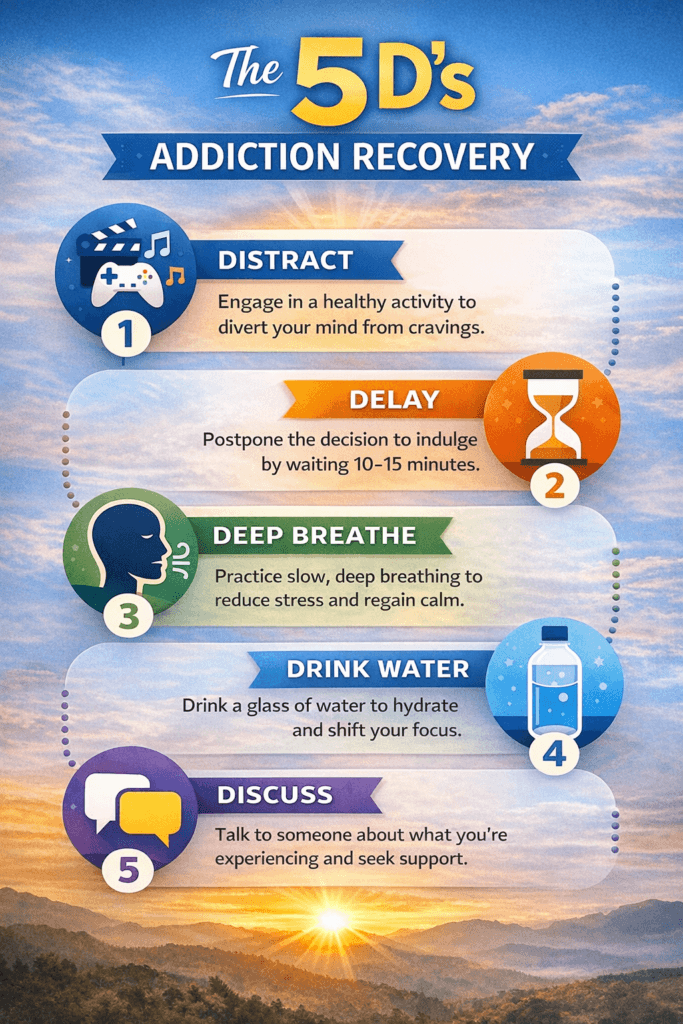
The 5 D’s of addiction recovery—Delay, Distract, Deep Breathe, Decide, and Discuss—are practical, evidence-informed coping strategies designed to help individuals manage cravings and emotional triggers in real time. Rather than relying on willpower alone, this framework teaches people how to pause automatic reactions, regulate stress responses, and engage rational thinking before acting. Because cravings are temporary neurobiological events, the 5 D’s create a structured pause between urge and behavior, allowing the brain’s decision-making systems to regain control. Learning and practicing these steps equip individuals with a reliable, repeatable method for navigating high-risk moments and strengthening long-term resilience in recovery.
The 5 D’s of Recovery: Delay, Distract, Deep Breathe, Decide, Discuss
Recovery is not just about avoiding substances—it’s about learning how to respond differently when cravings, urges, or emotional triggers arise. One of the most practical tools used in relapse prevention is the 5 D’s strategy: Delay, Distract, Deep Breathe, Decide, and Discuss. This structured approach helps individuals pause automatic reactions, regulate emotions, and regain control over impulses. Because cravings are temporary neurological events rather than permanent demands, these five steps create a buffer between urge and action, allowing the rational brain time to reengage and guide healthier choices.
1. Delay — Give the Urge Time to Pass
Cravings typically peak and fade within minutes. Delaying action—even for 10–15 minutes—weakens the urge’s intensity. During this time, the brain’s impulse system settles while the decision-making system strengthens.
Why it works: Urges feel urgent but are biologically short-lived.
2. Distract — Shift Attention Elsewhere
Redirecting focus interrupts the craving loop. Helpful distractions include:
- Walking or exercising
- Calling a friend
- Completing a task
- Listening to music
Why it works: The brain cannot fully concentrate on two demanding processes at once. Attention shift reduces craving intensity.
3. Deep Breathe — Calm the Nervous System
Slow, controlled breathing lowers stress hormones and stabilizes emotional reactions. Try inhaling slowly for 4 seconds, holding briefly, then exhaling for 6 seconds.
Why it works: Controlled breathing activates the parasympathetic nervous system, which counteracts anxiety and impulsivity.
4. Decide — Engage the Rational Mind
After calming down, consciously evaluate consequences:
- What happens if I use it?
- How will I feel tomorrow?
- What progress could I lose?
Why it works: Decision-making activates the prefrontal cortex, helping logic override impulse-driven behavior.
5. Discuss — Reach Out for Support
Talking to someone trusted provides perspective and accountability. This could be a sponsor, counselor, family member, or peer.
Why it works: Social connection reduces isolation, which is a major relapse trigger, and external feedback strengthens motivation.
How the 5 D’s Work Together
Each step targets a different part of the craving cycle:
- Delay weakens urgency
- Distract interrupts fixation
- Deep breathing stabilizes emotions
- Decide restores logic
- Discuss reinforces support
Combined, they transform a high-risk moment into a manageable one.
Practical Tip for Daily Use
Many people write the 5 D’s on a card or phone note so they can access the strategy instantly when cravings arise. Practicing the steps even during mild urges builds skill and confidence for more intense situations.
Conclusion
The 5 D’s framework is powerful because it turns recovery into a series of small, manageable actions rather than a single overwhelming decision. Cravings may be intense, but they are temporary—and each time someone successfully navigates them, the brain strengthens new pathways for self-control and resilience. Over time, these repeated wins reshape habits, reinforce confidence, and support lasting recovery.
Key Takeaway:
Recovery success often depends not on eliminating urges, but on knowing exactly what to do when they appear—and the 5 D’s provide a simple, science-backed roadmap for doing just that.
Self-Management Strategies to Implement the 5 D’s in Addiction Recovery
Recovery often hinges on what a person does in the brief window between a craving and a decision. The **5 D’s—Delay, Distract, Deep Breathe, Decide, and Discuss—**provide a structured method for navigating that window with intention rather than impulse. While the framework is simple, successfully applying it requires planning, awareness, and consistent practice. Self-management strategies help individuals prepare for high-risk moments, recognize triggers early, and apply each step effectively. By building these skills into daily routines, people can transform cravings from overwhelming threats into manageable experiences that strengthen confidence and long-term recovery stability.
Prepare Before Cravings Happen
Implementation starts before urges appear. Preparation strengthens confidence and response speed.
- Write the 5 D’s on a phone note or card
- Identify personal triggers and warning signs
- Create a list of quick distraction activities
- Save supportive contacts for easy access
Preparation reduces hesitation and increases the likelihood of using the strategy in real time.
Apply “Delay” With Structured Timing
Instead of simply telling yourself to wait, set a timer for 10–15 minutes. During that period:
- Drink water
- Change environment
- Walk outside
Timers make delay measurable and reinforce the truth that cravings rise and fall rather than lasting forever.
Personalize “Distract” Techniques
Distractions work best when they are engaging and meaningful. Create a personalized distraction toolkit, such as:
- A short workout routine
- A puzzle or game
- Cleaning or organizing tasks
- Music playlists
Rotating distractions prevents boredom and keeps the brain actively engaged.
Practice “Deep Breathing” Daily
Breathing skills work best when practiced before they are needed. Daily breathing exercises train the nervous system to respond quickly during stress. Try:
- 4–6 breathing pattern
- Box breathing
- Slow diaphragmatic breathing
Regular practice conditions the body to calm itself automatically during cravings.
Strengthen the “Decide” Step With Reflection
Decision-making improves when values are clear. Strengthen this step by:
- Writing recovery goals
- Listing consequences of relapse
- Reviewing past successes
- Keeping motivational reminders
These reflections help the rational brain respond quickly when urges challenge judgment.
Make “Discuss” Immediate and Easy
Many people hesitate to reach out during cravings. Remove barriers by:
- Pre-arranging support check-ins
- Creating a short “help text” template
- Joining peer recovery groups
- Setting expectations with trusted supporters
When communication is simple and stigma-free, support becomes a natural reflex rather than a last resort.
Track Progress and Patterns
Self-monitoring builds awareness and confidence. Use a journal or app to record:
- Trigger situations
- Which D was most helpful
- Craving intensity before and after
- Emotional state
Tracking patterns reveals growth and highlights which techniques work best for each individual.
Turn the 5 D’s Into a Habit Loop
Consistency transforms strategies into automatic responses. Repetition strengthens neural pathways associated with self-control, meaning the brain gradually defaults to coping skills instead of impulsive reactions. Over time, cravings lose intensity because the brain learns they no longer lead to substance use.
Conclusion
Implementing the 5 D’s is more than a technique—it’s a daily practice of self-awareness, preparation, and intentional action. When individuals build routines that support Delay, Distract, Deep Breathe, Decide, and Discuss, they develop a powerful internal system for managing urges safely and effectively. Each successful use of the strategy reinforces resilience, strengthens confidence, and reshapes brain pathways toward healthier coping.
Key Insight:
Recovery is strengthened not by avoiding challenges, but by mastering the tools that guide you through them—and the 5 D’s offer a clear, practical roadmap for doing exactly that.
Family Support Strategies to Implement the 5 D’s in Addiction Recovery
Recovery is rarely a solo journey. Family members often serve as the closest support system during moments when cravings, stress, or emotional triggers threaten progress. The **5 D’s—Delay, Distract, Deep Breathe, Decide, and Discuss—**are powerful coping tools, but their effectiveness increases when families understand how to reinforce them in real-life situations. When loved ones are educated, calm, and prepared, they can help interrupt impulsive reactions, stabilize emotions, and guide individuals toward healthier decisions. Family involvement doesn’t mean controlling recovery—it means creating a supportive environment that makes using recovery skills easier and more natural.
Help Reinforce “Delay” Without Pressure
When cravings hit, time is an ally. Families can support delay by:
- Encouraging pauses before decisions
- Suggesting short activities to pass the time
- Remaining calm rather than reacting urgently
A calm presence helps reduce emotional intensity, making it easier for the person to wait out the urge.
Support Healthy “Distraction” Options
Loved ones can help redirect attention away from cravings. Supportive strategies include:
- Inviting the person for a walk or activity
- Starting a conversation about a neutral topic
- Offering shared tasks like cooking or organizing
Participating together strengthens the connection while reducing focus on the urge.
Model and Encourage “Deep Breathing”
Family members can guide family members through breathing exercises during stressful moments. Instead of instructing, they can model calm breathing themselves. Seeing someone regulate their emotions provides a powerful nonverbal cue that calmness is possible.
Assist With the “Decide” Step
When someone is overwhelmed, decision-making may feel difficult. Families can gently help by asking grounding questions:
- “What would help you feel proud tomorrow?”
- “What’s helped you get through this before?”
- “What do you really want long term?”
These prompts activate reflective thinking rather than defensive reactions.
Strengthen “Discuss” Through Safe Communication
The Discuss step works best when individuals feel emotionally safe. Families can create that safety by:
- Listening without judgment
- Avoiding criticism or lectures
- Validating feelings even when concerned
- Thanking the person for opening up
Supportive listening builds trust, which increases the likelihood that the individual will reach out during future urges.
Create a Recovery-Friendly Environment
Families can reinforce the 5 D’s daily by shaping the home environment:
- Remove substances or triggers when possible
- Maintain predictable routines
- Encourage healthy habits like sleep and nutrition
- Celebrate progress and milestones
Stable environments reduce stress and make coping strategies easier to use.
Practice the 5 D’s Together
Families can rehearse the steps before stressful situations arise. Role-playing or discussing hypothetical triggers helps everyone understand their role and builds confidence. Practicing together turns the 5 D’s into a shared strategy rather than an individual burden.
Respond to Setbacks With Support, Not Shame
If a craving leads to a mistake, family response matters greatly. Supportive reactions that focus on learning—not blaming—help preserve motivation and self-worth. Shame often increases the risk of relapse, while encouragement strengthens resilience.
Conclusion
Families are powerful allies in recovery because they can reinforce coping strategies in real time. By understanding and supporting the 5 D’s—Delay, Distract, Deep Breathe, Decide, and Discuss—loved ones help create a protective buffer between cravings and actions. Consistent encouragement, calm communication, and structured support allow individuals to practice these skills until they become automatic responses.
Key Takeaway:
When families partner with recovery tools instead of trying to control outcomes, they become a stabilizing force that helps transform vulnerable moments into opportunities for growth, confidence, and lasting change.
Community Resource Strategies to Implement the 5 D’s in Addiction Recovery
Recovery thrives when individuals are supported not only by personal motivation and family encouragement, but also by strong community systems. The **5 D’s—Delay, Distract, Deep Breathe, Decide, and Discuss—**are highly effective coping tools for managing cravings and preventing relapse, yet their success often depends on whether supportive resources are available when they’re needed most. Communities that intentionally build environments, programs, and services aligned with these five strategies help individuals respond to urges safely and confidently. By integrating recovery-friendly policies, education, and accessible support networks, communities transform high-risk moments into opportunities for resilience and growth.
Community Support for “Delay”
Communities can make it easier for individuals to pause during cravings by ensuring safe spaces and structured options exist. Helpful resources include:
- Drop-in recovery centers
- Crisis stabilization units
- Peer recovery cafés
- After-hours helplines
These options provide immediate alternatives to impulsive behavior, giving individuals time for cravings to pass.
Community Resources That Encourage “Distract”
Healthy engagement opportunities reduce idle time and redirect attention away from urges. Effective community distractions include:
- Recreational programs and sports leagues
- Volunteer opportunities
- Skill-building workshops
- Art, music, or fitness classes
Access to meaningful activities strengthens purpose and reduces the likelihood of relapse triggers.
Public Programs That Promote “Deep Breathing”
Communities can teach emotional regulation skills through:
- Mindfulness classes
- Stress-management workshops
- Trauma-informed wellness programs
- Public health seminars
When these skills are widely taught, individuals are more likely to use calming techniques automatically during stressful or triggering situations.
Systems That Support the “Decide” Step
Clear decision-making improves when people have access to information and guidance. Community strategies include:
- Recovery education campaigns
- Counseling centers
- Recovery coaching services
- Evidence-based prevention programs
These resources strengthen reasoning skills and help individuals evaluate consequences before acting.
Networks That Encourage “Discuss”
Social connection is one of the strongest predictors of sustained recovery. Communities can foster discussion and support through:
- Peer support groups
- Faith-based recovery ministries
- Mentorship programs
- Community recovery events
Accessible conversation spaces reduce isolation and increase accountability, both of which protect against relapse.
Cross-System Collaboration
Communities are most effective when organizations work together. Partnerships between healthcare providers, schools, law enforcement, employers, and recovery groups create a coordinated safety net. Shared referral systems and communication pathways ensure individuals can move quickly from crisis to support without barriers or delays.
Training Community Gatekeepers
Teachers, coaches, employers, and first responders often witness early signs of distress or relapse risk. Training these community members to recognize behavioral warning signs and guide individuals toward the 5 D’s equips them to respond constructively rather than punitively.
Building Recovery-Friendly Environments
Communities can reinforce the 5 D’s by promoting environments that reduce triggers and encourage healthy coping:
- Safe medication disposal sites
- Drug-free public events
- Workplace wellness initiatives
- Youth engagement programs
These preventive measures lower exposure risk while strengthening protective factors.
Conclusion
Community involvement transforms recovery tools from individual techniques into shared support systems. When local programs, public services, and social networks align with the principles of Delay, Distract, Deep Breathe, Decide, and Discuss, they foster a culture in which individuals are empowered to manage cravings effectively. Consistent access to supportive environments, education, and connection helps reinforce coping skills until they become second nature.
Key Insight:
Recovery is strongest when communities actively support it. By embedding the 5 D’s into local resources and systems, communities don’t just respond to addiction—they build conditions that help prevent relapse and sustain long-term healing.
Frequently Asked Questions
Here are some common questions:
1. What are the 5 D’s in addiction recovery?
The 5 D’s are a coping strategy for managing cravings and triggers: Delay, Distract, Deep Breathe, Decide, and Discuss. They help create a pause between the urge and the action, allowing a person to respond thoughtfully rather than impulsively.
2. Why are the 5 D’s effective?
They target different parts of the craving cycle. Some steps calm the body, others redirect attention, and others engage logical thinking or social support. Together, they reduce impulsivity and strengthen self-control.
3. How long should I delay a craving?
Most cravings peak and fade within 10–20 minutes. Setting a timer for even 10 minutes can weaken the urge enough for it to pass or become manageable.
4. What if distraction doesn’t work?
Not every distraction works every time. Try switching activities, changing environments, or combining steps—for example, walking while calling someone. Flexibility is key.
5. Is deep breathing really helpful during cravings?
Yes. Slow breathing lowers stress hormones and activates the calming nervous system response. This reduces anxiety and makes urges feel less intense and more controllable.
6. What does the “Decide” step involve?
It means consciously evaluating choices instead of reacting automatically. You might think about long-term goals, past progress, consequences, or how you’ll feel later if you give in to the urge.
7. Why is “Discuss” important?
Talking to someone breaks isolation, which is a major relapse trigger. Supportive conversation provides perspective, encouragement, and accountability, all of which strengthen recovery.
8. Do the 5 D’s replace professional treatment?
No. They are a coping tool—not a substitute for therapy, medication, or treatment programs. They work best as part of a comprehensive recovery plan.
9. Can beginners use the 5 D’s effectively?
Yes. The strategy is designed to be simple and practical. With practice, it becomes more natural and automatic, especially if rehearsed during mild urges first.
10. What if I forget the steps during a craving?
That’s common early in recovery. Writing the steps on a card, saving them in your phone, or practicing daily can help you remember them when stress levels rise.
11. Are the 5 D’s useful for triggers other than substance cravings?
Absolutely. They can help manage urges related to stress, anger, anxiety, emotional eating, or impulsive decisions. The framework is flexible and applies to many behavioral challenges.
12. How do I know if the 5 D’s are working for me?
Signs include:
- Cravings are becoming shorter or less intense
- Feeling more in control of decisions
- Increased confidence in handling triggers
- Fewer impulsive reactions
Progress may be gradual, but consistency strengthens results.
Conclusion
The strength of the 5 D’s lies in their simplicity and adaptability—they can be used anywhere, anytime, and at any stage of recovery. Each step targets a different part of the craving cycle, transforming overwhelming urges into manageable experiences and reinforcing confidence with every successful use. Over time, repeated practice helps retrain brain pathways, making healthy responses more automatic and reducing the risk of relapse. Ultimately, the 5 D’s are more than a coping tool; they are a roadmap for self-control, emotional stability, and sustained healing, empowering individuals to respond to challenges with intention rather than impulse.
Video: 5 D’s to Stop Relapse Before It Happens #SobrietySupport #RecoveryJourney #MindfulLiving